
Hidden Burroughs-Kerouac Novel Surfaces;
So Does Malcolm Mc Neill's 'lost art of Ah POOK'

Is it something in the November air? Doubtful. Maybe it's the god of artistic collaborations wanting to set the record straight. Let's say it's strictly dumb coincidence.

Whatever the reason, this month provides a happy occasion for legions of Jack Kerouac fans, to say nothing of William S. Burroughs cultists, who always seem eager for new revelations about both writers' works and personalities. And if nothing else, it will add several strong threads to their already embroidered legends.

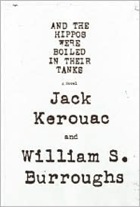
First came And the Hippos Were Boiled in Their Tanks, which has just arrived in bookstores only 64 years after William Burroughs and Jack Kerouac wrote it.

Jed Birmingham has a fascinating review at RealityStudio that discusses, among other things, why they cast its tale of murder and homosexual obsession as fiction and had to disguise the identities of the real-life characters.

[R]eviewers of Hippos have treated the book as a straight telling of the Carr-Kammerer story, more period memoir than novel. This is a dangerous practice. If we think of Hippos in terms of memoir, we have to be acutely aware of what is missing.

Now comes the lost art of Ah POOK IS HERE, opening Friday (Nov. 14) at the Salomon Arts Gallery in downtown Manhattan. It features Malcolm Mc Neill's collaboration with Burroughs a mere 38 years after the two of them teamed up for a word/image novel that they tried — and, sadly, failed — to get published.

Well, better late than never.

Mc Neill's "ah pook" artwork includes all sorts of fantastic sketches, drawings, and cartoons. Fantastic in the true meaning of the word. One vivid panorama is so large — "End of Days," measuring 25 feet x 24 inches — that the gallery display will have to be monumental.

In a riveting, unpublished memoir about their collaboration — Observed While Falling, which I've had the privilege of reading — Mc Neill writes that he was 22 years old and just out of art school in London when he began working with Burroughs, who was then 56 and famous — infamous might be the more apt description — as the author of Naked Lunch.
Oddly, Mc Neill had barely heard of him, let alone read any of his books. "The fact that I knew nothing about him before I met him was certainly my greatest asset," Mc Neill writes. "If I'd had any sense of his formidable intellect, or his intense personal history, I would have been intimidated to say the least." The memoir continues:

Apart from the age disparity and the unprecedented nature of his writing, he embodied an extreme persona for which I had no frame of reference at all: an avowed homosexual heroin addict, who'd shot and killed his wife, then essentially abandoned their only child. [This was] a scenario in which none of the elements were familiar, much less made sense. The need to try and make them so, however, was irresistible.

"I accepted him at face value," he notes, and Burroughs turned out to be "one of the sincerest, most unassuming normal people I'd ever met."

Although their seven-year project was left unfinished because they couldn't get it published — a text-only version eventually appeared — Mc Neill writes that the collaboration "changed my perception of many things, and now, many years later, continues to do so." He adds, "The one lesson above all that working with Bill Burroughs had taught me [is] that art is a magical process."

In other words, Mc Neill came to believe that art is not only prescient, but can actually make things happen. Which is not as weird as it sounds. Even Hemingway believed it. He put it this way: "The only writing that was any good was what you made up, what you imagined. That made everything come true. Like when he wrote 'My Old Man' he'd never seen a jockey killed and the next week Georges Parfrement was killed at that very jump and that was the way it looked." But I digress.

For much more about the "ah pook" collaboration, there are several spellbinding online interviews with Mc Neill at Big Bridge, RealityStudio, and Beats in Kansas.

After starting out doing cartoons in the underground press, Mc Neill went on to a mainstream career as a high-tech artist/illustrator. His work has appeared in publications ranging from The New York Times and Rolling Stone to National Lampoon and Marvel Comics. Eventually he got into television as a "live action / effects director," winning an Emmy, in 1984, for "Outstanding Graphics and Title Design" of the opening credits sequence for "Saturday Night Live." Now that is weird.

(Crossposted at HuffPo)

November 10, 2008 1:18 PM | | Comments (0)

Leave a comment

Me Elsewhere

'WILD SIDE' STILL ROCKS 

Nelson Algren was one of the great American authors of the 20th century, it is no exaggeration to say, and among the most neglected. Consider his underrated classic, "A Walk on the Wild Side." The title -- popularized and co-opted as an idiomatic phrase by Hollywood and Madison Avenue (institutions Algren loathed) -- is familiar to most anyone who speaks English or knows Lou Reed's lyrics. But the novel itself? Hardly.

BUSTER KEATON REVISITED 
Buster Keaton: Tempest in a Flat Hat is not a biography. "This book is merely a fan's notes," Edward McPherson writes in the introduction, although his publisher ignores the disclaimer and calls it a biography on the cover. In fact, the book is a bit of both, a difficult combination to bring off unless you're David Thomson, who set the standard with Rosebud, his penetrating rumination on the life and career of Orson Welles, which was nothing if not a distillation of every obsessive thought he ever had about the myth and the man and all his movies.
LAUREN BACALL, STILL SALTY AT 80 
When Lauren Bacall writes that her singing voice ranges "somewhere between B minus sharp and outer space," she's being candid and funny. It's not every stage star with two Tony Awards for best actress in a musical whose vocal talent offers so little promise. (OK, Harvey Fierstein excepted.) Still less would one admit it.
THE STARS ACCORDING TO BOGDANOVICH 
Peter Bogdanovich's superb collection of movie-star profiles and interviews -- a sequel to Who the Devil Made It, his interviews of top film directors -- begins with an affectionate tale about Orson Welles that reminds us just how intimate the author's connection to Hollywood's greatest has been. But contrary to what we've come to expect from dime-a-dozen celebrities and celebrity interviews not worth two cents, the tale avoids bromidic egotism and journalistic platitudes.
SAMMY'S WHITE DREAMS 
Four decades ago Lenny Bruce sentenced Sammy Davis Jr. to "30 years in Biloxi," stripping him of "his Jewish star" and "his religious statue of Elizabeth Taylor." Now we have two new biographies of Davis that spring him from ridicule, if not from doubts about his legacy, and restore a measure of dignity to a black entertainer whose huge fame and success never overcame his devout wish -- indeed his lifelong effort -- to be white.
more picks

Sites to See

About this Entry

This page contains a single entry by Straight Up | published on November 10, 2008 1:18 PM.

Bob's Your Uncle was the previous entry in this blog.

Uncle Bill's Words of Endearment is the next entry in this blog.

Find recent content on the main index or look in the archives to find all content.

AJ Ads


AJ Blogs

AJBlogCentral | rss

culture
About Last Night
Terry Teachout on the arts in New York City
Artful Manager
Andrew Taylor on the business of arts & culture
blog riley
rock culture approximately
critical difference
Laura Collins-Hughes on arts, culture and coverage
Dewey21C
Richard Kessler on arts education
diacritical
Douglas McLennan's blog
Dog Days
Dalouge Smith advocates for the Arts
Flyover
Art from the American Outback
Life's a Pitch
For immediate release: the arts are marketable
Mind the Gap
No genre is the new genre
Performance Monkey
David Jays on theatre and dance
Plain English
Paul Levy measures the Angles
Real Clear Arts
Judith H. Dobrzynski on Culture
Rockwell Matters
John Rockwell on the arts
Straight Up |
Jan Herman - arts, media & culture with 'tude

dance
Foot in Mouth
Apollinaire Scherr talks about dance
Seeing Things
Tobi Tobias on dance et al...

jazz
Jazz Beyond Jazz
Howard Mandel's freelance Urban Improvisation
ListenGood
Focus on New Orleans. Jazz and Other Sounds
Rifftides
Doug Ramsey on Jazz and other matters...

media
Out There
Jeff Weinstein's Cultural Mixology
Serious Popcorn
Martha Bayles on Film...

classical music
Creative Destruction
Fresh ideas on building arts communities
The Future of Classical Music?
Greg Sandow performs a book-in-progress
On the Record
Exploring Orchestras w/ Henry Fogel
Overflow
Harvey Sachs on music, and various digressions
PianoMorphosis
Bruce Brubaker on all things Piano
PostClassic
Kyle Gann on music after the fact
Sandow
Greg Sandow on the future of Classical Music
Slipped Disc
Norman Lebrecht on Shifting Sound Worlds

publishing
book/daddy
Jerome Weeks on Books
Quick Study
Scott McLemee on books, ideas & trash-culture ephemera

theatre
Drama Queen
Wendy Rosenfield: covering drama, onstage and off
lies like truth
Chloe Veltman on how culture will save the world

visual
Aesthetic Grounds
Public Art, Public Space
Another Bouncing Ball
Regina Hackett takes her Art To Go
Artopia
John Perreault's art diary
CultureGrrl
Lee Rosenbaum's Cultural Commentary
Modern Art Notes
Tyler Green's modern & contemporary art blog
Creative Commons License
This weblog is licensed under a Creative Commons License.