
Read a book, see a flick, eat too much, drink plenty vino, keep my nose clean, and generally laze about. Such is the simple life. So I almost forgot to remember.
 200-thumb-200x314.jpg "From San Francisco Earthquake, No. 4 'Black & Red Journal, Paris, May 1968, Your Own Correspondent' by Claude Pelieu, translated by Mary Beach") Daniel Cohn-Bendit (once known as Danny the Red) put it this way the other day: Why not stop talking about May ’68? All I am hearing is the prattle of the inept. That’s a paraphrase by a friend.
Daniel Cohn-Bendit (once known as Danny the Red) put it this way the other day: Why not stop talking about May ’68? All I am hearing is the prattle of the inept. That’s a paraphrase by a friend.
What Cohn-Bendit, who is now a Green Party member of the European Union parliament, actually said, was: “Forget it: ’68 is over — buried under cobblestones …” So shitcan the nostalgia: “It was nice for those who experienced it but it is over now.”
Everyone knows the events of May 1968 changed everything, except that they didn’t. Here’s why:
In France, conservatism was so entrenched on both the left and the right that both missed the movement’s meaning and could only fall back on stereotyped revolutionary interpretations. As for the anarchists, their utopia of widespread self-management — tied to outdated historical references — appeared entirely unsuitable. Starting from an initial rejection of political institutions and parliamentarism, we understood only later that the democratic challenge lies in occupying a politically “normalised” space.
Faced with the anarchists, with their confining minimalist political grammar — reflected in the famous slogan elections, piege à cons (elections, a trap for idiots) — and with the Communist Party, whose revolutionary ideal was eventually linked to totalitarian types of society, the future of May 1968 could only shift to the right with the election victory of General de Gaulle.
 Which is not all that different from what happened in the States. The election of Richard M. Nixon comes to mind.
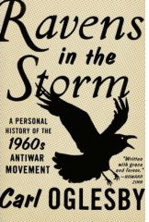
Nor is what Cohn-Bendit saying all that different from what Carl Oglesby says in his recently published memoir “Ravens in the Storm.” It’s about the 1960s anti-war movement, his involvement with the old Students for a Democratic Society, and his misadventures as the blue-collar, self-described “centrist” SDS president who was “star-chambered” for being an “incorrect liberal” unwilling to go along with the Weathermen.
They were young and angry and lived in a separate reality of their own. Many of them had been comfortably raised with a middle-class sense of entitlement, which they brought too easily to their politics. They believed that SDS was passé and that it was their right and their moral duty to take the step beyond nonviolence to terrorism. They were not personally violent. Even as terrorists, they confined themselves to symbolic targets and never killed anyone but three of their own, by accident.
But their vanity was boundless. They believed they were right simply because they were who they were. And after they had picked up a few deadly phrases from Marx, they went from knowing what was right to knowing what was “correct,” as though politics were like arithmetic.
One day I’ll have to read “Fugitive Days,” Bill Ayers’s memoir of the Weather Underground. Lazing about like this, I’ve got plenty of time. Its opening words sound promising: “Memory is a motherfucker.”
(Crossposted at HuffPo)
Postscript: Bill Osborne sends this riposte:
“…the democratic challenge lies in occupying a politically ‘normalized’ space.”
Well maybe in a parliamentary system that allows for small parties. Where is our Green Party? They need to tell us how progressives can occupy a “normalized” space in the USA.
Which candidate is going to bring our military spending under control? Which will create support for the arts like Europeans have? Who will end the death penalty? Who will revive our inner-city schools? Who will end the extreme poverty of our ghettos and create programs to revive our destroyed cities?
No candidate. Elections are indeed “a trap for idiots.” The only reason to read or watch the news is to study the techniques of deceit and manipulation that have become so habitual that they are now simply considered reality.
Does anyone really believe that Obama’s going to make more than a cosmetic difference? Look at our massive ghettos, and then think about a black President who only talks about race when forced to. It will be difficult for our electoral system to create genuine progress. No?
I have never felt more disengaged from the electoral process. It’s like watching a fixed horse race, where the same bigwigs own all the horses and will win all the money no matter which horse crosses the finish line first.
In a word: Yes.


