
By William Osborne, guest blogger
This spring the Vienna State Opera presented an exhibit exploring its collaboration with Nazism during the Third Reich. The International Herald Tribune published an excellent Associated Press article about it entitled “Vienna State Opera comes to terms with its purge of Jews 70 years ago.”
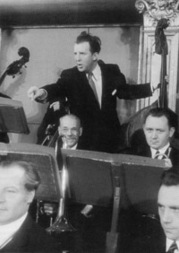 The article begins this way:
VIENNA, Austria: A famed conductor, a lowly laundress, singers, dancers, musicians. Jews, part Jews, or married to Jews, they were all a valued part of Vienna’s opera family — until the Nazis came.
First to go was ballet teacher Risa Dirtl.
She was a 14-year veteran of the Vienna State Opera. But her husband was Jewish — and so she was purged just three days after Austrians thronged a huge central square in their capital 70 years ago to accord a delirious welcome to Adolf Hitler.
“The directorate is obliged to inform you that you are relieved of your duties as ballet school teacher, effective immediately. Heil Hitler!” says Dirtl’s yellowed notice note dated March 16, 1938.
[T]he brusque letter of termination is only one of hundreds of documents on display reflecting the fate of “racially impure” opera employees or ones with spouses fitting that category after Austria was absorbed by Nazi Germany 70 years ago.
Within weeks, 95 people were purged and the exhibit — part of larger nationwide commemorations of the “Anschluss” — mostly focuses on them, documenting not only careers that came to an abrupt stop with the Nazi takeover but lives that sometimes ended in a Gestapo-run death camp.
The exhibit was initiated by the State Opera’s director, Ioan Holender. In an interview, Holender stresses that there were three general groups of people during the Holocaust: victims, perpetrators, and observers. He notes that the “observer” group is often overlooked — all those people in Germany, Austria, and throughout the world who looked on and did nothing, even though the extreme abuse, disappropriation, and violence against Jewish people invoked by the Nuremburg Laws was out in the open for years. It was completely obvious that these actions were leading toward genocide, and yet people continued to do nothing even as massive numbers of Jews began to disappear never to be heard from again.
This is a very valuable exhibit and statement for Austria as a whole, but it is also extremely ironic, because the Vienna State Opera Orchestra (which in its private configuration is the Vienna Philharmonic) continues to exclude people on the basis of race. For documented details see the articles section of my Web site. [Also mouse the photo, above, for the caption; then click. — JH]
And of course, this irony is only increased if we once again consider all of the “observers.” The Vienna Philharmonic is the oldest, most famous, best selling, most watched symphony orchestra in the world, and yet its racial ideologies are a taboo subject. It is one of classical music’s dirty secrets. We speak of all those proverbial Good Christian Germans and Austrians who didn’t see anything back then, but what about today?
What about the Board members of Carnegie Hall who present the orchestra in a series of concerts every year and who never say anything about the orchestra’s racist employment practices? Are they Good Christian Germans too? And what about the American, German, and Austrian press? And for that matter, what about the Internationaler Arbeitskreis Frau und Musik, and the FrauenMusikForum which have never published a single article about the Vienna Philharmonic’s employment practices?
When you start looking at these “observers” you find yourself so deep in shame, and embarrassing hostile tension that you just want to go along with the silence. Is that the right thing to do?
It was courageous for Ioan Holender, who is himself Jewish, to mount this exhibit. Those who address the Holocaust in Germany and Austria’s music world can all too often still face deep resentment and ostracism. Holender will soon retire. I think that might be why he waited until now to present this exhibit.
I don’t like the Vienna Philharmonic’s unfair hiring practices any more than you do, but I think it’s going way overboard to compare these to the Nazis. At the State Opera, female oboist recently had her probationary contract cancelled. I don’t know whether this was outright sexist bias or they just were not satisfied with her playing. But recently,at the New York Philharmonic, a young male violinist in his probationary season was dismissed. He brought legal action againt the Philharmonic, claiming he was passed over for retention, while several women were kept! I don’t know who is telling the truth, but situations like this happen!
Interesting article. I was surprised at your statement
It was courageous for Ioan Holender, who is himself Jewish, to mount this exhibit.
In 2008, the courageous act today is not a Jewish person pointing out the ways in which people behaved in terms of Nazis, WWII and a history of persecution against Jews? I think it’s established that they have a right to do so, due to the topic at hand. The more “courageous” act, I would say, would be when it is done by those whose community or related interests are potentially made accountable by the revelations.
I would have been surprised if he were just an average Christian Austrian, not to mention any of the other religious groups there – say like the Opus Dei members who hold sway over powerful positions in Austria.
Interesting comment, “Arthur101.” Actually, Holender took considerable risks. Jews still live very discrete lives in Germany and Austria, and it is often for reasons of safety. Holender has said things in the past on these topics and has faced considerable heat.
William Osborne
Osborne messages:
In regard to Robert Berger’s comment, this from Reuters yesterday:
“With neo-Nazi crime on the rise, police guard synagogues round the clock and the community is haunted by the memory of the Holocaust in which Nazis killed about 6 million Jews.”
http://www.nytimes.com/reuters/arts/entertainment-germany-jews-cologne.html?_r=1&oref=slogin
That’s what I mean about Jews living discretely in Germany and Austria.
I knew Risa Dirtl in 1945 and liked her very much. We were in Vienna right after the war. She treated me like family. Her personality was lovely -her laughter engaging, and her hospitality was exemplary. I named my daughter after this very dear woman. I am unable to find more about her on this ipad. But, I am just learning to use it, Is Willy still alive. Risa called me Corkt-line or Steosel, if I recall. Sincerely, Winifred Fleet