Read 'n' weep

Robert Parry explains how the United States became a Banana Republic.

A reader writes: "Thank you.  Parry's article is incisive in overview and on the mark in particulars. Excellent." He continues:

One example of Parry's thesis -- that "sophisticated manipulation of information is what would do the Republic in" -- is waterboarding being dismissively defined by journalistic leaders as "simulated drowning" rather than something like "repeated, forced drowning to near death."

However, what I see as "sophisticated" in that context differs somewhat from Parry's thesis: Much that is now classified and lamented as "sophisticated manipulation of information" is and used to be called "prevarication."

My view is that "what would do the Republic in" is not so much the "sophisticated manipulation of information" as the orchestration (think Rove) of the large-scale, often very clever, sophistry that results in journalistic leaders buying the prevarications by treating them as fact and continually repeating them as fact.

For instance, the Nixon-era's catchy but trivializing and dismissive term "Whitehouse horror story" is still with journalists who use the term "horror story" these days in place of "very serious violations" of criminal statutes, ratified treaties, or constitutional guarantees.  Equating Abu Grab torture and "Animal House" is another example.

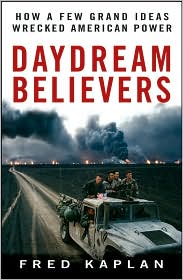
The reader, who prefers not to be named, messaged again: "After sending my e-note commenting on Parry's article, I realized that Phillip Carter's article INTEL DUMP - 'Daydream Believers' (April 11, 2008, The Washington Post, a review of Fred Kaplan's 'Daydream Believers: How a Few Grand Ideas Wrecked American Power') and an NPR excerpt from the book, supplement Parry's article. They are two aspects of the mess that the same set of daydream believers have created (with the usually eager cooperation of Congress and the media)." He continues:

As may become clear when you read Carter/Kaplan, configural theory was extremely unpopular with the daydream believers because it shows that new "transformational" weapons have in reality nothing like the capabilities they have in supposed scientific mathematical models that contravene physical theory, but are believed by the daydreamers (Rumsfeld, for instance) to scientifically confirm those nonexistent capabilities. What Parry's article and Carter / Kaplan separately identify is synergistic.

As Carter notes: "Much of this faith is rooted in admiration of American military technology and the belief that the 'revolution in military affairs' enabled us to do anything we wanted in the world, with or without our allies, regardless of whoever opposed us. Kaplan walks us through this history, from the carpet bombing campaigns of World War II to the first precision-guided bombing of a bridge in North Vietnam to the Gulf War and its famous smart bomb videotapes to today's wars in Iraq and Afghanistan." Thanks again for alerting me to Parry's article.

Por nada. I should have mentioned the title he gave it: "Losing the War for Reality."

April 13, 2008 2:52 PM | | Comments (0)

Leave a comment

Me Elsewhere

'WILD SIDE' STILL ROCKS 

Nelson Algren was one of the great American authors of the 20th century, it is no exaggeration to say, and among the most neglected. Consider his underrated classic, "A Walk on the Wild Side." The title -- popularized and co-opted as an idiomatic phrase by Hollywood and Madison Avenue (institutions Algren loathed) -- is familiar to most anyone who speaks English or knows Lou Reed's lyrics. But the novel itself? Hardly.

BUSTER KEATON REVISITED 
Buster Keaton: Tempest in a Flat Hat is not a biography. "This book is merely a fan's notes," Edward McPherson writes in the introduction, although his publisher ignores the disclaimer and calls it a biography on the cover. In fact, the book is a bit of both, a difficult combination to bring off unless you're David Thomson, who set the standard with Rosebud, his penetrating rumination on the life and career of Orson Welles, which was nothing if not a distillation of every obsessive thought he ever had about the myth and the man and all his movies.
LAUREN BACALL, STILL SALTY AT 80 
When Lauren Bacall writes that her singing voice ranges "somewhere between B minus sharp and outer space," she's being candid and funny. It's not every stage star with two Tony Awards for best actress in a musical whose vocal talent offers so little promise. (OK, Harvey Fierstein excepted.) Still less would one admit it.
THE STARS ACCORDING TO BOGDANOVICH 
Peter Bogdanovich's superb collection of movie-star profiles and interviews -- a sequel to Who the Devil Made It, his interviews of top film directors -- begins with an affectionate tale about Orson Welles that reminds us just how intimate the author's connection to Hollywood's greatest has been. But contrary to what we've come to expect from dime-a-dozen celebrities and celebrity interviews not worth two cents, the tale avoids bromidic egotism and journalistic platitudes.
HERMAN WOUK'S LATEST 
It's hard to say which comes off worse in Herman Wouk's latest novel, his first in a decade: the U.S. Congress or the American press. "A Hole in Texas" offers the choice between two emblematic stereotypes: a red-faced opportunist who heads the House Armed Services Committee and a mustachioed investigative reporter for the Washington Post.
more picks

Sites to See

About this Entry

This page contains a single entry by Straight Up | published on April 13, 2008 2:52 PM.

Endless war on the installment plan was the previous entry in this blog.

Uh, Sock It to 'Em is the next entry in this blog.

Find recent content on the main index or look in the archives to find all content.

AJ Blogs

AJBlogCentral | rss

special
Program Notes
the blog of the National Performing Arts Convention
culture
About Last Night
Terry Teachout on the arts in New York City
Artful Manager
Andrew Taylor on the business of arts & culture
blog riley
rock culture approximately
CultureGulf
Rebuilding Gulf Culture after Katrina
diacritical
Douglas McLennan's blog
Flyover
Art from the American Outback
Rockwell Matters
John Rockwell on the arts
Straight Up |
Jan Herman - arts, media & culture with 'tude

dance
Foot in Mouth
Apollinaire Scherr talks about dance
Seeing Things
Tobi Tobias on dance et al...

media
Out There
Jeff Weinstein's Cultural Mixology
Serious Popcorn
Martha Bayles on Film...

music
The Future of Classical Music?
Greg Sandow performs a book-in-progress
Jazz Beyond Jazz
Howard Mandel's freelance Urban Improvisation
ListenGood
Focus on New Orleans. Jazz and Other Sounds
On the Record
Exploring Orchestras w/ Henry Fogel
PostClassic
Kyle Gann on music after the fact
Rifftides
Doug Ramsey on Jazz and other matters...
Sandow
Greg Sandow on the future of Classical Music
Slipped Disc
Norman Lebrecht on Shifting Sound Worlds

publishing
book/daddy
Jerome Weeks on Books
Quick Study
Scott McLemee on books, ideas & trash-culture ephemera

theatre
lies like truth
Chloe Veltman on how culture will save the world
Stage Write
Elizabeth Zimmer on time-based art forms

visual
Aesthetic Grounds
Public Art, Public Space
Artopia
John Perreault's art diary
CultureGrrl
Lee Rosenbaum's Cultural Commentary
Modern Art Notes
Tyler Green's modern & contemporary art blog
Creative Commons License
This weblog is licensed under a Creative Commons License.