
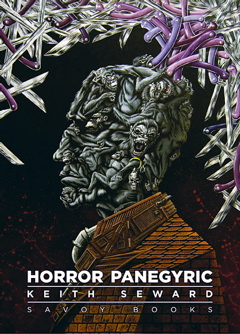
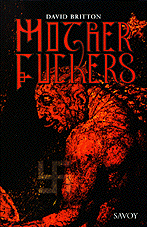
The title — “Motherfuckers: The Auschwitz of Oz” — tells you it’s an unusual novel. But it still doesn’t prepare you for the story (or the swastika on the cover). Which is why “Horror Panegyric,” published today by Savoy Books, works so handily.
As Keith Seward explains in his introductory essay:
Motherfuckers’ principals are Meng and Ecker, twins who had been subject to “scientific” experiments by Josef Mengele. After the war they find themselves in northern England, waiting for Lord Horror the way others wait for Godot. Ecker is rational but violent, Meng is a mutant whose huge cock and tits are nothing compared to the mutations of his mind. Not Holocaust survivors in any sense you’ve ever seen before, Meng and Ecker have adopted the ways of their captors — the bloodlusts and hates. However, there is nothing paramilitary about them. They’re not neo-Nazis or skinheads. They’re more like the ultraviolent droogs of A Clockwork Orange, though it is quite possible that the droogs would not feel any affinity in return. Meng and Ecker are even further out in some post-war delirium. Auschwitz, meet Oz.
“Motherfuckers” is the third in a series of novels by the British writing and publishing team David Britton and Michael Butterworth. The other two are “Lord Horror” (now out of print) and “Baptised in the Blood of Millions.” The novels succeed as “satire via hyperbole and excess,” Seward writes, by applying to literature what he calls “the Boschian method”:
• “time no longer flows in a straight line”
• “history loses its coordinate points and therefore its constancy
• “cause and effect are sundered”
• “space loses its divisions”
• “motion loses its efficacy”
• “gravity loses its inescapability”
• “life loses its phyla”
• “characters mutate”
• “behaviours lose their norms. Or rather, norms are represented not as injunctions but as worst-case scenarios”
• “art loses its conventions”
“Sure, there are writers who ‘push the envelope,'” Seward adds. “But Motherfuckers does not just push the envelope. It beats at it with its fists, kicks, bites, and stabs the envelope. No matter how jaded a reader you are, no matter how much you’ve read your Henry Miller and Marquis de Sade, this is the book that will leave you feeling bad for the envelope. After Motherfuckers, it will never be the same again.”
The police in Manchester, England (where Britton and Butterworth are based), didn’t appreciate the idea of “satire via hyperbole and excess.” Not long after “Lord Horror” was published, in 1989, the pair paid for their provocations in jail time and other forms of harrassment. Half the print run was confiscated, and a judge declared the book obscene, “less for its sex or violence than for anti-semitic ravings put into the mouths of anti-semitic characters,” Seward notes. (The fact that the title character of “Lord Horror” is based on the World War II British fascist William Joyce, popularly known as Lord Haw-Haw, apparently failed to strike the judge as relevant.)
 Britton went to prison for four months. Instead of discouraging him, the sentence hardened his resolve. It was in prison that he conceived the story of “Motherfuckers.”
Here’s a taste of it, taken from “Horror Panegyric,” which offers excerpts of all three novels:
Fifty years on, Horror had confided to Ecker, Auschwitz would be a recognisable brand name, a mythic character as well-known as Sherlock Holmes or Tarzan. A fortune awaited the author who could bring ‘Mr Auschwitz’ to life. To recreate the persona of Auschwitz would be an ordained mission. Auschwitz, the holy end-all of life’s futile pattern, slinking through the subconscious of humanity, the one archetypal riff common to all nightmares, fuelled on the anvil of Little Richard.
In a hundred years, Auschwitz would form its own genre and become the most successfully marketed product in the history of the world, a name as well-known globally as Coca Cola, taking all media under its encompassing umbrella. The camps were the obvious ultimate enclosed world, the desired image of world television, beamed by satellite into each city, town and village, ideal for community soap operas (a story of everyday life on the edge of life), of science fiction time travel (travel back through your life and end it in Auschwitz). In this televised scenario the dog-boys loomed large as Heathcliff doomed lovers, the spice of sexy bodice-rippers which thrilled millions of women. Guilt would never stand in the way of commerce …
Seward calls “Motherfuckers” a masterpiece and compares it to the works of the Marquis de Sade and William S. Burroughs. After reading it myself, I’m inclined to agree. But he prefers not to emphasize “the rectitude of these books” for their moral instruction. “You can read them like the Gospel, if you want, and draw out the lessons,” he writes. “But that’s not really the point. These are not moral books. They’re good books.”
To read Seward’s entire essay, go here.
Motherfuckers: “Auschwitz would form its own genre and become the most successfully marketed product in the history of the world, a name as well-known globally as Coca Cola, taking all media under its encompassing umbrella.”
But only if you lose the war. If you win, genocide remains a secret. Or at best, it might become a footnote of history, lost in the fog of memory.
William Osborne