A Christmas Tale

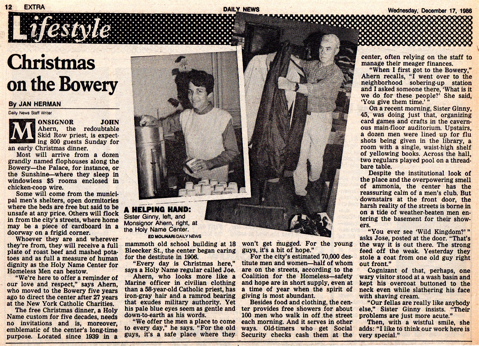
Once upon a time I wrote a story called "Christmas on the Bowery." It began like this: "Monsignor John Ahern, the redoubtable Skid Row priest, is expecting 800 guests Sunday for an early Christmas dinner."

Most will arrive from a dozen grandly named flophouses along the Bowery -- the Palace, for instance, or the Sunshine -- where they sleep in windowless $5 rooms enclosed in chicken-coop wire. Some will come from the municipal men's shelters, open dormitories where the beds are free but said to be unsafe at any price. Others will flock in from the city's streets, where home may be a piece of cardboard in a doorway on a frigid corner. Whoever they are and wherever they're from, they will receive a full plate of roast beef and mashed potatoes and as full a measure of human dignity as the Holy Name Center for Homeless Men can bestow.

I haven't been down to the center lately. But I was willing to bet it is now a gentrified condo for Wall Street honkies. Anybody who's been to Manhattan's Lower East Side these days probably wouldn't have taken the bet, either.

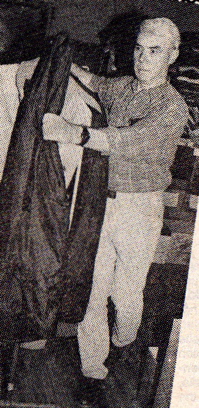
The free Christmas dinner, a Holy Name custom for five decades, needs no invitation and is, moreover, emblematic of the center's longtime purpose. Located since 1939 in a mammoth old school building at 18 Bleecker St., the center began caring for the destitute in 1906. ... Ahern, who looks more like a Marine officer in civilian clothing than a 58-year-old Catholic priest, has iron-gray hair and a ramrod bearing that exudes military authority. ... "We offer the men a place to come to every day," he says. "For the old guys, it's a safe place where they won't get mugged. For the young guys, it's a bit of hope."

Well, I just checked. The center, it turns out, is still operating two decades later -- though in a much reduced way -- within spitting distance of the most publicized symbol of Bowery gentrification, The New Museum of Contemporary Art. And wonder of wonders -- amid the boutique hotels, the multimillion-dollar condos, the liveried doormen, the custom-shopping grocers, the expensive cafes, the uptown art galleries for rich collectors now lined up on the Bowery in a "gallery row" -- Monsignor Ahern is still there at age 79, offering what he can. These days "he looks like a bantamweight," says Patrick Wynne, the center's program director. The Christmas dinners, however, are long gone.

With the elimination of the flophouses 10 years ago, Wynne explains, "the old guys have disappeared. They've either died off or were sent to nursing homes."

On a recent morning ... a dozen men were lined up for flu shots being given in the library, a room with a single, waist-high shelf of yellowing books. Across the hall, two regulars played pool on a threadbare table. Despite the institutional look of the place and the overpowering smell of ammonia, the center has the reassuring calm of a men's club. But downstairs at the front door, the harsh reality of the streets is borne in on a tide of weather-beaten men entering the basement for their showers. "You ever see 'Wild Kingdom?'" asks Jose, posted at the door. "That's the way it is out there. The strong feed off the weak. Yesterday they stole a coat from one old guy right out front." Cognizant of that, perhaps, one wary visitor stood at a wash basin and kept his overcoat buttoned to the neck even while slathering his face with shaving cream.

The center still offers free daily showers. But now, Wynne says, it's mostly immigrant day laborers, mainly Mexicans, who come in for them.
December 24, 2007 12:36 PM |

Categories:

Me Elsewhere

'WILD SIDE' STILL ROCKS 

Nelson Algren was one of the great American authors of the 20th century, it is no exaggeration to say, and among the most neglected. Consider his underrated classic, "A Walk on the Wild Side." The title -- popularized and co-opted as an idiomatic phrase by Hollywood and Madison Avenue (institutions Algren loathed) -- is familiar to most anyone who speaks English or knows Lou Reed's lyrics. But the novel itself? Hardly.

BUSTER KEATON REVISITED 
Buster Keaton: Tempest in a Flat Hat is not a biography. "This book is merely a fan's notes," Edward McPherson writes in the introduction, although his publisher ignores the disclaimer and calls it a biography on the cover. In fact, the book is a bit of both, a difficult combination to bring off unless you're David Thomson, who set the standard with Rosebud, his penetrating rumination on the life and career of Orson Welles, which was nothing if not a distillation of every obsessive thought he ever had about the myth and the man and all his movies.
LAUREN BACALL, STILL SALTY AT 80 
When Lauren Bacall writes that her singing voice ranges "somewhere between B minus sharp and outer space," she's being candid and funny. It's not every stage star with two Tony Awards for best actress in a musical whose vocal talent offers so little promise. (OK, Harvey Fierstein excepted.) Still less would one admit it.
THE STARS ACCORDING TO BOGDANOVICH 
Peter Bogdanovich's superb collection of movie-star profiles and interviews -- a sequel to Who the Devil Made It, his interviews of top film directors -- begins with an affectionate tale about Orson Welles that reminds us just how intimate the author's connection to Hollywood's greatest has been. But contrary to what we've come to expect from dime-a-dozen celebrities and celebrity interviews not worth two cents, the tale avoids bromidic egotism and journalistic platitudes.
HERMAN WOUK'S LATEST 
It's hard to say which comes off worse in Herman Wouk's latest novel, his first in a decade: the U.S. Congress or the American press. "A Hole in Texas" offers the choice between two emblematic stereotypes: a red-faced opportunist who heads the House Armed Services Committee and a mustachioed investigative reporter for the Washington Post.
more picks

Sites to See

About this Entry

This page contains a single entry by Straight Up | published on December 24, 2007 12:36 PM.

The Year in Roadkill was the previous entry in this blog.

Before I Forget is the next entry in this blog.

Find recent content on the main index or look in the archives to find all content.

AJ Blogs

AJBlogCentral | rss

culture
About Last Night
Terry Teachout on the arts in New York City
Artful Manager
Andrew Taylor on the business of arts & culture
blog riley
rock culture approximately
CultureGulf
Rebuilding Gulf Culture after Katrina
diacritical
Douglas McLennan's blog
Flyover
Art from the American Outback
Rockwell Matters
John Rockwell on the arts
Straight Up |
Jan Herman - arts, media & culture with 'tude

dance
Foot in Mouth
Apollinaire Scherr talks about dance
Seeing Things
Tobi Tobias on dance et al...

media
Out There
Jeff Weinstein's Cultural Mixology
Serious Popcorn
Martha Bayles on Film...

music
The Future of Classical Music?
Greg Sandow performs a book-in-progress
Jazz Beyond Jazz
Howard Mandel's freelance Urban Improvisation
ListenGood
Focus on New Orleans. Jazz and Other Sounds
On the Record
Exploring Orchestras w/ Henry Fogel
PostClassic
Kyle Gann on music after the fact
Rifftides
Doug Ramsey on Jazz and other matters...
Sandow
Greg Sandow on the future of Classical Music
Slipped Disc
Norman Lebrecht on Shifting Sound Worlds

publishing
book/daddy
Jerome Weeks on Books
Quick Study
Scott McLemee on books, ideas & trash-culture ephemera

theatre
Stage Write
Elizabeth Zimmer on time-based art forms

visual
Aesthetic Grounds
Public Art, Public Space
Artopia
John Perreault's art diary
CultureGrrl
Lee Rosenbaum's Cultural Commentary
Modern Art Notes
Tyler Green's modern & contemporary art blog
Creative Commons License
This weblog is licensed under a Creative Commons License.