
THE GOOD OLD BAD OLD DAYS

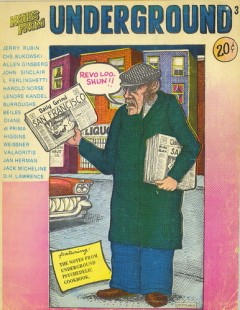
Long ago in San Francisco -- the year was 1969 -- John Bryan and I put together an issue of Notes From Underground³. As you can see, it had a self-mocking cartoon cover (by Gary Grimshaw, our "art director"), which showed a newsie shouting, "REVO LOO-SHUN!!" while hawking the Daily Grind. I don't know if you can make it out, but the front page of the Daily Grind is illustrated by a pig-faced plainclothes cop in a pork pie hat offering the peace sign. The news stories above the fold are headlined "OINK" and "BLAH BLAH."

The issue led off with an article by Jerry Rubin (in his anarcho-leftist phase), "The Thoughts of Chairman Jerry," which began:

We of the white middle class are not children of violence. But increasingly, day by day, we are becoming enemies of a system whose basic means of control is violence, or the threat of violence. One never knows if he is going to return from a demonstration anymore with his precious head in one piece.

Rubin's article was illustrated by another Grimshaw cartoon, which showed what the demonstrations were about and again mocked the contradictory nature of the times.

A middle-class shopper in the supermarket is staggered by the produce in the meat department. "OMYGOD!!!" She can take her pick of fresh Dead Vietnam Babies 29¢ lb. and U.S. Choice Ground Pigburger 89¢ lb. Her shopping cart is filled with goods, one of them brand-named Junk. The shelves behind her are stocked with Goo, Zip, Fuz and Poo.

The second article, by Charles Bukowski, was called "Should We Burn Uncle Sam's Ass?" It began:

Or will he burn ours? I'll be 50 in August so don't trust me. That's 20 years over 30, and I wonder who the boys under 30 are going to trust when they are over 30? But maybe you ought to trust me a little ...

We were self-mocking but serious. Bukowski's piece was followed by Allen Ginsberg's poem, "Violence," which was followed by White Panther Party founder John Sinclair's "Letters from Prison," then by "Student Revolutionary Poems" written during the 1968 student strike at San Francisco State.

And we were arty.
We printed Fluxus writer Dick Higgins's letter to French "happener" Jean-Jacques Lebel, "On the Artist as Revolutionary"; Lawrence Ferlinghetti's poem, "In a Time of Revolution, For Instance"; Harold Norse's article, "Cyanide Genocide"; a Lenore Kandel poem, which began: "I offer you one hundred ways of love"; an illustrated game of revolution, "Us & Them"; two poems by Nanos Valaoritis; Jack Micheline's poem, "Five Generations of Freaks"; a cutup by Carl Weissner and yours truly, "If the Revolution Fails"; a reprint of William S. Burroughs's "After the Inauguration," and Sinclair Beiles's comical tales from a mental ward:

In the washroom I reckoned the specific gravity of my fellow inmates' urine by floating bottles of it in a washbasin alongside bottles holding the same quantity of water. The nurses were suitably impressed. From then on I was Dr. Beiles who had taken his medical degree in Cairo.

And, because we were also psychedelic, we featured the Notes from Underground "Psychedelic Cookbook," which provided formulas for synthesizing mescaline and LSD. Oh yeah. And what have we got to show for it? The bad old new days. Oh yeah.

Postscript: If you think Grimshaw's supermarket cartoon is overstated, Bob Herbert has news for you about "an ocean of blood" in Iraq.

March 15, 2006 12:28 PM |

Categories:

Me Elsewhere

'WILD SIDE' STILL ROCKS 

Nelson Algren was one of the great American authors of the 20th century, it is no exaggeration to say, and among the most neglected. Consider his underrated classic, "A Walk on the Wild Side." The title -- popularized and co-opted as an idiomatic phrase by Hollywood and Madison Avenue (institutions Algren loathed) -- is familiar to most anyone who speaks English or knows Lou Reed's lyrics. But the novel itself? Hardly.

BUSTER KEATON REVISITED 
Buster Keaton: Tempest in a Flat Hat is not a biography. "This book is merely a fan's notes," Edward McPherson writes in the introduction, although his publisher ignores the disclaimer and calls it a biography on the cover. In fact, the book is a bit of both, a difficult combination to bring off unless you're David Thomson, who set the standard with Rosebud, his penetrating rumination on the life and career of Orson Welles, which was nothing if not a distillation of every obsessive thought he ever had about the myth and the man and all his movies.
LAUREN BACALL, STILL SALTY AT 80 
When Lauren Bacall writes that her singing voice ranges "somewhere between B minus sharp and outer space," she's being candid and funny. It's not every stage star with two Tony Awards for best actress in a musical whose vocal talent offers so little promise. (OK, Harvey Fierstein excepted.) Still less would one admit it.
THE STARS ACCORDING TO BOGDANOVICH 
Peter Bogdanovich's superb collection of movie-star profiles and interviews -- a sequel to Who the Devil Made It, his interviews of top film directors -- begins with an affectionate tale about Orson Welles that reminds us just how intimate the author's connection to Hollywood's greatest has been. But contrary to what we've come to expect from dime-a-dozen celebrities and celebrity interviews not worth two cents, the tale avoids bromidic egotism and journalistic platitudes.
SAMMY'S WHITE DREAMS 
Four decades ago Lenny Bruce sentenced Sammy Davis Jr. to "30 years in Biloxi," stripping him of "his Jewish star" and "his religious statue of Elizabeth Taylor." Now we have two new biographies of Davis that spring him from ridicule, if not from doubts about his legacy, and restore a measure of dignity to a black entertainer whose huge fame and success never overcame his devout wish -- indeed his lifelong effort -- to be white.
more picks

Sites to See

Abstract City
AmericaBlog
American Leftist
Andante
Antiwar.com
ArkivMusic.com
Articulate
Arts & Letters Daily

Blogcritics
Booknotes
Bright Lights Film Journal
Buck Fush

C-SPAN
Center for Cooperative Research
Noam Chomsky
Consortium News

Cost of War in Iraq
Council on Foreign Relations
Crooks and Liars
Cultural Weekly
TheCuttingFloor

The Daily Howler
David E's Fablog
Dark Roasted Blend
Democracy Now!
Devil Ducky

Editor's Cut
Ehrensteinland
Tim Ellis: Comedy
Eschaton

Film Threat
Robert Fisk
Fluxlist Europe

Glenn Greenwald
Good Reads

The Guardian (London)
GUERNICA: A Magazine of Art & Politics

Herman (Literary) Archive, Northwestern Univ. Library
The Huffington Post

Inter Press Service News Agency
International Relations Center
Internet Movie Database (IMDb)
Doug Ireland

Jacketmagazine
Clive James

Henry Kisor
Krugman's Blog:
Conscience of a Liberal

Lannan Foundation
Life During Wartime
Los Angeles Times
Low Culture

Metacritic
Mimeo Mimeo
Museum of Television & Radio

Nat. Arts Journalism Program
National Security Archive
The New York Times
NO!art

Onion Radio News
Open City
Open Library
Osborne & Conant

The Overgrown Path

Greg Palast
Political Irony

Postclassic Radio

Poynter/Romenesko:
Media People

Rain Taxi
The Raw Story
RealityStudio.org
Bill Reed
The Reeler
Rhizome
Rwanda Project

Salon
Seeing Black
Senses of Cinema
Seven Stories Press
Slate
Studs Terkel

TalkLeft
The Theater Times (Cris Gross)
The 3rd Page
ThugLit: Writing About Wrongs
Times Square Cam
The Tin Man
Truthdig
t r u t h o u t

Ubu Web
Underneath Their Robes

Wading in the Velvet Sea
Walking Man
The Wall Street Journal
Wikigate
Wikipedia

The Washington Post
James Wolcott
World O'Crap Man

About this Entry

This page contains a single entry by Straight Up | published on March 15, 2006 12:28 PM.

THE COPYCAT AND THE ORIGINAL CAT was the previous entry in this blog.

EHRENSTEIN SINGS OUT is the next entry in this blog.

Find recent content on the main index or look in the archives to find all content.

Creative Commons License
This weblog is licensed under a Creative Commons License.