
We’ve been banging on about the American strategy to democratize Salvadorize Iraq, as though the coming SUNNI GENOCIDE is a revelation because a “U.S. regime secretly bent on mass murder” has proxies doing the dirty work. But all of this has been hidden in plain sight for so long — in the mainstream media and elsewhere — that we’re shocked by our own naiveté.
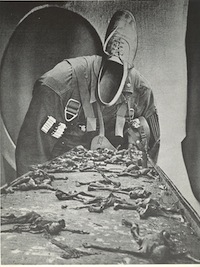
Collage © 1967 by Norman O. Mustill
Long story short: Have a look at Max Fuller’s roundup of media reports, “Death-squad style massacres: For Iraq, ‘The Salvador Option’ Becomes Reality,” which cites chapter and verse (URLs included). Published last June, it “examines evidence that the ‘Salvador Option’ for Iraq has been ongoing for some time and attempts to say what such an option will mean.” Among other things:
It pays particular attention to the role of the Special Police Commandos, considering both the background of their US liaisons and their deployment in Iraq. The article also looks at the evidence for death-squad style massacres in Iraq and draws attention to the almost complete absence of investigation.
The roundup begins with key articles:
• A Newsweek report of Jan. 8, 2005, which said that U.S.-backed counter-insurgency techniques used in El Salvador (including mass murder, torture and other atrocities), were about to be applied in Iraq — a claim denied by Defense Secretary Donald Rumsfeld, although, as Fuller points out, “the Salvador Option was already well underway”;

Colonel James Steele
Those are only two of nearly three dozen articles Fuller cites. Other reports not included in his roundup are worth reading as well, such as:
• Washington Post reporter David Ignatius’s “‘Our Guys Stayed and Fought'” (Feb. 25, 2005), which begins: “Let’s call it the ‘Adnan and Jim Strategy.'”
• [London] Independent reporter A.K. Gupta’s “Unraveling Iraq’s Secret Militias” (April 5, 2005), itself a telling summary of reports from Agence France-Presse, the Boston Globe, Knight Ridder, the Christian Science Monitor, Stars and Stripes, The Guardian, The Times of London, and elsewhere.
• David Corn’s “From Iran-Contra to Iraq” (May 7, 2005) in The Nation, which recaps the Maass article and describes what Maass does not get into — how Steele was discredited for lying about his participation in clandestine arms shipments to the Contras, which were exposed in the Congressional Iran-Contra investigation; how he fiinally admitted he had discussed these shipments with top American officials (Donald Gregg, the national security advisor to then-vice president George H.W. Bush, and Edwin G. Corr, then the U.S. Ambassador to El Salvador); and how, despite minor obstacles, Steele’s career sailed right along.
• Kim Sengupta’s “Iraq’s dirty war of wolves in police clothing,” reprinted in The New Zealand Herald from The Independent (Nov. 21, 2005), which describes the Wolf Brigade as vying with Adnan’s commandos “for the title of most feared” thugs and, like The New York Times last week, talks about “tortured prisoners huddled in dungeons, death-squad victims with their hands tied behind their backs, often mutilated with knives and electric drills,” and “families searching for relations who have been ‘disappeared.'”
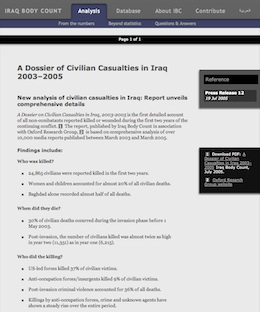
Iraq Body Count [CLICK TO READ THE REPORT]
The Pentagon itself stated a year ago — in the December 25 issue of the Advisor, an official Pentagon publication — that “Special Police Commandos have been deployed all over Iraq to hunt down insurgents and” — this makes it sound civilized — “to help provide security for the [then-]upcoming Jan. 30 elections.”
Last January, as Newsweek reported, Rumsfeld said “the idea of a Salvador option was ‘nonsense’ and denied that U.S. Special Forces were going into Syria. But when asked whether such a policy was under consideration, he replied, ‘Why would I even talk about something like that?'” Why, indeed. Eleven months later, the U.S. regime still doesn’t want to talk about Iraqi death squads and even less about the mass graves that are being found.
The Orwellian ironies are so strong, so much a part of the American political landscape and have been for so long, not merely since 9/11, that we take them for granted. Yup, the American strategy to democratize Salvadorize Iraq and distance ourselves from the death squads makes us proud to be red-white-and-blue citizens. All hail the twin engines of misrule in the “land of the free and the home of the brave.”
— Tireless Staff of Thousands
Postscript: “I’ve been through quite a few of the articles listed by Max Fuller and the ones you’ve listed. In all of them, one main observation is missing — the fact that the ultimate effect of large scale death-squad activity is almost always genocidal.
“So many people are killed outright, and so many additional people die due to the secondary results of mass murder, that genocide is inevitable. No one has reached the obvious conclusion that 15 years from now a huge number of Iraqi Sunnis probably will have been killed or exiled — probably somewhere between 500,000 to 1.8 million. [See 4th paragraph. — JH]
“Another missing observation is that this sort of death-squad activity combined with invasion has a very clear precedent in the German invasion of Eastern Europe and Russia. Military police commandos followed right behind the frontline troops and rounded up Jews, communist leaders and partisans. They functioned as death squads. Even their tactics were very similar to what we are seeing in Iraq. And they were often people who worked as proxies for the Germans.
“In modern warfare, this sort of genocidal death-squad activity is an inherent part of any invasion and occupation. I think this point needs to be stressed.”
— William Osborne
PPS: The top story on the front page of The New York Times, “G.I.’s to Increase U.S. Supervision of Iraqi Police” (dateline Baghdad, Dec. 29, 2005), addresses the issues we have been discussing. “Here’s an excerpt,” Osborne notes, “with the usual double talk”:
The increase is seen as a way to exert firmer control over the commando units, which are suspected of carrying out widespread atrocities against civilians in Sunni Arab neighborhoods. Human rights groups here say the units may be guilty of murdering and torturing hundreds, and possibly thousands, of Sunni Arab men of military age.
The conduct of the commandos has become a source of intense friction between the Shiite-led Iraqi government and American officials, who say the reports of the atrocities are jeopardizing the campaign to persuade Sunnis to stop supporting the insurgency.The plan to increase the number of American advisers is a significant departure from the overall American strategy of giving the Iraqis the lead role in fighting the insurgency. Indeed, the allegations of atrocities arose only after Americans began to give the Iraqi units more freedom to act on their own.
Even as he talked about the increase in advisers, the officer confirmed details of a shift to fewer American troops covering more Iraqi ground.
“In other words, the article presents talk of more U.S. supervision when, actually, general American participation is being reduced. Is this not what I have described — setting up a potential genocide while distancing ourselves and covering our tracks? It worked against the Mayans in Central America, and it will probably work in Iraq.”
See this from Der Spiegel Online:
Guatemala, 1981-1983
In the history of Guatemala’s bloody 36 years of civil war from 1960 to 1996, the early 80s stand out as a period of particular viciousness. In what became known as “The Silent Holocaust,” the Guatemalan army methodically worked its way through the country’s Mayan communities, killing men, women and children. A total of 200,000 people died during the war, many thousands of them Mayan victims of genocide.