
Oh, and let’s not forget this, with thanks to Hammond Guthrie for the reminder: “Cut and paste,” which appeared while we were in Dell meltdown mode. I’m especially fond of the conclusion:
When Burroughs died, JG Ballard lamented his passing by saying that he was the most important and original writer since the second world war. “Now,” he mourned, “we are left with the career novelists.”
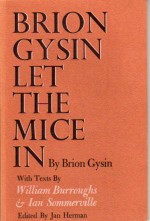
Something Else Press
In an editor’s note to “Brion Gysin Let the Mice In,” I pointed out that their first cut-ups were published in “Minutes to Go” and “The Exterminator,” to which “Mice” was intended as a companion. I also noted that the title came via Gregory Corso. Gysin wrote me from Tangier:
The original text included the words “said Gregory Corso in 1960,” and they consequently appeared in the cut up text, also. Gregory disassociated himself from the whole idea so thoroughly that I agreed with Bill Levy of Insect Trust Gazette that he should be edited out and, now, I rather regret it but there was Gregory’s voice in there, squalling away to be let out of there, so we took the scissors to him.
“Those first cut-ups tested the potency of words. Further investigations tested the influence of other sensory input,” I wrote somewhat tendentiously. “Ian Sommerville and Brion Gysin designed a dream machine on which a patent was granted in 1961. William Burroughs explored a vast subject throughout the Sixties. He formulated, described, and applied to his literary work certain discoveries about Control — of consciousness and society — through sound & image. Certainly, it is difficult to think of any writer of fiction who paid so much attention to theorizing the discrete psychoactive suggestiveness of words.”
A final sidenote, with thanks to Arts & Letters Daily for the tip: My favorite romantic, Michel Houellebecq, is back! He’s made a career all right, but not with the usual material.