
By Jan Herman
Economist Jeffrey Sachs was his usual stellar self earlier this week at the Council on Foreign Relations — calm, cogent, full of facts (all of them broken down into relevant categories), persuasive, angered by the Bush regime — contemptuous of it I’d say, but he managed to keep his contempt in check no doubt for diplomatic reasons — unhappy with the American public in general, and ultimately not very optimistic about Africa’s chances of succeeding in feeding itself or eliminating diseases like malaria unless the United States ponies up its fair share of development aid.
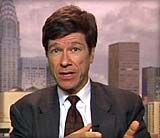 The best thing about listening to Sachs (left), who more often gives the impression of tempered optimism, is that the ideas he advocates are simple. His proposals are practical. They are integrated. Each one affects or leads to another. They make sense. Sachs has a reputation among his detractors and even among some admirers of being on an ego trip, a man who wants to save the world and believes he can if only others would agree with him and put his ideas into practice. Well, he didn’t come off that way on Tuesday. At least not to this listener. He seemed a wholly reasonable man with an entirely reasonable mission, although the title of his talk — “Can We End Global Poverty?” — might make you wonder.
Remember the recent headlines about the world’s wealthiest nations forgiving $40 billion owed to the World Bank, the International Monetary Fund and the African Development Bank by the world’s 18 poorest nations (14 of them in Africa, four in Latin America)? Well, that’s all they are — headlines. The reality contradicts them, said Sachs, who travels to Africa once a month as Special Advisor on development to U.N. Secretary General Kofi Anan and as Director of the Earth Institute at Columbia University.
In actual fact, Sachs told the council, all that’s going to happen is that the interest on the debt– $1.5 billion a year — won’t have to be paid back by the poorest nations. The interest will be paid by wealthy industrialized nations who make up the Group of Eight, or G8. The net result for some of the poorest African nations now receiving relatively tiny amounts of development aid from the U.S., for instance, is that they will receive less money than they otherwise might because the Bush regime intends to compensate for the interest payments it makes by deducting the amounts from current U.S. aid programs, Sachs said.
(Others have also made the point that the debt forgiveness is virtually an “empty gesture” in relation to the billions needed to help the poorest nations climb out of poverty. The interest payments over the next decade will cost the U.S. $120 million a year [less than 50 cents per capita], Britain $75 million, Germany, France, Japan and Italy roughly $75 million each, and Canada $45 million.)
 Sachs has been the strongest, most voluble proponent of development aid for the third world, especially in Africa. (See his new book “The End of Poverty.”) He’s been saying all along that $25 billion is the necessary investment to enable the poorest nations to grow more food, eliminate widespread diseases such as malaria (which could be done merely by distributing mosquito netting and antibiotics), provide safe drinking water, build roads, install a telecommunications system and offer basic education.
Although he called the debt forgiveness “a small step in the right direction,” in an interview on PBS earlier this week, he was less willing to sugarcoat it at the council, where he made the case that it was a piddling step, possibly in a backward direction. And he reminded the council, as he has been reminding anyone who will listen, that when Tony Blair recently asked America to join in giving the $25 billion, the answer from America’s Dear Leader, as we all know, was “no.”
If the U.S. would contribute its fair share, Sachs asserted, Africa could see a green revolution modeled on Asia’s green revolution of the ’60s. It was that revolution that started India and China, the most prominent examples, down the road to industrialized development.
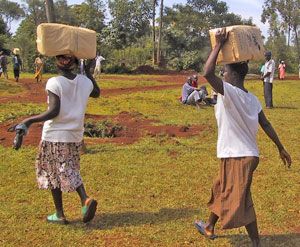 Merely distributing improved seed and fertilizer to African farmers would make an enormous difference, Sachs said. In a model project he’s been working on, a village in Kenya, right, which received seed and fertilizer just four to five months ago, is now harvesting 400% more food than it ever grew before, he said. The village will not only be able to feed itself and provide better nutrition, which will result in better all-around health, there will possibly be a surplus of food to give to schools and to sell or trade for other goods.
When someone asked about human rights and women’s rights, and why he did not pay more attention to those issues, Sachs pointed out that the most significant way to help women in Africa’s poorest nations is to relieve them of being beasts of burden. Women do all the water-carrying, most of the farming, all the care-giving for the ill and for the children, he said. Growing more food, eliminating malaria, providing clean water and the rest, are, in effect, both human rights and women’s rights projects.
Frankly, this is an inadequate summary of his talk. When the council puts up the transcript on its web site, I’ll post a link.
Postscript: In the absence of a transcript, here are some relevant excerpts from an op-ed piece Sachs wrote in the Los Angeles Times: “Africa’s Suffering Is Bush’s Shame.” It appeared last Sunday and began:
President Bush last week brazenly brushed aside British Prime Minister Tony Blair’s call for a doubling of aid to Africa. Blair and other European leaders have taken on the task of fighting extreme poverty — and Bush watches from the sidelines. To justify its dereliction, the Bush administration perpetuates a mythology that contributes to the premature deaths of millions of people each year.
The mythology says:
The U.S. is a generous provider of aid to Africa … but Africa is corrupt and mismanaged and thus cannot absorb more aid. In addition, there is no room in the [U.S.] budget to do any more than what we are currently doing. This multipart fantasy is widely shared in the U.S. and recalls Napoleon’s dictum that “history is a fable often told.”
“The facts are otherwise,” Sachs writes.
Total annual U.S. aid for all of Africa is about $3 billion, equivalent to about two days of Pentagon spending. About $1 billion pays for emergency food aid, of which half is for transport. About $1.5 billion is for “technical cooperation,” essentially salaries of U.S. consultants. Only about $500 million a year -— less than $1 per African — finances clinics, schools, food production, roads, power, Internet connectivity, safe drinking water, sanitation, family planning and lifesaving health interventions to fight malaria, AIDS and other diseases. [Boldface added.]
Sachs also points out:
Malaria will kill up to 3 million children this year, overwhelming Africa’s meager hospitals. Yet five measures could end this: long-lasting insecticide-treated bed nets (cost: $7 per net); effective medications freely available to the poor; community health workers trained in malaria control; medical diagnostic capacity at the local level; and indoor insecticide spraying where appropriate. The cost: $3 billion a year for the industrialized countries, $1 billion for the U.S. — about 10 times what’s currently spent on malaria control.
The administration’s claim that budget restraints prevent more spending on Africa is the most cynical of its contentions. The president has cut taxes by more than $200 billion a year, with the wealthiest Americans the chief beneficiaries, and has raised military spending by $200 billion a year. But when $20 billion is needed to keep the poorest of the poor in Africa alive and put the continent’s economies on a path toward long-term growth, there’s no money available.
The piece ends on what seems to me its only false note: “Americans want to do better.” I doubt that Sachs truly believes they do, not because he’s a cynic — he works too hard for that — but because at bottom I think he’s a realist.