
 Now that Bob Woodward and Carl Bernstein are together again, taking a victory lap after all these years,
like the Simon & Garfunkel of journalism, I’m reminded by my staff of thousands that once upon a
time, long ago and far away, I interviewed Woodward about his only non-political book — the one
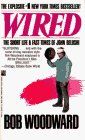
out of the Beltway, for which he is least known — “Wired: The
Short Life & Fast Times of John Belushi.”
chronicle of Richard Nixon’s fall — “All the
President’s Men” and “The
Final Days” — with his own “The Brethren,” about the secret workings of the U.S.
Supereme Court. It was 1984. Woodward was 41, twice-divorced at the time, and the doting
father of a 7-year-old daughter by his second marriage. He was living in a large Georgetown
house with Elsa Walsh, then a 26-year-old education reporter whom he later married. (She’s now
at The New Yorker, and they’re still married.)
You’ll excuse me for this nostalgia trip. But my staff insists. So here goes. Woodward had
come to Chicago for the interview. The town where he grew up, Wheaton, Ill., was not far away.
His brother and sister lived there. His father was a retired judge who was still practicing law there.
Belushi, too, had grown up in Wheaton. Predictably, I began by asking about that.
What was your life there?
probably should have, was that when I was in the 8th grade I got the American Legion Award. I
was the good clean guy. Belushi got it, too, when he was in the 8th grade six years later in the
early ’60s. When I learned that, I thought, ‘Gee, that is not the guy I saw on “Saturday Night
Live.” That struck close to home.
How did it change?
A good friend of mine got me interested in books. John Belushi got interested in rock ‘n’ roll.
That’s one primordial difference.
Both of us played on the same high school football team with the same coach, Howard
Barnes. I remember he put me on the team and said, “You have the best attitude of anyone. But
you’re one of the worst football players.” I think Belushi was the opposite. He was one of the best
football players and had one of the worst attitudes. …
You were attracted to the Belushi story because you said it was about “the failure of
success.” What were the pressues on you from fame and success?
You’ve got a lot of people wanting things — people saying “This is the way you ought to
invest,” or “Why don’t you come to my party?” You’re on call. It seems to me the defense against
that, which is quite artificial, is not to take success too seriously. To sort of see that it was luck.
And to realize very quickly how easy it could have been a failure.
Certainly Watergate for me was like that. A lot of people thought we were wrong, and it
seemed like a failure for many months. So the dividing line between success and failure is not that
great.
Wasn’t there any exhilaration?
Look, Watergate was not a happy story. Just like the Belushi story. They’re somewhat alike in
that respect. You don’t get any joy out of it.
You must have gotten some joy from clinching the story.
I remember the nightNixon resigned. I was sitting in the office of the Washington Post. Carl and I weren’t writing that
story. I was eating a baloney sandwich, watching his speech. We were sort of saying, “We don’t
have a story to write. What are we gonna do?” I remember getting in my car — it was raining that
night — and just sort of feeling a little empty. There was no dancing.
How different were the pressures on you from those on Belushi?
There’s the same pressure to have a second act. And a third. And a fourth. The thing that has
helped me the most is being anchored at the Washington Post. Unless they want to fire me, I’ll
always stay there. If you stick to what you’ve learned to do and not try other things like writing
novels or going into television or writing screenplays, it gives you an anchor.
That sounds like a veiled reference to Bernstein. What’s the different between how you
dealt with your success and how he did?
We’ve both made mistakes, and we went on. …
Was your relationship with him ever threatened?
Oh yeah, all the time. We didn’t like each other at first. We didn’t get on. There was always a
struggle between us. Strong egos. different points of view. Different
ideas.
Arrrgghhh. Enough with the nostalgia. It’s funky Friday. I’m outta here.