
A recent article about a conference
on the current state of classical music criticism by John Fleming, the performing arts critic of the
St. Petersburg Times, has really pissed off my composer friend William Osborne. What bugged
him was a recurring theme of the conference, namely that so many critics seemed willing to
accomodate pop junk in support of crossover music.
Fleming notes that “the next generation of classical music critics, if there is one, is probably
listening to more rock than Bach.” And he points to John Rockwell of The New York Times as “a
pivotal figure in that respect, having been the paper’s first staff rock critic in the ’70s, then a
classical music critic, roving cultural correspondent, editor and even an impresario, as founding
director of the Lincoln Center Festival.”
Osborne writes:
It is somewhat ridiculous that John Rockwell’s ideas about crossover are so
celebrated. Britney, Eminem, Madonna, Radio Head, etc. are now the key to our future — or so
we are told, time and time again. I’ll bet Sony, RCA, Bertlesman, EMI, Warner and Co. are all
pleased. People seem to forget the critical analysis of the increasing corporatization of our culture.
Let’s just go to Wal-Mart and buy the high art from Hollywood and Disneyland. Those who
suggest there might be something a bit zomboid in all that are just tired old leftists out of touch
with the brave new world. Thanks, John.
In fairness to Rockwell, we should point out he “had some cautionary words about
newspapers’ increased emphasis on pop culture coverage, often at the expense of classical
coverage,” as Fleming also reports. And he quotes from Rockwell’s prepared remarks at the
conference that the “people who make those decisions, by and large, know little and care less
about music (or films or television). They want news, because they were trained as reporters. And
they want pop culture because they think it will lure younger readers. Which it may or may not
do, since young readers usually want to think of themselves as out of the mainstream, and big-city
newspapers are nothing if not mainstream.”
Osborne continues:
Crossover is not even new. Before the baby-boomers, jazz was used for
crossover, and it even had an official name: “Third Stream” music. Its champions ranged from
Gershwin to Bernstein, and in its more academic vein, Gunther Schuller was the principle
spokesperson. Schuller even had a fine ensemble in Boston largely devoted to the music of Scott
Joplin. The crossover with popular music is just the continuation of an old American tradition,
now in its baby-boomer manifestation, and yet Rockwell shouts from the soap box like it is some
sort of new idea. This is an almost classic example of the pompously naive pandering of old hat
that gives journalism a bad name.
In a prelude to the conference, ArtsJournal had a 10-day blogging debate, called Critical
Conversation, which teemed with critics and readers who were just as nettled
as Osborne, if not more so. Rockwell cited the blogging debate at the conference, noting that two
ideas had kept it hopping. One, he said, was that “the real action in musical creativity was coming
out of the worlds of pop and rock.” The other was that “classical composition was kind of old
news.”
That’s the stuff that drives Osborne up the wall:
Isn’t it interesting how critics talk about the death of classical music and its
criticism, and few if any of them compare the situation in the States with the lively cultural
atmosphere in Europe created by its public funding. Instead they talk about new gimmicks for
journalistic writing and new kinds of crossover. These are only the small genuflections at the end
of the corporate tether. What ever happened to arts journalists really willing to take on the
system?
Instead of my answer, here’s a link to Osborne’s own critical writings (which go a long way
toward taking on the system). And here are more links to excerpts from his and Abbie Conant’s
“Cybeline,” a multimedia mini-opera that uses the mass media and demonstrates, among other
things, an entertaining sense of humor you might not expect from him:  “The Overture”
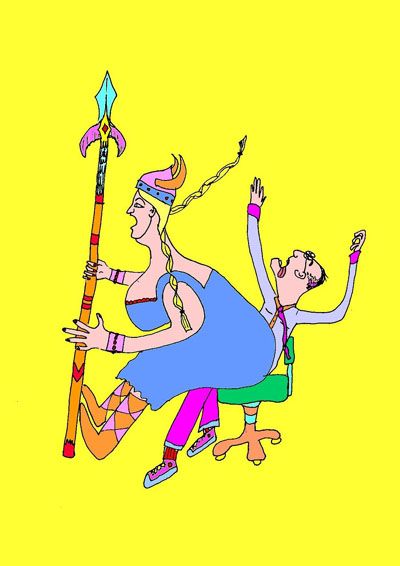
“Opera Singer Crushes Computer
Geek”
 “Industrially Mediated Realities”

For the complete “Cybeline” website,
including “Cybeline’s Vision” and “Number-Crunchin’
Cowboy,” previously posted as SONG OF THE
WEEK, you
can go here
and scroll down.