
By Jan Herman
The author Thane Rosenbaum wrote an article a few days ago outlining “the dilemma facing the builders of a Holocaust memorial in Berlin,” as it was described this morning by one of its readers. Read his complete article, “The Price of Forgiveness,” and then this morning’s reactions, “The Long Shadow of the Holocaust.”
“When it comes to the Holocaust, the Germans just can’t catch a break,” Rosenbaum began. But I can think of at least one break the Germans caught. Roman Polanski gave it to them in “The Pianist.”
I mention this because it’s time somebody said it. My feelings about that acclaimed movie came back to me last night when a friend messaged how much he loved it. Prompted by Fred Kaplan’s Sunday piece, “When Bad DVD’s Happen to Great Films,” he wanted to check the quality of his “Pianist” DVD. He intended to watch only a few minutes, but ended up watching the whole movie over again “because it was so powerful.”
Apparently, he didn’t notice, or it didn’t bother him, that the pianist’s family disappears into the camps after a lengthy setup detailing its various relationships and then is never mentioned again. There is not an iota of interest from our hero, the pianist himself. If memory serves, we follow him in his fatiguing travails for a long time in a long movie that seems to detail his every gesture and never once does the fate of his family come up again, even in his own mind.
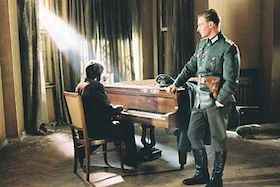
This confounded me. It diminished the movie for me. Totally inexplicable was the heroizing of the music-loving German officer who takes pity on him near the end of the movie. It’s not so much that the officer is heroized as a symbol of all “good” Germans, which is bad enough. After all, it’s just one of those clichés to pluck the heartstrings, which you’d expect from Hollywood, though not from Polanski. It’s the scroll after the film ends that bothers me the most.
The scroll memorializes the principal figures in the story, a reminder that the movie is based on real people. The scroll recounts what happened to each of them, especially the German officer, who by his inclusion is turned from a hero into a martyr. The scroll memorializes the time and place of his death. But does it memorialize the pianist’s family?Not for a moment.
What happened to the pianist’s mother, father, sister, brother? We know, of course. They disappeared into the camps. We saw them off, just as the pianist did, when they were being loaded like cattle into the train transport’s freight cars about a third of the way into the movie.
So where did they die? When did they die? What camp? What year? There is nothing in the scroll to tell us. Nothing. It’s as if their disappearance was forgotten not only by the pianist himself but by Polanski the filmmaker.
I found that an insult, an oversight so rotten that it soured the entire film for me. Even if you grant that their deaths could not be documented, that the oblivion of the camps swallowed them so completely their existence could not be tracked — which I doubt — that is still not a credible explanation. And if that is the case, then say so in the scroll. Don’t forget them as though they never existed at all.
Nobody to my knowledge has ever mentioned this unforgivable omission, and that too is inexplicable. Am I being over-sensitive about this? Have a look at that scroll again, and tell me it’s not disgusting.