
Valentino red, Balanchine light and dark


Valentino's costumes for the fall gala (puffy and ridiculous mainly, making the beautiful women dancers look bulbous and encased and their fine, pointe-clad feet resemble hooves) may have generated the buzz for New York City Ballet this season, but the real excitement was, thankfully, the dances: three programs of pure Balanchine-Stravinsky, the last two of which continue until Sunday. Run! 

Here is the start of last week's review for the Financial Times of program one

 
Balanchine once said: "Probably dance would stop if we didn't have Stravinsky." The composer gave him solid foundations on which to build dances, an education in composition, and confidence. In 1972, a year after Stravinsky's death, the New York City Ballet organised a now-legendary festival of a whopping 31 ballets to his scores, including 21 premieres. For the next two weeks, the company presents the cream of that crop: 13 Balanchines, beginning with Apollo, Orpheus and Agon, the only three whose music Stravinsky made to order. Of this "Greek trilogy", Apollo and Orpheus were conceived as a pair, yoked musically and philosophically and also perfect opposites. 
The music for the 1928 Apollo is all grand, sunny certitude. Stravinsky's tell-tale pulse may rollick as the young Olympian struggles to rein in his muses, but the music is too sweet to suggest trouble ahead. As for the choreography, the three muses' spiky legs evoke the sun's rays and their circling arms its body. Even as the steps shift between constructivist flatness and sculptural roundness, Apollo's eventual stature as the pillar of well-proportioned art is assured. 
 Still, he has some growing to do - where would the drama be otherwise? On opening night, Robert Fairchild presented the god evolving beat by beat. He favoured muscular impetus over static line, a brave and unusual choice that gave the performance the edge it lacked last year at his debut in the role. 
  Orpheus is as saturnine as Apollo is bright, but it has echoes of the earlier work.

For what those echoes are and what the current interpreters make of them, please click here for the whole Financial Times review.
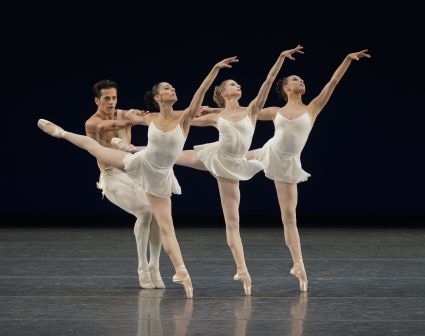
 
apolloreinsinmusessmall.jpeg Robert Fairchild reining in his muses: Ana Sophia Scheller as Calliope, Sterling Hyltin as Terpsichore, and Tiler Peck as Polyhymnia. Photo by Paul Kolnik courtesy of the New York City Ballet. 


September 26, 2012 8:15 PM | | Comments (0)

Categories:

Leave a comment

Topics on Tap

Monday September 24: Art and dance together again
Tuesday September 11: People's choice- -at the ballet?  If it were up to the audience,  what would a ballet season be?
Saturday Sept. 1: Is experimental dance already too far out to have any use for the Fringe?
Tuesday August 21: Outdoor shows
Wednesday August 15 Hearty dance versus aging audience at Jacob's Pillow 
previous

Contributors

Eva Yaa Asantewaa 

has written dance journalism and criticism since 1976, published most notably in Dance Magazine, Soho News, The Village Voice, The New York Times, The Philadelphia Inquirer, and Gay City News, and on her own blog, InfiniteBody.

Paul Parish 

is a regular contributor to Danceviewtimes and San Francisco magazine, and has contributed to many other publications. He was a Rhodes Scholar same time as Bill Clinton. He lives and dances in Berkeley.

Me Elsewhere

About this Entry

This page contains a single entry by foot in mouth published on September 26, 2012 8:15 PM.

Monday September 24: was the previous entry in this blog.

Wednesday September 26 is the next entry in this blog.

Find recent content on the main index or look in the archives to find all content.

AJ Blogs

AJBlogCentral | rss

culture
About Last Night
Terry Teachout on the arts in New York City
Artful Manager
Andrew Taylor on the business of arts & culture
blog riley
rock culture approximately
critical difference
Laura Collins-Hughes on arts, culture and coverage
Dewey21C
Richard Kessler on arts education
diacritical
Douglas McLennan's blog
Dog Days
Dalouge Smith advocates for the Arts
Flyover
Art from the American Outback
lies like truth
Chloe Veltman on how culture will save the world
Life's a Pitch
For immediate release: the arts are marketable
Mind the Gap
No genre is the new genre
Performance Monkey
David Jays on theatre and dance
Plain English
Paul Levy measures the Angles
Real Clear Arts
Judith H. Dobrzynski on Culture
Rockwell Matters
John Rockwell on the arts
State of the Art
innovations and impediments in not-for-profit arts
Straight Up |
Jan Herman - arts, media & culture with 'tude

dance
Foot in Mouth
Apollinaire Scherr talks about dance
Seeing Things
Tobi Tobias on dance et al...

jazz
Jazz Beyond Jazz
Howard Mandel's freelance Urban Improvisation
ListenGood
Focus on New Orleans. Jazz and Other Sounds
Rifftides
Doug Ramsey on Jazz and other matters...

media
Out There
Jeff Weinstein's Cultural Mixology
Serious Popcorn
Martha Bayles on Film...

classical music
Creative Destruction
Fresh ideas on building arts communities
The Future of Classical Music?
Greg Sandow performs a book-in-progress
Overflow
Harvey Sachs on music, and various digressions
PianoMorphosis
Bruce Brubaker on all things Piano
PostClassic
Kyle Gann on music after the fact
Sandow
Greg Sandow on the future of Classical Music
Slipped Disc
Norman Lebrecht on Shifting Sound Worlds
The Unanswered Question
Joe Horowitz on music

publishing
book/daddy
Jerome Weeks on Books
Quick Study
Scott McLemee on books, ideas & trash-culture ephemera

theatre
Drama Queen
Wendy Rosenfield: covering drama, onstage and off

visual
Aesthetic Grounds
Public Art, Public Space
Another Bouncing Ball
Regina Hackett takes her Art To Go
Artopia
John Perreault's art diary
CultureGrrl
Lee Rosenbaum's Cultural Commentary
Creative Commons License
This weblog is licensed under a Creative Commons License.