
Indie ballet

From my Financial Times review of the Smuin Ballet, at the Joyce a month ago: 

Trey McIntyre, whose own troupe is now the toast of Boise, has finally found a form for his whimsical, wide open, very American imagination. Taking its title and music from the Portland band The Shins, Oh, Inverted World is ballet's answer to indie rock - The Shins' kind, in which sweet, strummed melodies support vivid, ruminative lyrics. The dance imagines introspection as a way of being with others: a loose, unmannered communality. 
Shrugs, shakes, and pops punctuate the movement as jangle and pluck do the melodies. These casual eruptions set off chain reactions through the body, the cluster of dancers, even the dance's various sections, which McIntyre has strung together with unforced ingenuity.
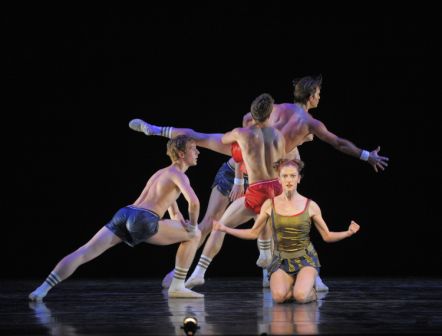
ohinvertedworldDavidAllensmall.jpgJane Rehm and other members of the Smuin Ballet in Oh, Inverted World. Photographer: David Allen. 


The McIntyre was the highlight of the Smuin Ballet's mishmash of a program last month (for the full Financial Times report, click here). In fact, those who were happy with McIntyre's slouchy low-key world were likely to hate the slick histrionics of Smuin's own Medea--and that neatly summarizes the problem American ballet as a whole faces.  

Smuin's schlock keeps the company solvent but also dooms it to artistic irrelevance; American classical companies make a similar bargain with the 19th-century or at least full length story ballet. The bulk of the national audience equates ballet with story ballet--and wants to see what they already know. The powers that be lack the funds and/or the guts not to give it to them. No one is being brave or, if you like, reckless enough. 

For a sample taste--a very bitter taste--of the audience to which ballet companies just may be catering, I suggest you read the reader comments to Alastair Macaulay's nuanced essay on the racial politics of too many Imperial ballets: Le Corsair, Raymonda, etc. (I don't agree with Macaulay's every point, but many. He argues carefully for the most part. I discuss similar issues in a 2005 essay for Newsday, "The Exotic Ballet," on the occasion of the Bolshoi's reconstruction of Petipa's The Pharaoh's Daughter. There's no free link to the article on the Newsday site, but it was pasted into this Russian ballet forum. Scroll down to after the photo from Don Q. I return to the issue near the end of this Foot post, here, about a year later.) 

Macaulay's responders combine vitriol with blockheadedness. One commenter argues in favor of the stupid and evil Muslim characters in Raymonda and Le Corsair because stereotypes, he says, are basically accurate. (They may have removed that comment...I couldn't find it this time.) 

Other people cling to the notion of authenticity despite Macaulay pointing out that there is no extant original to adhere to--and this lack of anchor seems only to have made the caricatures more offensive, not less. 

The commenters accuse him of the equivalent of book-burning and of "political correctness". Why is it that one is only guilty of "political correctness" when one is correcting for reactionary values? How about those who "correct" for liberality--you know, demand we favor the fetus over the mother in cases of rape. (See: the current Republican Party.)

It would be bad enough if the heads of ballet were organizing their seasons around know-nothings, but around bigots as well? 


September 10, 2012 5:00 PM | | Comments (6)

Categories:

6 Comments

Dear Ken and Marina,
I'll have to look at it more closely when the Balanchine "Nutcracker" comes around this year, but in the case of the Tea dance, the wit of Balanchine's musical response seems to me to reenforce the stereotype--that is, he has them do a note for note pluckiness, a musical visualization, that accentuates their "chinaman" head nods, and wise-finger pointing. I guess that could count as knowing caricature. In any case, every time I watch it, I imagine being a Chinese-American six-year-old and thinking, fuzzily, "Oh, this is supposed to be me." In other words, Balanchine may have wanted to be "before everything, about the music," as you say, Ken, but the world has a troublesome way of intervening.

Thanks so much for writing--and write again!
Apollinaire

So true, Ken! The key is usually in the music, which itself, is a fantasy. And also in Balanchine's wit, which allowed for the inclusion of elements that might be considered "lowbrow" or "in poor taste" by some.

It may be a metaphor too far (thought I don't think so) but the dancers in Act 2 of Nutcracker personify musical representations of tea and chocolate - not the people who grow or make them. Historically, Balanchine was in the forefront of integrating dancers of different ethnic backgrounds, starting on Broadway in the 30s and 40s, through the ascension of Arthur Mitchell in the NYCB of the 50s so, for me, he's cleared of the charge of lazy racial stereotyping. My own experience with watching Balanchine is that when I have had similar superficial reactions the answer invariable is to look closer at the steps. Balanchine is, before everything, about the music. Having said that, I'm unconvinced that the current NYCB management, and, by extension, it's dancers, makes that clear enough

I agree with pretty much every thing you say, but I also think there can be irony not just in the choreography itself (à la Ratmansky or Mark Morris), but also in the eye of the viewer. I can enjoy Don Q or the parrot dance in Bayadere or the antics of Le Corsaire's Ali as something silly, with a twinkle in the eye, i.e. with some sense of irony, even if it wasn't created in that spirit.
I haven't read the comments—I shudder at the thought...

Dear Marina,
I agree that when the stereotype is so obviously a ballet trope, it's not dangerous--you know, the feisty "ethnics" in Don Q. I still prefer the sort of thing that Ratmansky did with his gypsies in "The Humpbacked Horse"--where he's very actively playing with and against the stereotype, rather than just reproducing it-- or, in fact, what he does with the identically dressed maidens at the end of his "Firebird", who both invoke and caricature the ballet blanc standard (uniformity = happiness). (Clearly, I disagree with Macaulay on this point: he's missing the maddeningly teasing layers of irony that are so typically Russian. I talk about the Ratmansky ending to "Firebird" a bit more at the end of this essay here: http://www.artsjournal.com/foot/2012/06/ratmansky_redux_firebird_again.html).
If in "Raymonda," for example, they made a caricature of the caricature of the bad Arab, a la the "South Park" boys' "Team America," I'd enjoy it thoroughly. That's what Mark Morris does with his Arab queen in "The Hard Nut" or Ratmansky does with his macho bald harem lord to Tchaikovsky's "Chocolate."

Maybe that's how you understand the tea dance in Balanchine's "Nutcracker"--it's how I understand his cheesecake Arabian Chocolate. But for me the Chinaman single finger and the head wagging is mortifying. It's not even inventive. It's just dumb. So I'm not trying to not enjoy it, I don't enjoy it.

Still, I was mainly responding to the responses to Macaulay. It was as if it hadn't occurred to these objectors that there was any issue at all in these racial portraits. They weren't talking about whether there was a sell-by date for caricatures--nothing as subtle as your argument here. They were accusing him of advocating bowdlerization, as if these portraits were treasures that needed to be protected against the philistinism of political correctness. Ugh. Marina, did you read the comments? They are an education unto themselves--a scary one.

Thanks so much for writing,
Apollinaire

{Ed note: Marina Harss writes--splendidly--on dance for The New Yorker, The Nation, The Faster Times, and Dance Tabs.]

Dear Apollinaire,

I'm all for well-wrought characters and intelligent choreography (as you know), but here I have to disagree, just a little, and maybe just for the sake of argument. I don't know, but I feel like these caricatural dances are so dated and so far removed from their sources, and so tongue in cheek at this point, that they are difficult to be offended by. Not all Spanish women are proud and feisty vixens like Kitri, but should we not enjoy Don Quixote for what it is, a rollicking roller coaster of bravura and faux-Iberian attitude? Is it not ok to just put it in mental quotes and have a good time, taking it for what it is?Is it really necessary to be offended by things like the "tea" dance in Nutcracker in order to be a good person? I'm not sure...

Leave a comment

Topics on Tap

Tuesday September 11: People's choice- -at the ballet?  If it were up to the audience,  what would a ballet season be?
Saturday Sept. 1: Is experimental dance already too far out to have any use for the Fringe?
Tuesday August 21: Outdoor shows
Wednesday August 15 Hearty dance versus aging audience at Jacob's Pillow 
Saturday July 21: Pilobolus in the era of collaborations.
Saturday, July 14: Gamechanging American tap and modern dance
previous

Contributors

Eva Yaa Asantewaa 

has written dance journalism and criticism since 1976, published most notably in Dance Magazine, Soho News, The Village Voice, The New York Times, The Philadelphia Inquirer, and Gay City News, and on her own blog, InfiniteBody.

Paul Parish 

is a regular contributor to Danceviewtimes and San Francisco magazine, and has contributed to many other publications. He was a Rhodes Scholar same time as Bill Clinton. He lives and dances in Berkeley.

Me Elsewhere

About this Entry

This page contains a single entry by foot in mouth published on September 10, 2012 5:00 PM.

Saturday Sept. 1: was the previous entry in this blog.

Tuesday September 11: is the next entry in this blog.

Find recent content on the main index or look in the archives to find all content.

AJ Blogs

AJBlogCentral | rss

culture
About Last Night
Terry Teachout on the arts in New York City
Artful Manager
Andrew Taylor on the business of arts & culture
blog riley
rock culture approximately
critical difference
Laura Collins-Hughes on arts, culture and coverage
Dewey21C
Richard Kessler on arts education
diacritical
Douglas McLennan's blog
Dog Days
Dalouge Smith advocates for the Arts
Flyover
Art from the American Outback
lies like truth
Chloe Veltman on how culture will save the world
Life's a Pitch
For immediate release: the arts are marketable
Mind the Gap
No genre is the new genre
Performance Monkey
David Jays on theatre and dance
Plain English
Paul Levy measures the Angles
Real Clear Arts
Judith H. Dobrzynski on Culture
Rockwell Matters
John Rockwell on the arts
State of the Art
innovations and impediments in not-for-profit arts
Straight Up |
Jan Herman - arts, media & culture with 'tude

dance
Foot in Mouth
Apollinaire Scherr talks about dance
Seeing Things
Tobi Tobias on dance et al...

jazz
Jazz Beyond Jazz
Howard Mandel's freelance Urban Improvisation
ListenGood
Focus on New Orleans. Jazz and Other Sounds
Rifftides
Doug Ramsey on Jazz and other matters...

media
Out There
Jeff Weinstein's Cultural Mixology
Serious Popcorn
Martha Bayles on Film...

classical music
Creative Destruction
Fresh ideas on building arts communities
The Future of Classical Music?
Greg Sandow performs a book-in-progress
Overflow
Harvey Sachs on music, and various digressions
PianoMorphosis
Bruce Brubaker on all things Piano
PostClassic
Kyle Gann on music after the fact
Sandow
Greg Sandow on the future of Classical Music
Slipped Disc
Norman Lebrecht on Shifting Sound Worlds
The Unanswered Question
Joe Horowitz on music

publishing
book/daddy
Jerome Weeks on Books
Quick Study
Scott McLemee on books, ideas & trash-culture ephemera

theatre
Drama Queen
Wendy Rosenfield: covering drama, onstage and off

visual
Aesthetic Grounds
Public Art, Public Space
Another Bouncing Ball
Regina Hackett takes her Art To Go
Artopia
John Perreault's art diary
CultureGrrl
Lee Rosenbaum's Cultural Commentary
Creative Commons License
This weblog is licensed under a Creative Commons License.