When a young choreographer has the bud of a beautiful language but only an intermittent sense of what to do with it, her promise is an open question; as a reviewer I tend to answer in the affirmative, in the hope that the language will win out in the end.
Does it usually? That depends on the powers that be--not just critics, but producers, artistic directors, etc.--recognizing how much it counts for, how much it can lead the way, particularly in such a metaphorically rich, discursively poor art form as dance.
The Hungarian Atilla Kun (no, not Attila the Hun, as I wrote a few times --ayayay! and the movement is so gentle!) is the choreographer in question this time. He brought out the most delicate attentiveness and sincere commitment in the appealing young dancers--most under age 25 and trained locally, at the "national" ballet school of Gyor, a small city (about the size of Berkeley) in northwest Hungary.
Here's most of my Financial Times review from last week of that company's, the Gyor National Ballet's, New York show. (They do ballet in the liberal European sense, not in strict pointe-shoed parlance). They're touring the program to Western Europe-- Switzerland, Austria, and Germany--in March:
Stravinsky is dictatorial enough that a dance not driven by the score risks being left in the dust - the fate of Dimitrij Simkin and James Sutherland's Petrushka for the Györ National Ballet's "Stravinsky Evening", part of New York's four-month Performing Revolutions festival of Central and Eastern European arts. For the night's Rite of Spring, however, choreographer Atilla Kun shades the music's violent upsurge towards a delicate nature without plugging his ears. A feat.In this 1995 Petrushka , revived for the 20th anniversary of the Soviet Union's collapse, the curtain rises on a mammoth Red Star. But it is not the shiny undentable icon so much as a skeletal form made of driftwood, each strand worn and individual. The star reflects Simkin's desire, he writes in the programme, to show that " 'big chief' and small individual were well differentiated" in the Soviet Union of his youth. But he doesn't differentiate them. Rebellious Petrushka (a gentle Balint Sebestyen), the sinister Magician (a sinuous Balazs Patkai) and the will-less masses perform the same angular, impassive steps even as a panoply of discrete dramas rises up in the magical whir of the music.
Kun, who has been choreographing in his native Hungary for the past decade, hears only certain strains in The Rite of Spring as well: the wend of the bassoon, but not its minor-key menace; the beat's steadiness, but not its relentlessness. When the promising choreographer describes his Rite as "eleven remarkable artists searching [for] harmony within themselves, as well as through the music of nature and their companions", you think sleepytime George Winston, not Stravinsky. But the movement's detail -- maintained until the end, when Kun loses his nerve and succumbs to a stock rendition of ritual sacrifice -- makes room in the music for gentleness.
Kun is drawn to the body's rococo tips...

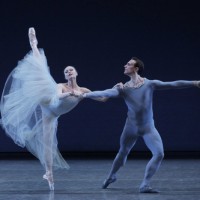
The flamingolike straightness of legs with precise, decorative detail of hands is typical of Kun's style for Rite. Dancers from our left to right: Virag Sothy, Szabina Cserpak and Balazs Patkai
For the rest of the review, click here.
I suppose the esteemed New York Times chief dance critic Alastair Macaulay is right that Alexey Miroshnichenko's Lady with the Little Dog "isn't the worst dog (sorry) ever seen on [the New York City Ballet] stage," though it was the worst my friend Carlene, my regular ballet companion, had seen. As Macaulay mentions, another older and more popular Soviet-ballet booster, Boris Eifman, takes the cake for awful. Eifman not only makes a travesty of the literature he submits to ghoulish treatment (Anna Karenina, for example), but he also offers an evil simulacrum of the ballet idiom. I remember my first encounter: I had been fully warned about the cornucopia of kitsch but not that the dancing would imitate the shapes of ballet while suctioning out all the muscles and bones. I got a terrible stomachache that first time, as if my body were supplying the guts missing onstage. And, sure, Miroshnichenko doesn't do that to ballet. But he does do it to Chekhov. The result is silly and boring more than horrifying, at least. If it were just a bit worse, it might actually be fun!
Here's what I had to say about it in my Financial Times review today:
The man in the Chekhov story who says, "We Russians of the educated classes have a partiality for questions that remain unanswered", could be describing his author - and a modern state of mind that ballet has been slow to embrace. Still, there are choreographers who would know what to do with the unresolvedness of "The Lady with the Little Dog", in which a chronically bored serial adulterer unexpectedly falls in love with his latest quarry, a married woman, and discovers "a new, beautiful life" beyond his reach. Alexei Ratmansky, for example, has characters spinning unhappily in circles of habit and circumstance. But Alexey Miroshnichenko is hard-pressed to create characters at all.
The St Petersburger's New York City Ballet premiere may have taken its name from the Chekhov story, but the two works only have in common a man and a woman. (The leprechaun-angels are the choreographer's own invention.) When Sterling Hyltin and Andrew Veyette strip to their underwear and roll around on the floor, it doesn't amount to even the simplest kind of love. Miroshnichenko doesn't do mental states. His choreography alternates between ballet school steps, which mean nothing, and senseless importations from civilian life, such as when a "naked" Hyltin gropes around in post-coital defeat for her clothes, except she wasn't wearing clothes. She was wearing a tutu.
Dog seems especially foolish sandwiched between Balanchine's edgy 1957 masterpiece Agon, to Stravinsky, and his imperial romp Cortège Hongrois.
Then I go on to talk about the evening's two Balanchine works and how Sean Suozzi saved the night for me.

Sean Suozzi in Agon, with Rebecca Krohn, his glorious partner in Cortege Hongrois, to his right. Photo for the New York City Ballet by Paul Kolnik.
Macaulay comes close to offering that ballet truism that "there are no mothers-in-law in ballet," as Balanchine put it with typical wit--that this silent art inevitably makes a hash of complicated plots, with their intricate back stories. There may not be mothers-in-law, but there is psychological depth: Antony Tudor's Pillar of Fire, for example, and Balanchine's Davidsbundslerdantze. Literature may not have prompted these ballets, but it could have. If Miroshnichenko had actually attended to the Chekhov story, he might have had something. And Chekhov was a playwright, so his storytelling lends itself to visualization.
Here are the categories Dmitry Gurov, our serial adulterer, comes up with for the women of past affairs:
carefree, good-natured women who were exhilarated by lovemaking and grateful to him for the happiness he gave them, however short-lived; and ... others--his wife among them--whose caresses were insincere, affected, hysterical, mixed up with a great deal of quite unnecessary talk, and whose expression seemed to say that all this was not just lovemaking or passion, but something much more significant; then... two or three beautiful, cold women, over whose features flitted a predatory expression, betraying a determination to wring from life more than it could give, women no longer in their first youth, capricious, irrational, despotic, brainless, and when Gurov had cooled to these, their beauty aroused in him nothing but repulsion, and the lace trimming on their underclothes reminded him of fish-scales.
Macaulay "applaud[s] Mr. Miroshnichenko in not weighing his ballet down with literal depictions of Chekhov's details," but what's striking about the details in the above paragraph at least is that they are precise without being literal and thus can lend themselves to dance. A choreographer might have tripled the Gurov character, so you have all three types of women each in a cluster with their own cloned Gurov. On one side of the stage we have the dance of the carefree and good-natured women (plus Gurov), and on another the dance of the pretentious and portentous women (plus Gurov) and downstage center the cold, beautiful, aging, predatory, and brainless (plus Gurov--witnessing them turn from mermaids to scaly fish in his arms). The women are multiplied to convey their type and the long line of his conquests, but they wouldn't have to all be there at once. They could move in and out of the wings to circle and dally around him, the choreographic geometry reflecting his sense of there always being more and more (and he's so grateful, really). The focus could shift cinematically between the three groups, as it does in Balanchine's Nutcracker party scene: a mashup of the man's past, kaleidescoped into the instant. Balanchine does something like that with the three Schumanns and Mrs. Schumanns in Davidsbundlertanze.
And dance can show cold and predatory and greedy; it can show capricious, irrational, despotic, brainless, and Gurov's repulsion too. Out of this first, busy scene, Anna--the hopeless young lady with the lapdog whom Gurov eventually falls in love with--might materialize, alone.
A choreographer could also show the first "bedroom" encounter between Dmitry and Anna, where she is sure he will not respect her once he sleeps with her--but, god, don't show us them stripping down to their underwear, with the lady flinging her blonde tresses around as in a wretched music video; show us a gradual though incomplete increase in trust and contact, as in Swan Lake when the hunter encounters his swan (but without the final submission).
When he realizes her impending infidelity causes her misery, Dmitry basically asks Anna (and haven't we all heard this chilling, bullying line before?), "So what do you want?" She wants something complicated and she's not sure what it is, but she could still dance something of that fire of wanting, at least, if not the thing she doesn't know. The solo could be a flingy off-balance affair as in Balanchine's The Four Temperaments, say. And Dmitry could dance being "bored to death," as Chekhov shockingly puts it, by her fear and tenuous hope; while Anna is suffering through her angsty solo, the carefree ladies of his past could be distracting him, flitting on and off like the sprites on the edge of Sleeping Beauty's vision scene. Occasionally, he returns his attention to the mopey spirit before him, perhaps lending a hand for a particularly reckless move of hers, before lapsing back into the less onerous visions in his head.
Would this be a story ballet? It wouldn't have to be, any more than other complicated-love ballets have been, such as Balanchine's Liebeslieder Waltzes or his Divertimento from "Le Baiser de La Fee." But it would still owe a great deal to its literary source.
The hardest thing to show is how Dmitry's boredom--and the story is steeped in boredom and silence--shifts into love. Chekhov doesn't know how to explain it either--which is what makes him so wise, that he doesn't try to, that he lets it remain a mystery, that he doesn't comment on the man's sea change. But he does show it--Dmitry clutches his head in the final scene and cries "How? How? How?"And ballets have shown it, too: there is the Poet in Balanchine's La Somnambula, for example. It might have been the heart of this ballet--the challenge and the excitement--to show us a pas de deux that radically changes mood as it goes. (For any of this to work, you would probably have to jettison the Shchedrin score and put something less soupy together.)
So, if there are no mothers-in-laws in ballet, there are at least the ghosts of mothers-in-law, and they should be welcomed more avidly onto the ballet stage.
Writing on the Pacific Northwest Ballet's debut under the widely admired former New York City Ballet principal Peter Boal proved a challenge, in that I know that Boal is a very thoughtful curator of dances--that as artistic director he wants collections of dances, not a haphazard jumble. But coming up with a program for a New York show that doesn't bring coal to Newcastle or wishfully exaggerate the proportions of the modest Joyce stage must have caused him to tear his hair, as I mildly suggest in my review for the Financial Times.
So when you know that the company is in some sense offering itself on the world stage (ah, the vanity of New Yorkers!) and at the same time has its hands tied, how do you review it? Carefully.
The Tharp, at least, is one of the loveliest ballets she's made in a while (even if I wish she'd set it on pointe: imagine that you had danced every day on point for years and then found yourself shortened by six inches.)
Here are the middle paragraphs from my Thursday review. You have until Sunday (Jan. 10) to catch the company at the Joyce.
The alienated-love duet, with stony man manoeuvring piteously searching woman into outlandish positions, and the cutesy solo - to Bach, usually, because Baroque grandeur intensifies the homely, tic-ridden dance's absurdity - have become such recognisable types that the genre overwhelms the material. So it is with Edwaard Liang's Fur Alina (to Arvo Pärt, the favourite of glum choreographers) and Stuttgart resident choreographer Marco Goecke's Mopey, which even James Moore's impressive mastery of the comical rapid-fire gestures couldn't entirely rescue. As for Benjamin Millepied's Three Movements, it is as uneven as many of his New York premieres this year, alternating between inspired imagery - here, a surprising riff on the samba - and leaden-footed group muddle.Boal's values as a dancer [Ed. note: I am referring here to something I said in the first paragraph] only emerge with the Tharp commission. In Opus 111, his appealing dancers share his rhythmic and visual clarity, immanent pleasure and intelligence. The 30-minute ballet to Brahms' lush, declarative String Quintet in G Major pools and streams without being too slippery. Tharp anchors the patterns migrating across the body - the circling leg becoming hula-hooping hips and then switching to vertical for swinging arms - in rudimentary ballet steps.

A frisky moment in Opus 111. Photo for Pacific Northwest Ballet by Angela Sterling.
For the whole article, click here.
You know when you catch a performance so magical, you feel grateful for weeks or years? It doesn't happen very often, but Wendy Whelan and Philip Neal's second-act pas de deux in Balanchine's Midsummer Night's Dream this Wednesday was one of those times (as others have attested). Here's the final paragraph in today's Financial Times review of the ballet:
By hour's end, Balanchine has come to the end of Shakespeare's story. He begins it again, this time as pure dance. In Act I, "The course of true love never did run smooth"; in the much shorter Act II, love enters the domain of art, and runs perfectly. (As Balanchine said of another ballet: "In the first act, it's the real people that are dancing; in the second act, it's their souls.") Sublimely attuned to each other, Wendy Whelan and longtime dance partner Philip Neal travel side by side "where the wild thyme blows,/Where oxlips and the nodding violet grows" and form a wedding canopy with their interlacing arms. She circumferences him with a leg; he wreathes an arm around her. He is her world, and she is the centre of that world.
Whelan and Neal. Photo by Paul Kolnik for the New York City Ballet
For the whole review, click here:
I have problems with this review: too much showing, not enough telling. In this last paragraph, for example, I included the famous Oberon directions to Puck about where he could find Titania, "lull'd in flowers" like Eve in Paradise Lost, not because Balanchine conjures a natural paradise but because he's doing in dancing what Shakespeare does in poetry: create grace that seems utterly natural and inevitable while in fact it adheres to artificial constraints such as meter and rhyme. But I couldn't figure out how to say that in the space I had (I wonder whether lay people realize that most journalists are assigned exact word counts--not "around 400," say, but "maximum of 400." The editors don't have the space for you to err). So I just quoted a couple of lines as if to say-- Here, I give you this because I can't give you the dance.
But you can still catch the ballet: you have a couple of days. Tuesday's cast--with Jenifer Ringer and Jared Angle in the second act duet and some of my favorite cloddish lovers (Andrew Veyette and Arch Higgins) plus Sara Mearns as a likely delicious Titania--is particularly promising.
To whet your appetite for idyllic dancing, here is a video I found via Will Amato's Facebook wall in which Pavlova's butterfly beauty (I've never seen such dappled lassitude) is set to a raga-esque soundtrack. The effect is to bring out the completeness of her melting collapses:
About
This blog's concern is the tricky business of recognizing dance's peculiar language and history without needlessly isolating it from the rest of the culture. The blog began September 2006, with Eva Yaa Asantewaa and Paul Parish joining as cherished contributors soon after. Reader participation warmly welcomed.
Apollinaire Scherr
has written regularly for The New Yorker, The New York
Times, Newsday, and New York Press, as well as SF Weekly, San Francisco
magazine, SFGate (the SF Chronicle's website) and the East Bay Express, in
the Bay Area. She has contributed to Salon, New York magazine, The Village
Voice, Elle, the San Francisco Chronicle, Barnard magazine, Flash Art International, ArtNews, The
Art Newspaper, and Art and Auction. She was a five-year Mellon Fellow in the
Humanities at Cornell University, where she did graduate work in English and
taught writing and literature seminars. She has been on panels for the Dance
Critics Association, the Bessies awards, the Alpert awards, Arts International awards, and has been a guest on public radio station WNYC.
Contact me Click here to send me an email...I haven't checked the old email, ascherr@artsjournal.com in forever b/c there was just too much spam to wade through.
more
AJ Ads
AJ Blogs
AJBlogCentral | rssculture
Terry Teachout on the arts in New York City
Andrew Taylor on the business of arts & culture
rock culture approximately
Laura Collins-Hughes on arts, culture and coverage
Richard Kessler on arts education
Douglas McLennan's blog
Dalouge Smith advocates for the Arts
Art from the American Outback
For immediate release: the arts are marketable
No genre is the new genre
David Jays on theatre and dance
Paul Levy measures the Angles
Judith H. Dobrzynski on Culture
John Rockwell on the arts
Jan Herman - arts, media & culture with 'tude
dance
Apollinaire Scherr talks about dance
Tobi Tobias on dance et al...
jazz
Howard Mandel's freelance Urban Improvisation
Focus on New Orleans. Jazz and Other Sounds
Doug Ramsey on Jazz and other matters...
media
Jeff Weinstein's Cultural Mixology
Martha Bayles on Film...
classical music
Fresh ideas on building arts communities
Greg Sandow performs a book-in-progress
Harvey Sachs on music, and various digressions
Bruce Brubaker on all things Piano
Kyle Gann on music after the fact
Greg Sandow on the future of Classical Music
Norman Lebrecht on Shifting Sound Worlds
Joe Horowitz on music
publishing
Jerome Weeks on Books
Scott McLemee on books, ideas & trash-culture ephemera
theatre
Wendy Rosenfield: covering drama, onstage and off
Chloe Veltman on how culture will save the world
visual
Public Art, Public Space
Regina Hackett takes her Art To Go
John Perreault's art diary
Lee Rosenbaum's Cultural Commentary
Tyler Green's modern & contemporary art blog

Recent Comments