
Earlier this season, worrying over the first-time Balanchine audience drawn by the $25 orchestra seats at New York City Ballet, I warned against the Short Stories program. My thinking: though Balanchine’s genius for unleashing the comedy in such recognizable genres as the tale of a toy animated by real feelings or the twisty gangster thriller runs through “The Steadfast Tin Soldier” and “Slaughter on Tenth Avenue,” the ballets don’t make you fall into the trance of the dance the way many of his plotless ballets do, and they don’t have the tragedy–sublimated and so complete, there’s no point even crying–that mark his greatest works. But I wasn’t thinking of “Swan Lake.”
If you have ever loved “Swan Lake” or thought, listening to the Tchaikovsky score, that you might, run to catch Balanchine’s one-act.
Which act, you ask? Strictly speaking, the two by the lake, where Odette and Siegfried meet, then lose each other. But Balanchine kaleidoscopes the whole story, all its tragedy and hope, into those two acts.
He honors traditional storytelling–preserving much of the original choreography for the swan queen–and at the same time reveals the story’s contours. At one point Siegfried spins Odette around and around in a deep attitude penché. She is a bird diving downward and also a figure become a state of things. We’ve entered the terrain of Yeats’s widening gyre, in which “innocence is drowned.”
More than with Odette, Balanchine takes liberties with the swans. Thanks to a performance Saturday full of feeling and vivid detail (special kudos to Dena Abergel), the corps patterns were a revelation.
In all black for their doom, the swan-women echo Odette’s movements of arms and wrists–for example, the broken wrist on an arm hugging the neck to sketch a span of wing that cuts both horizontally and vertically, that should pronounce freedom but instead signals imprisonment (the swan ladies may be able to fly, but it won’t help them escape their bird form).
The women also embody the turbulence of the first night, when the hunter endangers them, then promises to save them, and the last night, when he betrays them and the lake of tears swells. Balanchine keeps the corps in constant motion–the large and small circles a bow to the serpentine lines of the original choreographer, Lev Ivanov.
I’ve never seen a “Swan Lake” before that allows itself such departures from the original steps only to arrive at the center of the story.
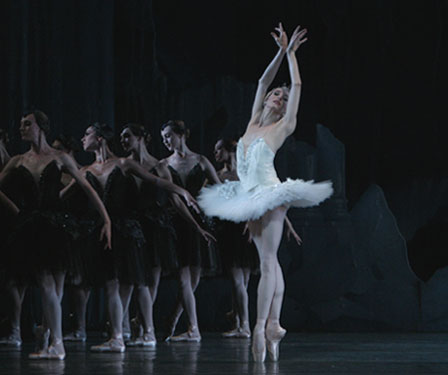
There will be three more performances of Short Stories, all next week: Tuesday Feb 24, Wednesday Feb 25, and Friday Feb 27. If you call on Monday the 23rd at 10 am, you have a shot at the $25 tickets. The casts are different from what I saw February 14. As Odette, Wendy Whelan (pictured above) seemed to me sublime for long stretches but occasionally too quiet in her effects. Others have felt she was more one or the other. Both of the new casts are promising–Sara Mearns because she’s almost always captivating and Maria Kowroski because she is when she’s dancing regal adagio roles.
Photo by Paul Kolnik for the New York City Ballet
UPDATE April 6: Tonya Plank, who saw the same performance of “Swan Lake” I did (we were sitting next to each other–very fun!) argues, compellingly, that the Balanchine version eviscerates the drama in its focus so exclusively on Odette’s plight: Siegfried’s fraught internal dilemma is cast aside. As she declares, “I am a Nureyevian when it comes to Swan Lake.” I kinda am, too. But it seemed to me Balanchine was successful in extracting the spirit of the story from its particular conditions–always a dangerous operation, because you can end up, as Tonya feels he did, with ballet cliches. Anyway, go here for her persuasive post.
Leave a Reply