
I
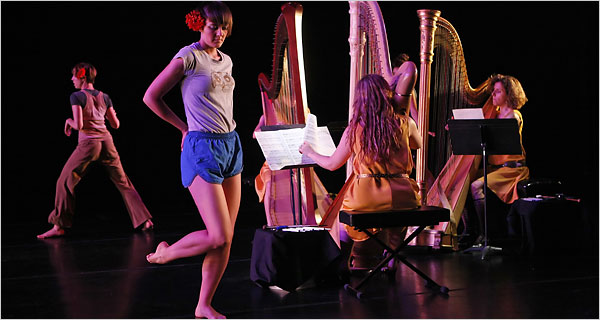
should have mentioned Neil Greenberg’s show at DTW already, as I’ve never seen
anything by him I haven’t liked, if not been deeply moved by. (I’m going
Friday, tonight–and may have more to say later [UPDATE: here is that more]). Thankfully, Foot in Mouth
contributor Eva Yaa Asantewaa reminded me, with this rave on her blog:
Everybody’s thrilled by and writing about Neil
Greenberg‘s new Really Queer Dance with Harps, and you should really
queerly or otherwise see it–especially for the radiant trio of harpists, led
by composer Zeena Parkins, at the golden heart of the piece. But my own
really queer heart has gone and continues to go out to Quartet with
Three Gay Men, the 2006 work danced by Greenberg, Luke Miller, Antonio
Ramos and Colin Stillwell. It’s just–hooray!–11 minutes,
and some of that time is spent dancing to RuPaul’s “Supermodel (You Better
Work).” Can’t go wrong, in my book, with RuPaul. And it’s a fantastic
dance, too, like a prism breaking Greenberg into four avatars who render his
spacious movement with luscious, queerforward simplicity. Oh, did I mention
it’s only 11 minutes? Brevity, the soul of wit.
Dance Theater Workshop
‘s got Dance By Neil Greenberg through
Saturday. Click here to watch a clip
of Quartet with Three Gay Men (it’s number 4 in the slideshow). Also
click here for
tickets, preview articles, more rave reviews, and an Artforum piece by Greenberg
himself that’s really smart. Greenberg should be a big star; the fact that
we can see him and his incredible, eccentric dancers up close and for $25 (or
less) is amazing for us, whatever it says about the situation of the artist in
America. So, Enjoy!
Photo by Erin Baiano; borrowed from The New York Times.
I happen to be a classical dancer from india. I find your blog interesting. I am amazed by the lines and strength of the dancers in those pictures. Let be from anywhere…Dance is dance and… dance any day is moving and touches me somewhere deep within.:)
dear Saikripa, Thanks so much for writing. It’s amazing, when I think about it, that I have a reader in India, among other farflung places. I’m glad you’ve discovered the blog.
I love classical Indian dance (you didn’t mention the kind you practice…).
I’m glad you find the blog interesting. I haven’t had time to write many posts lately, so do peruse the archives.
Best, Apollinaire
Dear Apollinaire,
I have appreciated yr conscientious approach to critical writing: you actually look at the dance and write about what you’ve seen, rather than imagining it or even worse, remaking it on your own. Thus I was astonished that you were willing to comment on a book you hadn’t read, even while revealing that you hadn’t read it. I’m taking of course of Goldner’s new book [“Balanchine Variations”]. When I commented on this lapse on yr part you agreed that you were in default, protesting that you’d asked for the book and it hadn’t arrived. [ed. note: I didn’t protest, I merely stated as much.] Perhaps by now, if you still don’t have the book, you’d consider doing the work of reading it rather than letting your remarks, based on Macalulay’s excerpts, become yr recorded opinion. I’ve read the book and admire it a lot – the writing is direct and unmannered, the perceptions are true to the works at hand, and there’s a lovely connection drawn between her lifetime of studying with Balanchine, writing hundreds of reviews, and now viewing today’s Balanchine performances in today’s perspective.
I’m sure there are grounds for quibbles; there always are. But I know no other writer on Balanchine who’s modest and authoritative at the same time, and whose ear for music is as fine-tuned as Goldner’s. And I’m comparing her to the other really fine critics who’ve specialized in his oeuvre: Denby, Haggin, Croce …
I hope you’ll do the homework and read it, however you obtain it.
Once more, much appreciation for all the good work you do.
Dear Ethan,
Thank you so much for writing. So are you the same as one Max Boswell, who started the discussion, in comments (which people don’t often read, I’ve discovered; sigh). and who had the same criticism? I’m not sure why you say that the only thing on record is my responding negatively: there’s also your valid criticism of my lapse, which handily cancels out my complaints of Macaulay’s version of Goldner’s book, and then, here, your own review. I didn’t want to erase the whole exchange, as it would seem like I was censoring YOU, not just me. At the same time, I must get to the book in my own time–of which I’ve had almost none in the last month. (For people who are curious about the earlier part of this exchange, here’s the second comment: http://www.artsjournal.com/foot/2007/05/contact_me.html#comment-10079)
More to the point: while Goldner’s “Balanchine Variations” never did arrive from the publishers, the Dance Critics Association gave me a copy as a gift for speaking on a panel this summer, and I am reading it, and it is fantastic–everything you say: written with fluidity and insight, a real pleasure to read, whether you know the works well that she’s talking about or not. I was going to write about it when I had time, but perhaps you are right, and I should get to it right now, however sketchily.
The tics that Macaulay praised–Goldner’s tendency to give a reading, and then stop short of committing to it–show up only spottily and hardly matter, b/c the readings are for the most part intriguing. And she only undercuts herself in the rare instance that they’re not–when they seem to arise out of a private iconography. (The main one: her Joan of Arc visions for “Serenade.” Wacky!)
More than her interpretations, though, I love the way Goldner thinks about the work from the context of Balanchine’s other works–her attention to details that reveal how his style works, how it makes meaning (and beauty).
I also find the way she weaves in biography and history really elegant. You can tell she spent years watching these ballets and has acquired a state of grace around them. I was marking up my copy of the book so as to be able to offer quotes that I liked once I’d finished, and would offer them now, but am at a day job, and don’t have access. Perhaps I’ll have time tomorrow to add them to this prolix comment.
Ethan (is this your real name now or another nomme de plume?), I would be curious why her musical insights excited you. I am dying for critics to tell me about the music, which I also listen to carefully, but don’t have the technical know-how to discuss particularly well. I guess her observations on the music didn’t stand out for me. Tell me why they did for you. (Perhaps some examples?)
I’m sorry for upsetting you–not once, but twice!
As for everyone else with a passing or deep interest in Balanchine: find a copy of Nancy Goldner’s “Balanchine Variations,” and enjoy!
Sincerely,
Apollinaire
Dear Apollinaire
A reader can’t ask for more! Many, many thanks for your gracious response to my comments (and those of Ethan Conwell). This has been a lovely exchange between critic and reader(s). I’m glad that you found the time [that day job of yours] to read Goldner’s “Balanchine Variations” with your sharp eye, and admired it. But what stands out most of all is the quality of your critical practice: principled, unflinching, humane (Apollonian). While engaged in an ongoing dialectic with artists, you also generously participate in a dialog with your audience.
Cheers.
Max Boswell
Dear Max,
well thank you–very cheering words, indeed. And, when I get a chance, I will write out some passages that exemplify Goldner’s excellence–and if you want to too, please do. ~) Apollinaire
Thank you really very successful dance is too great ım from turkey In istanbul