
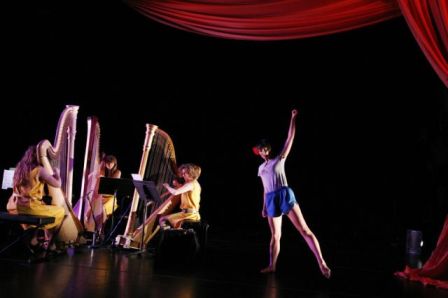
“It’s so internal!” my friend Amanda says with admiration
about Neil Greenberg’s “Really Queer Dance with Harps,” which premiered a couple
of weeks ago at Dance Theater Workshop. One move–a series of changements on half-point–reminded her
of a schizophrenic she’d seen outside a hospital in Rome jangling his insides with
stiff little jumps.
The insides of Greenberg’s dancers are not at risk: they inhabit
a whorl of trunk as sturdy as a tree’s. But
their bare galumphing feet–smacking the floor exactly as you’re taught not to in ballet class–resound with social ineptitude and a
rough flamboyance. They call to mind Frankenstein’s
monster (on a good day).
Meanwhile, the arms are socially aware–grace notes of affect, as are the flowers in the hair of boys and girls alike. Fragility
and delicacy, self-declaration and tribal identification, flutter on the
body’s periphery as if the soul and its accessories were butterflies. In
one of “Really Queer Dance’s” several distinct phrases, one hand grazes
the vulnerable crease in the hip where an angel forced Jacob to testify, while the other reaches overhead like a weather vane or the paw of a disco queen feeling out the
scene.
Only the gaze enters the world naked–shed of inwardness. Or it tries to, anyway. Eyes askew in the head and head askew on the spine as
if the effort caused all sorts of distortions, the dancers peer
at the wall of darkness that separates us from them without recognition, or seduction, in
the look.
You know those people who find fault with one lover after
another for years on end without it ever occurring to them that the problem
might lie with their conception of love? Well, the dance equivalent is the false notion that dance is the most unmediated of arts, the
least artful of arts, a quasi-art that delivers its truths straight. People who
insist they really do like dance, it’s only a matter of finding the right dance, are often seeking sheer physicality! sheer feeling! sheer
pleasure! But precisely because dance
is physical, which, yes, is tangled
up in our minds with pleasure and feeling, it can’t only be physical, emotional,
pleasurable, or it wouldn’t be art, it would just be body, feeling, sensation. On the other hand, it has no choice but to present even introspection on the surface. All it has is surface, which does double duty as inside and out.
Greenberg homes in on this poignant paradox, which, he discovers, life shares with dance. His subject is invariably an inner life that we can only approach via surfaces–an inner life made up, in fact, of surfaces, the detritus of the everyday.
“Really Queer Dance with Harps” may be no more inward than previous dances–as usual, each dancer is alone with others, never touching (until the goofy coda) and never acknowledging anyone in any conventional sense, and as usual the dancers share a family of gestures that means something particular to each of them. But here those family members are especially individual. (The eight highly trained, wonderfully idiosyncratic dancers are Ellen Barnaby, Nicholas Duran, Johnni Durango, Christine Elmo, Paige Martin, Luke Miller, Antonio Ramos, and Colin Stilwell.)
Until recently, Greenberg devised his choreography on his
own body, videotaping himself improvising, then editing what he saw for his
dancers’ consumption. For “Really Queer Dance with Harps” and its companion on
the program, the equally glorious though short “Quartet with Three Gay Men,” he
decided to have the dancers invent most of the phrases. The effect is to
intensify the scene’s casual-seeming, non-syncopated character. The phrases
seem more than ever like floating idées
fixes, snagging on a person like a plastic bag on a rosebush. Sometimes they become assimilated into her style of being, and
sometimes they don’t.
“Really Queer Dance with Harps” is low key and in no hurry. The
movement has more feeling and lusciousness than the Cunningham vocabulary it
grew out of. (At this juncture, too many of Cunningham’s dancers treat steps as if
they were a task assigned them, above which they can smile at each other unbothered. Cunningham should ask them to commit all of themselves to what they’re doing.)
And three golden harpists massage Zeena Parkins’ mercurial music into their heart-shaped harps to call to mind the heart. But the dance does share Cunningham’s aversion
to the conventional dramatic arc–and the present he lets you sink into and pull back
from again and again.
In this, it’s like life, too.
For more, here’s the
esteemed Roslyn Sulcas’ excellent review for the New York Times and my friend Nancy Dalva’s Danceviewtimes post. For the full monty of previews and views, try Dance Theater Workshop’s web site (which has failed to include this blog as well as danceviewtimes, for example, on
its blog roll. Sigh. Why even have a blog roll if it’s so strictly self-serving?)
Photo by Julia Cervantes for Dance Theater Workshop.
Thank you for including me on the page with this thoughtful piece! (Though as you might suspect, Apollinaire, I think Cunningham’s work is quite full of feeling and lusciousness….)
Apollinaire responds:
Hello, Nancy! I’m glad you enjoyed the piece. (It means a lot to me, coming from you.)
*I * think Cunningham’s work is full of feeling and lusciousness, too–I didn’t mean to suggest it wasn’t. And, after all, which feeling is probably a good question. Maybe it’s less that Greenberg has more feeling and lusciousness as that he worries those two qualities more (in the original sense, of a dog after a hare). As for the Cunningham dancers, whom I disparaged, I do think that if they all participated in the dancing with their heads too–I mean literally, with their heads: their faces, their eyes, not playacting but the way Cunningham himself did, for example (there was a real play between his look and his movement)–the feeling the movement generated, whatever it happened to be, would be clearer. That said, it’s only a few dancers and only once in a while that they hold themselves above what they’re doing, which is a kind of feeling, too, just not one I have much affinity with. I’m sure Cunningham appreciates that–that they will feel what they feel–and perhaps it’s why he’s let them be.
Greenberg’s dance brings all three to his art: physicality, feeling and sheer pleasure — ! Where have you been all my life?