

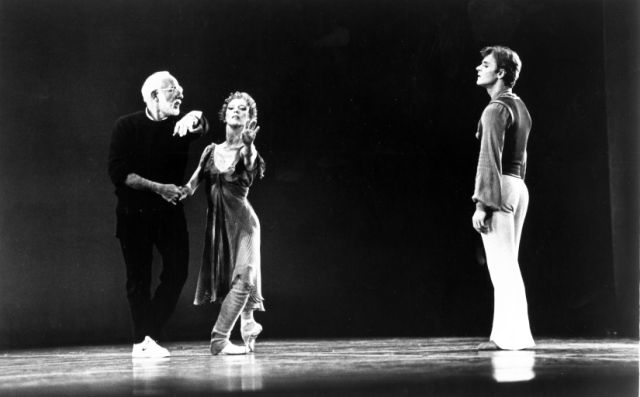
Natalia Makarova rehearsing “Other Dances” with Jerome Robbins for
“Dance in America.” The NYC Ballet fetes Robbins’ work through June 29.
(Photo by Brownie Harris for WNET/13, 1980.)
Here’s my tiny story for Newsday on the huge Robbins Celebration at New York City Ballet, followed by Q&As with Baryshnikov and City Ballet principals Damian Woetzel and Wendy Whelan that didn’t make the cut. (Imagine an enormous sidebar!) All of the dances discussed in the story and the Q&As are part of the festival, which begins Tuesday.
The black and white photos are by Brownie Harris for WNET, the colors by Paul Kolnik for New York City Ballet.
BY APOLLINAIRE SCHERR
Special to Newsday
“To make a decision, he was torturing everyone else and himself until the very last second,” says Mikhail Baryshnikov of his friend Jerome Robbins. “Which means there was probably no better choreographer in the history of Broadway.”
The quick-witted, neurotic New Yorker may be most famous for “West Side Story” and “Fiddler on the Roof,” but he was wowing Broadway audiences–and producers–as early as 1944, at age 26, with “On the Town.”
“Then he decides he wants to choreograph for women on pointe,” explains Baryshnikov.
Enraptured by the New York City Ballet’s debut performance in 1948, Robbins wrote its director, George Balanchine, “I’ll come as anything you want. I can perform, I can choreograph.”
“Come,” was Balanchine’s response. Robbins spent most of the rest of his life shuttling between Broadway and ballet.
On the tenth anniversary of his death, New York City Ballet celebrates Robbins with a whopping 33 ballets on 10 distinct programs through June.
Many of the dances–the social comedies “Fancy Free” and “The Concert,” for example, and the sensual fantasy “Afternoon of a Faun”– are plainly the product of a theater mind. For these, the choreographer focused on mood, says Damian Woetzel, whom Robbins–with his unerring eye for talent–plucked from the City Ballet school in 1984.
When Woetzel–whose two decades of unforced virtuosity end in a final burst of major Robbins roles this season– learned the role of Riff in “West Side Story Suite,” “Jerry thought I looked a little too ready to fight when the curtain comes up. He said, ‘You’re confident, so of course you’re ready to fight, but you’re not already fighting.’ ”
Even when the ballet had no story and dramatic intent wasn’t an issue, Robbins demanded “the opposite of a jewelry-box dancer,” explains City Ballet’s extraordinary Wendy Whelan, who says she owes her “bit of authenticity” to the many hours spent in the studio with Robbins early in her career.
“In ‘Brandenberg,’ ” the 1997 Bach epic, “you feel like a kid–scurrying and running and skipping and playing games,” she says. And “Brahms/Handel,” a collaboration with Twyla Tharp, “is a conversation between the two of them–and they really like each other. His lines are very clear, and hers are tweaked and curved. The dance weaves between them.”
But in both ballets–in nearly every Robbins ballet–“it’s about looking at each other, relating to each other, being down-to-earth,” says Whelan.
“Jerry didn’t want it to look like you were out there giving a show,” Woetzel says. “And isn’t that ironic–because he was such a great showman.”
WHEN&WHERE New York City Ballet’s Jerome Robbins Celebration runs through June 29 at the State Theater, Lincoln Center. Tickets $12 to $98. Call 212-870-5570 or visit nycballet.com.
Q&As
MIKHAIL BARYSHNIKOV, for whom Robbins choreographed “Other Dances” with fellow Russian émigré Natalia Makarova for a 1976 gala. When Baryshnikov went to City Ballet in 1978, Robbins made major roles for him in “The Four Seasons” and “Opus 19/The Dreamer.” Later he created “A Suite of Dances” for Baryshnikov for the White Oak project. All of these works will be performed this season at City Ballet.

Baryshnikov doing his Slavic thing in “Other Dances” (Photo courtesy of WNET/13, by Brownie Harris. 1980)
How did you know Robbins?
We were friendly before we worked together. We had mutual friends and I was
very flattered that he came to see me dance at Ballet Theatre, and we had a few
dinners. And of course for the gala for the public library [where “Other Dances” premiered in 1976] Genia Doll [who paid for the dance] was a dancer in Ballets Russes and married to Leonide Massine, and had a salon in New York–her husband was a wealthy French man, and they had a house near Jerry’s house in Long Island. And we spent a lot of time together either in her place on Fifth Avenue or in the Hamptons. I was really proud that I can be Jerry’s friend. Totally starstruck.
Do you think he was starstruck over you?
I didn’t give a damn what he cared about me! This guy choreographed “Fiddler on the Roof” and “West Side Story”!
Did you know about him in the Soviet Union?
I was 26 years old when I came here. I’d seen the movie of “West Side Story” and I saw New York City Ballet in 1972 in Leningrad. I knew not just of him, but his work already–in small doses, I must admit.
What was he like socially?
He was very funny, he was a very good storyteller.
Okay, “Other Dances.”
The whole thing about “Other Dances” was he didn’t want people confusing it with “Dances at a Gathering.” “Other Dances” is not, “Yes, Virginia, another piano ballet on Chopin’s music,” you know what I mean. “Dances at a Gathering” was a community piece and very earthy and very gestural. And in its intent, when Eddie Villella [the originator of the boy in brown, the first dancer onstage] kneels and touches the ground, it’s very emotional inside somehow. It is a slice of communal belonging. While “Other Dances” is a pas de deux and utterly Slavic, you know. Because of the fascination with Natasha’s arms.
You’re Slavic.
Yes, it’s true, but it’s very much about her. The people whom Jerry admired, he really, truly admired. He adored Natasha Makarova for the way she moved, the way she moved her arms–he was totally fascinated. At rehearsals, she was very flirty with him and very upfront, and he loved that. He loved to be tenderly abused.
She never had a very good memory
from rehearsal to rehearsal. She was kind of improvising all the time, and
Jerry loved that too, but he’d say, “Well, yesterday I saw you do
this.” And she’d say, “Well, today is a different day, Jerry.”
It was sort of a comedy routine with Natasha. It was sweet to see them play
like two kids.
And you just sat there and watched?
Yes, of course, and I’d be doubling for him. He was usually trying to do the steps full out. Sometimes I say, “Jerry, stop it. You’ll kill yourself.”
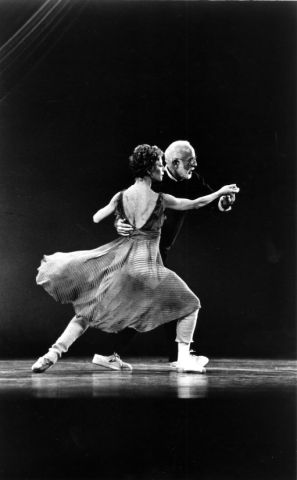
Jerry and Natasha have all the fun while Misha looks on.
What kind of a dancer was he?
He was a great character dancer, you could see it. And, remember, he was one of the best interpreters of Petrushka–the most fascinating and deep and tragic. People who worked with him at that time said so. [Robbins returned the compliment, saying of Baryshnikov’s Petrushka at ABT, “[I] very gratefully gave him my invisible cape that
said on it The Petroushka.”]
And in “Other Dances” he uses mazurka and the stamping and the arms absolutely from character dancing. In a way, “Dances at a Gathering” is a pure neoclassical piece, even though there’s the epaulement and the Polish arms. Here, because we are both Russian and we did those steps from our childhood, it was utterly Slavic in nature. When I start to dance this with [New York City Ballet dancer] Patricia McBride she interpreted it as Jerry’s dancer, she knew his choreography. It was a totally different sentiment; she was wonderful dancer, you know, but it was definitely a different color.
Do you think he was nostalgic about Russia/Poland–wished he had an Imperial background or was closer to his
own roots in Poland?
Of course, because he was a great character dancer, he admired, growing up, people like Leonide Massine, Irina Baronova–the old Russians–because they were part of history. Jerry just admired the spirit of those people.
I remember I talked to Boris Aronson, a famous designer–he designed my “Nutcracker”– and he said about “Fiddler on the Roof,” “The dance with the bottles on their heads, it’s such a nonsense. Jews would never do that. And yet, how correct it is! How theatrically ingenious.” That’s the biggest compliment from an old timer like that.
You know when you’re doing those mazurka head waggles [in the 1980 Dance in America film of “Other Dances”] and you’re shaking your head like a madman–was that your idea?
No, no, no. On my end, I never improvised. It was Jerry. In fact there are some photographs of Jerry in rehearsal flicking his wrist and turning around. It was very much Jerry. I could see him, in rehearsals, wearing sneakers and the velvet jeans and that Slavic shirt–you know, without the collar. And that’s where the costume came
from. He always got into this folk element with all his heart.
[About the dance’s last section]
I told him that when Balanchine came to Russia, a journalist said, “Oh, Mr. Balanchine, Tchaikovsky’s Serenade–it’s just impossible to imagine another piece of
choreography to this music.” And Balanchine said, “Nonsense. I could do two more ballets, and maybe even better than this one.” I told Jerry this and he laughed. He never heard this story. He first choreographed my dance and then he decided to do another for Natasha to the same music. I don’t know how much my story enlightened this decision, but it might have.
You’ve worked with a lot of choreographers; Robbins had a special reputation for being monstrous…
People who worked with him had these horror stories and at the same time fascination. But 99 percent of the time I had a great time. When he would come with his little dog Nick, I knew it would be a great rehearsal. When something troubled him, he would play with Nick and become Fun Jerry again. But when he got into that staring into the floor and very silent and very abrupt and very rude without understanding what he was saying, I left him alone. I just knew, Thank God I’m not the choreographer. Balanchine never had to remind company to pay attention; certain choreographers have to have a whip in their hand or a sharp tongue.
What is his legacy? What choreographers have taken from him?
His legacy is so abruptly divided between Broadway and ballet. I really think that inviting Robbins to be an associate choreographer Balanchine knew very well his Broadway work and the level of the talent, and especially Jerry’s immense desire to work with him and admiration. Balanchine took him as an apprentice and trusted him. I think that was one of Balanchine’s great qualities as a leader. But who took from Robbins? I don’t know, I don’t know, I really do not know. Jerry’s a self-made
choreographer. He is an odd, odd bird in this sense.
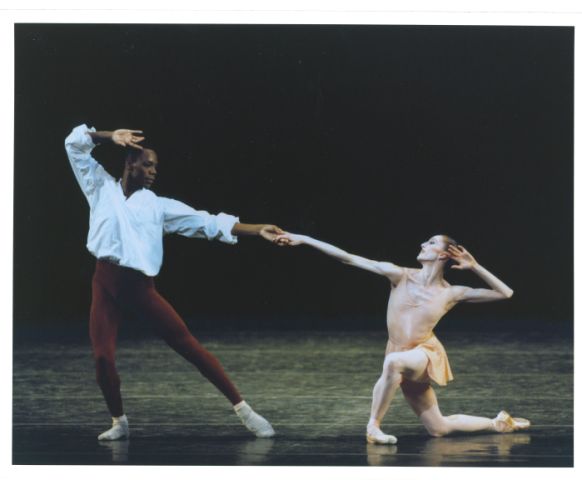 Albert Evans and Wendy Whelan in “Goldberg Variations.” Photo, Paul Kolnik.
WENDY WHELAN, principal dancer,
joined New York City Ballet as an apprentice in 1984 and was cast in Robbins
and Tharp’s “Brahms/Handel.” She also originated a role in
“Brandenberg,” his final work.
As a young dancer, he was my Balanchine, I didn’t have Balanchine, but I had Robbins. I feel very grateful and lucky for that. I was in the room with him every day for a good seven years, maybe a little more. Ten years almost.
What did you learn?
It was all about looking at each other, relating to each other, being natural.
I remember makeup and hair for his pieces he wanted to look more natural, more browns and earth tones. He wanted you to look real, like a human being.
And is that how it feels dancing it?
Yeah. Either a human being or a part of a social system. It wasn’t like you’re out of this world. You’re either an insect or you’re a person dying or you’re a person studying or working–in a lot of his ballets you’re wearing practice clothes–or you’re relating in the spirit of each other, but it’s never like you are Balanchine’s Palais de Crystal jewel in the center. I never felt like that.
Did it feel more true?
For me, it was, first of all because I never knew Balanchine, so I never really knew my essence in his work. He wasn’t there to accept me. With Robbins, I learned it was so important to him to be honest and true as yourself.
He finds people who have a strong individuality and who aren’t afraid of exposing it. Because when you’re in the studio with him, he wants you to open up to him. If you’re shy, he’s like, “I don’t have time to waste. You either do it or you don’t.” He would push people to see their true colors and then he would go with that.
And you see that his best friends were really outspoken people, like Tanny LeClerq. She just said it like it was. And he appreciated it.
Tell me about the two pas de deux you’ve done in “Goldberg Variations.”
First there’s the crazy, Allegra Kent, acrobatic one [that Rachel Rutherford does now]. I adore that pas de deux. It goes to both extremes. It’s a play on the bendy and sharp to the quick and sharp. And if he’s going to put anything sexual in “Goldberg,” it’s in there. Yeah, throw a little sex into the second part.
And the third pas de deux [which Whelan did last season and will do again]?
I’m still figuring that one out. It’s very epic, because it’s so long. The tone is sad, and it ends very sadly. She goes over his back and reaches up, and she roolllllls down like a log from up high, facing the floor, and he lifts her off.
It’s unresolved. I think Jerry likes that, when there’s not really an answer: a giant question mark in the middle. There’s so many things in dance that you can’t explain.
[About a duet in the Robbins-Tharp collaboration Brahms/Handel,” a “West Side Story” for the classical set, with Robbins dancers in blue and Tharp dancers in green]
This might be my favorite section. It’s very brief but it’s kind of jiggy, which Jerry liked. His humor comes into his ballets a lot and it’s a jiggy humor.
Was he a jiggy dancer?
Yeah, a little bit. There’s a lot of stuff with hands on your hips just plieing to the music (dunk, da-dunk-dunk). It’s just fun. That’s part of the socialness of it. You’re dancing with each other and there’s some kind of deep-seated humor to it, and it just feels good to be dancing with your friend.
Kind of beautiful.
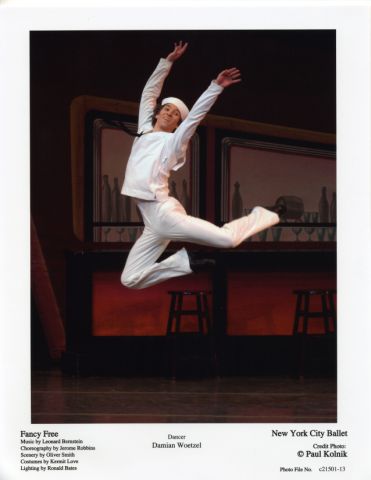
DAMIAN WOETZEL, beloved principal dancer with City Ballet, which he joined in 1985 and is leaving this season. This is the last chance to catch him in “Fancy Free” (above) or in “Dances at a Gathering,” for example. His farewell performance is June 18.
“Fancy Free” was the first ballet I went to a rehearsal for. I was still in the school and Jerry had seen me dance and he told me to come watch him rehearse. I was 17 years old. The attention to detail within the choreography for each character is what stuck out. The corrections he gave weren’t, You’re doing the step wrong. It was how the step related to the character, and that was what was wrong. And he’s famous for that in his Broadway life–through the dance came the drama-“Fancy Free” [Robbins’ first ballet, from 1944] obviously previewed that.
When I got to do the ballet, I was doing the part he made on himself, and that gave me a little more insight into his thought patterns because they were in his body in a different way. He was so famous for his ability to demonstrate. The way he would do the [fans?] part in “The Concert,” it was just beyond hysterical. He was so good at mime, for lack of a better word. As a dancer, to make that your own and imitate at the same time can be a life’s work. But with Jerry’s stuff, it’s all so natural that it makes perfect sense. To use an example from “Fancy Free,” the three sailors’ every step is choreographed dramatically.
There’s a tendency to overdo in an effort to succeed–in everything in life, probably–and Jerry’s work succeeds by nuance and subtlety. I’m sure you’ve heard how he told dancers to mark in rehearsal and even on stage at moments, and that spoke to his desire to get beyond just energy. It demanded even more energy to do it that way, but it’s a more sophisticated challenge.
Was there a difference between how he coached his situation ballets such as “Fancy Free” and his plotless dances like “Dances at a Gathering”?
There’s a tremendous difference. He was adamant that there was no story in “Dances at a Gathering,” for instance.
So what does he say about touching the ground at the beginning of “Dances at a Gathering”?
When we would do the touching of the floor, the mood was of temperature, of feeling the place itself. What did it mean? Ooh, he didn’t talk about that. Definitely he would set the stage for the emotional setting. I think [that first section] was an archetype. It was a half-marked, half-danced remembrance of things past, and yet it’s just a dance. And it ends with typical American nonchalance. It dwindles out, and that was very Jerry.
You know the story of Jerry seeing Eddie Villella in a shaft of light and that’s where “Afternoon of a Faun” came out of? It’s the unconscious conscious. The unstudied practice.
He has a sense of situation whether in “Faun” or “Fancy Free.”
Yes, but those two are so wildly different in the way he gets into people’s heads. “Faun” is a covert action, and “Fancy” is a might yawp. Those four bat-bat-bat-bat at the start of “Fancy”–can you imagine the arrival of Jerome Robbins [as one of the sailors in “Fancy Free” and as a choreographer]?
That is quite an arrival.
n
For more on the Robbins Festival this spring at New York City Ballet, I discuss Robbins’ “Watermill” here and here his “Dybbuk” and here the problem with how the NYCB is dancing “The Goldberg Variations.” Also: the Robbins influence on the extraordinary Bolshoi director-choreographer Alexei Ratmansky, particularly in this season’s “Concerto DSCH” and the promising choreographer Benjamin Millepied, and a short notice of PBS’s American Masters documentary on Robbins, airing February 18, 2009.
Dear Ms. Scherr,
I enjoyed your article on Robbins.
I visited a friend recently who is a concert pianist, and had him play for me the Chopin pieces of “Other Dances,” which I had seen with Baryshnikov and Kirkland with the ABT and which aired on Dance in America (with
I have been unsuccessful in finding either a DVD or VHS recording of this, which as you know appeard with Baryshnikov and Makarova, on Dance in America.
Do you have any suggestions?
Thank you,
Eric A. Eisenbud, M.D.
Boulder, Colorado
Dear Eric,
I thought the dancers said such incredibly interesting things, so I’m so glad you enjoyed the article and interviews. I’m not sure that the DVD/VHS is in print anymore–I watched it in the non-collecting research division of the Performing Arts library here in New York. But I HIGHLY HIGHLY recommend it–they should reissue it, it’s so exciting. My only thought is that you might go to the PBS web site and see if there’s any number to call for ordering back tapes. I have a hunch it was never issued as such, because then it would be in the circulating division of the library. They should really reissue it. The tape is called, as I remember it “Two Duets” The other duet is an early work by Peter Martins, something Orange (how could I forget its name? a striking name).
Thanks for writing! Apollinaire