
Jerome Robbins' "Goldberg Variations," back and front

I know, I know, Foot in Mouth has been experiencing a time warp lately. Here, for example, are some thoughts on a ballet I saw more than two weeks ago.


In his "Goldberg Variations," to the complete Bach score, Jerome Robbins concludes most of his own variations with a flock of dancers rushing in from the wings as the dancers already there finish up. It's a nice touch, a little joke about the dance's tag-team structure, which works kind of like the camera in Richard Linklater's "Slacker," tracking one person (and story) around a corner only to take off after somebody else. Bach's variations don't point to a theme, as in the conventional theme-and-variations arrangement, so much as backwards and forwards to one another, and Robbins aims to do the same.

Depending on your point of view, the result is ballet ad nauseum or ballet ad infinitum. Critics have been divided on this question since the dance's debut in 1971. Arlene Croce dubbed the New York City Ballet work "ninety minutes of hard labor"; other critics, including me, have experienced it as waves on waves of delicious invention. When the performance is good, each time the dancers arrive from the wings I am excited--and grateful--for more. Only the middle of "The Goldberg Variations" sags.

But the piece's power to sustain attention and delight depends on the dancers knowing how to fill the space--front and back. In recognition of Bach's architectural splendor, the choreographic configurations--circles inside of circles, folk dance lines, zigzags, and many walking formations--count for at least as much as the individual steps. Negative space is especially charged. In one number, a group advances from the wing upstage while another faces them as they walk backwards into the opposite wing downstage. The dancers may move almost as casually as people on the street, but the courtliness of the occasion is palpable: the regal advance, the gracious retreat, and the electricity of the space between.
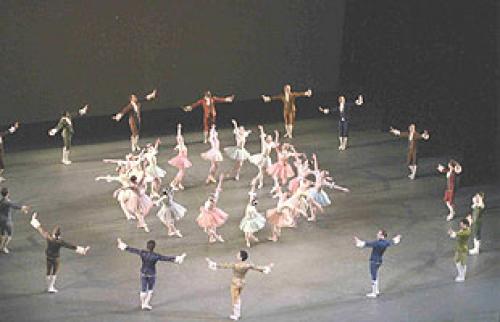

goldbergcrowd.jpg


Except for the three romantic pas de deux in the dance's second half, the steps are plain throughout. But for plain not to devolve into meager or dull--for the movement to animate the space as Bach has animated time in linking past variation to future--the dancers need to relinquish the customary forward pitch of the body that Balanchinean speed demands and feel their backs from crown to foot: the heel's pressure against the floor, the flex of the haunches, the expansive shallow in the upper back, the tautness of the stalk of neck.

In one of the short archival videos introducing each Robbins evening this season, we see the choreographer working with a young Damian Woetzel on the rumba solo in "Fancy Free." At one point, the dancer goes from being curved to the floor in profile to upright facing front. Woetzel makes that transition like the sun rising from the ocean. Robbins tells him to unfurl the spine like a fern. He wants the drama not along the horizon but up and down. He often wants that.

If the "Goldberg" dancers imagined themselves floating belly up in cool water on a hot day, the submerged skin taking on its own temperature and character, or riding a bike fast enough to feel the breeze blowing off their backs, they'd do better by this dance, which is only really alive when the back is.


The New York City Ballet will perform "The Goldberg Variations" once more this year, on Tuesday July 22 at the Saratoga Springs Performing Arts Center upstate. Longtime Village Voice critic Deborah Jowitt will present a pre-performance talk at 7 pm. (Performance at 8 pm.) Visit the SPAC website for more info.


Photo by Paul Kolnik for the New York City Ballet.


July 13, 2008 10:28 PM | | Comments (0)

Categories:

Leave a comment

Topics on Tap

That '70s ballerina:  Cynthia Gregory in conversation
apollinaire, Thursday October 9 Ann Liv Young, the crumbling Bush era's Karen Finley
Apollinaire, Saturday Oct. 4: Theater only about itself
Lori Ortiz and Apollinaire, Tuesday September 27 Artist as friends--and art as friendly
Apollinaire, Sunday September 14 Paul Lazar in Mac Wellman's "1965UU" at the Chocolate Factory through October 4
Apollinaire, Friday September 12 After a false start with City Ballet, Alexei Ratmansky signs five-year contract to choreograph regularly for American Ballet Theatre
previous

Contributors

Eva Yaa Asantewaa 

has written dance journalism and criticism since 1976, published most notably in Dance Magazine, Soho News, The Village Voice, The New York Times, The Philadelphia Inquirer, and Gay City News, and on her own blog, InfiniteBody.

Paul Parish 

is a regular contributor to Danceviewtimes and San Francisco magazine, and has contributed to many other publications. He was a Rhodes Scholar same time as Bill Clinton. He lives and dances in Berkeley.

Me Elsewhere

About this Entry

This page contains a single entry by foot in mouth published on July 13, 2008 10:28 PM.

What I like about him was the previous entry in this blog.

Alvin Ailey's fiftieth, from the inside out is the next entry in this blog.

Find recent content on the main index or look in the archives to find all content.

AJ Ads

Introducing
AJ Arts Blog Ads

Now you can reach the most discerning arts blog readers on the internet. Target individual blogs or topics in the ArtsJournal ad network.

Advertise Here

AJ Blogs

AJBlogCentral | rss

culture
About Last Night
Terry Teachout on the arts in New York City
Artful Manager
Andrew Taylor on the business of arts & culture
blog riley
rock culture approximately
CultureGulf
Rebuilding Gulf Culture after Katrina
Dewey21C
Richard Kessler on arts education
diacritical
Douglas McLennan's blog
Flyover
Art from the American Outback
Life's a Pitch
For immediate release: the arts are marketable
Mind the Gap
No genre is the new genre
Performance Monkey
David Jays on theatre and dance
Rockwell Matters
John Rockwell on the arts
Straight Up |
Jan Herman - arts, media & culture with 'tude

dance
Foot in Mouth
Apollinaire Scherr talks about dance
Seeing Things
Tobi Tobias on dance et al...

jazz
Jazz Beyond Jazz
Howard Mandel's freelance Urban Improvisation
ListenGood
Focus on New Orleans. Jazz and Other Sounds
Rifftides
Doug Ramsey on Jazz and other matters...

media
Out There
Jeff Weinstein's Cultural Mixology
Serious Popcorn
Martha Bayles on Film...

classical music
The Future of Classical Music?
Greg Sandow performs a book-in-progress
On the Record
Exploring Orchestras w/ Henry Fogel
Overflow
Harvey Sachs on music, and various digressions
PostClassic
Kyle Gann on music after the fact
Sandow
Greg Sandow on the future of Classical Music
Slipped Disc
Norman Lebrecht on Shifting Sound Worlds

publishing
book/daddy
Jerome Weeks on Books
Quick Study
Scott McLemee on books, ideas & trash-culture ephemera

theatre
Drama Queen
Wendy Rosenfield: covering drama, onstage and off
lies like truth
Chloe Veltman on how culture will save the world
Stage Write
Elizabeth Zimmer on time-based art forms

visual
Aesthetic Grounds
Public Art, Public Space
Artopia
John Perreault's art diary
CultureGrrl
Lee Rosenbaum's Cultural Commentary
Modern Art Notes
Tyler Green's modern & contemporary art blog
Creative Commons License
This weblog is licensed under a Creative Commons License.