
 Previously (The Board as Engagers), I discussed considering one role of the board to be that of relationship engine. That would lead recruitment processes to include relationship capital as one criteria for membership. I also acknowledged, at the end, that that might not be immediately possible, practical, or even advisable in all situations and promised an alternative. That’s what we’re about here.
(NB: In posts on mainstreaming engagement, I am addressing only those individuals or organizations that want broader and deeper relationships with their communities but are uncertain how to begin or even whether it is possible to do so without completely reinventing the organization.)
Board membership is a lot of work and a lot of responsibility. It can be difficult to find anyone willing to take on a two- to ten-year commitment. Further, board membership can require training and experience that are not common currency in our communities. Finally, board membership should be based on an abiding passion about the mission. In circumstances where an arts organization is attempting to develop relationships with groups previously uninvolved with them, it might be difficult to find individuals in those groups who possess such a passion.
Board recruitment is always difficult. It can be considerably more so when attempting to expand the base.
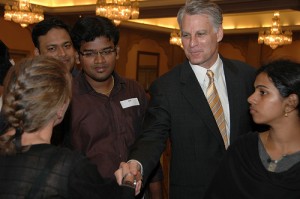
An alternative is to take a more ad hoc, project based, or focused approach. When individuals who might become allies and are representative of groups with which the organization is seeking to build a relationship are identified, they should be cultivated. Over time, as trust in the organization’s motives is developed, these people can then become ambassadors for the organization within their own organizations or communities. Collectively, I sometimes imagine these people as a Board of Engagers–people with credibility in their community who can vouch for the organization and can provide practical advice on connecting with their peers. They would have a limited role without legal or fiduciary responsibilities and it might thus be easier to attract people.
Relatively simple to say, much more complicated to do. However, groups that already have “Friends Of . . .” organizations or Boards of Visitors have this mechanism in place. It would “simply” require a re-visioning of their role to include community engagement in the mix of tasks. For those that do not, the structure can be developed informally over time and could be led by board members (and other volunteers) who understand the importance of such work.
If we are committed to community engagement, the path to engaging is best pursued via existing structures and programming. It need not be as difficult or resource-intensive as might be initially imagined, especially if what is imagined is adding on completely new mechanisms.
Engage!
Doug
Photo: 
 Some rights reserved by U.S. Embassy New Delhi