Not quite winning: a review
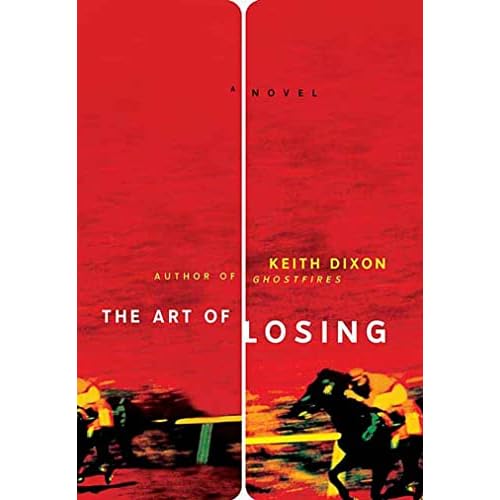
Keith Dixon writes James M. Cain-ish novels -- noirish tales written in a wonderfully succinct, sardonic style, depicting an unforgiving world where people are trapped by money needs and by family ties. In Mr. Dixon's case, this has meant fathers and sons. In his debut, Ghostfires, it was a drug addict father dependent on his alcoholic son, and no good was going to come from that.
In his sharp new novel, The Art of Losing, it's a perpetually cash-strapped indie filmmaker, Michael Jacobs, too proud to ask for funding from his rich father or even his more successful and pined-for co-worker, a beautiful Danish director named Beck Trier (surely a joke on Lars von Trier). Michael's last three films have flopped, which sets him up for a race-fixing scheme concocted by his producer-buddy, Sebby Laslo. Laslo is such a gambling addict, the bookies won't even take his bets anymore, so he needs Michael to front the bet. But it won't be the proverbial 'sure thing' to win. Laslo has figured out the art of losing: He has a jockey who's riding the favorite horse and he'll throw the race -- while they bet on the next two likely contenders.
With Cain, it was insurance fraud that he knew backwards and forwards. In The Art of Losing, Mr. Dixon displays an easy and credible authority with filmmaking and horseracing, especially the way the two industries attract risk-takers. "I'm making documentaries," Michael says, "the kind of films that ask the viewer to do some thinking. The distributor's got to make all of his cash outlay and his print-and-advertising money back before he makes a dime. A twenty-thousand dollar budget against 75 percent profit, with national distribution my only hope for a gasp of air. Five or six people take two hours of their lives to go see something that took me a year of my life to make. And then nothing. Then I do it all over again, and again, and every day I sink a little deeper in debt. So really, I've got to ask you, which of us, which of us is the degenerate gambler -- Sebby or me?"
With Michael as narrator, Mr. Dixon captures that glib, artsy bitterness, wanting success but loathing it (and oneself) at the same time. A classic throwaway wisecrack: "I liked [Sebby Laslo] immediately. He had that polished look of smooth hair and perfect tan that Angelenos often use to disguise their moral dereliction."
The interlocking pieces of Michael's own moral dereliction are neatly but not mechanically set out. Mr. Dixon finesses the balancing act -- making us pull for Michael's underdog success while knowing that all of this foreshadowing (and the novel's title) has got to add up to something grim. Curiously, the other novel that The Art of Losing recalls is Vincent Patrick's The Pope of Greenwich Village (terrific novel, so-so movie). Consider: Two buddies, in hock to their eyebrows, one of them shadier than the other, a little less trustworthy -- he's the one with a plan to get out of debt through gambling on the horses. But their scheme only triggers the wrath of the leg-breakers. Pope and Losing have very different milieux, though -- the one raffish and working-class-New York, the other downtown-airless and too-smart-for-its-own good.
The Art of Losing doesn't end up quite where you'd expect, though. Normally, I'd say that's a good thing. Cain's hard-bitten, no-way-out universe tended to be predictable, though satisfying in its own right: The schemes get played out to their ultimate dead ends, and the morally compromised ended up punished -- or dead, usually both. As if doffing his hat to the great noir traditions, Mr. Dixon even evokes -- in a dream memory -- the classic house-of-mirrors ending of Orson Welles' The Lady from Shanghai ("Sometime later I beheld myself in a room of mirrors that seemed to have no exit").
But noirish thrillers of the past several decades have often opted instead for redemption: The story isn't so much about revealing the murderer or stopping the killer as it is about the main character ultimately making a choice that's going to cost him something but which is the right thing to do, more or less.
Both of these mechanisms apply here -- more or less. But I have to say the resolution of The Art of Losing is not entirely satisfying. It's difficult to say anything more without revealing too much, but I didn't fully buy the narrator's final, lost-soul-seeking-salvation trajectory, even as it's meant to seem inevitable. That's really only the last two chapters, though, just 12 pages or so. Other than that, The Art of Losing is aces-high, a smart piece of neo-noir writing -- tough, terse, clean.
Categories:
Blogroll
Critical Mass (National Book Critics Circle blog)
Acephalous
Again With the Comics
Bookbitch
Bookdwarf
Bookforum
BookFox
Booklust
Bookninja
Books, Inq.
Bookslut
Booktrade
Book World
Brit Lit Blogs
Buzz, Balls & Hype
Conversational Reading
Critical Compendium
Crooked Timber
The Elegant Variation
Flyover
GalleyCat
Grumpy Old Bookman
Hermenautic Circle
The High Hat
Intellectual Affairs
Jon Swift
Laila Lalami
Lenin's Tomb
Light Reading
The Litblog Co-op
The Literary Saloon
LitMinds
MetaxuCafe
The Millions
Old Hag
The Phil Nugent Experience
Pinakothek
Powell's
Publishing Insider
The Quarterly Conversation
Quick Study (Scott McLemee)
Reading
Experience
Sentences
The Valve
Thrillers:
Confessions of an Idiosyncratic Mind
Crime Fiction Dossier
Detectives Beyond Borders
Mystery Ink
The Rap Sheet
Print Media:
Boston Globe Books
Chicago Tribune Books
The Chronicle Review
The Dallas Morning News
The Literary Review/UK
London Review of Books
Times Literary Supplement
San Francisco Chronicle Books
Voice Literary Supplement
Washington Post Book World

1 Comments