
Flickr: JP ..
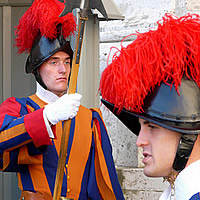
I can’t explain why, exactly, but I’ve been thinking about uniforms lately — particularly careers that require a uniform like the military, the judiciary, the priesthood, the police. At first glance, these mandated outfits might seem like costumes, like some relic of a previous age of status and class and credential. But uniforms actually serve a wide variety of functions, and address certain problems of the individuals who wear them and the callings or careers they represent.
A 1972 article in the American Journal of Sociology by Nathan Joseph and Nicholas Alex (two men with four first names, it seems) explores the many functions of the uniform, and the sociological concepts that attach to those functions. Among them:
- The uniform as a group emblem
As an emblem of a group, the uniform becomes the group. And an individual’s behavior respects or disrespects the uniform, rather than the group. Individuals outside the calling or profession can also use the uniform to express their opinions of the group — by wearing military clothing as casual streetwear, for example, or damaging or destroying a uniform as a symbolic protest. - The uniform reveals and conceals status
A uniform immediately identifies its wearer as a member of a group. And often the wearer of a uniform is discouraged from expressing their individual attitudes or opinions. Further, a uniform conceals most other forms of status or class — a judge’s personal style or social status is masked by his or her robe. - The uniform is a certificate of legitimacy
A uniform is usually conveyed through a hierarchy, and identifies its wearer as an authorized agent of the group. It “is a symbolic statement that the wearer will adhere to group norms and standardized roles, and has mastered essential group skills and values.” This is an important symbol both for the individuals wearing the uniform, and those they interact with. - The uniform suppresses individuality
An individual in uniform who does not follow accepted norms and standards is much more obvious to the world. A sleeping detective in a car may not raise notice. But a sleeping policeman in uniform most certainly will. And often, uniforms will come with extensive prohibitions or guidelines about how they can be modified by the wearer.
In short, a uniform is a symbol to the world about status, affiliation, norms, and public functions. And, a uniform is a symbol to its wearers that they are part of and responsible to a specific set of values, functions, and purposes.
And why on earth am I talking about uniforms in an arts management blog? Because I think professions without uniforms can have a hazier understanding of where the individual ends and where their professional role begins. When we are doing difficult or stressful work. When we are receiving praise or recognition that belongs to our work, not necessarily our own vanity. When we need to behave with more clarity, more decisiveness, more directness than we might be comfortable with in our personal life. And when we weather the storm of controversy or anger from our communities, our audiences, or our boards.
I’m not saying that arts and cultural managers need a uniform (although, that would be completely awesome). I’m just wondering if we can think of ourselves in a role or a function — perhaps one that changes throughout the day or year depending on the task at hand — in the way a profession in uniform might. Or, can we think of ourselves as part of a larger group or calling, with common norms, values, and goals in the world? We have work to do. We’re often personally passionate about that work. But there are moments in that work when it’s essential that we know we’re serving the job and the cause rather than just being ourselves.

Our staff has been wearing Artosphere Festival (www.artospherefestival.org) t-shirts for weeks, and you’re right, it does make you feel part of something. It’s interesting that even when we aren’t wearing a uniform, to the outside, we are still seen as representing our company (at least around here, anyway). I guess my point is we might as well be wearing one.
This article must have gotten lost on its way to being published. I just checked the date and discovered it’s not April 1st.
A uniform also indicates whether you’re on duty or off duty, reinforcing the boundaries between work life and personal life.
I think we do have a uniform. If you look around at any arts conference, for example Americans for the Arts or Grantmakers in the Arts, you’ll see it. Designer eyeglasses, hand-made jewlery, Clothing with an artistic bent.