AJ Logo an ARTSJOURNAL weblog | ArtsJournal Home | AJ Blog Central

« October 2008 | Main | December 2008 »

November 29, 2008

DVD

The River. Jean Renoir's 1951 screen version of Rumer Godden's autobiographical novel about expatriate life in India is one of the permanent masterpieces of adolescence, a gentle tale of innocence and experience filled with lush Technicolor images of a land of lost content. Renoir summed it up like this: "The discovery of love by small girls, the death of a little boy who was too fond of snakes, the rather foolish dignity of an English family living on India like a plum on a peach-tree: above all, India itself." David Thomson captured the essence of The River in eleven words: "So little happens, yet you feel the wheel of the world" (TT).

Posted November 29, 9:24 PM

DVD

Road House. Ida Lupino was never sexier than in this crisp 1948 thriller about a nightclub owner (Richard Widmark at his craziest) who falls for a hard-edged dame from the big city, then jumps off the deep end when she prefers his best friend (Cornel Wilde). A wonderful, insufficiently appreciated film noir, long overdue for transfer to DVD. This is the one where Lupino sings "One for My Baby" in a hoarse little voice (yes, it's hers) that sounds as though its owner had just downed a double Drano on the rocks (TT).

Posted November 29, 2:28 PM

November 28, 2008

TT: A smooth snow job

I gave thumbs-up reviews to a pair of New York shows in today's Wall Street Journal, one a Broadway musical (Irving Berlin's White Christmas) and one an off-Broadway play (Itamar Moses' Back Back Back). Here's an excerpt.

* * *

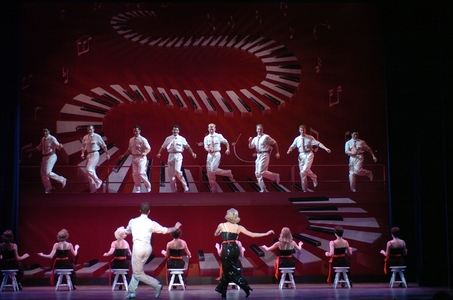
WHITE%20CHRISTMAS.jpgNow that playgoers and producers are feeling the financial pinch, the market for super-safe no-brainer shows is soaring. Escapism looks especially good between Thanksgiving and Christmas, and so Broadway is saying hello to "Irving Berlin's White Christmas," a sure-fire seasonal musical that's been road-tested in Boston, Los Angeles, San Francisco and Toronto. This stage version of the Bing Crosby-Danny Kaye movie is pure, unadulterated commodity theater, right down to the inclusion of Berlin's name in the title of the show--but the ingredients are costly and the craftsmanship immaculate, and only the Scroogiest of Scrooges will turn up their noses at its sleek charm.

Michael Curtiz' original 1954 film was itself a commodity, a Technicolor variation on "Holiday Inn" in which Kaye replaced Fred Astaire and the whole film took place at Christmastime. It's long been a seasonal staple, but I never liked it as much as "Holiday Inn," and the stage version of "White Christmas" is a definite improvement on its cinematic source. The reason for this is twofold: David Ives, that wittiest of playwrights, has joined forces with Paul Blake to spruce up the script, while Walter Bobbie, the justly celebrated director of the Broadway revival of "Chicago," has put the show on stage with his customary comedic skill. The result is a streamlined valentine to the Eisenhower era that's packed with period references, some obvious (the heroes appear on "The Ed Sullivan Show") and others subtle (there's an Eames chair in their dressing room). The songs have even been orchestrated by Larry Blank in the smoothly jazzy style of Nelson Riddle, the "Songs for Swingin' Lovers" man....

Itamar Moses is having himself a time. Two of his plays, "Back Back Back" and "Yellowjackets," had high-profile premieres in San Diego and Berkeley earlier this year, while "The Four of Us" transferred from San Diego to New York for a successful Off-Broadway run. Meanwhile, "Bach in Leipzig," the play that put Mr. Moses on the map in 2005, was revived to brilliant effect by Shakespeare Santa Cruz. Not bad for a 31-year-old phenom.

Now "Back Back Back" has made its way to the Manhattan Theatre Club in a new production directed by Daniel Aukin, and I am delighted to report that it is a very superior piece of work, one of the best new American plays to come my way in 2008. This is all the more surprising given the unpromising fact that "Back Back Back" is issue-driven--and that the issue in question is the use of steroids by major-league baseball players...

I know nothing about baseball beyond what I learned from watching "Bull Durham" and "Eight Men Out," but I had no difficulty grasping what was going on in "Back Back Back." As a precaution, though, I brought along a baseball fan who assured me at evening's end that Mr. Moses had gotten everything right--and that the play closely tracks the real-life events on which it is based. Yet "Back Back Back" never feels like a docudrama, much less a polemic. Instead Mr. Moses has given us a taut, touchingly elegiac study of friendship and betrayal...

* * *

Read the whole thing here.

This is a fascinating article about Back Back Back by a writer with personal knowledge of the major-league-baseball steroid scandal. (Incidentally, he liked the play as much as I did.)

Posted November 28, 12:00 AM

TT: Almanac

"THANKSGIVING DAY. A day devoted by persons with inflammatory rheumatism to thanking a loving Father that it is not hydrophobia."

H.L. Mencken, A Book of Burlesques

Posted November 28, 12:00 AM

November 27, 2008

TT: Don't look back

lrg_huge_typewriter.jpgIt's not exactly a secret that I stay pretty busy, but even by my extreme standards, 2008 has been a bit on the hectic side. According to my records, I reviewed or will be reviewing a total of one hundred and fourteen shows for The Wall Street Journal in 2008, fifty-six of which took place outside New York City. (To put it another way, I reviewed shows in fourteen states and the District of Columbia.) During that time I knocked out roughly ninety columns and other pieces for the Journal and Commentary, plus a dozen or so articles that were published elsewhere, and finished writing A Cluster of Sunlight: The Life of Louis Armstrong and the libretto for The Letter.

I also made four new friends and mourned the deaths of two old ones, read a couple of hundred books and looked at a like number of paintings, saw eighteen performances of fourteen Shakespeare plays (not counting Falstaff and Kiss Me, Kate), bought three pieces of art, stayed in a Frank Lloyd Wright house, visited the grave of Willa Cather, had lunch at the Supreme Court Building, hugged Leontyne Price, posted to this blog with reasonable regularity, and spent as much time as possible in the company of Mrs. T.

I've been known to complain from time to time about being overworked, but for most of these things--especially the last--I am profoundly grateful. May you be as grateful for at least as many different and wondrous things on this Thanksgiving Day.

Posted November 27, 12:00 AM

TT: So you want to see a show?

Here's my list of recommended Broadway, off-Broadway, and out-of-town shows, updated weekly. In all cases, I gave these shows favorable reviews (if sometimes qualifiedly so) in The Wall Street Journal when they opened. For more information, click on the title.

Warning: Broadway shows marked with an asterisk were sold out, or nearly so, last week.

BROADWAY:
Alfred Hitchcock's The 39 Steps (comedy, G, suitable for bright children, reviewed here)
August: Osage County (drama, R, adult subject matter, reviewed here)
Avenue Q (musical, R, adult subject matter and one show-stopping scene of puppet-on-puppet sex, reviewed here)
Boeing-Boeing (comedy, PG-13, cartoonishly sexy, reviewed here)
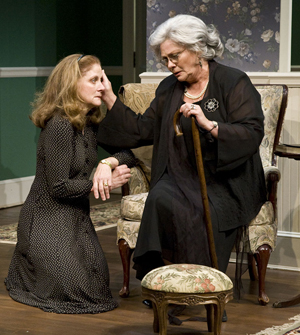
DTEweb.jpgDividing the Estate (black comedy, G, far too serious for children, reviewed here)
Equus (drama, R, nudity and adult subject matter, closes Feb. 8, reviewed here)
Gypsy (musical, PG-13, adult subject matter, closes Mar. 1, reviewed here)
The Little Mermaid (musical, G, entirely suitable for children, reviewed here)
A Man for All Seasons * (drama, G, too intellectually demanding for children of any age, closes Dec. 14, reviewed here)
South Pacific * (musical, G/PG-13, some sexual content, brilliantly staged but unsuitable for viewers acutely allergic to preachiness, reviewed here)

OFF BROADWAY:
The Fantasticks (musical, G, suitable for children capable of enjoying a love story, reviewed here)

CLOSING SUNDAY IN SUBURBAN CHICAGO:
Picnic (drama, PG-13, adult themes, reviewed here)

Posted November 27, 12:00 AM

TT: Almanac

"Sir, gratitude is a fruit of great cultivation; you do not find it among gross people."

Samuel Johnson (quoted in James Boswell, A Journal of a Tour to the Hebrides)

Posted November 27, 12:00 AM

November 26, 2008

TT: Snapshot

Fred Astaire performs "One for My Baby" in the 1943 film The Sky's the Limit:

(This is the latest in a weekly series of arts-related videos that appear in this space each Wednesday.)

Posted November 26, 12:00 AM

TT: Almanac

"A turkey is more occult and awful than all the angels and archangels. In so far as God has partly revealed to us an angelic world, he has partly told us what an angel means. But God has never told us what a turkey means. And if you go and stare at a live turkey for an hour or two, you will find by the end of it that the enigma has rather increased than diminished."

G.K. Chesterton, "Christmas" (in All Things Considered)

Posted November 26, 12:00 AM

November 25, 2008

TT: From their mouths

L_ISBN_9780712305440.jpgA few months ago I wrote a "Sightings" column for The Wall Street Journal called "Hearing Is Believing" in which I took note of the release by the British Library of a series of CDs devoted to talks by and interviews with W.H. Auden, Graham Greene, George Bernard Shaw, Evelyn Waugh, and H.G. Wells that were originally broadcast over the BBC. Now comes a pair of three-disc samplers devoted to archival recordings of broadcasts by other writers, most of whom who didn't make it into the studio often enough to fill up a full CD.

The Spoken Word: American Writers contains recordings by James Baldwin, Saul Bellow, Pearl Buck, William S. Burroughs, Raymond Chandler, Ralph Ellison, F. Scott Fitzgerald, Lillian Hellman, Patricia Highsmith, Sinclair Lewis, Anita Loos, Mary McCarthy, James Michener, Arthur Miller, Henry Miller, Toni Morrison, Vladimir Nabokov, Eugene O'Neill, Isaac Bashevis Singer, Gertrude Stein, John Steinbeck, William Styron, James Thurber, Gore Vidal, Eudora Welty, Tennessee Williams, and Thornton Wilder.

The Spoken Word: British Writers contains recordings by J.G. Ballard, Algernon Blackwood, Anthony Burgess, John le Carré, G.K. Chesterton, Arthur Conan Doyle, Noël Coward, Ian Fleming, E.M. Forster, William Golding, Graham Greene, Aldous Huxley, Rudyard Kipling, Doris Lessing, Arthur Machen (who he?), Somerset Maugham, Daphne du Maurier, Nancy Mitford, the Baroness Orczy (she wrote The Scarlet Pimpernel), Joe Orton, Harold Pinter, J.B. Priestley, C.P. Snow, Muriel Spark, J.R.R. Tolkien, Evelyn Waugh, Rebecca West, Angus Wilson, P.G. Wodehouse, and Virginia Woolf.

Two questions:

(1) Where the hell is Max Beerbohm?

(2) What are you waiting for? Place your order!

* * *

Incidentally, iTunes offers downloads of some interesting spoken-word recordings by famous writers of the past:

• For Kingsley Amis, search for "A Song of Experience/Nocturne."

• For John Betjeman, search for "The Church's Restoration/The Olympic Girl."

• For G.K. Chesterton, Arthur Conan Doyle, Leo Tolstoy, and W.B. Yeats, search for "The Very Best Historic Voices." (This album also contains a counterfeit recording that purports to be the voice of Oscar Wilde.)

• For T.S. Eliot, search for "The Love Song of J. Alfred Prufrock."

• For Robert Frost, search for "Robert Frost Two Poems."

• For Rudyard Kipling, search for "Reflections on War."

• For Philip Larkin, search for "An Arundel Tomb/Mr. Bleaney."

• For George Bernard Shaw, search for "Public Address on His Ninetieth Birthday."

Posted November 25, 12:00 AM

TT: Getting to know her

A reader writes:

You have written eloquently and movingly about Nancy LaMott, but I never really had a chance to hear her sing. Just now, sitting in my office, with Pandora Radio in the background, Johnny Mercer's "When October Goes" came on. It was the most incredible singing I have ever heard. It absolutely blew me away. It's as if her very soul was pouring out through the song. Rare are the moments when you hear a song and you just know that it can never--ever--be done any better. You should remind your readers what a gift she was--and is.

My friend Nancy died thirteen years ago next month, but her voice is still with us, and I'm glad to see that people are still discovering it. That particular song is on Come Rain or Come Shine: The Songs of Johnny Mercer, my favorite of her albums. Give it to someone you love for Christmas.

Posted November 25, 12:00 AM

TT: Under construction

The video and audio modules of the right-hand column have been sorely in need of updating for several months--many of the links have gone dead--so I have pulled them off the site in order to do the necessary work. This may take quite some time. Apologies in advance, and please be patient!

Posted November 25, 12:00 AM

TT: Almanac

"Our family talked a lot at table, and only two subjects were taboo: politics and personal troubles. The first was sternly avoided because Father ran a nonpartisan daily in a small town, with some success, and did not wish to express his own opinions in public, even when in private."

M.F.K. Fisher, Cook's and Diner's Dictionary

Posted November 25, 12:00 AM

November 24, 2008

CD

Stephen Sondheim: The Story So Far (Sony Classics, four CDs). Eighty-two songs by the greatest musical-theater composer of the postwar era. All of Sondheim's shows are represented, and the performances range from original-cast recordings to rare demos sung and played by the composer himself. Sondheim fanatics will already have the bulk of this material, but if you're just getting to know him, The Story So Far is a good place to start (TT).

Posted November 24, 4:22 PM

TT: No, but I heard the movie

Throughout the first few months of the writing of The Letter, I carried the bulk of the creative load, hammering out the first draft of the libretto and painstakingly revising it under the watchful eye of Paul Moravec, my musical collaborator. Now the ball is in Paul's court: he's orchestrating The Letter, a grueling task with which I have nothing to do beyond listening to a synthesized version of each scene on my iBook and commenting on the scoring.

Because I'm not only a writer but a musician with professional performing experience, I take for granted certain things about the making of an opera of which laymen know little or nothing. Hence it surprises me--or used to, anyway--that so few people outside the profession understand what it means to orchestrate a piece of classical music. To put it as succinctly as possible, The Letter was originally composed for voices and piano. What Paul is now doing is rewriting the piano part for a seventy-piece pit orchestra that consists of two flutes and a piccolo, two oboes and an English horn, two clarinets and a bass clarinet, two bassoons, a tenor saxophone, four French horns, three trumpets, three trombones, a harp, two percussionists, and a symphony-size string section.

sondheim.jpgThis is a back-breakingly complicated and labor-intensive task, one that Broadway and Hollywood composers normally "outsource" to well-paid specialists. Jonathan Tunick, for instance, orchestrates most of Stephen Sondheim's musicals, while virtually all of the film scores of Max Steiner, who wrote the music for the 1940 film version of The Letter, were orchestrated by Hugo Friedhofer. (This undoubtedly explains why musical-comedy buffs are always asking me whether and/or why Paul is doing his own orchestrations.)

Even Leonard Bernstein used a pair of professional orchestrators for West Side Story, not because he couldn't have scored the show himself--he was a superbly imaginative orchestrator in his own right--but because he simply didn't have the time. As Humphrey Burton explained in his Bernstein biography:

Once the green light had been given, Bernstein had two main tasks; coaching the company in his music and supervising the orchestrations, which began in late June, with Sid Ramin and Irwin Kostal carrying out Bernstein's wishes. Ramin was especially knowledgeable about jazz and vaudeville. He suggested some of the slapstick effects in "Officer Krupke." Kostal had been a student of Stefan Wolpe: he did the music for the weekly Show of Shows starring Sid Caesar. He described Bernstein as a great orchestrator. "If he'd had the time he wouldn't even need us....When it came to West Side Story every note is his: still, he would say once in a while, 'Who said that orchestration can't be creative?' He was entirely appreciative of anything that we did. Jerome Robbins, if you changed anything, would really get angry. Lenny would say, 'Jesus, why didn't I think of that?'"

In opera, on the other hand, it's taken for granted that the composer will orchestrate his own music. Orchestration is a creative process, not a mechanical chore. The difference between a two-line piano part and a full orchestral score is analogous to the difference between a finished painting and the preliminary black-and-white sketches on which it is based. The sketches may be works of art in their own right, but no real artist would think for a moment of farming out the task of turning them into a large-scale canvas, any more than a serious novelist would outline the plot of a book, then let his secretary write the dialogue.

f05sampt.jpgTake a familiar painting like John Singer Sargent's "El Jaleo," the huge and spectacular 1882 portrait of a flamenco dancer in action that hangs in the Isabella Stewart Gardner Museum in Boston. It's one of Sargent's most celebrated paintings, and deservedly so. But "El Jaleo" isn't just "about" its subject matter and composition, memorable as they are: it's also about the startlingly vivid colors that Sargent used to bring that composition to life. El_Jaleo.jpgIf somebody else had chosen those colors and applied them to the canvas, even after talking at length to Sargent about what the artist had in mind, then the final painting wouldn't be a fully authentic Sargent but a collaboration between John Singer Sargent and Mr. Somebody Else, and my guess is that we would think less of it for that reason.

The same is true in opera. Think of a well-known aria like, say, "Che gelida manina" from Puccini's La Bohème. Remember how it starts? Your little hand is frozen, Rodolfo says to Mimi. Let me warm it for you. Then, against a simple background of softly murmuring strings, you hear the crisp, icy ping of a harp, and all at once you feel a chill in the air. That's what musicians call "tone painting," and it's as crucial to the effect of the aria as the gentle tune that Rodolfo sings. If Puccini had chosen instead to score the first few pages of "Che gelida manina" for mandolin and clarinets...well, you get the idea.

Needless to say, Paul is well aware of the extent to which the scoring of The Letter will contribute to the effect that it makes in the opera house. Like me, he is also a film buff, and he's no less aware of the huge contribution made by film composers and their orchestrators to the dramatic impact of the classic movies of the Thirties and Forties. "Is this fun for you at all, or just work?" I asked him via e-mail last week. This was his reply:

It would be more fun if there weren't so MUCH to get through--very time-consuming, but periods of enjoyment. I have learned from movie scores that timbre is to a remarkable degree the name of the game in setting the mood subliminally for the listener.

stanley33art1.jpgOf course I'm relying on my experience with the medium of opera principally for orchestration as with other matters, not film music. It's an opera, after all. But the connection between the two is endlessly fascinating: movies were the operas of the twentieth century (and probably still are today) and people like Max Steiner & Co. would have been opera composers had they lived a hundred years earlier. Many of those guys were latter-day Wagnerians, and film was where the action was.

As a 20th, now 21st-century American, I have been naturally exposed to as much film music as opera music--probably more, in fact--so I am naturally drawing some on my movie experience. One could follow the ancestry of this particular opera score from opera through film through to opera again. In following the trajectory of Steiner & Co. in reverse to some extent, my modus operandi moves into the present and future of something else.

It stands to reason that both of us should often find ourselves using film-derived metaphors when talking about The Letter. As I wrote in this space two months ago:

Up to now I've only heard The Letter accompanied by a piano, and the difference is staggering. To hear the opening pages of our not-so-little opera reconceived in orchestral terms is like seeing a black-and-white movie reshot in Technicolor and CinemaScope.

I only wish I could share the experience with you! I'm proud of my contribution to The Letter, but I know more than enough about music to appreciate the infinitely greater complexity of the task in which Paul is now immersed, and it humbles me to think of what he's putting himself through in order to bring our opera to the stage.

UPDATE: A friend writes:

A two-sentence bio of two men: "Jerome Robbins, if you changed anything, would really get angry. Lenny would say, 'Jesus, why didn't I think of that?'"

Right on both counts.

Posted November 24, 12:00 AM

TT: In case you didn't notice...

...the right-hand column is full of new stuff. Take a gander, won't you?

Posted November 24, 12:00 AM

TT: Almanac

"Conductors must give unmistakable and suggestive signals to the orchestra--not choreography to the audience."

George Szell (quoted in Newsweek, Jan. 28, 1963)

Posted November 24, 12:00 AM

November 23, 2008

CD

Mel Tormé and the Marty Paich Dek-Tette (Bethlehem). Originally recorded in 1956, this immensely sophisticated collection of pop standards teamed Tormé with a ten-piece jazz ensemble whose arrangements were based on the influential 1949-50 recordings of Miles Davis' "Birth of the Cool" nonet and played by such heavy West Coast hitters as Bud Shank, Red Mitchell, and Mel Lewis. It established Tormé as a world-class jazz singer at a single stroke and remains wonderfully listenable to this day. The opening track, "Lulu's Back in Town," became one of Tormé's trademark songs, though his sensitively sung version of Harold Arlen's "When the Sun Comes Out" is, if possible, even better (TT).

Posted November 23, 10:08 PM

BOOK

Aljean Harmetz, The Making of Casablanca: Bogart, Bergman, and World War II. This book, originally published in 1992 as Round Up the Usual Suspects, is not a standard-issue piece of celebrity-oriented fluff but a snappily written, hugely entertaining primary-source history that delves deeply into the genesis of the iconic studio-system picture of the Forties. It may well be the most informative book ever written about the making of a Hollywood picture, and among many other useful things, it leaves the attentive reader in no possible doubt that the auteur theory of film is utterly irrelevant to the creation of an assembly-line film like Casablanca (TT).

Posted November 23, 9:55 PM

November 22, 2008

PLAY

Dividing the Estate (Booth, 222 W. 45, closes Jan. 4). Horton Foote's grimly funny portrait of a houseful of Texans who've been sponging off their mother for so long that they've forgotten how to earn an honest buck is the best-written, best-acted play in town, not excluding August: Osage County and A Man for All Seasons. It's the go-to show for theater buffs who long to spend a whole evening on Broadway without having their intelligence insulted. Give yourself a ticket for Christmas (TT).

Posted November 22, 5:38 PM

BOOK

John Adams, Hallelujah Junction: Composing an American Life (FSG, $26). A hugely important, exceedingly well-written memoir in which the composer of Nixon in China and Doctor Atomic explains with engaging clarity why he broke with modernism to forge a new, more accessible style of classical composition. Even if, like me, you find it impossible to warm up to Adams' minimalist music, this book will leave you in no doubt of why it has made so deep an impression on a generation of American composers and listeners (TT).

Posted November 22, 5:31 PM

CD

John McCormack, Deutsche Lieder 1914-1936 (Hamburger Archiv für Gesangskunst). When not singing "Mother Machree" and "The Garden Where the Praties Grow," Ireland's favorite tenor was a dead-serious recitalist who had a knack for bringing out the ballad-like quality of German art songs. This beautifully remastered imported CD contains all twenty-seven of his surviving recordings of songs by Brahms, Mendelssohn, Raff, Schubert, Schumann, and Wolf. Some are performed in English, others in Irish-tinged German, but all are sung with a combination of straightforwardness and sweet lyricism that I find completely charming. Would that McCormack had recorded twice as many Lieder, but to hear him singing Wolf's "Herr, was trägt der Boden hier" (his favorite art song) is to be reminded of how lucky we are to live in the age of recorded sound (TT).

Posted November 22, 5:30 PM

THE GHOSTS OF STUDIO ONE

"Even in its present, somewhat dilapidated state, the TV version of Reginald Rose's courtroom drama Twelve Angry Men, which aired on Studio One in 1954, shows with stunning clarity what the finest live-drama series had to offer..."

Posted November 22, 10:34 AM

November 21, 2008

TT: Road to nowhere

Three new shows this week, one disappointing, one great, one pretty good. Read all about Road Show, Dividing the Estate, and American Buffalo in today's Wall Street Journal drama column. Here's an excerpt.

* * *

alg_road_show.jpgStephen Sondheim and John Weidman got their wish: "Road Show" finally made it to New York. This much-revised musical about two brothers who can't decide whether to love or hate one another has been under construction for a decade, but only now has the show, which was previously known as "Wise Guys" and "Bounce" and made it as far as a 2003 tryout in Washington, D.C., taken definitive shape as the one-act chamber musical currently being performed downtown at the Public Theater. I wish I could say it was worth the wait, but "Road Show" isn't up to the high standards of the creators of "Pacific Overtures." The book is flat, the score fluent but pale, and my reluctant guess is that the Public will be the last stop on its long trip....

[Mr. Sondheim's] stylistic fingerprints are all over the score--no one else could have written a bar of it--and it may be that closer acquaintance will make its beauties more apparent. Alas, my first impression is that the songs lack the lyrical bite and sharp melodic profile that one takes for granted from the reigning genius of postwar American musical theater.

About the failings of Mr. Weidman's book I have no doubts, for they're painfully evident: "Road Show" is all tell and no show, a string of talky, undramatic ensemble numbers that feels more like an oratorio than a musical....

Horton Foote's "Dividing the Estate," which had an extravagantly well-received run Off Broadway last fall, has now transferred to Broadway with its original 13-person cast intact. It's a bitingly macabre comedy about a family of Texans who've been sponging off the money of their mother (Elizabeth Ashley) for so long that they've forgotten how to live their own lives. No doubt Primary Stages and Lincoln Center Theatre, the co-producers, hope to profit from the protracted hoopla over Tracy Letts' "August: Osage County," a similarly dark study of American family life. They deserve to get their wish: "Dividing the Estate" is the best show now playing on Broadway, give or take "Gypsy." Not only is it at least as good a play as "August: Osage County," but this production, directed by Michael Wilson, is a stunner, a gorgeous piece of ensemble theater in which nobody puts a foot wrong....

The word is that "American Buffalo," the second David Mamet revival to open on Broadway this season, will close on Sunday unless ticket sales take an upward turn between now and then. Too bad. This isn't a perfect production, but it's worthy and definitely ought to be seen....

Cedric the Entertainer, the comedian-turned-movie-star who made a splash in "Barbershop," is less a stage actor than a stage presence--but a strong one. He delivers Mamet's highly stylized dialogue in a too-naturalistic manner, but it's easy to imagine him making a powerful impression in a more straightforward show, and I very much hope that somebody casts him in an August Wilson play one of these days....

* * *

Read the whole thing here.

Watch my wsj.com video review of American Buffalo here:


Posted November 21, 12:00 AM

TT: The ghosts of Studio One

StudioOne_Anthology.jpgLike many another aging baby boomer, I'm fascinated by early television, and in particular by the live telecasts that dominated network TV from its inception at the end of the Forties to the introduction of videotape in the late Fifties. So when Koch Vision sent me a copy of Studio One Anthology, a six-DVD box set containing kinescopes of seventeen dramas that aired between 1948 and 1956 on Studio One, perhaps the best-remembered anthology drama series of the live-TV era, I immediately felt a "Sightings" column coming on.

Studio One Anthology contains, among other interesting things, the original 1954 TV version of Reginald Rose's Twelve Angry Men, which was later turned into a Hollywood film starring Henry Fonda and a stage version that was first performed on Broadway in 2004. I never cared for the movie and had mixed feelings about the play, but I was eager to see what Twelve Angry Men looked like in its original form.

How did it measure up to its better-known successors--and is Studio One as good as its still-formidable reputation? To find out, pick up a copy of Saturday's Wall Street Journal and turn to my "Sightings" column.

UPDATE: Read the whole thing here.

Posted November 21, 12:00 AM

TT: Almanac

"When we imagine what it is like to be a languageless creature, we start, naturally, from our own experience, and most of what then springs to mind has to be adjusted (mainly downward). The sort of consciousness such animals enjoy is dramatically truncated, compared to ours. A bat, for instance, not only can't wonder whether it's Friday; it can't even wonder whether it's a bat; there is no role for wondering to play in its cognitive structure."

Daniel Clement Dennett, Consciousness Explained

Posted November 21, 12:00 AM

November 20, 2008

GALLERY

John Marin: Ten Masterworks in Watercolor (Meredith Ward, 44 E. 74, up through Dec. 20). Ten important works on paper by the pioneering American modernist whose virtuosity in the watercolor medium remains unrivaled. Some are from Marin's estate, others from private collections, and most are familiar only to Marin specialists. A rare opportunity to view a great American painter at the peak of his powers (TT).

Posted November 20, 4:29 PM

TT: So you want to see a show?

Here's my list of recommended Broadway, off-Broadway, and out-of-town shows, updated weekly. In all cases, I gave these shows favorable reviews (if sometimes qualifiedly so) in The Wall Street Journal when they opened. For more information, click on the title.

Warning: Broadway shows marked with an asterisk were sold out, or nearly so, last week.

BROADWAY:
Alfred Hitchcock's The 39 Steps (comedy, G, suitable for bright children, reviewed here)
August: Osage County (drama, R, adult subject matter, reviewed here)
Avenue Q (musical, R, adult subject matter and one show-stopping scene of puppet-on-puppet sex, reviewed here)
Boeing-Boeing (comedy, PG-13, cartoonishly sexy, reviewed here)
Equus (drama, R, nudity and adult subject matter, closes Feb. 8, reviewed here)
Gypsy (musical, PG-13, adult subject matter, closes Mar. 1, reviewed here)
The Little Mermaid (musical, G, entirely suitable for children, reviewed here)
A Man for All Seasons (drama, G, too intellectually demanding for children of any age, closes Dec. 14, reviewed here)
South Pacific * (musical, G/PG-13, some sexual content, brilliantly staged but unsuitable for viewers acutely allergic to preachiness, reviewed here)

OFF BROADWAY:
The Fantasticks (musical, G, suitable for children capable of enjoying a love story, reviewed here)

CLOSING NEXT WEEK IN SUBURBAN CHICAGO:
Picnic (drama, PG-13, adult themes, closes Nov. 30, reviewed here)

Posted November 20, 12:00 AM

TT: Almanac

"We are always on stage, even when we are stabbed in earnest at the end."

Georg Büchner, Danton's Death (trans. Gerhard P. Knapp)

Posted November 20, 12:00 AM

November 19, 2008

OGIC: Killing me softly

I'm really obsessed with Keats's "To Autumn"; I think it's a perfect and magical piece of writing, with effects that resonate and evolve for a lifetime. I got familiar with the poem in my first year of graduate school, when I took a memorable course called "Keats and Critique." The course explored the premise--popular among the Victorians who installed him belatedly as a great English poet--that Keats was done in, in part, by his bad reviews. And it's true that when they were bad, they were vicious.

When I reread this poem--or, as lately, recite it and write it out as outlets for its hold upon my ear and brain--I fend off impulses to thrust it upon innocent passers-by, pointing out its most bewitching features. I don't so much have a reading of it as a set of things I notice in it, a collection that grows slowly over the years. Here are just a few of these amateur observations, truly off the top of my head; consider yourself one of those unsuspecting bystanders.

The first stanza describes an ample, apparently endless autumn bounty.

Season of mists and mellow fruitfulness,
Close bosom-friend of the maturing sun;
Conspiring with him how to load and bless
With fruit the vines that round the thatch-eves run;
To bend with apples the moss'd cottage-trees,
And fill all fruit with ripeness to the core;
To swell the gourd, and plump the hazel shells
With a sweet kernel; to set budding more,
And still more, later flowers for the bees,
Until they think warm days will never cease,
For summer has o'er-brimmed their clammy cells.

Throughout the poem there's a (deceptive) sense that time is suspended. In this stanza, that's accomplished in large measure by the repeated use of infinitive verbs: "to load and bless"; "to bend"; "[to] fill": "to swell"; "[to] plump"; "to set." The last line, explaining how the bees are fooled, links this sense of time drawn out to the abundance described throughout the stanza. Tees bent under the weight of fruit, the filling, swelling, plumping, budding, overbrimming of nature--all of this burgeoning--is mimicked in the poem's language, where phrases spill over the bounds of their lines and a gratuitous second instance of "more" in line nine performs the word's own meaning. The stanza is literally fruitful: "fruit" appears three times in its 11 lines, including an instance as something that fills (vines) and one as something that is filled (with ripeness).

The next stanza switches gears, presenting autumn as an allegorical figure.

Who hath not seen thee oft amid thy store?
Sometimes whoever seeks abroad may find
Thee sitting careless on a granary floor,
Thy hair soft-lifted by the winnowing wind;
Or on a half-reap'd furrow, sound asleep,
Drows'd with the fume of poppies while thy hook
Spares the next swath and all its twined flowers:
And sometimes like a gleaner thou dost keep
Steady thy laden head across a brook;
Or by a cyder-press, with patient look,
Thou watchest the last oozings hours by hours.

Again, time is on hold. The personified Autumn is an indolent creature, "sitting careless" in a workplace, "sound asleep" in the fields, watching the press rather than operating it. Even in the most industrious of the four attitudes described here, she is only like a gleaner. The work of her hook, in her previous guise, is to "spare"; it's at rest. All of this is in contrast with the busy industry of the first stanza, though the sense of time stood still persists. Until that last line, that is, when a sense of ending finally sets in--in the "last oozings," significant both for the adjective's meaning and for the noun's sound, and in the invocation of hours. There's also the gently diminishing length of the four views of Autumn offered here: they fill three lines, three lines, two, and two. (Note, though, they stop short of approaching zero.)

The third and last stanza masterfully dissolves into sounds, capturing a last, momentary stasis before winter sets in.

Where are the songs of spring? Ay, where are they?
Think not of them, thou hast thy music too,--
While barred clouds bloom the soft-dying day,
And touch the stubble-plains with rosy hue;
Then in a wailful choir the small gnats mourn
Among the river sallows, borne aloft
Or sinking as the light wind lives or dies;
And full-grown lambs loud bleat from hilly bourn;
Hedge-crickets sing; and now with treble soft,
The red-breast whistles from a garden-croft;
And gathering swallows twitter in the skies.

There are so many interesting things going on here. The use of "bloom" as a transitive verb; the singular, whistling red-breast set against the plural plains, gnats, sallows, lambs, crickets, swallows, and skies; the seemingly unnecessary designation of the gnats as "small." Autumn's music, it must be said, is a gentle, symphonic, glorious, consoling...dirge. "Soft-dying" describes not only the day but the season and the year as viewed through the prism of this poem, and by extension human life (it also provides a coda to the soft-lifting of stanza two). From its flirting with the notion of birth, through the use of the homophones "borne" and "bourn" (not to mention rhyming them with "mourn"), to the invocation of lambs on the threshold of adulthood and a wind that flits easily from death to life, it looks to the seasonal cycle for consolation for the life-cycle. It tries to touch mortality with rosy hue. It softens you up for the final blow, which takes place off the page--delivered, we imagine, softly.

P.S. By coincidence, Anecdotal Evidence also posts on Keats, death, and beauty today.

Posted November 19, 12:13 PM

TT: Clive Barnes, R.I.P.

CliveBarnes1MN.jpgWhen I was a teenager and first became aware of criticism as a profession, Clive Barnes was one of its very biggest names. Born in 1927, Barnes had come to this country in 1965 to work for the New York Times. Right from the start, he was the kind of writer who got written about, in part because he had two arrows in his critical quiver: he covered dance and theater, and did so with self-evident relish. At some point it occurred to me that I, too, might want to write about more than one subject, and I have no doubt that Barnes' example was part of what inspired me to do so.

I discovered ballet in 1987 and started writing about it for The New Dance Review shortly thereafter. That was when I first recognized Barnes as a physical presence, sitting on the aisle of virtually every first night that I attended. Sixteen years later I became the drama critic of The Wall Street Journal and joined the New York Drama Critics' Circle, of which Barnes and John Simon were the senior members. It seemed utterly improbable to me that I should be casting votes alongside men whose reviews I'd been reading for the better part of four decades, much less calling them by their first names. I found Clive to be perfectly friendly and collegial, but by then it was impossible for me to shed the diffidence of my long-lost youth and get to know him more than casually. To me he was Clive Barnes, and that was that.

Clive's byline recently disappeared from the New York Post, to which he had moved in 1978, and the paper's dance and drama reviews started carrying an ominous tagline: Clive Barnes is on leave. This morning a mutual friend passed the not-surprising word that he had died of liver cancer. Almost to the end, though, he clung to his aisle seat, and as late as two weeks ago he was still filing reviews that left no doubt of his undiminished appetite for ballet, the art that he loved most and knew best. That's the best of all possible epitaphs for a long-lived critic.

UPDATE: The New York Times obituary is here.

The New York Post obituary is here.

Posted November 19, 9:16 AM

TT: Snapshot

Sid Caesar and Nanette Fabray engage in a pantomime argument on a 1954 episode of Caesar's Hour, accompanied by the first movement of Beethoven's Fifth Symphony:

(This is the latest in a weekly series of arts-related videos that appear in this space each Wednesday.)

Posted November 19, 12:00 AM

TT: Almanac

"The distinction between the two types of art is a difference of density rather than of species. In the same number of bars of Beethoven and Sousa, there is, in Beethoven, more of the essence of music, giving a thicker, more intense effect likely to alienate the unfamiliar listener by 'boring' him, just as the palate accustomed to that richer food is bored by the thinness of the popular tune. The feeling that this is not the only difference is due to the fact that as an art grows more and more complex and dense, the number of relations among simple elements increases until those relations look like extraordinarily refined experiences denied to the common herd. Yet there is no real barrier to be leaped over by an effort of genius between understanding a 'vulgar' dance tune and a Beethoven symphony."

Jacques Barzun, Of Human Freedom

Posted November 19, 12:00 AM

November 18, 2008

TT: Eavesdropping on Tom Stoppard with Gwen Orel

s638584127_951933_3123.jpgTom Stoppard, who might just be the greatest living English-language playwright, is in Manhattan on business, and made a couple of public appearances last week. Alas, I was unavoidably elsewhere, but my friend Gwen Orel, who writes about theater and Celtic music for all sorts of publications on and off line, was present on both occasions, and filed this report.

* * *

stoppard_19843t.jpgBack in the twentieth century, around 1989 or so, some Serious Theatre People averred that "Tom Stoppard is over." The Real Thing was his Tempest, they said, his farewell to the stage. Fast forward to Rough Crossing, Arcadia, The Invention of Love, The Coast of Utopia, and Rock and Roll. Some farewell! By now Stoppard, who's in town to rehearse his new adaptation of The Cherry Orchard at BAM, has morphed into a sort of playwright-rock idol. Accordingly, he appeared in pale (though not blue) suede shoes at two public talks last week, both of them quickly overbooked. Though he was funny and charming as usual, it was fascinating to observe what a difference a moderator made.

At CUNY, Stoppard was joined by Nobel Prize-winning playwright Derek Walcott for a Great Issues Forum moderated by David Nasaw, the university's Arthur M. Schlesinger, Jr. Professor of American History. The topic was "Cultural Power," and the press release said that Stoppard & Co. would be exploring "the power of culture and art in a globalizing world." Instead, they considered the Impact and Influence of Art. Yep, said Walcott, art's impact cannot be easily counted and measured. Yep, said Stoppard, culture is what distinguishes us as human. All interesting, but...power?

The professor was smart but all too clearly awed by his celebrated guests, who seemed in turn to adore one another. He began, promisingly, by considering the way "the world changed last Tuesday," showing a slide of Barack Obama with a book in his hand, which turned out to be Walcott's Collected Poems, 1948-1984. Then the poet read us Forty Acres, his new poem about Obama, commissioned by the Times of London: Out of the turmoil emerges one emblem, an engraving --/a young Negro at dawn in straw hat and overalls,/an emblem of impossible prophecy...

Asked for his reaction, Stoppard said that the poem "silenced" him--but, of course, it hadn't, and he self-deprecatingly remarked that he could go on "speaking like a wind-up toy." At one point he mentioned a recent New York Times article about the New York City Opera which pointed out that the Paris Opera's budget is larger than that of the entire National Endowment for the Arts. Provocatively, he then suggested that the patronage of the rich American may "get the government off the hook." This was power! This was culture! This was another ball dropped.

The next day, Stoppard was interiewed at BAM by David Remnick, editor of The New Yorker and author of Lenin's Tomb, who may be the only editor in New York who hadn't rushed out to read Isaiah Berlin justto prepare for The Coast of Utopia. Remnick actually out-Stopparded Stoppard with his wit and erudition, and the result was a chat that unlike its predecessor was fascinating, insightful, and over too soon. When Remnick said "For our last question..." Stoppard looked at his watch and looked truly disappointed.

The topic was Chekhov, but the conversation managed to get somewhere near...well, cultural power. Asked what niche his new version of The Cherry Orchard would fill, Stoppard said that directors like to have a new text in rehearsal: "Theatre is a storytelling art form--plays are palimpsests of maps on different scales." He was "constantly looking for that elusive place where the natural utterance functions as a narrative utterance."

Gracefully segueing from a consideration of Solzhenitsyn and Stalin to literary influence, Stoppard described his aesthetic response to newsprint and his early ambition to be a foreign correspondent and live a glamorous life. "It can be arranged," Remnick murmured. For once Stoppard was speechless--briefly. Remnick added, "There's a 10 p.m. to Kabul." Then Stoppard recovered. "The St. Tropez kind of correspondent," he replied.

Asked how working in America was different than at home, Stoppard admitted that he was less comfortable here, explaing that there was "more a sense of heavy pressure to succeed--perhaps there's more shame in failing than there ought to be." (Maybe that's because they don't publish the West End grosses every week.)

What next? Stoppard said that he'd had just about decided to start working on a screenplay for Arcadia that he would then direct when the BBC came up with the idea of adapting some novels from the nineteenth century and the Twenties--something he says that he really wants to do. Me, I hope it's Waugh. I can't imagine anybody channeling the glamorous war-correspondent author of A Handful of Dust better than Tom Stoppard.

Posted November 18, 12:00 AM

TT: A traveling drama critic orders dinner for one

When Dad was on the road alone
And dined, alone, at night,
He wanted everything to be
Not passable, but right:

"A perfect baked potato
Demands the utmost care.
The only way to order steak
Is medium, not rare."

When I was ten, I told myself:
How lucky to be grown,
To eat at fancy restaurants,
To do things on your own.

I sip my lukewarm Perrier,
A Trollope close to hand.
The waitress looks exactly like
That blonde in Freshman Band.

She smiles and serves the second course.
(Perhaps there's too much sage?)
Suppressing shades of teenage lust,
I sigh and turn the page.

The rain descends, the Muzak purrs,
I chew my veal and think:
Just one more night and I'll be home.
"Miss? Bring another drink."

Posted November 18, 12:00 AM

TT: Almanac

"If the explorer moves toward the risks of the formless and the unknown, the tourist moves toward the security of pure cliché. It is between these two poles that the traveler mediates."

Paul Fussell, Abroad

Posted November 18, 12:00 AM

November 17, 2008

TT: Size matters

71767571.jpgThe news that the Metropolitan Opera has decided to trim its budget by scrapping its revival of The Ghosts of Versailles set me to thinking about the problem of producing new operas that are conceived on a large scale. Such operas do get written--John Adams, for one, has had exceptionally good luck with the genre--but they tend not to get revived all that often. Conversely, a not-inconsiderable percentage of the operas written since 1945 that have had a healthy revival life are "chamber operas" like Benjamin Britten's The Turn of the Screw and Gian Carlo Menotti's The Medium that were specifically designed for performance by small companies.

The trouble with chamber operas is that they usually can't be produced in a large auditorium, at least not very effectively. The Medium is an hour-long opera performed on a single set by a cast of five singers and an actor and accompanied by a fourteen-piece orchestra. You can make it work in a Broadway-sized theater--indeed, The Medium ran for seven months in the 1,100-seat Ethel Barrymore Theatre in 1947--but it feels a size or two too small when performed in most opera houses.

This isn't a hard-and-fast rule. Mark Lamos' staging of The Turn of the Screw was presented in 1996 by the New York City Opera in the 2,800-seat New York State Theater, and you never felt for a moment that the opera was dwarfed by the house. As I wrote in the New York Daily News two days after the opening:

Right from the start, this Turn of the Screw grabs you by the throat and doesn't let go. Mark Lamos' staging, surrealistically designed by John Conklin and lit with the flat, bright clarity of a nightmare by Robert M. Wierzel, emphasizes the horror-show aspects of the opera without descending into bathos or camp. Lamos has an uncanny knack for directing singers--I can't remember the last time I saw better operatic acting.

Twelve years later, Lamos' Turn of the Screw remains the most exciting production of that great opera that I've had the luck to see--but the fact remains that it was it was conceived for Glimmerglass Opera's wonderfully intimate 910-seat Alice Busch Opera Theater in Cooperstown, New York, and I suspect that it packed an even bigger punch there than it did at Lincoln Center.

19181-004-104BC573.jpgAmerica's opera houses range in size from the monstrous to the petite. The Lyric Opera of Chicago performs in the 4,300-seat Auditorium Theatre, while the Metropolitan Opera House holds 3,800 people. At the other end of the spectrum is New York's Amato Opera House, which has 107 seats. Most American houses, however, fall somewhere in between these extremes. The Kennedy Center Opera House, home of the Washington National Opera, has 2,200 seats, 75 more than the Santa Fe Opera's Crosby Theater, where The Letter, the opera that I'm writing with Paul Moravec, will be premiered next July.

What sort of opera do you write for such large but not elephantine houses--and is it possible to write it in such a way that it can also be successfully staged in smaller theaters? As I mentioned the other day, the original proposal for The Letter that Paul and I made to the Santa Fe Opera was explicit on this point:

Our goal is to write an opera whose casting and scenic requirements are compatible with the needs of medium-sized regional houses but which is musically "big" enough to work just as well in large houses.

Hence The Letter, a ninety-minute-long opera with five major roles, two smaller but dramatically essential roles, and a chorus of a dozen men who also cover a number of minor parts. It calls for five simple sets that can be changed quickly and in full view of the audience: a living room, a lawyer's office, a jail cell, the bar of the Singapore Club, and a courtroom. Paul is scoring The Letter for a full-sized pit orchestra, but he also plans to prepare a second version suitable for performance by a smaller group.

wsspbl.jpgThe Letter, in short, should be well within the means of most regional companies. At the same time, though, the opera's emotional scale and musical gestures are anything but small. The next-to-last scene, for instance, takes place in the courtroom where Leslie Crosbie, the character played by Bette Davis in the 1940 film version of The Letter, is being tried for murder. It's a churning, propulsive ensemble inspired by the "Tonight Quintet" from West Side Story, and even though there will only be sixteen singers on stage, it's going to get loud.

If I had to guess, I'd say that The Letter will be a bit too small for the Metropolitan Opera House, but it ought to fit quite nicely into the Crosby Theater--though the Met, lest we forget, has a long history of presentng such compact works as Mozart's Così fan tutte, which calls for for six singers and a smallish chorus and orchestra, alongside grander-than-grand operas like Otello and Turandot. Might our not-so-little melodrama eventually turn up there as well, especially now that the Met's management has become newly cost-conscious? I doubt it, but stranger things have happened...

UPDATE: Two friends wrote to point out what I knew perfectly well but somehow managed to forget, which is that the Chicago Lyric Opera performs not in the Auditorium Theatre but in the Civic Opera House, which has 3,600 seats, a couple of hundred fewer than the Metropolitan Opera House. Big, in other words, but not super-big.

My apologies.

Posted November 17, 12:00 AM

TT: A package from home

If you read this posting and found it sobering, you might want to consider contributing to Operation Gratitude, which sends personalized "care packages" to American troops deployed overseas. Take a look at the Operation Gratitude mailbag and you'll know what a difference these packages can make.

This letter caught my eye:

Hello from Afghanistan. I just want to say thank you very much for the care package. I received the package yesterday and I enjoyed it more than words can explain. I am not sure if the people back home understand fully the appreciation that we feel when we get these packages for home. It is very difficult to explain and I don't think I would be able, even if I tried, so I will just say thank you again. God bless you all and take care, Sergeant Major D. J. C. US Army

He did just fine.

Posted November 17, 12:00 AM

TT: Almanac

"The psychological principle is this: anyone can do any amount of work, provided it isn't the work he is supposed to be doing at that moment."

Robert Benchley, "How to Get Things Done"

Posted November 17, 12:00 AM

November 14, 2008

TT: Karl Marx in a tutu

This was a two-musical week--I saw Billy Elliot on Broadway and Disney High School Musical at New Jersey's Paper Mill Playhouse, and didn't care for either show. Here's an excerpt from my Wall Street Journal review.

* * *

Elton John, who fell flat on his face with "Lestat," his last Broadway musical, is back in town with a show that promises to have a longer and considerably more profitable run. "Billy Elliot," a stage version of the 2000 film about a coal miner's son who longs to be a ballet dancer, opened in London three years ago and is still going strong. Small wonder, since "Billy Elliot," seen from one point of view, has everything you could possibly want in a musical: It's a Thatcher-bashing big-budget three-hour glamfest that makes tough-minded noises but ends up being a 20-hankie weeper.

The setting of "Billy Elliot" is the British miners' strike of 1984-85, about which the average American playgoer knows absolutely nothing. This makes it possible for Lee Hall, who wrote the book and lyrics, to dish up a version that is--to put it very, very, very mildly--a trifle one-sided. In one of the fanciest numbers, a chorus of winsome miners' children sings a festive holiday carol whose refrain goes like this: Merry Christmas Maggie Thatcher/We all celebrate today/Cause it's one day closer to your death.

Against this black-and-white backdrop of class warfare, we meet young Billy, a motherless 11-year-old kid who falls in love with dance, struggles to persuade his homophobic family to send him to the Royal Ballet School and...but you can guess the rest, right? Even if you didn't see the movie, you'd have to be pretty slow on the uptake not to see the happy ending lumbering down the pike, complete with a kick line of miners in tutus who've evidently gotten in touch with their inner Busby Berkeleys.

Musicals, of course, don't have to be surprising to be good. What counts is craftsmanship, of which "Billy Elliot" has some, and emotional truth, of which it has none whatsoever....

tn-500_19.jpgTwo hundred fifty-five million people, I'm told, have seen the original "High School Musical" movie. Not being one of them, I can't tell you how the stage version measures up, but Paper Mill's production, directed by Mark S. Hoebee and choreographed by Denis Jones, is a slick and satisfying piece of work. Two of the performers, Sydney Morton and Stephanie Pam Roberts, are exceptional--I'll be surprised if Ms. Morton, who plays Gabriella, the pretty math whiz, doesn't make it to Broadway one of these days--and everyone else is both talented and likable. The sets and costumes are handsome, the pit band excellent.

What about the musical itself? It is, not at all surprisingly, an innocuous confection that gives the impression of having been written by a committee on a computer. The book is a sexless Mickey-and-Judy-join-the-drama-club fable into which the high-minded folks at Disney have shoehorned far more than their usual quota of public-service announcements for tolerance. (In the small world of Disney, tolerance is the sole and only virtue.) The kiddie-rock score is the work of 13 different songwriters, none of whom shows any sign of being able to write a catchy tune or a clever lyric....

* * *

Read the whole thing here.

Watch my wsj.com video review of Billy Elliot here:

Posted November 14, 12:00 AM

TT: Almanac

"Music is a parasitical luxury, supported by the few. It is something that must be inflicted on the public."

Sir Thomas Beecham (quoted in Time, Apr. 5, 1943)

Posted November 14, 12:00 AM

November 13, 2008

TT: So you want to see a show?

Here's my list of recommended Broadway, off-Broadway, and out-of-town shows, updated weekly. In all cases, I gave these shows favorable reviews (if sometimes qualifiedly so) in The Wall Street Journal when they opened. For more information, click on the title.

Warning: Broadway shows marked with an asterisk were sold out, or nearly so, last week.

BROADWAY:
Alfred Hitchcock's The 39 Steps (comedy, G, suitable for bright children, reviewed here)
August: Osage County (drama, R, adult subject matter, reviewed here)
Avenue Q (musical, R, adult subject matter and one show-stopping scene of puppet-on-puppet sex, reviewed here)
Boeing-Boeing (comedy, PG-13, cartoonishly sexy, reviewed here)
Equus (drama, R, nudity and adult subject matter, closes Feb. 8, reviewed here)
Gypsy (musical, PG-13, adult subject matter, reviewed here)
The Little Mermaid (musical, G, entirely suitable for children, reviewed here)
A Man for All Seasons (drama, G, too intellectually demanding for children of any age, closes Dec. 14, reviewed here)
South Pacific * (musical, G/PG-13, some sexual content, brilliantly staged but unsuitable for viewers acutely allergic to preachiness, reviewed here)

OFF BROADWAY:
The Fantasticks (musical, G, suitable for children capable of enjoying a love story, reviewed here)

IN SUBURBAN CHICAGO:
Picnic (drama, PG-13, adult themes, closes Nov. 30, reviewed here)

Posted November 13, 12:00 AM

TT: Almanac

"I believe that one tradition spawns another. I believe in tradition in life in general, not fashion. I don't think that a new message falls from the sky and the light bulb goes on and suddenly there's another whole new aesthetic. I think the best art comes from the best art."

Helen Frankenthaler (quoted in The Art Newspaper, June 2000)

Posted November 13, 12:00 AM

November 12, 2008

TT: Acquisition

%2816%29%20FRIEDMAN%20LANDSCAPE.JPGFor the past few years I've been writing at odd intervals about Arnold Friedman, a little-known American painter whom I once described in the Washington Post as "the greatest artist you've never heard of." (You can read more about him here and here.) Along the way I tracked down and bought four of his lithographs, all of which I cherish, but I took it for granted that I'd never be able to afford an oil painting by Friedman.

Very much to my surprise, a small Friedman oil turned up on eBay a few weeks ago, and after a modest amount of preliminary dickering, I was able to persuade the owner to part with it at a price that was well within my modest means. It's called "Landscape," and my educated guess is that it was painted around 1940. Mrs. T hasn't seen it yet--she's up in Connecticut--but I think she's going to like the latest addition to the Teachout Museum. I hope you do, too.

Posted November 12, 12:00 AM

TT: Snapshot

The "Public Melody Number One" musical sequence from Raoul Walsh's 1937 film Artists and Models, staged by Vincente Minnelli and featuring Louis Armstrong and Martha Raye. Raye darkened her skin with makeup in order to appear on screen with Armstrong:

(This is the latest in a weekly series of arts-related videos that appear in this space each Wednesday.)

Posted November 12, 12:00 AM

TT: Almanac

"One is safe if one is still able to risk."

Helen Frankenthaler (quoted in the New York Times, Apr. 27, 2003)

Posted November 12, 12:00 AM

November 11, 2008

TT: The eleventh day of the eleventh month

gasshellsinnomansland.gifOn October 9, 1918, an HMV sound engineer named Will Gaisberg set up a primitive piece of recording equipment immediately behind a unit of the Royal Garrison Artillery stationed outside Lille and recorded a British gas-shell bombardment. His purpose in doing so was to preserve the sounds of war before the coming armistice caused them to vanish forever from the face of the earth.

According to HMV's catalogue, the recording, which was commercially released, consisted of

the actual reproduction of the screaming and whistling of the shells previous to the entry of the British troops into Lille. It is not an imitation but was recorded on the battlefront. The report of the guns and the whistling of the shells is the actual sound of the Royal Garrison Artillery in action on October 9th, 1918. No book or picture can ever visualise the reality of modern warfare just the way this record has done...it would require only the slightest imagination for one, by means of this record, to be projected into the past, and feel that he is really present on the battlefield witnessing this historic chapter of the war.

Here is Gaisberg's own account of the making of the recording:

Gradually we came within the sound of the guns, and eventually, when only a short distance from Lille, we pulled up at a row of ruined cottages, in one of which the heavy siege battery had made its quarters. In the wrecked kitchen we unpacked our recording machines and made our preparations before getting directly behind a battery of great 4.5' guns and 6' howitzers, camouflaged until they looked at close quarters like giant insects. Here the machine could well catch the finer sounds of the "singing," the "whine," and the "scream" of the shells, as well as the terrific reports when they left the guns.

Dusk fell, and we were obliged, very reluctantly, to pack up our recording instrument and return to Boulogne--and to England; but we brought with us a true representation of the bombardment, which will have a unique place in the history of the Great War.

2007123150260701.jpgYou can listen to the two-minute-long recording by going here, and it can also be downloaded from iTunes by searching for "Gas Shells Bombardment." It is one of the most haunting and disturbing documents of the past that I know--one made all the more haunting by the knowledge that Gaisberg accidentally inhaled some of the gas from the attack, which damaged his lungs irreparably. In London he fell victim to the international flu epidemic that was then ravaging the city, and died on November 5, six days before World War I came to an end.

Ninety years later, only ten veterans of what Woodrow Wilson called "the War to End War," one of whom is an American, are still alive. If you think of them today--and you should--take a moment to think about Will Gaisberg as well.

Posted November 11, 12:16 AM

TT: Good old days

image.jpegA new friend of mine who dances for a living wrote the other day to tell me that she's just been cast as the Woman With the Purse in Jerome Robbins' Fancy Free, the wonderful 1943 sailor-suit ballet that made stars out of Robbins and Leonard Bernstein, who wrote the delicious and irresistible score. Her e-mail reminded me of how rarely I get to dance performances these days. The publication in 2004 of All in the Dances, my brief life of George Balanchine, turned out in the short run to be an end rather than a beginning: more than a year has gone by since I last saw New York City Ballet, and even longer since my most recent visit to the Paul Taylor Dance Company, both of which used to be central to my hectic life as a peripatetic aesthete. Alas, I'm good for only so many nights out each week, and now that I'm a full-time drama critic and part-time opera librettist, I've been forced to put dance on the shelf, at least for the time being.

9780375421228.jpgHence it is with a mixture of nostalgia and wistfulness that I announce the publication of Robert Gottlieb's Reading Dance: A Gathering of Memoirs, Reportage, Criticism, Profiles, Interviews, and Some Uncategorizable Extras, a thirteen-hundred-page anthology whose subtitle is impeccably accurate. Reading Dance contains pieces about Balanchine, Robbins, Frederick Ashton, Fred Astaire, Mikhail Baryshnikov, Serge Diaghilev, Isadora Duncan, Suzanne Farrell, Martha Graham, Gelsey Kirkland, Mark Morris, Vaslav Nijinsky, Rudolf Nureyev, Paul Taylor, Twyla Tharp and dozens of other key figures in dance. The list of contributors includes Joan Acocella, Mindy Aloff, Cecil Beaton, Cyril Beaumont, Max Beerbohm, Toni Bentley, Holly Brubach, Richard Buckle, Clement Crisp, Arlene Croce, Edwin Denby, Janet Flanner, Lynn Garafola, Robert Greskovic, B.H. Haggin, Deborah Jowitt, Allegra Kent, Lincoln Kirstein, Alistair Macaulay, George Jean Nathan, Jean Renoir, Marcia Siegel, Paul Taylor, Tobi Tobias, Kenneth Tynan, David Vaughan, and my old friend Anita Finkel, whose premature and untimely death robbed the world of dance of one of its most passionate commentators.

I am represented in Reading Dance by "Pale Horse, Pale Rider," an essay about Merce Cunningham that was originally published in Anita's New Dance Review in 1994 and reprinted a decade later in A Terry Teachout Reader. Revisiting that half-remembered piece filled me with memories of the heady years when it was common for me to attend three or four ballet and modern dance performances a week. Back then my first encounters with Balanchine, Cunningham, and Taylor were still hitting me with the force of revelation, and I felt the urgent need to write as often as I could about the life-changing things that I was seeing--and feeling.

Needless to say, my life has changed greatly since then, but I still love dance with all my heart, and I'm glad that Bob Gottlieb has gone to so much trouble to tell me what I've been missing. I'll be back, Bob, I promise!

Posted November 11, 12:00 AM

TT: Words to the wise

lg_marin_1973-054_001.jpg• "John Marin: Ten Masterworks in Watercolor" goes up next Thursday at Meredith Ward Fine Art and will be on display through Dec. 20. The show consists of ten works on paper by the pioneering American modernist whose virtuosity in the watercolor medium remains unrivaled. Some are from Marin's estate, others from private collections, and most are familiar only to Marin specialists. It's been a number of years since any of Marin's watercolors were last on view in Manhattan, making this a rare opportunity to experience a great American painter at the peak of his powers.

For more information, go here.

• The Maria Schneider Orchestra, to which regular readers of this blog need no introduction, will be performing Nov. 25-30 (except for Thanksgiving) at the Jazz Standard. It's become a tradition of sorts for Maria and her big band to set up shop at the Jazz Standard during Thanksgiving week. Alas, they don't appear nearly often enough in the New York area, so tables are likely to be snapped up fast. Don't delay--reserve today.

For more information, go here and scroll down.

• Speaking of my favorite New York nightclub, Roger Kellaway's Live at the Jazz Standard, a two-CD set from IPO Recordings, was released today. I wrote the liner notes, which are based on a posting that I knocked out immediately after coming home from the opening night of the 2006 engagement at which this album was recorded:

Kellaway is currently fronting a piano-guitar-bass trio, which he claims to be the fulfillment of a "childhood dream." Oscar Peterson led just such a group in the Fifties, and Kellaway, a lifelong Peterson fan who has always enjoyed playing without a drummer, knows how to make the most of the elbow room afforded by that wonderfully flexible instrumentation. Russell Malone is the guitarist, Jay Leonhart the bassist. The three men opened the set with a super-sly version of Benny Golson's "Killer Joe," and within four bars you knew they were going to swing really, really hard. So they did, with Kellaway pitching his patented curve balls all night long, including a bitonal arrangement of Bobby Darin's "Splish Splash" and what surely must have been the first time that the Sons of the Pioneers' "Tumbling Tumbleweeds" has ever been performed by a jazz group.

Everybody in the band (including vibraphonist Stefon Harris, who joined the trio for "Cotton Tail," "You Don't Know What Love Is" and "52nd Street Theme") was smoking. Kellaway, though, was...well, I really don't have words to describe the proliferating creativity and rhythmic force of his piano playing. Sarah did pretty well, though: "Did you see my jaw drop?" she asked me when it was all over. Russell Malone, with whom I chatted between sets, put it even more tersely. "That man is scary," he said, shaking his head.

Yes, it was that good and then some, and then some more--and now you can hear what you missed.

Posted November 11, 12:00 AM

TT: Almanac

"Pictures can work perfectly; life cannot."

Helen Frankenthaler (quoted in The Art Newspaper, June 2000)

Posted November 11, 12:00 AM

November 10, 2008

ENTER, STAGE RIGHT?

"When the curtain goes up, I don't care whether the author of the show I'm about to see is a Republican, a Democrat, an anarchist or a drunkard, so long as he's taken the advice of Anton Chekhov: 'Anyone who says the artist's field is all answers and no questions has never done any writing....It is the duty of the court to formulate the questions correctly, but it is up to each member of the jury to answer them according to his own preference.' That's what great playwrights do: They put a piece of the world on stage, then step out of the way and leave the rest to you..."

Posted November 10, 5:14 PM

TT: Image #31

Louis Armstrong was not only a great artist but one of the brightest stars in the sky of America's popular culture. One of the signs of his admittance to that pantheon was the frequency with which Al Hirschfeld drew him. For most of his long lifetime, Hirschfeld was America's best-known and most successful caricaturist. To be drawn by him was like being the mystery guest on What's My Line? It meant that you'd really, truly arrived.

9780521679923.jpgSo far as I know, Armstrong first achieved that distinction in 1939, the year that he played Bottom on Broadway in Swingin' the Dream, a swing-era musical version of A Midsummer Night's Dream that closed after just thirteen performances. Hirschfeld drew him for the New York Times that season. The failure of Swingin' the Dream put an end to his brief stage career, but not to his popularity, and from then on he would figure prominently in Hirschfeld's gallery of celebrities.

I wanted very much to include a Hirschfeld caricature of Louis Armstrong in A Cluster of Sunlight, my Armstrong biography, both as an indication of his renown and because Hirschfeld's portrayals of Armstrong are vividly suggestive of the way in which he was perceived by the public at large. In the prologue to A Cluster of Sunlight, I talk about the contrast between "the grinning jester with the gleaming white handkerchief who sang 'Hello, Dolly!' and 'What a Wonderful World' night after night for adoring audiences" and the private man whom I got to know by listening to the private conversations that he taped for posterity throughout the last quarter-century of his life:

Off stage he could be moody and profane, and he knew how to hold a grudge. "I got a simple rule about everybody," he told a journalist. "If you don't treat me right--shame on you!" While he was anything but cynical, he had no illusions about the world in which he lived, whose follies he summed up with pointed wit. A friend dropped in on him after a gig and asked what was new. "Nothin' new," he said. "White folks still ahead." He was as clear-headed about his own fame: "I can't go no place they don't roll up the drum, you have to stand up and take a bow, get up on the stage. And sitting in an audience, I'm signing programs for hours all through the show. And you got to sign them to be in good faith. And afterwards all those hangers-on get you crowded in at the table--and you know you're going to pay the check."

At the same time, I learned in the course of writing my book that Armstrong's public face was not a mask. Though he was more complicated than he let on, he was in the end what he seemed to be, an essentially happy man who lived to give pleasure to his fans. In later years, to be sure, his minstrel-show mugging made many younger Americans uncomfortable, black and white alike. Ossie Davis, who co-starred with Armstrong in his next-to-last feature film, Sammy Davis Jr.'s A Man Called Adam, detested his good-humored clowning and wrote sharply about it: "Everywhere we'd look, there'd be Louis--sweat popping, eyes bugging, mouth wide open, grinning, oh my Lord, from ear to ear....mopping his brow, ducking his head, doing his thing for the white man." But Armstrong's stage persona was part of who he was, and it is impossible to understand him without accepting that fact and coming to terms with it.

The Armstrong whom Al Hirschfeld drew was the Armstrong whom Ossie Davis hated--and he wasn't alone. One of the things that I discovered while researching my book was that Time commissioned a Hirschfeld caricature of Armstrong in 1998 that the editors chose not to publish after black staffers at the magazine complained that it was racially insensitive. While I didn't include this story in A Cluster of Sunlight because it was peripheral to the narrative, it made me feel even more strongly that I needed to reproduce one of Hirschfeld's caricatures in my book in order to provide the fullest possible context for my discussion of the changing ways in which black and white listeners perceived Armstrong throughout his long career.

HIRSCHFELD%20The caricature that I had in mind was drawn in 1991. It is one of Hirschfeld's most complex and evocative pieces of portraiture, a little-known color lithograph called "Satchmo!" that embodies what Philip Larkin once called "the stageshow Armstrong" more completely than any drawing of Louis Armstrong that I have ever seen--and I've seen plenty.

To be sure, I have no doubt that some contemporary viewers will see in "Satchmo!" the Armstrong to whom Shelby Steele referred in A Bound Man, his 2007 book about Barack Obama:

The relentlessly beaming smile, the handkerchief dabbing away the sweat, the reflexive bowing, the exaggerated humility and graciousness--all this signaled that he would not breach the manners of segregation, the propriety that required him to be both cheerful and less than fully human.

But I see another Armstrong in Hirschfeld's drawing, the one whom the black jazz pianist Jaki Byard knew and loved. "As I watched him and talked with him, I felt he was the most natural man," Byard said. "Playing, talking, singing, he was so perfectly natural the tears came to my eyes."

Who is right? That's for the reader of A Cluster of Sunlight to decide, which is why I paid a visit last Wednesday to the Margo Feiden Galleries, the representatives of Al Hirschfeld's estate. I was anxious, having been told more than once that it was difficult and costly to obtain permission to reproduce Hirschfeld's caricatures. Neither proved to be true. Within a matter of minutes, the deal was done, and I spent the remainder of my visit inspecting the gallery, whose walls are thickly hung with original caricatures, many of them of well-known jazz musicians (Duke Ellington was another of Hirschfeld's preferred subjects).

Image #31, as "Satchmo!" is now known to Harcourt, my publisher, will be the final photograph reproduced in A Cluster of Sunlight. This is the caption I wrote for it:

"Grinning, oh my Lord, from ear to ear": Many now feel ill at ease with the old-fashioned, crowd-pleasing entertainer portrayed in this 1991 caricature by Al Hirschfeld, but there was nothing false about Satchmo's unselfconscious smile.

I hope you agree.

Incidentally, the subtitle of Shelby Steele's book was Why We Are Excited About Obama and Why He Can't Win. He was wrong about that, too.

Posted November 10, 12:00 AM

TT: Almanac

Has music ever been a more direct source for your painting, in a way that looking at a master has informed your painting?

Not directly, but music is often essential background while I work. But if, for instance, I am listening to Mozart or Vivaldi or some great baroque piece, and I am lying there in the dark before I go to sleep, I can see it drawn. Then I begin to see how and why the harmony occurs, and you might get a whole, beautiful, patterned order, that is so pleasurable and so generous, and is endlessly good. You can hear it over and over again, and it is always giving you something. Joy, order, invention, pleasure, truth.

Helen Frankenthaler, interviewed in The Art Newspaper (June 2000)

Posted November 10, 12:00 AM

November 7, 2008

GALLERY

Frankenthaler at Eighty: Six Decades (Knoedler & Company, 19 E. 70, up through Jan. 10). Nine large-scale canvases and works on paper painted between 1957 and 2002 by America's foremost abstractionist. A superb miniature retrospective that concisely sums up Helen Frankenthaler's creative achievement (TT).

Posted November 07, 9:01 PM

TT: Debacle at Lincoln Center

Gérard Mortier resigned from the New York City Opera earlier today, leaving that already shaky institution in desperate straits. The New York Times broke the story here. Here's the heart of the matter:

Speaking from his apartment in Ghent, Belgium, Mr. Mortier said he decided to resign when it became clear that the board would not give him the money needed to produce a meaningful slate of opera productions. He said that from the start he had been promised a budget of $60 million, a number even mentioned in his contract. But the board was prepared to approve only $36 million, he said, not much more than the basic fixed costs of running the company, leaving him little room for innovative productions.

"I told them with the best will I can't do that," Mr. Mortier said. "I cannot go to run a company that has less than the smallest company in France." Mr. Mortier is in the final year of running the Paris National Opera, which has a budget closer to $300 million. "You don't need me for that," he said.

Previous City Opera budgets had been around $42 million, not including overspending that created a $15 million deficit....

In June I wrote a "Sightings" column for The Wall Street Journal arguing that Mortier's programming innovations might well end in disaster for the company. Under the circumstances, it seems appropriate to reprint that column in its entirety. Here it is.

* * *

New York's second biggest opera company is closing up shop--temporarily. Lincoln Center's New York State Theater, home of the New York City Opera, will be undergoing major renovations throughout City Opera's 2008-09 season. The company had originally planned to present a series of concert opera performances in various locations around the city, then decided to trim costs by cutting back to a single semistaged version of Samuel Barber's "Antony and Cleopatra" that will be be performed at Carnegie Hall next Jan. 15 and 16. In addition, City Opera's orchestra will be giving five concerts of modern music, one in each borough of New York City.

That's all, folks.

Not until the fall of 2009 will the New York City Opera resume its regular schedule, and when it does, the repertoire will consists of six 20th-century operas. No Handel, no Mozart, no Puccini--just Claude Debussy's "Pelléas et Mélisande," Leos Janacek's "The Makropulos Case," Igor Stravinsky's "The Rake's Progress," Benjamin Britten's "Death in Venice," Olivier Messiaen's "St. Francis of Assisi," and Philip Glass's "Einstein on the Beach." All of these works are widely admired, but none has ever been mistaken for a box-office draw.

Gérard Mortier, City Opera's new general manager, is the man behind this risky roll of the dice. Mr. Mortier, who previously dished up postmodern opera at the Salzburg Festival and the Paris Opera, has said that New York needs "a new vision in opera," and his first season definitely fills the bill. But he doesn't think that New York needs a new opera house, and so City Opera is abandoning its long-standing attempt to move out of the theater it shares with the New York City Ballet and build one of its own.

To be sure, Mr. Mortier is well aware of the inadequacies of the State Theater, which was built with dance, not opera, in mind. Among other things, the house was designed in such a way as to deaden the sound of dancing feet--the opposite of what should happen in an opera house, where the goal is to make the singers on stage more audible, not less. Hence the renovations, whose purpose is not only to spruce up the shabby-looking auditorium but to improve its inadequate acoustics by installing an orchestra pit that can be raised and lowered at will.

I wish Mr. Mortier all the luck in the world, but I fear that he may have gotten things backwards. Paul Kellogg, his predecessor, had already breathed new artistic life into the once-moribund company by presenting a smartly staged, shrewdly chosen mix of operas that ranged from baroque showpieces to brand-new American works. As Mr. Kellogg saw it, the company's main problem was that it performed in a 2,800-seat auditorium that was both acoustically flawed and too big to suit the theatrically serious productions he favored. After 9/11, he pushed hard to build a three-theater complex at Ground Zero, a plan that I backed on this page five years ago. Alas, the Lower Manhattan Development Corporation turned up its nose at Mr. Kellogg's ambitious scheme, and now that the redevelopment of Ground Zero has gone sour, the chances of building an opera house there are...well, zero. That's why Mr. Mortier has chosen to renovate City Opera's currrent home rather than trying to build a new one.

While I see his point, I can't help but wonder what effect the company's year-long hiatus will have on the loyalty of its current subscribers. Will they find new ways to spend their money? And even if they don't, what will they think of the fare that Mr. Mortier plans to offer them in 2009? In Europe he has long been identified with ultratrendy, government-subsidized updates of familiar operas, most notoriously a "Fledermaus" in which Johann Strauss' lovable characters snorted cocaine and got beaten up by Nazis. If that's what he has in mind for, say, "Pelléas," I have a feeling that his stay in New York might end up being shorter than he expects.

But Mr. Mortier is right about one thing. The New York City Opera needs to try something different--not because Mr. Kellogg's productions were inadequate, but because the Metropolitan Opera, City Opera's neighbor at Lincoln Center, has changed its once-stodgy theatrical ways. Under Joe Volpe, the Met offered a steady diet of blandly staged warhorses spiced up with an occasional dash of Eurotrash. But Peter Gelb, his successor, is bringing in stage-savvy directors like John Doyle and Bartlett Sher, and while the results so far have been artistically uneven, they have also brought the Met into direct competition with City Opera, which for many years had a near-monopoly on imaginatively staged large-house opera in New York.

So how does Mr. Mortier propose to fight back against the 10,000-pound gorilla next door? By offering the public a megadose of modernism. And he might be right, too, since under-40 classical-music fans appear to be more open to new sounds than their parents. If, on the other hand, he's guessing wrong about the open-mindedness of his audience, then Gérard Mortier may be remembered as the man who turned out the lights at the New York City Opera--for keeps.

Posted November 07, 7:57 PM

TT: A very pretty war

I'm back in New York and feeling grumpy: today's Wall Street Journal drama column contains thumbs-down reviews of Black Watch and Romantic Poetry. Here's an excerpt.

* * *

What is war like? Those who, like me, have never seen combat in person often look to art to tell us what we missed, while pacifist playwrights seek to portray war in order to persuade us that it is ever and always a bad thing. Yet both groups ignore the warning of Walt Whitman, who worked in the army hospitals of Washington, D.C., during the Civil War, a harrowing experience which persuaded him that "the real war will never get in the books." Nor has the National Theatre of Scotland succeeded in putting it on stage in a believable fashion in "Black Watch," a theatrical spectacle about the Iraq war whose return engagement at Brooklyn's St. Ann's Warehouse has just been extended through Dec. 21....

Black%20Watch2.jpg"Black Watch"'s portrayal of modern war is aestheticized and prettified almost beyond recognition. Much of the show consists of a series of tableau-like montages whose elaborate choreography is meant to juxtapose the regiment's ceremonial duties with the bloody realities of war. Yet those realities are carefully kept at arm's length, just as the composite personalities of the soldiers seen in "Black Watch" are never allowed to emerge save in flashes.

Of course there are many ways to show war on stage, and some of them, like Shakespeare's battle scenes or the dream-like vignettes of violent death woven into "Company B," Paul Taylor's World War II ballet, are highly aestheticized. But these great works of art never pretend to be anything other than works of art. They do not offer themselves as documentary slices of life, and so we feel no need to trust their makers to tell the truth. Nor do Shakespeare or Taylor ever indulge in the tear-jerking sentimentality to which "Black Watch" not infrequently stoops...

John Patrick Shanley is a gifted but uneven writer in whose authorial personality tough-minded realism and dopey whimsy exist side by side. When the former is in command, we get "Doubt" and "Defiance"; when the latter takes charge, we get "Joe Versus the Volcano" and "Romantic Poetry," the dreadful new Off-Broadway musical to which Mr. Shanley has contributed the book and lyrics. It's about a cellphone salesman from Newark who longs to be a poet, which tells you just about all you need to know about the plot, in which--are you sitting down?--love conquers all....

* * *

Read the whole thing here.

Posted November 07, 12:00 AM

TT: Enter, stage right?

This being an inescapably political week, I'm addressing a political topic--of sorts--in Saturday's Wall Street Journal "Sightings" column.

My inspiration was a recent New York Times story called "Liberal Views Dominate Footlights" in which several American theater professionals were asked why the only political plays that get produced in this country are written from a liberal point of view. All replied that so far as they knew, conservatives don't write plays. What struck me most forcibly about the story was its tacit assumption that anyone in his right mind would want to watch a "conservative" play that was the ideological inverse of the left-wing political plays to which my job requires me to subject myself from time to time.

I dropped that conceptual coin into my mental slot, and out came tomorrow's "Sightings" column. Pick up a copy of the Saturday Journal and see what I have to say. It might surprise you.

UPDATE: Read the whole thing here.

Posted November 07, 12:00 AM

TT: Almanac

"Democracy is the fig leaf of elitism."

Florence King, Reflections in a Jaundiced Eye

Posted November 07, 12:00 AM

November 6, 2008

TT: So you want to see a show?

Here's my list of recommended Broadway, off-Broadway, and out-of-town shows, updated weekly. In all cases, I gave these shows favorable reviews (if sometimes qualifiedly so) in The Wall Street Journal when they opened. For more information, click on the title.

Warning: Broadway shows marked with an asterisk were sold out, or nearly so, last week.

BROADWAY:
Alfred Hitchcock's The 39 Steps (comedy, G, suitable for bright children, reviewed here)
August%20Osage%20County.jpgAugust: Osage County (drama, R, adult subject matter, reviewed here)
Avenue Q (musical, R, adult subject matter and one show-stopping scene of puppet-on-puppet sex, reviewed here)
Boeing-Boeing (comedy, PG-13, cartoonishly sexy, reviewed here)
Equus (drama, R, nudity and adult subject matter, closes Feb. 8, reviewed here)
Gypsy (musical, PG-13, adult subject matter, reviewed here)
The Little Mermaid (musical, G, entirely suitable for children, reviewed here)
A Man for All Seasons (drama, G, too intellectually demanding for children of any age, closes Dec. 14, reviewed here)
South Pacific * (musical, G/PG-13, some sexual content, brilliantly staged but unsuitable for viewers acutely allergic to preachiness, reviewed here)

OFF BROADWAY:
The Fantasticks (musical, G, suitable for children capable of enjoying a love story, reviewed here)

IN SUBURBAN CHICAGO:
Picnic (drama, PG-13, adult themes, closes Nov. 30, reviewed here)

CLOSING THIS WEEKEND IN CLEVELAND:
Into the Woods and Macbeth (Sondheim musical/Shakespeare play, G/PG-13, performed in alternating repertory through Sunday, reviewed here)

Posted November 06, 12:00 AM

TT: Almanac

"Democracy means government by the uneducated, while aristocracy means government by the badly educated."

G.K. Chesterton (quoted in the New York Times, Feb. 1, 1931)

Posted November 06, 12:00 AM

November 5, 2008

TT: Down the road

Last night I heard wild cheering and honking horns in the streets of the Upper West Side of New York City. For my part I found myself thinking not so much of the immediate moment as of the increasingly distant past. I was born in 1956 and grew up in a small town whose public schools were segregated well into the Sixties. My father witnessed a lynching in the streets of that same town a quarter-century earlier, one whose perpetrators were never brought to trial.

A few weeks ago I finished writing the biography of Louis Armstrong, who even at the height of his fame continued to be treated by some Americans not as the culture-changing genius that he was but as a menial--an inferior, if you will. Barrett Deems, who played in Armstrong's band in the Fifties, spoke years later of one terrible episode that had burned itself into his memory:

The [road] manager and I were the only two white guys in the organization, and here's Louis with five or ten grand in his pocket, his wife with a twenty thousand dollar mink coat, and they both had to sleep in a gymnasium in North Carolina because they couldn't find any accommodations. That was a killer. It takes the heart out of a man.

Henry James said it: we shall never be again as we were.

Posted November 05, 12:00 AM

TT: Eighty and counting

helen_2.jpgI commend your attention to "Frankenthaler at 80: Six Decades," which goes up at Knoedler & Company tomorrow and will be on view there through January 10. Here's part of the press release:

Helen Frankenthaler, eminent among American abstract painters, will be eighty in December 2008. To celebrate her landmark birthday, Knoedler & Company is pleased to present this survey exhibition of major paintings spanning Frankenthaler's entire career, from the 1950s to the 2000s. The show can be described as by, with, and from Frankenthaler. The selection has been made by the exhibition's curator, Karen Wilkin, in consultation with the artist, from paintings that, until now, she has retained as part of her personal collection of her own work....

I got an advance peek at "Frankenthaler at 80" yesterday afternoon, and found it altogether remarkable. The show consists of nine works painted between 1957 and 2002, none of them small and one, "A Green Thought in a Green Shade," very large. It isn't easy to suggest Frankenthaler's stylistic range in so compact an exhibition, but this one gets the job done with room to spare.

The accompanying catalogue, not at all surprisingly, is a superior piece of work. Karen Wilkin ranks very high on the short list of my favorite art critics, living or dead, and what she doesn't know about Helen Frankenthaler probably isn't so. Her essay makes a special point of praising Frankenthaler for her variety and unpredictability:

No matter what the mood, temperature, or even source of her paintings, she has never been a systematic explorer of material or formal possibilities. Unlike many of her colleagues, who habitually tested their ideas about chroma, interval, edge, and scale through intuition-driven themes and variations, she has never worked in series. There may be broad connections among groups of pictures made at about the same time, but each work has been "worried"--as Frankenthaler puts it--out of real experience....

We categorize Frankenthaler at our peril. Describe her as a master of radiant, uninhibited color relationships and she presents us with dark, brooding images, luminous monochromes, or pale, light-struck compositions devoid of chromatic color. Call her a radical innovator and we discover that, throughout her evolution, she has been engaged in a dialogue with the art of the past. Assign her to the ranks of uncompromising abstract painters and we notice that she is preternaturally attentive to the nuances of her surroundings, whether at home or abroad.

%2814%29%20FRANKENTHALER%20GREY%20FIREWORKS.jpgIt happens that Helen Frankenthaler is my favorite living painter, and the passage quoted above goes a long way toward explaining why, though I'd add one thing: she is one of the most enjoyable of the great American modernists, a painter who is unafraid to give pleasure and secure in the knowledge that to do so is a legitimate goal of modern art. Her work has been giving me intense and lasting pleasure ever since I started looking at paintings, and I'd surely write about this gorgeous show in The Wall Street Journal were I not the fortunate owner of one of her prints, "Grey Fireworks," which hangs over the couch in my Upper West Side living room and of which Mrs. T and I are sinfully proud.

Instead of holding forth at length about Frankenthaler's virtues, I'll simply urge you to go see "Frankenthaler at 80" for yourself. As for me, I can't wait to see it again.

Posted November 05, 12:00 AM

TT: Speaking of Mencken

h.l.mencken-200x300.jpgI ran across this Web page by chance when hunting down the original source of today's almanac entry. It's a complete listing of every time that H.L. Mencken is quoted in the second edition of the Oxford English Dictionary. The vast majority of the citations are usage-related excerpts from The American Language, but I did run across two Mencken quotes that had slipped my mind:

• "Why assume so glibly that the God who presumably created the universe is still running it?"

• "Is it hot in the rolling-mill? Are the hours long? Is $1.15 a day not enough? Then escape is very easy. Simply throw up your job, spit on your hands, and write another 'Rosenkavalier'."

Many more Mencken quotes can be found here. No matter what you thought of the election results, you'll almost certainly find one that suits your tastes.

Posted November 05, 12:00 AM

TT: Snapshot

UPA's 1953 animated version of James Thurber's "The Unicorn in the Garden," with music by David Raksin:

(This is the latest in a weekly series of arts-related videos that appear in this space each Wednesday.)

Posted November 05, 12:00 AM

TT: Almanac

"Democracy is the theory that the common people know what they want, and deserve to get it good and hard."

H.L. Mencken, A Little Book in C Major

Posted November 05, 12:00 AM

November 4, 2008

DVD

Budd Boetticher: The Collector's Choice (Sony, five discs). At long last, the five Budd Boetticher-Randolph Scott Westerns made between 1957 and 1960 have made it to DVD. (Seven Men From Now, the first film in the series, was released in 2005.) Three of these stark, laconic moral tales, The Tall T, Ride Lonesome, and Comanche Station, rank high on the short list of great postwar Westerns, while Decision at Sundown and Buchanan Rides Alone, though not in the same league, are definitely worth seeing. Also included is A Man Can Do That, Bruce Ricker's Boetticher documentary. Essential viewing for film buffs (TT).

Posted November 04, 9:16 PM

TT: By the clock

One of the other things I did during last week's trip to Washington, D.C., was attend a reception for Richard Gaddes, the Santa Fe Opera's recently retired general director, who was in town to receive an NEA Opera Honor. I chatted with several members of the Santa Fe Opera board about The Letter, which Richard commissioned. All were amazed and delighted when I told them that The Letter is only ninety minutes long. One of the men to whom I spoke didn't know that our opera is based on the same Somerset Maugham play that William Wyler filmed in 1940. "A Bette Davis opera?" he said. "And it's only an hour and a half long? You can't miss!"

Needless to say, there's no such thing as a can't-miss opera, but I knew what he meant, as well I should have: we planned it that way, right from the start.

In August of 2006, a few days after I first suggested that Paul Moravec, my collaborator-to-be, read "The Letter," the short story that Maugham later adapted for the stage, with an eye to turning it into an opera, Paul wrote back to me as follows:

First impression: top-drawer, rattling good stuff, ripping yarn. I see it as a 90-minute, no-intermission opera (à la Wozzeck).

Later that day he sent me a second e-mail:

Further ramblings on why an opera plot should just go as inevitably and irresistably as a locomotive: in the absence of such a plot, it seems that the composer has to work too hard just to make his music overcome natural inertia. Dramatic music requires the vehicle of such a plot to ride on and through from beginning to end. It involves the nature of time itself: if the time-sense is thick and viscous and boring, so is the effect of the music, no matter how brilliant it may be. As the time-sense of the narrative goes, so goes the time-sense of the music. It is a deeply poetic medium, not at all prosaic, and, for example, the dragging effect of too much detailed prosaic exposition, too much contemplative commentary, too much character elaboration, etc., is just death.

davis045.jpgBy then it was already clear that we were thinking along the same lines, if from slightly different angles: Paul was thinking like a poet, I like a craftsman. (That sums us both up pretty well.)

The next day I replied:

Here's the opening: house to black. The orchestra plays three or four Tosca-like prefatory chords. Then, in total silence, we hear six gunshots in the darkness. Lights up fast on Leslie standing over the dead body of her lover, holding a smoking revolver.

BOOOOOOOM!! Is that an opera, or what?

And yes, you're totally right--the model is Wozzeck and it should play without an intermission.

Within a few days I'd refined the opening gambit--the gunshots now came first, followed by the music--and shortly thereafter the two of us started talking face to face and in detail about we wanted to do.

Three months later we sent an outline of The Letter to Richard Gaddes, accompanied by a letter in which we jointly explained what we had in mind:

We see The Letter as a cross between a musical film noir and a verismo opera, smaller in physical scale than Tosca but similar in weight and intensity. We want it to feel like a movie, which is why we plan for it to run roughly ninety minutes without an intermission, with orchestral interludes bridging the scene breaks. Our goal is to write an opera whose casting and scenic requirements are compatible with the needs of medium-sized regional houses but which is musically "big" enough to work just as well in large houses.

Ten days after that, Gaddes sent us the simplest and most thrilling of replies: "We are planning to proceed with the commission of The Letter for 2009."

salome.jpgWhat this correspondence makes clear is that from the very outset of our collaboration, we knew exactly what kind of opera we wanted to write. In addition to Tosca, Paul had in mind Alban Berg's Wozzeck, while I was thinking more of Richard Strauss' Salome, Benjamin Britten's The Turn of the Screw, and Gian Carlo Menotti's The Medium, but all of these works are concise, fast-moving, and melodramatic in the best sense of the word.

At the same time, the initial conception of The Letter was influenced as much by cinematic models as by operatic ones. We had talked early on about the possibility of writing a Raymond Chandler opera, and Paul also suggested that Casablanca would make a perfect libretto. I nipped those ideas in the bud, knowing that we could never get the rights to adapt Casablanca or any of the Chandler novels that have been filmed (i.e., most of them). But the idea of writing a film-noir opera was still very much in our minds when I suggested "The Letter" to Paul.

That's why we decided to stick with Paul's initial impulse and write a ninety-minute opera with no intermission. Of course it's perfectly possible to hold the attention of an audience for much longer than an hour and a half--Tracy Letts' August: Osage County plays for three and a half hours--but since so many modern operas have been both overlong and musically uninviting, it struck us that we might do well to surprise everyone by making our first opera as short and accessible as a classic Hollywood movie.

No doubt certain spinach-pushing critics will jump from there to the conclusion that The Letter is unserious, but that's their problem, not ours. Paul and I believe that it's possible for an opera to be both popular and serious, like Tosca or Salome or Rigoletto. Or Sweeney Todd, for that matter.

In the ever-relevant words of Louis Armstrong, "Showmanship does not mean you're not serious." We're dead serious--but The Letter is still a show.

Posted November 04, 12:00 AM

TT: Almanac

"The people reign over the American political world as God rules over the universe. It is the cause and the end of all things; everything rises out of it and is absorbed back into it."

Alexis de Tocqueville, Democracy in America

Posted November 04, 12:00 AM

November 3, 2008

TT: Among the brethren

I hear there's an election tomorrow, but I've been too busy to think much about it. As I mentioned last week, I just got back from spending three days in Washington, D.C., where I attended a meeting of the National Council on the Arts, and no sooner did I return to New York than I took in two off-Broadway shows, Black Watch and Romantic Poetry. That's my life, and I shouldn't ever complain about it, though sometimes I do. But I couldn't come up with a single thing in the world to grouse about last Friday, for I spent the afternoon lunching at the Supreme Court Building with Associate Justices Ruth Bader Ginsburg, Anthony Kennedy, and Antonin Scalia, along with three of the four winners of the first NEA Opera Honors, one of whom is none other than Leontyne Price.

nea.lrg.jpgI was on hand to introduce another of the honorees, Richard Gaddes (front row, left) of the Santa Fe Opera, to the assembled luminaries, of whom there were plenty. Dana Gioia, the outgoing chairman of the National Endowment for the Arts, shared ceremonial duties with Justice Ginsburg. Carlisle Floyd, the composer of Susannah and Of Mice and Men and another of the honorees, was introduced by William Bolcom, the composer of A View from the Bridge and the husband and recital partner of Joan Morris. (James Levine, the fourth honoree, was stuck in New York, rehearsing the Metropolitan Opera in The Damnation of Faust.) The handsome conference room in which we dined was packed with opera-loving Washington types and lined with formal portraits of the court's previous chief justices. It was, in short, quite a party.

In the crowd was my colleague Tony Tommasini of the New York Times, who was scurrying around the room with pencil and pad in hand. "You're not working today, are you?" I asked. He nodded ruefully. "Not me," I said with a smile. "I've got the day off--or, rather, I'm wearing a different hat."

I knew in a general way that the three Supreme Court justices hosting the luncheon were opera buffs, but not until Friday did I learn just how buffy they are. Justice Ginsburg, it turns out, is both a devoted operagoer and--brace yourself--a longtime fan of the Santa Fe Opera. "Once I discovered the Santa Fe Opera, I stopped going to Salzburg and Glyndebourne," she said in her welcoming address, a witty and exceedingly learned talk on lawyers in opera in which she pointed out that (A) there aren't many of them and (B) they're mostly crooked. Nor are Justices Kennedy and Scalia far behind her in their enthusiasm for the art form of which I have lately become a part-time practitioner.

The Sunrise String Quartet supplied appropriate background music as we all ate our chicken piccata, playing instrumental arrangements of popular arias. My chair faced away from them, but I half-noticed midway through the meal that they'd struck up "Un bel di vedremo," the best-known aria from Puccini's Madama Butterfly. Then I heard a smoky soprano voice singing along softly but beautifully, floating Puccini's high notes with perfect poise. A ripple of excitement fluttered through the room. I turned around and saw Leontyne Price singing the aria from her seat, sounding not like an octogenarian retiree but like...well, Leontyne Price. We all clapped and cheered wildly when she was done. "Once a diva, always a diva," I whispered to the ambassador on my right, wiping a tear from my eye with my napkin.

PH2008110100037.jpgAfter lunch came the introductions of the honorees. I had hastily scribbled an additional improvised line into my speech during Justice Ginsburg's remarks, and I wondered as I walked to the podium whether it was appropriate to the occasion. I looked out at the audience and realized, much to my surprise, that I was more than a little bit nervous. I took a deep breath and started talking:

The word "great" is not often used to decribe impresarios, but it is the right word for Richard Gaddes. He has led not one but two major opera companies, the Opera Theatre of St. Louis, which he founded, and the Santa Fe Opera, from which he stepped down at the end of this season.

In St. Louis he invited Louise Nevelson to design her first stage set, gave Jonathan Miller his American directing debut, and launched the careers of Jerry Hadley, Thomas Hampson, Susanne Mentzer, Sylvia McNair, and Vinson Cole. In Santa Fe he devoted himself no less assiduously to cultivating the careers of promising young artists, overseeing one of America's first and foremost professional development and training programs. In both cities he programmed a long and impressive string of operas old and new.

I have personal reason to know of Richard's commitment to new opera, for he commissioned Paul Moravec and me to write our first opera, The Letter, which will be premiered next July at Santa Fe.

I looked up from my text and caught Justice Ginsburg's eye before reading the line that I'd added a few minutes earlier:

One of the principal characters is a lawyer!

The room was dead silent for a split-second. Then Justice Ginsburg started laughing, and so did everyone else. I grinned and went back to my prepared text:

I hope that our opera will uphold Richard's hard-earned, well-deserved reputation as an impresario of taste, elegance, adventure, and wisdom, for all of which he will always be remembered throughout the world of music.

Afterward I made a beeline for Justice Ginsburg's table and invited her to come to the opening night of The Letter. "Of course I'll be there, and so will my husband," she replied. By then Justice Scalia had already vanished into the crowd, but I was introduced a moment later to Justice Kennedy, who told me an anecdote about a family of Chinese classical musicians who had miraculously managed to survive the Cultural Revolution. I turned to the woman next to me when we were finished talking and saw that she was Leontyne Price.

"I'll never forget the sound of your voice today," I said, doing my best to keep my own voice under control.

"Well," she replied, "I wanted to show everybody that I could still sing a bit, even though I'm eighty years old!" And all at once I was embracing her.

The ceremony had run overtime and I had to leave for New York at once, so I said a hasty but heartfelt farewell to Richard Gaddes, ran down the marble steps of the Supreme Court Building, and caught a cab that rushed me to Union Station. As I galloped through the front door, I nearly knocked down a heedless tourist who was talking on his cellphone. "We just got to Washington," he told the person on the other end of the line. "I wonder if we'll see anyone famous?"

You just might, friend, I said to myself. You just might.

* * *

Anthony Tommasini's New York Times report on Friday's ceremony is here.

Posted November 03, 12:00 AM

TT: On the air

If you're in or near Cleveland, I'll be on the radio today, appearing on WCPN's Around Noon to talk about my recent visits to the Great Lakes Theater Festival and the Cleveland Play House. The show starts at noon ET, and my segment is scheduled to get under way at roughly 12:25. Tune in 90.3 on your FM dial to listen.

For more information, or to listen to Around Noon on line, go here.

Posted November 03, 12:00 AM

TT: Points taken

We don't do politics at "About Last Night," but given the general interest in the outcome of tomorrow's vote, I selected five widely varied quotes about democracy to serve as this week's almanac entries. As always, they may or may not reflect the opinions of one or more of the three people who blog in this space, but we ain't tellin', so don't ask us.

Posted November 03, 12:00 AM

TT: Almanac

"To acquire immunity to eloquence is of the utmost importance to the citizens of a democracy."

Bertrand Russell, Power

Posted November 03, 12:00 AM

e="application/atom+xml" title="Atom" href="http://www.artsjournal.com/aboutlastnight/atom.xml" /> About Last Night: November 2008 Archives

« October 2008 | Main | December 2008 »

November 2008 Archives

November 3, 2008

TT: Almanac

"To acquire immunity to eloquence is of the utmost importance to the citizens of a democracy."

Bertrand Russell, Power

TT: Points taken

We don't do politics at "About Last Night," but given the general interest in the outcome of tomorrow's vote, I selected five widely varied quotes about democracy to serve as this week's almanac entries. As always, they may or may not reflect the opinions of one or more of the three people who blog in this space, but we ain't tellin', so don't ask us.

TT: On the air

If you're in or near Cleveland, I'll be on the radio today, appearing on WCPN's Around Noon to talk about my recent visits to the Great Lakes Theater Festival and the Cleveland Play House. The show starts at noon ET, and my segment is scheduled to get under way at roughly 12:25. Tune in 90.3 on your FM dial to listen.

For more information, or to listen to Around Noon on line, go here.

TT: Among the brethren

I hear there's an election tomorrow, but I've been too busy to think much about it. As I mentioned last week, I just got back from spending three days in Washington, D.C., where I attended a meeting of the National Council on the Arts, and no sooner did I return to New York than I took in two off-Broadway shows, Black Watch and Romantic Poetry. That's my life, and I shouldn't ever complain about it, though sometimes I do. But I couldn't come up with a single thing in the world to grouse about last Friday, for I spent the afternoon lunching at the Supreme Court Building with Associate Justices Ruth Bader Ginsburg, Anthony Kennedy, and Antonin Scalia, along with three of the four winners of the first NEA Opera Honors, one of whom is none other than Leontyne Price.

nea.lrg.jpgI was on hand to introduce another of the honorees, Richard Gaddes (front row, left) of the Santa Fe Opera, to the assembled luminaries, of whom there were plenty. Dana Gioia, the outgoing chairman of the National Endowment for the Arts, shared ceremonial duties with Justice Ginsburg. Carlisle Floyd, the composer of Susannah and Of Mice and Men and another of the honorees, was introduced by William Bolcom, the composer of A View from the Bridge and the husband and recital partner of Joan Morris. (James Levine, the fourth honoree, was stuck in New York, rehearsing the Metropolitan Opera in The Damnation of Faust.) The handsome conference room in which we dined was packed with opera-loving Washington types and lined with formal portraits of the court's previous chief justices. It was, in short, quite a party.

In the crowd was my colleague Tony Tommasini of the New York Times, who was scurrying around the room with pencil and pad in hand. "You're not working today, are you?" I asked. He nodded ruefully. "Not me," I said with a smile. "I've got the day off--or, rather, I'm wearing a different hat."

I knew in a general way that the three Supreme Court justices hosting the luncheon were opera buffs, but not until Friday did I learn just how buffy they are. Justice Ginsburg, it turns out, is both a devoted operagoer and--brace yourself--a longtime fan of the Santa Fe Opera. "Once I discovered the Santa Fe Opera, I stopped going to Salzburg and Glyndebourne," she said in her welcoming address, a witty and exceedingly learned talk on lawyers in opera in which she pointed out that (A) there aren't many of them and (B) they're mostly crooked. Nor are Justices Kennedy and Scalia far behind her in their enthusiasm for the art form of which I have lately become a part-time practitioner.

The Sunrise String Quartet supplied appropriate background music as we all ate our chicken piccata, playing instrumental arrangements of popular arias. My chair faced away from them, but I half-noticed midway through the meal that they'd struck up "Un bel di vedremo," the best-known aria from Puccini's Madama Butterfly. Then I heard a smoky soprano voice singing along softly but beautifully, floating Puccini's high notes with perfect poise. A ripple of excitement fluttered through the room. I turned around and saw Leontyne Price singing the aria from her seat, sounding not like an octogenarian retiree but like...well, Leontyne Price. We all clapped and cheered wildly when she was done. "Once a diva, always a diva," I whispered to the ambassador on my right, wiping a tear from my eye with my napkin.

PH2008110100037.jpgAfter lunch came the introductions of the honorees. I had hastily scribbled an additional improvised line into my speech during Justice Ginsburg's remarks, and I wondered as I walked to the podium whether it was appropriate to the occasion. I looked out at the audience and realized, much to my surprise, that I was more than a little bit nervous. I took a deep breath and started talking:

The word "great" is not often used to decribe impresarios, but it is the right word for Richard Gaddes. He has led not one but two major opera companies, the Opera Theatre of St. Louis, which he founded, and the Santa Fe Opera, from which he stepped down at the end of this season.

In St. Louis he invited Louise Nevelson to design her first stage set, gave Jonathan Miller his American directing debut, and launched the careers of Jerry Hadley, Thomas Hampson, Susanne Mentzer, Sylvia McNair, and Vinson Cole. In Santa Fe he devoted himself no less assiduously to cultivating the careers of promising young artists, overseeing one of America's first and foremost professional development and training programs. In both cities he programmed a long and impressive string of operas old and new.

I have personal reason to know of Richard's commitment to new opera, for he commissioned Paul Moravec and me to write our first opera, The Letter, which will be premiered next July at Santa Fe.

I looked up from my text and caught Justice Ginsburg's eye before reading the line that I'd added a few minutes earlier:

One of the principal characters is a lawyer!

The room was dead silent for a split-second. Then Justice Ginsburg started laughing, and so did everyone else. I grinned and went back to my prepared text:

I hope that our opera will uphold Richard's hard-earned, well-deserved reputation as an impresario of taste, elegance, adventure, and wisdom, for all of which he will always be remembered throughout the world of music.

Afterward I made a beeline for Justice Ginsburg's table and invited her to come to the opening night of The Letter. "Of course I'll be there, and so will my husband," she replied. By then Justice Scalia had already vanished into the crowd, but I was introduced a moment later to Justice Kennedy, who told me an anecdote about a family of Chinese classical musicians who had miraculously managed to survive the Cultural Revolution. I turned to the woman next to me when we were finished talking and saw that she was Leontyne Price.

"I'll never forget the sound of your voice today," I said, doing my best to keep my own voice under control.

"Well," she replied, "I wanted to show everybody that I could still sing a bit, even though I'm eighty years old!" And all at once I was embracing her.

The ceremony had run overtime and I had to leave for New York at once, so I said a hasty but heartfelt farewell to Richard Gaddes, ran down the marble steps of the Supreme Court Building, and caught a cab that rushed me to Union Station. As I galloped through the front door, I nearly knocked down a heedless tourist who was talking on his cellphone. "We just got to Washington," he told the person on the other end of the line. "I wonder if we'll see anyone famous?"

You just might, friend, I said to myself. You just might.

* * *

Anthony Tommasini's New York Times report on Friday's ceremony is here.

November 4, 2008

TT: Almanac

"The people reign over the American political world as God rules over the universe. It is the cause and the end of all things; everything rises out of it and is absorbed back into it."

Alexis de Tocqueville, Democracy in America

TT: By the clock

One of the other things I did during last week's trip to Washington, D.C., was attend a reception for Richard Gaddes, the Santa Fe Opera's recently retired general director, who was in town to receive an NEA Opera Honor. I chatted with several members of the Santa Fe Opera board about The Letter, which Richard commissioned. All were amazed and delighted when I told them that The Letter is only ninety minutes long. One of the men to whom I spoke didn't know that our opera is based on the same Somerset Maugham play that William Wyler filmed in 1940. "A Bette Davis opera?" he said. "And it's only an hour and a half long? You can't miss!"

Needless to say, there's no such thing as a can't-miss opera, but I knew what he meant, as well I should have: we planned it that way, right from the start.

In August of 2006, a few days after I first suggested that Paul Moravec, my collaborator-to-be, read "The Letter," the short story that Maugham later adapted for the stage, with an eye to turning it into an opera, Paul wrote back to me as follows:

First impression: top-drawer, rattling good stuff, ripping yarn. I see it as a 90-minute, no-intermission opera (à la Wozzeck).

Later that day he sent me a second e-mail:

Further ramblings on why an opera plot should just go as inevitably and irresistably as a locomotive: in the absence of such a plot, it seems that the composer has to work too hard just to make his music overcome natural inertia. Dramatic music requires the vehicle of such a plot to ride on and through from beginning to end. It involves the nature of time itself: if the time-sense is thick and viscous and boring, so is the effect of the music, no matter how brilliant it may be. As the time-sense of the narrative goes, so goes the time-sense of the music. It is a deeply poetic medium, not at all prosaic, and, for example, the dragging effect of too much detailed prosaic exposition, too much contemplative commentary, too much character elaboration, etc., is just death.

davis045.jpgBy then it was already clear that we were thinking along the same lines, if from slightly different angles: Paul was thinking like a poet, I like a craftsman. (That sums us both up pretty well.)

The next day I replied:

Here's the opening: house to black. The orchestra plays three or four Tosca-like prefatory chords. Then, in total silence, we hear six gunshots in the darkness. Lights up fast on Leslie standing over the dead body of her lover, holding a smoking revolver.

BOOOOOOOM!! Is that an opera, or what?

And yes, you're totally right--the model is Wozzeck and it should play without an intermission.

Within a few days I'd refined the opening gambit--the gunshots now came first, followed by the music--and shortly thereafter the two of us started talking face to face and in detail about we wanted to do.

Three months later we sent an outline of The Letter to Richard Gaddes, accompanied by a letter in which we jointly explained what we had in mind:

We see The Letter as a cross between a musical film noir and a verismo opera, smaller in physical scale than Tosca but similar in weight and intensity. We want it to feel like a movie, which is why we plan for it to run roughly ninety minutes without an intermission, with orchestral interludes bridging the scene breaks. Our goal is to write an opera whose casting and scenic requirements are compatible with the needs of medium-sized regional houses but which is musically "big" enough to work just as well in large houses.

Ten days after that, Gaddes sent us the simplest and most thrilling of replies: "We are planning to proceed with the commission of The Letter for 2009."

salome.jpgWhat this correspondence makes clear is that from the very outset of our collaboration, we knew exactly what kind of opera we wanted to write. In addition to Tosca, Paul had in mind Alban Berg's Wozzeck, while I was thinking more of Richard Strauss' Salome, Benjamin Britten's The Turn of the Screw, and Gian Carlo Menotti's The Medium, but all of these works are concise, fast-moving, and melodramatic in the best sense of the word.

At the same time, the initial conception of The Letter was influenced as much by cinematic models as by operatic ones. We had talked early on about the possibility of writing a Raymond Chandler opera, and Paul also suggested that Casablanca would make a perfect libretto. I nipped those ideas in the bud, knowing that we could never get the rights to adapt Casablanca or any of the Chandler novels that have been filmed (i.e., most of them). But the idea of writing a film-noir opera was still very much in our minds when I suggested "The Letter" to Paul.

That's why we decided to stick with Paul's initial impulse and write a ninety-minute opera with no intermission. Of course it's perfectly possible to hold the attention of an audience for much longer than an hour and a half--Tracy Letts' August: Osage County plays for three and a half hours--but since so many modern operas have been both overlong and musically uninviting, it struck us that we might do well to surprise everyone by making our first opera as short and accessible as a classic Hollywood movie.

No doubt certain spinach-pushing critics will jump from there to the conclusion that The Letter is unserious, but that's their problem, not ours. Paul and I believe that it's possible for an opera to be both popular and serious, like Tosca or Salome or Rigoletto. Or Sweeney Todd, for that matter.

In the ever-relevant words of Louis Armstrong, "Showmanship does not mean you're not serious." We're dead serious--but The Letter is still a show.

DVD

Budd Boetticher: The Collector's Choice (Sony, five discs). At long last, the five Budd Boetticher-Randolph Scott Westerns made between 1957 and 1960 have made it to DVD. (Seven Men From Now, the first film in the series, was released in 2005.) Three of these stark, laconic moral tales, The Tall T, Ride Lonesome, and Comanche Station, rank high on the short list of great postwar Westerns, while Decision at Sundown and Buchanan Rides Alone, though not in the same league, are definitely worth seeing. Also included is A Man Can Do That, Bruce Ricker's Boetticher documentary. Essential viewing for film buffs (TT).

November 5, 2008

TT: Almanac

"Democracy is the theory that the common people know what they want, and deserve to get it good and hard."

H.L. Mencken, A Little Book in C Major

TT: Snapshot

UPA's 1953 animated version of James Thurber's "The Unicorn in the Garden," with music by David Raksin:

(This is the latest in a weekly series of arts-related videos that appear in this space each Wednesday.)

TT: Speaking of Mencken

h.l.mencken-200x300.jpgI ran across this Web page by chance when hunting down the original source of today's almanac entry. It's a complete listing of every time that H.L. Mencken is quoted in the second edition of the Oxford English Dictionary. The vast majority of the citations are usage-related excerpts from The American Language, but I did run across two Mencken quotes that had slipped my mind:

• "Why assume so glibly that the God who presumably created the universe is still running it?"

• "Is it hot in the rolling-mill? Are the hours long? Is $1.15 a day not enough? Then escape is very easy. Simply throw up your job, spit on your hands, and write another 'Rosenkavalier'."

Many more Mencken quotes can be found here. No matter what you thought of the election results, you'll almost certainly find one that suits your tastes.

TT: Eighty and counting

helen_2.jpgI commend your attention to "Frankenthaler at 80: Six Decades," which goes up at Knoedler & Company tomorrow and will be on view there through January 10. Here's part of the press release:

Helen Frankenthaler, eminent among American abstract painters, will be eighty in December 2008. To celebrate her landmark birthday, Knoedler & Company is pleased to present this survey exhibition of major paintings spanning Frankenthaler's entire career, from the 1950s to the 2000s. The show can be described as by, with, and from Frankenthaler. The selection has been made by the exhibition's curator, Karen Wilkin, in consultation with the artist, from paintings that, until now, she has retained as part of her personal collection of her own work....

I got an advance peek at "Frankenthaler at 80" yesterday afternoon, and found it altogether remarkable. The show consists of nine works painted between 1957 and 2002, none of them small and one, "A Green Thought in a Green Shade," very large. It isn't easy to suggest Frankenthaler's stylistic range in so compact an exhibition, but this one gets the job done with room to spare.

The accompanying catalogue, not at all surprisingly, is a superior piece of work. Karen Wilkin ranks very high on the short list of my favorite art critics, living or dead, and what she doesn't know about Helen Frankenthaler probably isn't so. Her essay makes a special point of praising Frankenthaler for her variety and unpredictability:

No matter what the mood, temperature, or even source of her paintings, she has never been a systematic explorer of material or formal possibilities. Unlike many of her colleagues, who habitually tested their ideas about chroma, interval, edge, and scale through intuition-driven themes and variations, she has never worked in series. There may be broad connections among groups of pictures made at about the same time, but each work has been "worried"--as Frankenthaler puts it--out of real experience....

We categorize Frankenthaler at our peril. Describe her as a master of radiant, uninhibited color relationships and she presents us with dark, brooding images, luminous monochromes, or pale, light-struck compositions devoid of chromatic color. Call her a radical innovator and we discover that, throughout her evolution, she has been engaged in a dialogue with the art of the past. Assign her to the ranks of uncompromising abstract painters and we notice that she is preternaturally attentive to the nuances of her surroundings, whether at home or abroad.

%2814%29%20FRANKENTHALER%20GREY%20FIREWORKS.jpgIt happens that Helen Frankenthaler is my favorite living painter, and the passage quoted above goes a long way toward explaining why, though I'd add one thing: she is one of the most enjoyable of the great American modernists, a painter who is unafraid to give pleasure and secure in the knowledge that to do so is a legitimate goal of modern art. Her work has been giving me intense and lasting pleasure ever since I started looking at paintings, and I'd surely write about this gorgeous show in The Wall Street Journal were I not the fortunate owner of one of her prints, "Grey Fireworks," which hangs over the couch in my Upper West Side living room and of which Mrs. T and I are sinfully proud.

Instead of holding forth at length about Frankenthaler's virtues, I'll simply urge you to go see "Frankenthaler at 80" for yourself. As for me, I can't wait to see it again.

TT: Down the road

Last night I heard wild cheering and honking horns in the streets of the Upper West Side of New York City. For my part I found myself thinking not so much of the immediate moment as of the increasingly distant past. I was born in 1956 and grew up in a small town whose public schools were segregated well into the Sixties. My father witnessed a lynching in the streets of that same town a quarter-century earlier, one whose perpetrators were never brought to trial.

A few weeks ago I finished writing the biography of Louis Armstrong, who even at the height of his fame continued to be treated by some Americans not as the culture-changing genius that he was but as a menial--an inferior, if you will. Barrett Deems, who played in Armstrong's band in the Fifties, spoke years later of one terrible episode that had burned itself into his memory:

The [road] manager and I were the only two white guys in the organization, and here's Louis with five or ten grand in his pocket, his wife with a twenty thousand dollar mink coat, and they both had to sleep in a gymnasium in North Carolina because they couldn't find any accommodations. That was a killer. It takes the heart out of a man.

Henry James said it: we shall never be again as we were.

November 6, 2008

TT: Almanac

"Democracy means government by the uneducated, while aristocracy means government by the badly educated."

G.K. Chesterton (quoted in the New York Times, Feb. 1, 1931)

TT: So you want to see a show?

Here's my list of recommended Broadway, off-Broadway, and out-of-town shows, updated weekly. In all cases, I gave these shows favorable reviews (if sometimes qualifiedly so) in The Wall Street Journal when they opened. For more information, click on the title.

Warning: Broadway shows marked with an asterisk were sold out, or nearly so, last week.

BROADWAY:
Alfred Hitchcock's The 39 Steps (comedy, G, suitable for bright children, reviewed here)
August%20Osage%20County.jpgAugust: Osage County (drama, R, adult subject matter, reviewed here)
Avenue Q (musical, R, adult subject matter and one show-stopping scene of puppet-on-puppet sex, reviewed here)
Boeing-Boeing (comedy, PG-13, cartoonishly sexy, reviewed here)
Equus (drama, R, nudity and adult subject matter, closes Feb. 8, reviewed here)
Gypsy (musical, PG-13, adult subject matter, reviewed here)
The Little Mermaid (musical, G, entirely suitable for children, reviewed here)
A Man for All Seasons (drama, G, too intellectually demanding for children of any age, closes Dec. 14, reviewed here)
South Pacific * (musical, G/PG-13, some sexual content, brilliantly staged but unsuitable for viewers acutely allergic to preachiness, reviewed here)

OFF BROADWAY:
The Fantasticks (musical, G, suitable for children capable of enjoying a love story, reviewed here)

IN SUBURBAN CHICAGO:
Picnic (drama, PG-13, adult themes, closes Nov. 30, reviewed here)

CLOSING THIS WEEKEND IN CLEVELAND:
Into the Woods and Macbeth (Sondheim musical/Shakespeare play, G/PG-13, performed in alternating repertory through Sunday, reviewed here)

November 7, 2008

TT: Almanac

"Democracy is the fig leaf of elitism."

Florence King, Reflections in a Jaundiced Eye

TT: Enter, stage right?

This being an inescapably political week, I'm addressing a political topic--of sorts--in Saturday's Wall Street Journal "Sightings" column.

My inspiration was a recent New York Times story called "Liberal Views Dominate Footlights" in which several American theater professionals were asked why the only political plays that get produced in this country are written from a liberal point of view. All replied that so far as they knew, conservatives don't write plays. What struck me most forcibly about the story was its tacit assumption that anyone in his right mind would want to watch a "conservative" play that was the ideological inverse of the left-wing political plays to which my job requires me to subject myself from time to time.

I dropped that conceptual coin into my mental slot, and out came tomorrow's "Sightings" column. Pick up a copy of the Saturday Journal and see what I have to say. It might surprise you.

UPDATE: Read the whole thing here.

TT: A very pretty war

I'm back in New York and feeling grumpy: today's Wall Street Journal drama column contains thumbs-down reviews of Black Watch and Romantic Poetry. Here's an excerpt.

* * *

What is war like? Those who, like me, have never seen combat in person often look to art to tell us what we missed, while pacifist playwrights seek to portray war in order to persuade us that it is ever and always a bad thing. Yet both groups ignore the warning of Walt Whitman, who worked in the army hospitals of Washington, D.C., during the Civil War, a harrowing experience which persuaded him that "the real war will never get in the books." Nor has the National Theatre of Scotland succeeded in putting it on stage in a believable fashion in "Black Watch," a theatrical spectacle about the Iraq war whose return engagement at Brooklyn's St. Ann's Warehouse has just been extended through Dec. 21....

Black%20Watch2.jpg"Black Watch"'s portrayal of modern war is aestheticized and prettified almost beyond recognition. Much of the show consists of a series of tableau-like montages whose elaborate choreography is meant to juxtapose the regiment's ceremonial duties with the bloody realities of war. Yet those realities are carefully kept at arm's length, just as the composite personalities of the soldiers seen in "Black Watch" are never allowed to emerge save in flashes.

Of course there are many ways to show war on stage, and some of them, like Shakespeare's battle scenes or the dream-like vignettes of violent death woven into "Company B," Paul Taylor's World War II ballet, are highly aestheticized. But these great works of art never pretend to be anything other than works of art. They do not offer themselves as documentary slices of life, and so we feel no need to trust their makers to tell the truth. Nor do Shakespeare or Taylor ever indulge in the tear-jerking sentimentality to which "Black Watch" not infrequently stoops...

John Patrick Shanley is a gifted but uneven writer in whose authorial personality tough-minded realism and dopey whimsy exist side by side. When the former is in command, we get "Doubt" and "Defiance"; when the latter takes charge, we get "Joe Versus the Volcano" and "Romantic Poetry," the dreadful new Off-Broadway musical to which Mr. Shanley has contributed the book and lyrics. It's about a cellphone salesman from Newark who longs to be a poet, which tells you just about all you need to know about the plot, in which--are you sitting down?--love conquers all....

* * *

Read the whole thing here.

TT: Debacle at Lincoln Center

Gérard Mortier resigned from the New York City Opera earlier today, leaving that already shaky institution in desperate straits. The New York Times broke the story here. Here's the heart of the matter:

Speaking from his apartment in Ghent, Belgium, Mr. Mortier said he decided to resign when it became clear that the board would not give him the money needed to produce a meaningful slate of opera productions. He said that from the start he had been promised a budget of $60 million, a number even mentioned in his contract. But the board was prepared to approve only $36 million, he said, not much more than the basic fixed costs of running the company, leaving him little room for innovative productions.

"I told them with the best will I can't do that," Mr. Mortier said. "I cannot go to run a company that has less than the smallest company in France." Mr. Mortier is in the final year of running the Paris National Opera, which has a budget closer to $300 million. "You don't need me for that," he said.

Previous City Opera budgets had been around $42 million, not including overspending that created a $15 million deficit....

In June I wrote a "Sightings" column for The Wall Street Journal arguing that Mortier's programming innovations might well end in disaster for the company. Under the circumstances, it seems appropriate to reprint that column in its entirety. Here it is.

* * *

New York's second biggest opera company is closing up shop--temporarily. Lincoln Center's New York State Theater, home of the New York City Opera, will be undergoing major renovations throughout City Opera's 2008-09 season. The company had originally planned to present a series of concert opera performances in various locations around the city, then decided to trim costs by cutting back to a single semistaged version of Samuel Barber's "Antony and Cleopatra" that will be be performed at Carnegie Hall next Jan. 15 and 16. In addition, City Opera's orchestra will be giving five concerts of modern music, one in each borough of New York City.

That's all, folks.

Not until the fall of 2009 will the New York City Opera resume its regular schedule, and when it does, the repertoire will consists of six 20th-century operas. No Handel, no Mozart, no Puccini--just Claude Debussy's "Pelléas et Mélisande," Leos Janacek's "The Makropulos Case," Igor Stravinsky's "The Rake's Progress," Benjamin Britten's "Death in Venice," Olivier Messiaen's "St. Francis of Assisi," and Philip Glass's "Einstein on the Beach." All of these works are widely admired, but none has ever been mistaken for a box-office draw.

Gérard Mortier, City Opera's new general manager, is the man behind this risky roll of the dice. Mr. Mortier, who previously dished up postmodern opera at the Salzburg Festival and the Paris Opera, has said that New York needs "a new vision in opera," and his first season definitely fills the bill. But he doesn't think that New York needs a new opera house, and so City Opera is abandoning its long-standing attempt to move out of the theater it shares with the New York City Ballet and build one of its own.

To be sure, Mr. Mortier is well aware of the inadequacies of the State Theater, which was built with dance, not opera, in mind. Among other things, the house was designed in such a way as to deaden the sound of dancing feet--the opposite of what should happen in an opera house, where the goal is to make the singers on stage more audible, not less. Hence the renovations, whose purpose is not only to spruce up the shabby-looking auditorium but to improve its inadequate acoustics by installing an orchestra pit that can be raised and lowered at will.

I wish Mr. Mortier all the luck in the world, but I fear that he may have gotten things backwards. Paul Kellogg, his predecessor, had already breathed new artistic life into the once-moribund company by presenting a smartly staged, shrewdly chosen mix of operas that ranged from baroque showpieces to brand-new American works. As Mr. Kellogg saw it, the company's main problem was that it performed in a 2,800-seat auditorium that was both acoustically flawed and too big to suit the theatrically serious productions he favored. After 9/11, he pushed hard to build a three-theater complex at Ground Zero, a plan that I backed on this page five years ago. Alas, the Lower Manhattan Development Corporation turned up its nose at Mr. Kellogg's ambitious scheme, and now that the redevelopment of Ground Zero has gone sour, the chances of building an opera house there are...well, zero. That's why Mr. Mortier has chosen to renovate City Opera's currrent home rather than trying to build a new one.

While I see his point, I can't help but wonder what effect the company's year-long hiatus will have on the loyalty of its current subscribers. Will they find new ways to spend their money? And even if they don't, what will they think of the fare that Mr. Mortier plans to offer them in 2009? In Europe he has long been identified with ultratrendy, government-subsidized updates of familiar operas, most notoriously a "Fledermaus" in which Johann Strauss' lovable characters snorted cocaine and got beaten up by Nazis. If that's what he has in mind for, say, "Pelléas," I have a feeling that his stay in New York might end up being shorter than he expects.

But Mr. Mortier is right about one thing. The New York City Opera needs to try something different--not because Mr. Kellogg's productions were inadequate, but because the Metropolitan Opera, City Opera's neighbor at Lincoln Center, has changed its once-stodgy theatrical ways. Under Joe Volpe, the Met offered a steady diet of blandly staged warhorses spiced up with an occasional dash of Eurotrash. But Peter Gelb, his successor, is bringing in stage-savvy directors like John Doyle and Bartlett Sher, and while the results so far have been artistically uneven, they have also brought the Met into direct competition with City Opera, which for many years had a near-monopoly on imaginatively staged large-house opera in New York.

So how does Mr. Mortier propose to fight back against the 10,000-pound gorilla next door? By offering the public a megadose of modernism. And he might be right, too, since under-40 classical-music fans appear to be more open to new sounds than their parents. If, on the other hand, he's guessing wrong about the open-mindedness of his audience, then Gérard Mortier may be remembered as the man who turned out the lights at the New York City Opera--for keeps.

GALLERY

Frankenthaler at Eighty: Six Decades (Knoedler & Company, 19 E. 70, up through Jan. 10). Nine large-scale canvases and works on paper painted between 1957 and 2002 by America's foremost abstractionist. A superb miniature retrospective that concisely sums up Helen Frankenthaler's creative achievement (TT).

November 10, 2008

TT: Almanac

Has music ever been a more direct source for your painting, in a way that looking at a master has informed your painting?

Not directly, but music is often essential background while I work. But if, for instance, I am listening to Mozart or Vivaldi or some great baroque piece, and I am lying there in the dark before I go to sleep, I can see it drawn. Then I begin to see how and why the harmony occurs, and you might get a whole, beautiful, patterned order, that is so pleasurable and so generous, and is endlessly good. You can hear it over and over again, and it is always giving you something. Joy, order, invention, pleasure, truth.

Helen Frankenthaler, interviewed in The Art Newspaper (June 2000)

TT: Image #31

Louis Armstrong was not only a great artist but one of the brightest stars in the sky of America's popular culture. One of the signs of his admittance to that pantheon was the frequency with which Al Hirschfeld drew him. For most of his long lifetime, Hirschfeld was America's best-known and most successful caricaturist. To be drawn by him was like being the mystery guest on What's My Line? It meant that you'd really, truly arrived.

9780521679923.jpgSo far as I know, Armstrong first achieved that distinction in 1939, the year that he played Bottom on Broadway in Swingin' the Dream, a swing-era musical version of A Midsummer Night's Dream that closed after just thirteen performances. Hirschfeld drew him for the New York Times that season. The failure of Swingin' the Dream put an end to his brief stage career, but not to his popularity, and from then on he would figure prominently in Hirschfeld's gallery of celebrities.

I wanted very much to include a Hirschfeld caricature of Louis Armstrong in A Cluster of Sunlight, my Armstrong biography, both as an indication of his renown and because Hirschfeld's portrayals of Armstrong are vividly suggestive of the way in which he was perceived by the public at large. In the prologue to A Cluster of Sunlight, I talk about the contrast between "the grinning jester with the gleaming white handkerchief who sang 'Hello, Dolly!' and 'What a Wonderful World' night after night for adoring audiences" and the private man whom I got to know by listening to the private conversations that he taped for posterity throughout the last quarter-century of his life:

Off stage he could be moody and profane, and he knew how to hold a grudge. "I got a simple rule about everybody," he told a journalist. "If you don't treat me right--shame on you!" While he was anything but cynical, he had no illusions about the world in which he lived, whose follies he summed up with pointed wit. A friend dropped in on him after a gig and asked what was new. "Nothin' new," he said. "White folks still ahead." He was as clear-headed about his own fame: "I can't go no place they don't roll up the drum, you have to stand up and take a bow, get up on the stage. And sitting in an audience, I'm signing programs for hours all through the show. And you got to sign them to be in good faith. And afterwards all those hangers-on get you crowded in at the table--and you know you're going to pay the check."

At the same time, I learned in the course of writing my book that Armstrong's public face was not a mask. Though he was more complicated than he let on, he was in the end what he seemed to be, an essentially happy man who lived to give pleasure to his fans. In later years, to be sure, his minstrel-show mugging made many younger Americans uncomfortable, black and white alike. Ossie Davis, who co-starred with Armstrong in his next-to-last feature film, Sammy Davis Jr.'s A Man Called Adam, detested his good-humored clowning and wrote sharply about it: "Everywhere we'd look, there'd be Louis--sweat popping, eyes bugging, mouth wide open, grinning, oh my Lord, from ear to ear....mopping his brow, ducking his head, doing his thing for the white man." But Armstrong's stage persona was part of who he was, and it is impossible to understand him without accepting that fact and coming to terms with it.

The Armstrong whom Al Hirschfeld drew was the Armstrong whom Ossie Davis hated--and he wasn't alone. One of the things that I discovered while researching my book was that Time commissioned a Hirschfeld caricature of Armstrong in 1998 that the editors chose not to publish after black staffers at the magazine complained that it was racially insensitive. While I didn't include this story in A Cluster of Sunlight because it was peripheral to the narrative, it made me feel even more strongly that I needed to reproduce one of Hirschfeld's caricatures in my book in order to provide the fullest possible context for my discussion of the changing ways in which black and white listeners perceived Armstrong throughout his long career.

HIRSCHFELD%20The caricature that I had in mind was drawn in 1991. It is one of Hirschfeld's most complex and evocative pieces of portraiture, a little-known color lithograph called "Satchmo!" that embodies what Philip Larkin once called "the stageshow Armstrong" more completely than any drawing of Louis Armstrong that I have ever seen--and I've seen plenty.

To be sure, I have no doubt that some contemporary viewers will see in "Satchmo!" the Armstrong to whom Shelby Steele referred in A Bound Man, his 2007 book about Barack Obama:

The relentlessly beaming smile, the handkerchief dabbing away the sweat, the reflexive bowing, the exaggerated humility and graciousness--all this signaled that he would not breach the manners of segregation, the propriety that required him to be both cheerful and less than fully human.

But I see another Armstrong in Hirschfeld's drawing, the one whom the black jazz pianist Jaki Byard knew and loved. "As I watched him and talked with him, I felt he was the most natural man," Byard said. "Playing, talking, singing, he was so perfectly natural the tears came to my eyes."

Who is right? That's for the reader of A Cluster of Sunlight to decide, which is why I paid a visit last Wednesday to the Margo Feiden Galleries, the representatives of Al Hirschfeld's estate. I was anxious, having been told more than once that it was difficult and costly to obtain permission to reproduce Hirschfeld's caricatures. Neither proved to be true. Within a matter of minutes, the deal was done, and I spent the remainder of my visit inspecting the gallery, whose walls are thickly hung with original caricatures, many of them of well-known jazz musicians (Duke Ellington was another of Hirschfeld's preferred subjects).

Image #31, as "Satchmo!" is now known to Harcourt, my publisher, will be the final photograph reproduced in A Cluster of Sunlight. This is the caption I wrote for it:

"Grinning, oh my Lord, from ear to ear": Many now feel ill at ease with the old-fashioned, crowd-pleasing entertainer portrayed in this 1991 caricature by Al Hirschfeld, but there was nothing false about Satchmo's unselfconscious smile.

I hope you agree.

Incidentally, the subtitle of Shelby Steele's book was Why We Are Excited About Obama and Why He Can't Win. He was wrong about that, too.

ENTER, STAGE RIGHT?

"When the curtain goes up, I don't care whether the author of the show I'm about to see is a Republican, a Democrat, an anarchist or a drunkard, so long as he's taken the advice of Anton Chekhov: 'Anyone who says the artist's field is all answers and no questions has never done any writing....It is the duty of the court to formulate the questions correctly, but it is up to each member of the jury to answer them according to his own preference.' That's what great playwrights do: They put a piece of the world on stage, then step out of the way and leave the rest to you..."

November 11, 2008

TT: Almanac

"Pictures can work perfectly; life cannot."

Helen Frankenthaler (quoted in The Art Newspaper, June 2000)

TT: Words to the wise

lg_marin_1973-054_001.jpg• "John Marin: Ten Masterworks in Watercolor" goes up next Thursday at Meredith Ward Fine Art and will be on display through Dec. 20. The show consists of ten works on paper by the pioneering American modernist whose virtuosity in the watercolor medium remains unrivaled. Some are from Marin's estate, others from private collections, and most are familiar only to Marin specialists. It's been a number of years since any of Marin's watercolors were last on view in Manhattan, making this a rare opportunity to experience a great American painter at the peak of his powers.

For more information, go here.

• The Maria Schneider Orchestra, to which regular readers of this blog need no introduction, will be performing Nov. 25-30 (except for Thanksgiving) at the Jazz Standard. It's become a tradition of sorts for Maria and her big band to set up shop at the Jazz Standard during Thanksgiving week. Alas, they don't appear nearly often enough in the New York area, so tables are likely to be snapped up fast. Don't delay--reserve today.

For more information, go here and scroll down.

• Speaking of my favorite New York nightclub, Roger Kellaway's Live at the Jazz Standard, a two-CD set from IPO Recordings, was released today. I wrote the liner notes, which are based on a posting that I knocked out immediately after coming home from the opening night of the 2006 engagement at which this album was recorded:

Kellaway is currently fronting a piano-guitar-bass trio, which he claims to be the fulfillment of a "childhood dream." Oscar Peterson led just such a group in the Fifties, and Kellaway, a lifelong Peterson fan who has always enjoyed playing without a drummer, knows how to make the most of the elbow room afforded by that wonderfully flexible instrumentation. Russell Malone is the guitarist, Jay Leonhart the bassist. The three men opened the set with a super-sly version of Benny Golson's "Killer Joe," and within four bars you knew they were going to swing really, really hard. So they did, with Kellaway pitching his patented curve balls all night long, including a bitonal arrangement of Bobby Darin's "Splish Splash" and what surely must have been the first time that the Sons of the Pioneers' "Tumbling Tumbleweeds" has ever been performed by a jazz group.

Everybody in the band (including vibraphonist Stefon Harris, who joined the trio for "Cotton Tail," "You Don't Know What Love Is" and "52nd Street Theme") was smoking. Kellaway, though, was...well, I really don't have words to describe the proliferating creativity and rhythmic force of his piano playing. Sarah did pretty well, though: "Did you see my jaw drop?" she asked me when it was all over. Russell Malone, with whom I chatted between sets, put it even more tersely. "That man is scary," he said, shaking his head.

Yes, it was that good and then some, and then some more--and now you can hear what you missed.

TT: Good old days

image.jpegA new friend of mine who dances for a living wrote the other day to tell me that she's just been cast as the Woman With the Purse in Jerome Robbins' Fancy Free, the wonderful 1943 sailor-suit ballet that made stars out of Robbins and Leonard Bernstein, who wrote the delicious and irresistible score. Her e-mail reminded me of how rarely I get to dance performances these days. The publication in 2004 of All in the Dances, my brief life of George Balanchine, turned out in the short run to be an end rather than a beginning: more than a year has gone by since I last saw New York City Ballet, and even longer since my most recent visit to the Paul Taylor Dance Company, both of which used to be central to my hectic life as a peripatetic aesthete. Alas, I'm good for only so many nights out each week, and now that I'm a full-time drama critic and part-time opera librettist, I've been forced to put dance on the shelf, at least for the time being.

9780375421228.jpgHence it is with a mixture of nostalgia and wistfulness that I announce the publication of Robert Gottlieb's Reading Dance: A Gathering of Memoirs, Reportage, Criticism, Profiles, Interviews, and Some Uncategorizable Extras, a thirteen-hundred-page anthology whose subtitle is impeccably accurate. Reading Dance contains pieces about Balanchine, Robbins, Frederick Ashton, Fred Astaire, Mikhail Baryshnikov, Serge Diaghilev, Isadora Duncan, Suzanne Farrell, Martha Graham, Gelsey Kirkland, Mark Morris, Vaslav Nijinsky, Rudolf Nureyev, Paul Taylor, Twyla Tharp and dozens of other key figures in dance. The list of contributors includes Joan Acocella, Mindy Aloff, Cecil Beaton, Cyril Beaumont, Max Beerbohm, Toni Bentley, Holly Brubach, Richard Buckle, Clement Crisp, Arlene Croce, Edwin Denby, Janet Flanner, Lynn Garafola, Robert Greskovic, B.H. Haggin, Deborah Jowitt, Allegra Kent, Lincoln Kirstein, Alistair Macaulay, George Jean Nathan, Jean Renoir, Marcia Siegel, Paul Taylor, Tobi Tobias, Kenneth Tynan, David Vaughan, and my old friend Anita Finkel, whose premature and untimely death robbed the world of dance of one of its most passionate commentators.

I am represented in Reading Dance by "Pale Horse, Pale Rider," an essay about Merce Cunningham that was originally published in Anita's New Dance Review in 1994 and reprinted a decade later in A Terry Teachout Reader. Revisiting that half-remembered piece filled me with memories of the heady years when it was common for me to attend three or four ballet and modern dance performances a week. Back then my first encounters with Balanchine, Cunningham, and Taylor were still hitting me with the force of revelation, and I felt the urgent need to write as often as I could about the life-changing things that I was seeing--and feeling.

Needless to say, my life has changed greatly since then, but I still love dance with all my heart, and I'm glad that Bob Gottlieb has gone to so much trouble to tell me what I've been missing. I'll be back, Bob, I promise!

TT: The eleventh day of the eleventh month

gasshellsinnomansland.gifOn October 9, 1918, an HMV sound engineer named Will Gaisberg set up a primitive piece of recording equipment immediately behind a unit of the Royal Garrison Artillery stationed outside Lille and recorded a British gas-shell bombardment. His purpose in doing so was to preserve the sounds of war before the coming armistice caused them to vanish forever from the face of the earth.

According to HMV's catalogue, the recording, which was commercially released, consisted of

the actual reproduction of the screaming and whistling of the shells previous to the entry of the British troops into Lille. It is not an imitation but was recorded on the battlefront. The report of the guns and the whistling of the shells is the actual sound of the Royal Garrison Artillery in action on October 9th, 1918. No book or picture can ever visualise the reality of modern warfare just the way this record has done...it would require only the slightest imagination for one, by means of this record, to be projected into the past, and feel that he is really present on the battlefield witnessing this historic chapter of the war.

Here is Gaisberg's own account of the making of the recording:

Gradually we came within the sound of the guns, and eventually, when only a short distance from Lille, we pulled up at a row of ruined cottages, in one of which the heavy siege battery had made its quarters. In the wrecked kitchen we unpacked our recording machines and made our preparations before getting directly behind a battery of great 4.5' guns and 6' howitzers, camouflaged until they looked at close quarters like giant insects. Here the machine could well catch the finer sounds of the "singing," the "whine," and the "scream" of the shells, as well as the terrific reports when they left the guns.

Dusk fell, and we were obliged, very reluctantly, to pack up our recording instrument and return to Boulogne--and to England; but we brought with us a true representation of the bombardment, which will have a unique place in the history of the Great War.

2007123150260701.jpgYou can listen to the two-minute-long recording by going here, and it can also be downloaded from iTunes by searching for "Gas Shells Bombardment." It is one of the most haunting and disturbing documents of the past that I know--one made all the more haunting by the knowledge that Gaisberg accidentally inhaled some of the gas from the attack, which damaged his lungs irreparably. In London he fell victim to the international flu epidemic that was then ravaging the city, and died on November 5, six days before World War I came to an end.

Ninety years later, only ten veterans of what Woodrow Wilson called "the War to End War," one of whom is an American, are still alive. If you think of them today--and you should--take a moment to think about Will Gaisberg as well.

November 12, 2008

TT: Almanac

"One is safe if one is still able to risk."

Helen Frankenthaler (quoted in the New York Times, Apr. 27, 2003)

TT: Snapshot

The "Public Melody Number One" musical sequence from Raoul Walsh's 1937 film Artists and Models, staged by Vincente Minnelli and featuring Louis Armstrong and Martha Raye. Raye darkened her skin with makeup in order to appear on screen with Armstrong:

(This is the latest in a weekly series of arts-related videos that appear in this space each Wednesday.)

TT: Acquisition

%2816%29%20FRIEDMAN%20LANDSCAPE.JPGFor the past few years I've been writing at odd intervals about Arnold Friedman, a little-known American painter whom I once described in the Washington Post as "the greatest artist you've never heard of." (You can read more about him here and here.) Along the way I tracked down and bought four of his lithographs, all of which I cherish, but I took it for granted that I'd never be able to afford an oil painting by Friedman.

Very much to my surprise, a small Friedman oil turned up on eBay a few weeks ago, and after a modest amount of preliminary dickering, I was able to persuade the owner to part with it at a price that was well within my modest means. It's called "Landscape," and my educated guess is that it was painted around 1940. Mrs. T hasn't seen it yet--she's up in Connecticut--but I think she's going to like the latest addition to the Teachout Museum. I hope you do, too.

November 13, 2008

TT: Almanac

"I believe that one tradition spawns another. I believe in tradition in life in general, not fashion. I don't think that a new message falls from the sky and the light bulb goes on and suddenly there's another whole new aesthetic. I think the best art comes from the best art."

Helen Frankenthaler (quoted in The Art Newspaper, June 2000)

TT: So you want to see a show?

Here's my list of recommended Broadway, off-Broadway, and out-of-town shows, updated weekly. In all cases, I gave these shows favorable reviews (if sometimes qualifiedly so) in The Wall Street Journal when they opened. For more information, click on the title.

Warning: Broadway shows marked with an asterisk were sold out, or nearly so, last week.

BROADWAY:
Alfred Hitchcock's The 39 Steps (comedy, G, suitable for bright children, reviewed here)
August: Osage County (drama, R, adult subject matter, reviewed here)
Avenue Q (musical, R, adult subject matter and one show-stopping scene of puppet-on-puppet sex, reviewed here)
Boeing-Boeing (comedy, PG-13, cartoonishly sexy, reviewed here)
Equus (drama, R, nudity and adult subject matter, closes Feb. 8, reviewed here)
Gypsy (musical, PG-13, adult subject matter, reviewed here)
The Little Mermaid (musical, G, entirely suitable for children, reviewed here)
A Man for All Seasons (drama, G, too intellectually demanding for children of any age, closes Dec. 14, reviewed here)
South Pacific * (musical, G/PG-13, some sexual content, brilliantly staged but unsuitable for viewers acutely allergic to preachiness, reviewed here)

OFF BROADWAY:
The Fantasticks (musical, G, suitable for children capable of enjoying a love story, reviewed here)

IN SUBURBAN CHICAGO:
Picnic (drama, PG-13, adult themes, closes Nov. 30, reviewed here)

November 14, 2008

TT: Almanac

"Music is a parasitical luxury, supported by the few. It is something that must be inflicted on the public."

Sir Thomas Beecham (quoted in Time, Apr. 5, 1943)

TT: Karl Marx in a tutu

This was a two-musical week--I saw Billy Elliot on Broadway and Disney High School Musical at New Jersey's Paper Mill Playhouse, and didn't care for either show. Here's an excerpt from my Wall Street Journal review.

* * *

Elton John, who fell flat on his face with "Lestat," his last Broadway musical, is back in town with a show that promises to have a longer and considerably more profitable run. "Billy Elliot," a stage version of the 2000 film about a coal miner's son who longs to be a ballet dancer, opened in London three years ago and is still going strong. Small wonder, since "Billy Elliot," seen from one point of view, has everything you could possibly want in a musical: It's a Thatcher-bashing big-budget three-hour glamfest that makes tough-minded noises but ends up being a 20-hankie weeper.

The setting of "Billy Elliot" is the British miners' strike of 1984-85, about which the average American playgoer knows absolutely nothing. This makes it possible for Lee Hall, who wrote the book and lyrics, to dish up a version that is--to put it very, very, very mildly--a trifle one-sided. In one of the fanciest numbers, a chorus of winsome miners' children sings a festive holiday carol whose refrain goes like this: Merry Christmas Maggie Thatcher/We all celebrate today/Cause it's one day closer to your death.

Against this black-and-white backdrop of class warfare, we meet young Billy, a motherless 11-year-old kid who falls in love with dance, struggles to persuade his homophobic family to send him to the Royal Ballet School and...but you can guess the rest, right? Even if you didn't see the movie, you'd have to be pretty slow on the uptake not to see the happy ending lumbering down the pike, complete with a kick line of miners in tutus who've evidently gotten in touch with their inner Busby Berkeleys.

Musicals, of course, don't have to be surprising to be good. What counts is craftsmanship, of which "Billy Elliot" has some, and emotional truth, of which it has none whatsoever....

tn-500_19.jpgTwo hundred fifty-five million people, I'm told, have seen the original "High School Musical" movie. Not being one of them, I can't tell you how the stage version measures up, but Paper Mill's production, directed by Mark S. Hoebee and choreographed by Denis Jones, is a slick and satisfying piece of work. Two of the performers, Sydney Morton and Stephanie Pam Roberts, are exceptional--I'll be surprised if Ms. Morton, who plays Gabriella, the pretty math whiz, doesn't make it to Broadway one of these days--and everyone else is both talented and likable. The sets and costumes are handsome, the pit band excellent.

What about the musical itself? It is, not at all surprisingly, an innocuous confection that gives the impression of having been written by a committee on a computer. The book is a sexless Mickey-and-Judy-join-the-drama-club fable into which the high-minded folks at Disney have shoehorned far more than their usual quota of public-service announcements for tolerance. (In the small world of Disney, tolerance is the sole and only virtue.) The kiddie-rock score is the work of 13 different songwriters, none of whom shows any sign of being able to write a catchy tune or a clever lyric....

* * *

Read the whole thing here.

Watch my wsj.com video review of Billy Elliot here:

November 17, 2008

TT: Almanac

"The psychological principle is this: anyone can do any amount of work, provided it isn't the work he is supposed to be doing at that moment."

Robert Benchley, "How to Get Things Done"

TT: A package from home

If you read this posting and found it sobering, you might want to consider contributing to Operation Gratitude, which sends personalized "care packages" to American troops deployed overseas. Take a look at the Operation Gratitude mailbag and you'll know what a difference these packages can make.

This letter caught my eye:

Hello from Afghanistan. I just want to say thank you very much for the care package. I received the package yesterday and I enjoyed it more than words can explain. I am not sure if the people back home understand fully the appreciation that we feel when we get these packages for home. It is very difficult to explain and I don't think I would be able, even if I tried, so I will just say thank you again. God bless you all and take care, Sergeant Major D. J. C. US Army

He did just fine.

TT: Size matters

71767571.jpgThe news that the Metropolitan Opera has decided to trim its budget by scrapping its revival of The Ghosts of Versailles set me to thinking about the problem of producing new operas that are conceived on a large scale. Such operas do get written--John Adams, for one, has had exceptionally good luck with the genre--but they tend not to get revived all that often. Conversely, a not-inconsiderable percentage of the operas written since 1945 that have had a healthy revival life are "chamber operas" like Benjamin Britten's The Turn of the Screw and Gian Carlo Menotti's The Medium that were specifically designed for performance by small companies.

The trouble with chamber operas is that they usually can't be produced in a large auditorium, at least not very effectively. The Medium is an hour-long opera performed on a single set by a cast of five singers and an actor and accompanied by a fourteen-piece orchestra. You can make it work in a Broadway-sized theater--indeed, The Medium ran for seven months in the 1,100-seat Ethel Barrymore Theatre in 1947--but it feels a size or two too small when performed in most opera houses.

This isn't a hard-and-fast rule. Mark Lamos' staging of The Turn of the Screw was presented in 1996 by the New York City Opera in the 2,800-seat New York State Theater, and you never felt for a moment that the opera was dwarfed by the house. As I wrote in the New York Daily News two days after the opening:

Right from the start, this Turn of the Screw grabs you by the throat and doesn't let go. Mark Lamos' staging, surrealistically designed by John Conklin and lit with the flat, bright clarity of a nightmare by Robert M. Wierzel, emphasizes the horror-show aspects of the opera without descending into bathos or camp. Lamos has an uncanny knack for directing singers--I can't remember the last time I saw better operatic acting.

Twelve years later, Lamos' Turn of the Screw remains the most exciting production of that great opera that I've had the luck to see--but the fact remains that it was it was conceived for Glimmerglass Opera's wonderfully intimate 910-seat Alice Busch Opera Theater in Cooperstown, New York, and I suspect that it packed an even bigger punch there than it did at Lincoln Center.

19181-004-104BC573.jpgAmerica's opera houses range in size from the monstrous to the petite. The Lyric Opera of Chicago performs in the 4,300-seat Auditorium Theatre, while the Metropolitan Opera House holds 3,800 people. At the other end of the spectrum is New York's Amato Opera House, which has 107 seats. Most American houses, however, fall somewhere in between these extremes. The Kennedy Center Opera House, home of the Washington National Opera, has 2,200 seats, 75 more than the Santa Fe Opera's Crosby Theater, where The Letter, the opera that I'm writing with Paul Moravec, will be premiered next July.

What sort of opera do you write for such large but not elephantine houses--and is it possible to write it in such a way that it can also be successfully staged in smaller theaters? As I mentioned the other day, the original proposal for The Letter that Paul and I made to the Santa Fe Opera was explicit on this point:

Our goal is to write an opera whose casting and scenic requirements are compatible with the needs of medium-sized regional houses but which is musically "big" enough to work just as well in large houses.

Hence The Letter, a ninety-minute-long opera with five major roles, two smaller but dramatically essential roles, and a chorus of a dozen men who also cover a number of minor parts. It calls for five simple sets that can be changed quickly and in full view of the audience: a living room, a lawyer's office, a jail cell, the bar of the Singapore Club, and a courtroom. Paul is scoring The Letter for a full-sized pit orchestra, but he also plans to prepare a second version suitable for performance by a smaller group.

wsspbl.jpgThe Letter, in short, should be well within the means of most regional companies. At the same time, though, the opera's emotional scale and musical gestures are anything but small. The next-to-last scene, for instance, takes place in the courtroom where Leslie Crosbie, the character played by Bette Davis in the 1940 film version of The Letter, is being tried for murder. It's a churning, propulsive ensemble inspired by the "Tonight Quintet" from West Side Story, and even though there will only be sixteen singers on stage, it's going to get loud.

If I had to guess, I'd say that The Letter will be a bit too small for the Metropolitan Opera House, but it ought to fit quite nicely into the Crosby Theater--though the Met, lest we forget, has a long history of presentng such compact works as Mozart's Così fan tutte, which calls for for six singers and a smallish chorus and orchestra, alongside grander-than-grand operas like Otello and Turandot. Might our not-so-little melodrama eventually turn up there as well, especially now that the Met's management has become newly cost-conscious? I doubt it, but stranger things have happened...

UPDATE: Two friends wrote to point out what I knew perfectly well but somehow managed to forget, which is that the Chicago Lyric Opera performs not in the Auditorium Theatre but in the Civic Opera House, which has 3,600 seats, a couple of hundred fewer than the Metropolitan Opera House. Big, in other words, but not super-big.

My apologies.

November 18, 2008

TT: Almanac

"If the explorer moves toward the risks of the formless and the unknown, the tourist moves toward the security of pure cliché. It is between these two poles that the traveler mediates."

Paul Fussell, Abroad

TT: A traveling drama critic orders dinner for one

When Dad was on the road alone
And dined, alone, at night,
He wanted everything to be
Not passable, but right:

"A perfect baked potato
Demands the utmost care.
The only way to order steak
Is medium, not rare."

When I was ten, I told myself:
How lucky to be grown,
To eat at fancy restaurants,
To do things on your own.

I sip my lukewarm Perrier,
A Trollope close to hand.
The waitress looks exactly like
That blonde in Freshman Band.

She smiles and serves the second course.
(Perhaps there's too much sage?)
Suppressing shades of teenage lust,
I sigh and turn the page.

The rain descends, the Muzak purrs,
I chew my veal and think:
Just one more night and I'll be home.
"Miss? Bring another drink."

TT: Eavesdropping on Tom Stoppard with Gwen Orel

s638584127_951933_3123.jpgTom Stoppard, who might just be the greatest living English-language playwright, is in Manhattan on business, and made a couple of public appearances last week. Alas, I was unavoidably elsewhere, but my friend Gwen Orel, who writes about theater and Celtic music for all sorts of publications on and off line, was present on both occasions, and filed this report.

* * *

stoppard_19843t.jpgBack in the twentieth century, around 1989 or so, some Serious Theatre People averred that "Tom Stoppard is over." The Real Thing was his Tempest, they said, his farewell to the stage. Fast forward to Rough Crossing, Arcadia, The Invention of Love, The Coast of Utopia, and Rock and Roll. Some farewell! By now Stoppard, who's in town to rehearse his new adaptation of The Cherry Orchard at BAM, has morphed into a sort of playwright-rock idol. Accordingly, he appeared in pale (though not blue) suede shoes at two public talks last week, both of them quickly overbooked. Though he was funny and charming as usual, it was fascinating to observe what a difference a moderator made.

At CUNY, Stoppard was joined by Nobel Prize-winning playwright Derek Walcott for a Great Issues Forum moderated by David Nasaw, the university's Arthur M. Schlesinger, Jr. Professor of American History. The topic was "Cultural Power," and the press release said that Stoppard & Co. would be exploring "the power of culture and art in a globalizing world." Instead, they considered the Impact and Influence of Art. Yep, said Walcott, art's impact cannot be easily counted and measured. Yep, said Stoppard, culture is what distinguishes us as human. All interesting, but...power?

The professor was smart but all too clearly awed by his celebrated guests, who seemed in turn to adore one another. He began, promisingly, by considering the way "the world changed last Tuesday," showing a slide of Barack Obama with a book in his hand, which turned out to be Walcott's Collected Poems, 1948-1984. Then the poet read us Forty Acres, his new poem about Obama, commissioned by the Times of London: Out of the turmoil emerges one emblem, an engraving --/a young Negro at dawn in straw hat and overalls,/an emblem of impossible prophecy...

Asked for his reaction, Stoppard said that the poem "silenced" him--but, of course, it hadn't, and he self-deprecatingly remarked that he could go on "speaking like a wind-up toy." At one point he mentioned a recent New York Times article about the New York City Opera which pointed out that the Paris Opera's budget is larger than that of the entire National Endowment for the Arts. Provocatively, he then suggested that the patronage of the rich American may "get the government off the hook." This was power! This was culture! This was another ball dropped.

The next day, Stoppard was interiewed at BAM by David Remnick, editor of The New Yorker and author of Lenin's Tomb, who may be the only editor in New York who hadn't rushed out to read Isaiah Berlin justto prepare for The Coast of Utopia. Remnick actually out-Stopparded Stoppard with his wit and erudition, and the result was a chat that unlike its predecessor was fascinating, insightful, and over too soon. When Remnick said "For our last question..." Stoppard looked at his watch and looked truly disappointed.

The topic was Chekhov, but the conversation managed to get somewhere near...well, cultural power. Asked what niche his new version of The Cherry Orchard would fill, Stoppard said that directors like to have a new text in rehearsal: "Theatre is a storytelling art form--plays are palimpsests of maps on different scales." He was "constantly looking for that elusive place where the natural utterance functions as a narrative utterance."

Gracefully segueing from a consideration of Solzhenitsyn and Stalin to literary influence, Stoppard described his aesthetic response to newsprint and his early ambition to be a foreign correspondent and live a glamorous life. "It can be arranged," Remnick murmured. For once Stoppard was speechless--briefly. Remnick added, "There's a 10 p.m. to Kabul." Then Stoppard recovered. "The St. Tropez kind of correspondent," he replied.

Asked how working in America was different than at home, Stoppard admitted that he was less comfortable here, explaing that there was "more a sense of heavy pressure to succeed--perhaps there's more shame in failing than there ought to be." (Maybe that's because they don't publish the West End grosses every week.)

What next? Stoppard said that he'd had just about decided to start working on a screenplay for Arcadia that he would then direct when the BBC came up with the idea of adapting some novels from the nineteenth century and the Twenties--something he says that he really wants to do. Me, I hope it's Waugh. I can't imagine anybody channeling the glamorous war-correspondent author of A Handful of Dust better than Tom Stoppard.

November 19, 2008

TT: Almanac

"The distinction between the two types of art is a difference of density rather than of species. In the same number of bars of Beethoven and Sousa, there is, in Beethoven, more of the essence of music, giving a thicker, more intense effect likely to alienate the unfamiliar listener by 'boring' him, just as the palate accustomed to that richer food is bored by the thinness of the popular tune. The feeling that this is not the only difference is due to the fact that as an art grows more and more complex and dense, the number of relations among simple elements increases until those relations look like extraordinarily refined experiences denied to the common herd. Yet there is no real barrier to be leaped over by an effort of genius between understanding a 'vulgar' dance tune and a Beethoven symphony."

Jacques Barzun, Of Human Freedom

TT: Snapshot

Sid Caesar and Nanette Fabray engage in a pantomime argument on a 1954 episode of Caesar's Hour, accompanied by the first movement of Beethoven's Fifth Symphony:

(This is the latest in a weekly series of arts-related videos that appear in this space each Wednesday.)

TT: Clive Barnes, R.I.P.

CliveBarnes1MN.jpgWhen I was a teenager and first became aware of criticism as a profession, Clive Barnes was one of its very biggest names. Born in 1927, Barnes had come to this country in 1965 to work for the New York Times. Right from the start, he was the kind of writer who got written about, in part because he had two arrows in his critical quiver: he covered dance and theater, and did so with self-evident relish. At some point it occurred to me that I, too, might want to write about more than one subject, and I have no doubt that Barnes' example was part of what inspired me to do so.

I discovered ballet in 1987 and started writing about it for The New Dance Review shortly thereafter. That was when I first recognized Barnes as a physical presence, sitting on the aisle of virtually every first night that I attended. Sixteen years later I became the drama critic of The Wall Street Journal and joined the New York Drama Critics' Circle, of which Barnes and John Simon were the senior members. It seemed utterly improbable to me that I should be casting votes alongside men whose reviews I'd been reading for the better part of four decades, much less calling them by their first names. I found Clive to be perfectly friendly and collegial, but by then it was impossible for me to shed the diffidence of my long-lost youth and get to know him more than casually. To me he was Clive Barnes, and that was that.

Clive's byline recently disappeared from the New York Post, to which he had moved in 1978, and the paper's dance and drama reviews started carrying an ominous tagline: Clive Barnes is on leave. This morning a mutual friend passed the not-surprising word that he had died of liver cancer. Almost to the end, though, he clung to his aisle seat, and as late as two weeks ago he was still filing reviews that left no doubt of his undiminished appetite for ballet, the art that he loved most and knew best. That's the best of all possible epitaphs for a long-lived critic.

UPDATE: The New York Times obituary is here.

The New York Post obituary is here.

OGIC: Killing me softly

I'm really obsessed with Keats's "To Autumn"; I think it's a perfect and magical piece of writing, with effects that resonate and evolve for a lifetime. I got familiar with the poem in my first year of graduate school, when I took a memorable course called "Keats and Critique." The course explored the premise--popular among the Victorians who installed him belatedly as a great English poet--that Keats was done in, in part, by his bad reviews. And it's true that when they were bad, they were vicious.

When I reread this poem--or, as lately, recite it and write it out as outlets for its hold upon my ear and brain--I fend off impulses to thrust it upon innocent passers-by, pointing out its most bewitching features. I don't so much have a reading of it as a set of things I notice in it, a collection that grows slowly over the years. Here are just a few of these amateur observations, truly off the top of my head; consider yourself one of those unsuspecting bystanders.

The first stanza describes an ample, apparently endless autumn bounty.

Season of mists and mellow fruitfulness,
Close bosom-friend of the maturing sun;
Conspiring with him how to load and bless
With fruit the vines that round the thatch-eves run;
To bend with apples the moss'd cottage-trees,
And fill all fruit with ripeness to the core;
To swell the gourd, and plump the hazel shells
With a sweet kernel; to set budding more,
And still more, later flowers for the bees,
Until they think warm days will never cease,
For summer has o'er-brimmed their clammy cells.

Throughout the poem there's a (deceptive) sense that time is suspended. In this stanza, that's accomplished in large measure by the repeated use of infinitive verbs: "to load and bless"; "to bend"; "[to] fill": "to swell"; "[to] plump"; "to set." The last line, explaining how the bees are fooled, links this sense of time drawn out to the abundance described throughout the stanza. Tees bent under the weight of fruit, the filling, swelling, plumping, budding, overbrimming of nature--all of this burgeoning--is mimicked in the poem's language, where phrases spill over the bounds of their lines and a gratuitous second instance of "more" in line nine performs the word's own meaning. The stanza is literally fruitful: "fruit" appears three times in its 11 lines, including an instance as something that fills (vines) and one as something that is filled (with ripeness).

The next stanza switches gears, presenting autumn as an allegorical figure.

Who hath not seen thee oft amid thy store?
Sometimes whoever seeks abroad may find
Thee sitting careless on a granary floor,
Thy hair soft-lifted by the winnowing wind;
Or on a half-reap'd furrow, sound asleep,
Drows'd with the fume of poppies while thy hook
Spares the next swath and all its twined flowers:
And sometimes like a gleaner thou dost keep
Steady thy laden head across a brook;
Or by a cyder-press, with patient look,
Thou watchest the last oozings hours by hours.

Again, time is on hold. The personified Autumn is an indolent creature, "sitting careless" in a workplace, "sound asleep" in the fields, watching the press rather than operating it. Even in the most industrious of the four attitudes described here, she is only like a gleaner. The work of her hook, in her previous guise, is to "spare"; it's at rest. All of this is in contrast with the busy industry of the first stanza, though the sense of time stood still persists. Until that last line, that is, when a sense of ending finally sets in--in the "last oozings," significant both for the adjective's meaning and for the noun's sound, and in the invocation of hours. There's also the gently diminishing length of the four views of Autumn offered here: they fill three lines, three lines, two, and two. (Note, though, they stop short of approaching zero.)

The third and last stanza masterfully dissolves into sounds, capturing a last, momentary stasis before winter sets in.

Where are the songs of spring? Ay, where are they?
Think not of them, thou hast thy music too,--
While barred clouds bloom the soft-dying day,
And touch the stubble-plains with rosy hue;
Then in a wailful choir the small gnats mourn
Among the river sallows, borne aloft
Or sinking as the light wind lives or dies;
And full-grown lambs loud bleat from hilly bourn;
Hedge-crickets sing; and now with treble soft,
The red-breast whistles from a garden-croft;
And gathering swallows twitter in the skies.

There are so many interesting things going on here. The use of "bloom" as a transitive verb; the singular, whistling red-breast set against the plural plains, gnats, sallows, lambs, crickets, swallows, and skies; the seemingly unnecessary designation of the gnats as "small." Autumn's music, it must be said, is a gentle, symphonic, glorious, consoling...dirge. "Soft-dying" describes not only the day but the season and the year as viewed through the prism of this poem, and by extension human life (it also provides a coda to the soft-lifting of stanza two). From its flirting with the notion of birth, through the use of the homophones "borne" and "bourn" (not to mention rhyming them with "mourn"), to the invocation of lambs on the threshold of adulthood and a wind that flits easily from death to life, it looks to the seasonal cycle for consolation for the life-cycle. It tries to touch mortality with rosy hue. It softens you up for the final blow, which takes place off the page--delivered, we imagine, softly.

P.S. By coincidence, Anecdotal Evidence also posts on Keats, death, and beauty today.

November 20, 2008

TT: Almanac

"We are always on stage, even when we are stabbed in earnest at the end."

Georg Büchner, Danton's Death (trans. Gerhard P. Knapp)

TT: So you want to see a show?

Here's my list of recommended Broadway, off-Broadway, and out-of-town shows, updated weekly. In all cases, I gave these shows favorable reviews (if sometimes qualifiedly so) in The Wall Street Journal when they opened. For more information, click on the title.

Warning: Broadway shows marked with an asterisk were sold out, or nearly so, last week.

BROADWAY:
Alfred Hitchcock's The 39 Steps (comedy, G, suitable for bright children, reviewed here)
August: Osage County (drama, R, adult subject matter, reviewed here)
Avenue Q (musical, R, adult subject matter and one show-stopping scene of puppet-on-puppet sex, reviewed here)
Boeing-Boeing (comedy, PG-13, cartoonishly sexy, reviewed here)
Equus (drama, R, nudity and adult subject matter, closes Feb. 8, reviewed here)
Gypsy (musical, PG-13, adult subject matter, closes Mar. 1, reviewed here)
The Little Mermaid (musical, G, entirely suitable for children, reviewed here)
A Man for All Seasons (drama, G, too intellectually demanding for children of any age, closes Dec. 14, reviewed here)
South Pacific * (musical, G/PG-13, some sexual content, brilliantly staged but unsuitable for viewers acutely allergic to preachiness, reviewed here)

OFF BROADWAY:
The Fantasticks (musical, G, suitable for children capable of enjoying a love story, reviewed here)

CLOSING NEXT WEEK IN SUBURBAN CHICAGO:
Picnic (drama, PG-13, adult themes, closes Nov. 30, reviewed here)

GALLERY

John Marin: Ten Masterworks in Watercolor (Meredith Ward, 44 E. 74, up through Dec. 20). Ten important works on paper by the pioneering American modernist whose virtuosity in the watercolor medium remains unrivaled. Some are from Marin's estate, others from private collections, and most are familiar only to Marin specialists. A rare opportunity to view a great American painter at the peak of his powers (TT).

November 21, 2008

TT: Almanac

"When we imagine what it is like to be a languageless creature, we start, naturally, from our own experience, and most of what then springs to mind has to be adjusted (mainly downward). The sort of consciousness such animals enjoy is dramatically truncated, compared to ours. A bat, for instance, not only can't wonder whether it's Friday; it can't even wonder whether it's a bat; there is no role for wondering to play in its cognitive structure."

Daniel Clement Dennett, Consciousness Explained

TT: The ghosts of Studio One

StudioOne_Anthology.jpgLike many another aging baby boomer, I'm fascinated by early television, and in particular by the live telecasts that dominated network TV from its inception at the end of the Forties to the introduction of videotape in the late Fifties. So when Koch Vision sent me a copy of Studio One Anthology, a six-DVD box set containing kinescopes of seventeen dramas that aired between 1948 and 1956 on Studio One, perhaps the best-remembered anthology drama series of the live-TV era, I immediately felt a "Sightings" column coming on.

Studio One Anthology contains, among other interesting things, the original 1954 TV version of Reginald Rose's Twelve Angry Men, which was later turned into a Hollywood film starring Henry Fonda and a stage version that was first performed on Broadway in 2004. I never cared for the movie and had mixed feelings about the play, but I was eager to see what Twelve Angry Men looked like in its original form.

How did it measure up to its better-known successors--and is Studio One as good as its still-formidable reputation? To find out, pick up a copy of Saturday's Wall Street Journal and turn to my "Sightings" column.

UPDATE: Read the whole thing here.

TT: Road to nowhere

Three new shows this week, one disappointing, one great, one pretty good. Read all about Road Show, Dividing the Estate, and American Buffalo in today's Wall Street Journal drama column. Here's an excerpt.

* * *

alg_road_show.jpgStephen Sondheim and John Weidman got their wish: "Road Show" finally made it to New York. This much-revised musical about two brothers who can't decide whether to love or hate one another has been under construction for a decade, but only now has the show, which was previously known as "Wise Guys" and "Bounce" and made it as far as a 2003 tryout in Washington, D.C., taken definitive shape as the one-act chamber musical currently being performed downtown at the Public Theater. I wish I could say it was worth the wait, but "Road Show" isn't up to the high standards of the creators of "Pacific Overtures." The book is flat, the score fluent but pale, and my reluctant guess is that the Public will be the last stop on its long trip....

[Mr. Sondheim's] stylistic fingerprints are all over the score--no one else could have written a bar of it--and it may be that closer acquaintance will make its beauties more apparent. Alas, my first impression is that the songs lack the lyrical bite and sharp melodic profile that one takes for granted from the reigning genius of postwar American musical theater.

About the failings of Mr. Weidman's book I have no doubts, for they're painfully evident: "Road Show" is all tell and no show, a string of talky, undramatic ensemble numbers that feels more like an oratorio than a musical....

Horton Foote's "Dividing the Estate," which had an extravagantly well-received run Off Broadway last fall, has now transferred to Broadway with its original 13-person cast intact. It's a bitingly macabre comedy about a family of Texans who've been sponging off the money of their mother (Elizabeth Ashley) for so long that they've forgotten how to live their own lives. No doubt Primary Stages and Lincoln Center Theatre, the co-producers, hope to profit from the protracted hoopla over Tracy Letts' "August: Osage County," a similarly dark study of American family life. They deserve to get their wish: "Dividing the Estate" is the best show now playing on Broadway, give or take "Gypsy." Not only is it at least as good a play as "August: Osage County," but this production, directed by Michael Wilson, is a stunner, a gorgeous piece of ensemble theater in which nobody puts a foot wrong....

The word is that "American Buffalo," the second David Mamet revival to open on Broadway this season, will close on Sunday unless ticket sales take an upward turn between now and then. Too bad. This isn't a perfect production, but it's worthy and definitely ought to be seen....

Cedric the Entertainer, the comedian-turned-movie-star who made a splash in "Barbershop," is less a stage actor than a stage presence--but a strong one. He delivers Mamet's highly stylized dialogue in a too-naturalistic manner, but it's easy to imagine him making a powerful impression in a more straightforward show, and I very much hope that somebody casts him in an August Wilson play one of these days....

* * *

Read the whole thing here.

Watch my wsj.com video review of American Buffalo here:


November 22, 2008

THE GHOSTS OF STUDIO ONE

"Even in its present, somewhat dilapidated state, the TV version of Reginald Rose's courtroom drama Twelve Angry Men, which aired on Studio One in 1954, shows with stunning clarity what the finest live-drama series had to offer..."

CD

John McCormack, Deutsche Lieder 1914-1936 (Hamburger Archiv für Gesangskunst). When not singing "Mother Machree" and "The Garden Where the Praties Grow," Ireland's favorite tenor was a dead-serious recitalist who had a knack for bringing out the ballad-like quality of German art songs. This beautifully remastered imported CD contains all twenty-seven of his surviving recordings of songs by Brahms, Mendelssohn, Raff, Schubert, Schumann, and Wolf. Some are performed in English, others in Irish-tinged German, but all are sung with a combination of straightforwardness and sweet lyricism that I find completely charming. Would that McCormack had recorded twice as many Lieder, but to hear him singing Wolf's "Herr, was trägt der Boden hier" (his favorite art song) is to be reminded of how lucky we are to live in the age of recorded sound (TT).

BOOK

John Adams, Hallelujah Junction: Composing an American Life (FSG, $26). A hugely important, exceedingly well-written memoir in which the composer of Nixon in China and Doctor Atomic explains with engaging clarity why he broke with modernism to forge a new, more accessible style of classical composition. Even if, like me, you find it impossible to warm up to Adams' minimalist music, this book will leave you in no doubt of why it has made so deep an impression on a generation of American composers and listeners (TT).

PLAY

Dividing the Estate (Booth, 222 W. 45, closes Jan. 4). Horton Foote's grimly funny portrait of a houseful of Texans who've been sponging off their mother for so long that they've forgotten how to earn an honest buck is the best-written, best-acted play in town, not excluding August: Osage County and A Man for All Seasons. It's the go-to show for theater buffs who long to spend a whole evening on Broadway without having their intelligence insulted. Give yourself a ticket for Christmas (TT).

November 23, 2008

BOOK

Aljean Harmetz, The Making of Casablanca: Bogart, Bergman, and World War II. This book, originally published in 1992 as Round Up the Usual Suspects, is not a standard-issue piece of celebrity-oriented fluff but a snappily written, hugely entertaining primary-source history that delves deeply into the genesis of the iconic studio-system picture of the Forties. It may well be the most informative book ever written about the making of a Hollywood picture, and among many other useful things, it leaves the attentive reader in no possible doubt that the auteur theory of film is utterly irrelevant to the creation of an assembly-line film like Casablanca (TT).

CD

Mel Tormé and the Marty Paich Dek-Tette (Bethlehem). Originally recorded in 1956, this immensely sophisticated collection of pop standards teamed Tormé with a ten-piece jazz ensemble whose arrangements were based on the influential 1949-50 recordings of Miles Davis' "Birth of the Cool" nonet and played by such heavy West Coast hitters as Bud Shank, Red Mitchell, and Mel Lewis. It established Tormé as a world-class jazz singer at a single stroke and remains wonderfully listenable to this day. The opening track, "Lulu's Back in Town," became one of Tormé's trademark songs, though his sensitively sung version of Harold Arlen's "When the Sun Comes Out" is, if possible, even better (TT).

November 24, 2008

TT: Almanac

"Conductors must give unmistakable and suggestive signals to the orchestra--not choreography to the audience."

George Szell (quoted in Newsweek, Jan. 28, 1963)

TT: In case you didn't notice...

...the right-hand column is full of new stuff. Take a gander, won't you?

TT: No, but I heard the movie

Throughout the first few months of the writing of The Letter, I carried the bulk of the creative load, hammering out the first draft of the libretto and painstakingly revising it under the watchful eye of Paul Moravec, my musical collaborator. Now the ball is in Paul's court: he's orchestrating The Letter, a grueling task with which I have nothing to do beyond listening to a synthesized version of each scene on my iBook and commenting on the scoring.

Because I'm not only a writer but a musician with professional performing experience, I take for granted certain things about the making of an opera of which laymen know little or nothing. Hence it surprises me--or used to, anyway--that so few people outside the profession understand what it means to orchestrate a piece of classical music. To put it as succinctly as possible, The Letter was originally composed for voices and piano. What Paul is now doing is rewriting the piano part for a seventy-piece pit orchestra that consists of two flutes and a piccolo, two oboes and an English horn, two clarinets and a bass clarinet, two bassoons, a tenor saxophone, four French horns, three trumpets, three trombones, a harp, two percussionists, and a symphony-size string section.

sondheim.jpgThis is a back-breakingly complicated and labor-intensive task, one that Broadway and Hollywood composers normally "outsource" to well-paid specialists. Jonathan Tunick, for instance, orchestrates most of Stephen Sondheim's musicals, while virtually all of the film scores of Max Steiner, who wrote the music for the 1940 film version of The Letter, were orchestrated by Hugo Friedhofer. (This undoubtedly explains why musical-comedy buffs are always asking me whether and/or why Paul is doing his own orchestrations.)

Even Leonard Bernstein used a pair of professional orchestrators for West Side Story, not because he couldn't have scored the show himself--he was a superbly imaginative orchestrator in his own right--but because he simply didn't have the time. As Humphrey Burton explained in his Bernstein biography:

Once the green light had been given, Bernstein had two main tasks; coaching the company in his music and supervising the orchestrations, which began in late June, with Sid Ramin and Irwin Kostal carrying out Bernstein's wishes. Ramin was especially knowledgeable about jazz and vaudeville. He suggested some of the slapstick effects in "Officer Krupke." Kostal had been a student of Stefan Wolpe: he did the music for the weekly Show of Shows starring Sid Caesar. He described Bernstein as a great orchestrator. "If he'd had the time he wouldn't even need us....When it came to West Side Story every note is his: still, he would say once in a while, 'Who said that orchestration can't be creative?' He was entirely appreciative of anything that we did. Jerome Robbins, if you changed anything, would really get angry. Lenny would say, 'Jesus, why didn't I think of that?'"

In opera, on the other hand, it's taken for granted that the composer will orchestrate his own music. Orchestration is a creative process, not a mechanical chore. The difference between a two-line piano part and a full orchestral score is analogous to the difference between a finished painting and the preliminary black-and-white sketches on which it is based. The sketches may be works of art in their own right, but no real artist would think for a moment of farming out the task of turning them into a large-scale canvas, any more than a serious novelist would outline the plot of a book, then let his secretary write the dialogue.

f05sampt.jpgTake a familiar painting like John Singer Sargent's "El Jaleo," the huge and spectacular 1882 portrait of a flamenco dancer in action that hangs in the Isabella Stewart Gardner Museum in Boston. It's one of Sargent's most celebrated paintings, and deservedly so. But "El Jaleo" isn't just "about" its subject matter and composition, memorable as they are: it's also about the startlingly vivid colors that Sargent used to bring that composition to life. El_Jaleo.jpgIf somebody else had chosen those colors and applied them to the canvas, even after talking at length to Sargent about what the artist had in mind, then the final painting wouldn't be a fully authentic Sargent but a collaboration between John Singer Sargent and Mr. Somebody Else, and my guess is that we would think less of it for that reason.

The same is true in opera. Think of a well-known aria like, say, "Che gelida manina" from Puccini's La Bohème. Remember how it starts? Your little hand is frozen, Rodolfo says to Mimi. Let me warm it for you. Then, against a simple background of softly murmuring strings, you hear the crisp, icy ping of a harp, and all at once you feel a chill in the air. That's what musicians call "tone painting," and it's as crucial to the effect of the aria as the gentle tune that Rodolfo sings. If Puccini had chosen instead to score the first few pages of "Che gelida manina" for mandolin and clarinets...well, you get the idea.

Needless to say, Paul is well aware of the extent to which the scoring of The Letter will contribute to the effect that it makes in the opera house. Like me, he is also a film buff, and he's no less aware of the huge contribution made by film composers and their orchestrators to the dramatic impact of the classic movies of the Thirties and Forties. "Is this fun for you at all, or just work?" I asked him via e-mail last week. This was his reply:

It would be more fun if there weren't so MUCH to get through--very time-consuming, but periods of enjoyment. I have learned from movie scores that timbre is to a remarkable degree the name of the game in setting the mood subliminally for the listener.

stanley33art1.jpgOf course I'm relying on my experience with the medium of opera principally for orchestration as with other matters, not film music. It's an opera, after all. But the connection between the two is endlessly fascinating: movies were the operas of the twentieth century (and probably still are today) and people like Max Steiner & Co. would have been opera composers had they lived a hundred years earlier. Many of those guys were latter-day Wagnerians, and film was where the action was.

As a 20th, now 21st-century American, I have been naturally exposed to as much film music as opera music--probably more, in fact--so I am naturally drawing some on my movie experience. One could follow the ancestry of this particular opera score from opera through film through to opera again. In following the trajectory of Steiner & Co. in reverse to some extent, my modus operandi moves into the present and future of something else.

It stands to reason that both of us should often find ourselves using film-derived metaphors when talking about The Letter. As I wrote in this space two months ago:

Up to now I've only heard The Letter accompanied by a piano, and the difference is staggering. To hear the opening pages of our not-so-little opera reconceived in orchestral terms is like seeing a black-and-white movie reshot in Technicolor and CinemaScope.

I only wish I could share the experience with you! I'm proud of my contribution to The Letter, but I know more than enough about music to appreciate the infinitely greater complexity of the task in which Paul is now immersed, and it humbles me to think of what he's putting himself through in order to bring our opera to the stage.

UPDATE: A friend writes:

A two-sentence bio of two men: "Jerome Robbins, if you changed anything, would really get angry. Lenny would say, 'Jesus, why didn't I think of that?'"

Right on both counts.

CD

Stephen Sondheim: The Story So Far (Sony Classics, four CDs). Eighty-two songs by the greatest musical-theater composer of the postwar era. All of Sondheim's shows are represented, and the performances range from original-cast recordings to rare demos sung and played by the composer himself. Sondheim fanatics will already have the bulk of this material, but if you're just getting to know him, The Story So Far is a good place to start (TT).

November 25, 2008

TT: Almanac

"Our family talked a lot at table, and only two subjects were taboo: politics and personal troubles. The first was sternly avoided because Father ran a nonpartisan daily in a small town, with some success, and did not wish to express his own opinions in public, even when in private."

M.F.K. Fisher, Cook's and Diner's Dictionary

TT: Under construction

The video and audio modules of the right-hand column have been sorely in need of updating for several months--many of the links have gone dead--so I have pulled them off the site in order to do the necessary work. This may take quite some time. Apologies in advance, and please be patient!

TT: Getting to know her

A reader writes:

You have written eloquently and movingly about Nancy LaMott, but I never really had a chance to hear her sing. Just now, sitting in my office, with Pandora Radio in the background, Johnny Mercer's "When October Goes" came on. It was the most incredible singing I have ever heard. It absolutely blew me away. It's as if her very soul was pouring out through the song. Rare are the moments when you hear a song and you just know that it can never--ever--be done any better. You should remind your readers what a gift she was--and is.

My friend Nancy died thirteen years ago next month, but her voice is still with us, and I'm glad to see that people are still discovering it. That particular song is on Come Rain or Come Shine: The Songs of Johnny Mercer, my favorite of her albums. Give it to someone you love for Christmas.

TT: From their mouths

L_ISBN_9780712305440.jpgA few months ago I wrote a "Sightings" column for The Wall Street Journal called "Hearing Is Believing" in which I took note of the release by the British Library of a series of CDs devoted to talks by and interviews with W.H. Auden, Graham Greene, George Bernard Shaw, Evelyn Waugh, and H.G. Wells that were originally broadcast over the BBC. Now comes a pair of three-disc samplers devoted to archival recordings of broadcasts by other writers, most of whom who didn't make it into the studio often enough to fill up a full CD.

The Spoken Word: American Writers contains recordings by James Baldwin, Saul Bellow, Pearl Buck, William S. Burroughs, Raymond Chandler, Ralph Ellison, F. Scott Fitzgerald, Lillian Hellman, Patricia Highsmith, Sinclair Lewis, Anita Loos, Mary McCarthy, James Michener, Arthur Miller, Henry Miller, Toni Morrison, Vladimir Nabokov, Eugene O'Neill, Isaac Bashevis Singer, Gertrude Stein, John Steinbeck, William Styron, James Thurber, Gore Vidal, Eudora Welty, Tennessee Williams, and Thornton Wilder.

The Spoken Word: British Writers contains recordings by J.G. Ballard, Algernon Blackwood, Anthony Burgess, John le Carré, G.K. Chesterton, Arthur Conan Doyle, Noël Coward, Ian Fleming, E.M. Forster, William Golding, Graham Greene, Aldous Huxley, Rudyard Kipling, Doris Lessing, Arthur Machen (who he?), Somerset Maugham, Daphne du Maurier, Nancy Mitford, the Baroness Orczy (she wrote The Scarlet Pimpernel), Joe Orton, Harold Pinter, J.B. Priestley, C.P. Snow, Muriel Spark, J.R.R. Tolkien, Evelyn Waugh, Rebecca West, Angus Wilson, P.G. Wodehouse, and Virginia Woolf.

Two questions:

(1) Where the hell is Max Beerbohm?

(2) What are you waiting for? Place your order!

* * *

Incidentally, iTunes offers downloads of some interesting spoken-word recordings by famous writers of the past:

• For Kingsley Amis, search for "A Song of Experience/Nocturne."

• For John Betjeman, search for "The Church's Restoration/The Olympic Girl."

• For G.K. Chesterton, Arthur Conan Doyle, Leo Tolstoy, and W.B. Yeats, search for "The Very Best Historic Voices." (This album also contains a counterfeit recording that purports to be the voice of Oscar Wilde.)

• For T.S. Eliot, search for "The Love Song of J. Alfred Prufrock."

• For Robert Frost, search for "Robert Frost Two Poems."

• For Rudyard Kipling, search for "Reflections on War."

• For Philip Larkin, search for "An Arundel Tomb/Mr. Bleaney."

• For George Bernard Shaw, search for "Public Address on His Ninetieth Birthday."

November 26, 2008

TT: Almanac

"A turkey is more occult and awful than all the angels and archangels. In so far as God has partly revealed to us an angelic world, he has partly told us what an angel means. But God has never told us what a turkey means. And if you go and stare at a live turkey for an hour or two, you will find by the end of it that the enigma has rather increased than diminished."

G.K. Chesterton, "Christmas" (in All Things Considered)

TT: Snapshot

Fred Astaire performs "One for My Baby" in the 1943 film The Sky's the Limit:

(This is the latest in a weekly series of arts-related videos that appear in this space each Wednesday.)

November 27, 2008

TT: Almanac

"Sir, gratitude is a fruit of great cultivation; you do not find it among gross people."

Samuel Johnson (quoted in James Boswell, A Journal of a Tour to the Hebrides)

TT: So you want to see a show?

Here's my list of recommended Broadway, off-Broadway, and out-of-town shows, updated weekly. In all cases, I gave these shows favorable reviews (if sometimes qualifiedly so) in The Wall Street Journal when they opened. For more information, click on the title.

Warning: Broadway shows marked with an asterisk were sold out, or nearly so, last week.

BROADWAY:
Alfred Hitchcock's The 39 Steps (comedy, G, suitable for bright children, reviewed here)
August: Osage County (drama, R, adult subject matter, reviewed here)
Avenue Q (musical, R, adult subject matter and one show-stopping scene of puppet-on-puppet sex, reviewed here)
Boeing-Boeing (comedy, PG-13, cartoonishly sexy, reviewed here)
DTEweb.jpgDividing the Estate (black comedy, G, far too serious for children, reviewed here)
Equus (drama, R, nudity and adult subject matter, closes Feb. 8, reviewed here)
Gypsy (musical, PG-13, adult subject matter, closes Mar. 1, reviewed here)
The Little Mermaid (musical, G, entirely suitable for children, reviewed here)
A Man for All Seasons * (drama, G, too intellectually demanding for children of any age, closes Dec. 14, reviewed here)
South Pacific * (musical, G/PG-13, some sexual content, brilliantly staged but unsuitable for viewers acutely allergic to preachiness, reviewed here)

OFF BROADWAY:
The Fantasticks (musical, G, suitable for children capable of enjoying a love story, reviewed here)

CLOSING SUNDAY IN SUBURBAN CHICAGO:
Picnic (drama, PG-13, adult themes, reviewed here)

TT: Don't look back

lrg_huge_typewriter.jpgIt's not exactly a secret that I stay pretty busy, but even by my extreme standards, 2008 has been a bit on the hectic side. According to my records, I reviewed or will be reviewing a total of one hundred and fourteen shows for The Wall Street Journal in 2008, fifty-six of which took place outside New York City. (To put it another way, I reviewed shows in fourteen states and the District of Columbia.) During that time I knocked out roughly ninety columns and other pieces for the Journal and Commentary, plus a dozen or so articles that were published elsewhere, and finished writing A Cluster of Sunlight: The Life of Louis Armstrong and the libretto for The Letter.

I also made four new friends and mourned the deaths of two old ones, read a couple of hundred books and looked at a like number of paintings, saw eighteen performances of fourteen Shakespeare plays (not counting Falstaff and Kiss Me, Kate), bought three pieces of art, stayed in a Frank Lloyd Wright house, visited the grave of Willa Cather, had lunch at the Supreme Court Building, hugged Leontyne Price, posted to this blog with reasonable regularity, and spent as much time as possible in the company of Mrs. T.

I've been known to complain from time to time about being overworked, but for most of these things--especially the last--I am profoundly grateful. May you be as grateful for at least as many different and wondrous things on this Thanksgiving Day.

November 28, 2008

TT: Almanac

"THANKSGIVING DAY. A day devoted by persons with inflammatory rheumatism to thanking a loving Father that it is not hydrophobia."

H.L. Mencken, A Book of Burlesques

TT: A smooth snow job

I gave thumbs-up reviews to a pair of New York shows in today's Wall Street Journal, one a Broadway musical (Irving Berlin's White Christmas) and one an off-Broadway play (Itamar Moses' Back Back Back). Here's an excerpt.

* * *

WHITE%20CHRISTMAS.jpgNow that playgoers and producers are feeling the financial pinch, the market for super-safe no-brainer shows is soaring. Escapism looks especially good between Thanksgiving and Christmas, and so Broadway is saying hello to "Irving Berlin's White Christmas," a sure-fire seasonal musical that's been road-tested in Boston, Los Angeles, San Francisco and Toronto. This stage version of the Bing Crosby-Danny Kaye movie is pure, unadulterated commodity theater, right down to the inclusion of Berlin's name in the title of the show--but the ingredients are costly and the craftsmanship immaculate, and only the Scroogiest of Scrooges will turn up their noses at its sleek charm.

Michael Curtiz' original 1954 film was itself a commodity, a Technicolor variation on "Holiday Inn" in which Kaye replaced Fred Astaire and the whole film took place at Christmastime. It's long been a seasonal staple, but I never liked it as much as "Holiday Inn," and the stage version of "White Christmas" is a definite improvement on its cinematic source. The reason for this is twofold: David Ives, that wittiest of playwrights, has joined forces with Paul Blake to spruce up the script, while Walter Bobbie, the justly celebrated director of the Broadway revival of "Chicago," has put the show on stage with his customary comedic skill. The result is a streamlined valentine to the Eisenhower era that's packed with period references, some obvious (the heroes appear on "The Ed Sullivan Show") and others subtle (there's an Eames chair in their dressing room). The songs have even been orchestrated by Larry Blank in the smoothly jazzy style of Nelson Riddle, the "Songs for Swingin' Lovers" man....

Itamar Moses is having himself a time. Two of his plays, "Back Back Back" and "Yellowjackets," had high-profile premieres in San Diego and Berkeley earlier this year, while "The Four of Us" transferred from San Diego to New York for a successful Off-Broadway run. Meanwhile, "Bach in Leipzig," the play that put Mr. Moses on the map in 2005, was revived to brilliant effect by Shakespeare Santa Cruz. Not bad for a 31-year-old phenom.

Now "Back Back Back" has made its way to the Manhattan Theatre Club in a new production directed by Daniel Aukin, and I am delighted to report that it is a very superior piece of work, one of the best new American plays to come my way in 2008. This is all the more surprising given the unpromising fact that "Back Back Back" is issue-driven--and that the issue in question is the use of steroids by major-league baseball players...

I know nothing about baseball beyond what I learned from watching "Bull Durham" and "Eight Men Out," but I had no difficulty grasping what was going on in "Back Back Back." As a precaution, though, I brought along a baseball fan who assured me at evening's end that Mr. Moses had gotten everything right--and that the play closely tracks the real-life events on which it is based. Yet "Back Back Back" never feels like a docudrama, much less a polemic. Instead Mr. Moses has given us a taut, touchingly elegiac study of friendship and betrayal...

* * *

Read the whole thing here.

This is a fascinating article about Back Back Back by a writer with personal knowledge of the major-league-baseball steroid scandal. (Incidentally, he liked the play as much as I did.)

November 29, 2008

DVD

Road House. Ida Lupino was never sexier than in this crisp 1948 thriller about a nightclub owner (Richard Widmark at his craziest) who falls for a hard-edged dame from the big city, then jumps off the deep end when she prefers his best friend (Cornel Wilde). A wonderful, insufficiently appreciated film noir, long overdue for transfer to DVD. This is the one where Lupino sings "One for My Baby" in a hoarse little voice (yes, it's hers) that sounds as though its owner had just downed a double Drano on the rocks (TT).

DVD

The River. Jean Renoir's 1951 screen version of Rumer Godden's autobiographical novel about expatriate life in India is one of the permanent masterpieces of adolescence, a gentle tale of innocence and experience filled with lush Technicolor images of a land of lost content. Renoir summed it up like this: "The discovery of love by small girls, the death of a little boy who was too fond of snakes, the rather foolish dignity of an English family living on India like a plum on a peach-tree: above all, India itself." David Thomson captured the essence of The River in eleven words: "So little happens, yet you feel the wheel of the world" (TT).

About November 2008

This page contains all entries posted to About Last Night in November 2008. They are listed from oldest to newest.

October 2008 is the previous archive.

December 2008 is the next archive.

Many more can be found on the main index page or by looking through the archives.

Powered by
Movable Type 3.33