AJ Logo an ARTSJOURNAL weblog | ArtsJournal Home | AJ Blog Central

« October 2007 | Main | December 2007 »

November 30, 2007

TT: They sing! They dance! They debate!

Just because the Broadway strike is settled doesn't mean I'm going to forget about all those out-of-town companies I've been talking up for the past few weeks. In today's Wall Street Journal I review Goodspeed Musicals' 1776 (in Connecticut) and Paper Mill Playhouse's Meet Me in St. Louis (in New Jersey). Here's a preview of the column.

* * *

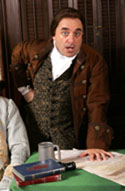
1776-SU-087rt2web.jpgGoodspeed Musicals' revival of "1776" was the first time I'd seen Peter Stone's rousing salute to the Founding Fathers onstage since the original road-show version came to St. Louis 35 years ago. That production was a spectacular piece of work whose quick-change set (designed by the legendary Jo Mielziner) is still clear in my mind's eye. I wondered how Goodspeed could squeeze the whole show onto the tiny stage of its 130-year-old theater without breaking something, but no sooner did the red-white-and-blue curtain go up on Michael Schweikardt's handsome-looking version of the Chamber of the Continental Congress than I knew I was in good hands. Goodspeed's "1776" is a masterpiece of compression, a production that more than makes up in stylishness for what it lacks in costly gimmickry.

"1776," of course, tells the story of the writing of the Declaration of Independence. That isn't exactly your stock musical-comedy plot, and for all the show's not-infrequent moments of cartoonishness, it's gratifying to see how seriously Stone (who wrote the book) and Sherman Edwards (who wrote the songs) took their task. In between the one-liners, "1776" paints a clear-eyed picture of the hard-nosed give and take of political compromise....

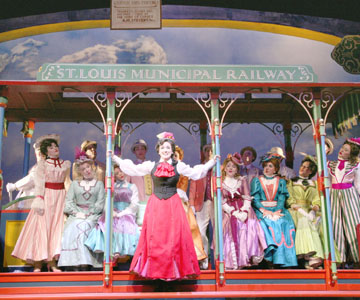
mmsl1_preview.jpgLike "1776," Paper Mill's "Meet Me in St. Louis" profits from being performed on a good-looking set. Rob Bissinger's rendering of 5135 Kensington Avenue, the best-known imaginary address in Hollywood, is a life-sized, candy-colored dollhouse whose walls swing open to reveal a turn-of-the-century living room. Denis Jones' staging of the musical numbers is equally eye-catching--I've never seen better choreography in a regional musical-comedy production--and the cast tears into his steps with the right mix of precision and high spirits. I wish Mark S. Hoebee, the director, had dialed down the cuteness a notch or two, but it never gets out of hand, and several of the performers, especially JB Adams and Roni Caggiano, are as good as you could possibly hope for....

* * *

To read the whole thing, go here. (Please e-mail me if you have any trouble with this link!)

Posted November 30, 12:00 AM

CAAF: 5x5 Books of a New World Order by Calvin Baker

5 x 5 Books ... is a recommendation of five books that appears regularly in this space. Today's installment comes from an old friend of mine, Calvin Baker. Calvin's the author of three novels, including, most recently, the magnificent Dominion, which Maud championed as one of the best books of 2006.

Whenever a certain kind of person asks me what the world beyond the post-modern looks like I usually reply that it will look like a poem or a film or a sculpture: like art; not theory. But art in America, as a rule is understood in its relationship to other forces (mercantile, political, academic, whatever), never its own primacy. It's a situation, whatever its other advantages or disadvantages, which has engendered a conversation that has failed to understand the fundamental shift underfoot, concerning itself instead with its own self-reflective anxieties.

The truth, or closer to it, is that the next great thing is already well underway, and it is possible to point to several writers who share a concern, an opening move if not a common project, that might be described (roughly, for now) as creating narratives large enough to contain our fractured inheritances from the last epoch. While some of these writers have already been acclaimed for various aspects of the stories they've told, the underlying scale and import of the questions being posed -- What's Going On? -- have yet to be taken up in a meaningful way.

In the meantime here are five novels of ideas (3 classic and 2 that seem destined to become canonical), each revolutionary or anti-revolutionary in a way that describes their respective ages as well as anything else. They deserve to be read, or read again, on different terms: in light of their relationship to the novel itself.

1. Buddenbrooks by Thomas Mann. When Tony Buddenbrooks, a beautiful, divorced, woman of dwindling prospects dismisses a wealthy suitor because, "Er sagt mich stadt mir" (He says who <.em>instead of whom), and it's not the beginning of a morality tale then you know you're in a world of the sublime. In this case it's the fluid, intellectually sophisticated, milieu of the early 20th-century haute bourgeoisie (Bildungsburghertum), with the shadow of aristocracy on one hand, and the tenuous nature of their own position on the other.

Mann, of course, was the last European master who could act with the underlying assumption that the intellectual, political and material wants of the society he was born into shared more than physical space -- that his project and the values of his culture were one -- without drawing suspicion of naïveté or worse.

He continued to believe this until he was living in exile. Claiming until the last that the betrayal of the rest of the society by its political custodians was an aberration. Historians might make other claims, however, as the arcs of the 20th century played out at different paces in the European capitals, the case can still be made for Mann as the last of the great realists, trusting unmediated literary representation and inquiry to make deep sense of the world. Never mind that it was already a modernist one.

2. Invisible Man by Ralph Ellison. Ellison might be the single most important American writer of the last hundred years. Where others traded on well-established schools of thought he combined the protean modernist sensibility of Toomer with the formal perfection of the European novel to create an Erfahrungsroman for the 20th century. He is the fork in the road of American literature, one path leading to the well-behaved world of mannerism and craftsmanship, and the other diving down the rabbit hole into the gleeful madman lands of Reed and, only slightly less directly, Pynchon. Besides having a share to the claim Great American Novel, this book does even more than invent the jazz novel. This is funk before funk had a name.

3. The Alexandria Quartet by Lawrence Durrell. This is the epitome of a book whose failures show as much its triumphs. Durrell lays bear his ambition with the claim: "Modern literature offers us no Unities, so I have turned to science and am trying to complete [a novel] whose form is based on relativity. Three sides of space and one of time. ... I have tried to turn the novel through both subjective and objective modes..." Post-modernism avant la letter. And that's just the hand he reveals. Among a great many other things this is a project that also happens to be Cosmopolitan, devious (Sadian, Lawrencian, that is to say before the pill) and sexy as hell.

If his worldly gaze strikes the contemporary reader as chauvinistic, or as sharing a border of Empire with Kipling, well nothing can transcend its age entirely. Here is a writer whose meridional creativity grasps with a beautiful ease of intelligence the relationship between the fleeting and the permanent in a single sentence. Between the body, language and the fragile invisible they may sometimes express, or summon into being.

4. By Night in Chile by Roberto Bolaño, translated by Chris Andrews. Latin American artists tend to look further afield for inspiration and models than their northern counterparts. Certainly they tend to be more Europe-facing. So much so it might be argued that between the anxieties of whiteness and so-called Magic Realism the following generation had a hard time taking shape. It turns out, in the best of cases, it's because they were out wrasslin' with the biggest problems they could find.

For Roberto Bolaño the essential, atlas-like question is the nature of creation and the genesis of evil itself, both its personal and historical manifestations on a global scale. As might be imagined ambition like that needs a language of its own, and Bolaño creates a startling poetry to carry his meaning over.

If Bolaño is one of the great artists of his generation (and his core achievement seems to me on a level with Achebe -- Sui generis), he has found in Chris Andrews the ideal translator. Where other interpreters seem to miss a beat, Andrews displays an intensity and lightness that get to the poetic and metaphysical reaches without losing, or attempting to sweep away, the spaces and silences of what cannot be translated.

5. Never Let Me Go by Kazuo Ishiguro. Post-modernism taken seriously has become the province of the grand old men, playing out the bittersweet end of what was the game of their times. It is not equal to the codes or experiences of our moment. While Coetzee -- viewed with mutual suspicion by most black African writers, who suffer a different double-blind -- tries to balance the equation while describing magnificently and, in the end quite revealingly, the noble and tortured last wall of the old school, several writers have already scrambled over to the other side. Among the many conceivable solutions none is quite so sly as the one offered by Kazuo Isiguruo (who shares many concerns with Coetzee, but feints to the zeitgeist as often as the canon). His deceptively simple sentences contain whole other worlds, vast unspoken epistemologies, beneath their surface. Among other things Never Let Me Go is a haunting disquisition on whether love or art can explain our world, or save us from inhuman fates.

The most frequent complaint against this book is: Why don't they make a run for it? Opening onto the larger: Why don't we all?

Posted November 30, 12:00 AM

TT: Almanac

"I have always hated biography, and more especially, autobiography. If biography, the writer invariably finds it necessary to plaster the subject with praises, flattery and adulation and to invest him with all the Christian graces. If autobiography, the same plan is followed, but the writer apologizes for it."

Carolyn Wells, The Rest of My Life

Posted November 30, 12:00 AM

November 29, 2007

TT: By the way...

(1) Yes, we have a new toy.

(2) Yes, I'm playing with it.

(3) Yes, I'm having fun.

(4) No, I don't know how to upload audio files yet. Don't get greedy.

Posted November 29, 3:37 PM

TT: Picture this

Earlier this year the soon-to-be Mrs. T and I purchased a Jane Wilson watercolor called "Breaking Light." It was part of DC Moore Gallery's most recent exhibition of Wilson's work, about which I blogged here.

This is the watercolor:
%2836%29%20WILSON%20BREAKING%20LIGHT

A couple of weeks ago, DC Moore sent us a copy of Valerie Gladstone's review of the show, which appeared in the March issue of ARTnews. Much to our surprise, "Breaking Light" was mentioned in the review:

Like Bonnard and Rothko, whose works resonate in a number of these paintings, Wilson employs color in various innotative ways to produce depth and create surface vitality. Her skies are so immense, they dwarf the land and sea beneath them...

The artist's watercolors were as compelling as her oils, albeit softer and with a more liquid feeling. This was abundantly apparent in her brooding aquamarine painting Breaking Light (2003).

Pretty cool, huh?

Posted November 29, 2:45 PM

TT: Planning ahead for Valentine's Day

Midder Music is releasing a two-CD set of previously unreleased recordings by my old friend Nancy LaMott on February 12. It's a sequel of sorts to Live at Tavern on the Green, the 2005 album of performances taped at her last nightclub engagement. (I wrote about that CD here.)
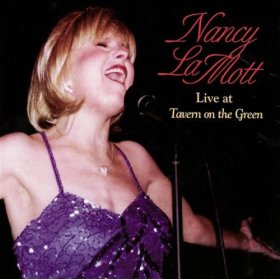
51c6zxGUKyL._AA280_.jpg Ask Me Again, the new album, will contain twenty tracks, including "Call Me Irresponsible," "Cheek to Cheek," "Easy to Love," "Have Yourself a Merry Little Christmas," "The Shadow of Your Smile," "The Wind Beneath My Wings," and a Stephen Sondheim medley. I haven't heard it yet, but I heard Nancy sing most of the songs on Ask Me Again at one time or another, and I have no doubt that you'll enjoy them now as much as I did then.

In addition to the CD, Midder also plans to release a companion DVD called I'll Be Here With You: A Collection of Rare Live Performances 1978-1995. Among other things, it will include a version of "Moon River" that Nancy sang on The Charles Grodin Show nine days before her death in 1995.

For more details, go here.

Posted November 29, 9:22 AM

TT: So you want to see a (post-strike) show?

It's true! It's true! The Broadway stagehands' strike has been tentatively settled. Some shows are expected to reopen immediately, but few specific details were available as of late Wednesday night, though it's generally expected that virtually all shows will be up and running by the weekend.

One show, Chicago, is offering a one-time cut-rate ticket price of $26.50 for Thursday night's performance, available only at the box office. I'll update this posting throughout the day with news of any similar offers. (As of noon today, no other shows have announced discounts for tonight's performances.)

In the meantime, here's my list of recommended Broadway, off-Broadway, and out-of-town shows, updated weekly. In all cases, I gave these shows favorable reviews in The Wall Street Journal when they opened. (I like Chicago, too, but I haven't seen the Broadway production since 2005 and can't tell you what shape it's in now.)

For more information, click on the title.

Warning: Broadway shows marked with an asterisk were sold out, or nearly so, last week.

BROADWAY:
Avenue Q (musical, R, adult subject matter and one show-stopping scene of puppet-on-puppet sex, reviewed here)
A Chorus Line (musical, PG-13/R, adult subject matter, reviewed here)
The Drowsy Chaperone (musical, G/PG-13, mild sexual content and a profusion of double entendres, reviewed here)
Grease (musical, PG-13, some sexual content, reviewed here)
Rock 'n' Roll (drama, PG-13, way too complicated for kids, reviewed here)
The 25th Annual Putnam County Spelling Bee * (musical, PG-13, mostly family-friendly but contains a smattering of strong language and a production number about an unwanted erection, closes Jan. 20, reviewed here)

OFF BROADWAY:
The Fantasticks (musical, G, suitable for children old enough to enjoy a love story, reviewed here)
The Glorious Ones (musical, R, extremely bawdy, closes Jan. 6, reviewed here)
Things We Want (drama, R, adult subject matter, closes Dec. 30, reviewed here)

CHICAGO:
A Park in Our House (drama, PG-13, adult subject matter, closes Dec. 9, reviewed here)
What the Butler Saw (comedy, R, extremely adult subject matter, closes Dec. 9, reviewed here)

CLOSING SOON IN NEW YORK:
Pygmalion * (comedy, G, suitable for mature and intelligent young people, closes Dec. 16, reviewed here)

Posted November 29, 12:00 AM

TT: Almanac

"The secret of biography resides in finding the link between talent and achievement. A biography seems irrelevant if it doesn't discover the overlap between what the individual did and the life that made this possible. Without discovering that, you have shapeless happenings and gossip."

Leon Edel, interview in Writers at Work, Eighth Series

Posted November 29, 12:00 AM

November 28, 2007

CAAF: Morning coffee

• John Updike on wonky dinosaurs. (via Ed.)

• Daniel Engber to Jonah Lehrer: "Proust was not a neuroscientist." Engber's article closes with a call for entries for a list of the "all-time worst literary allusions in the history of peer-reviewed science." The first submission:

"Great writers, from Dante to Joyce, often weave various meanings into their writings."--Guigo et al. 2006. Unweaving the meanings of messenger RNA sequences. Molecular Cell 23: 150-151.

Posted November 28, 8:00 AM

TT: Hither, yon, etc.

I'm up early again working on a piece, so I checked our world map of recent visitors and saw that in the past few hours we've been viewed in Australia, Botswana, China, Egypt, Germany, Greece, Grenada, India, Italy, Japan, Latvia, Mexico, New Zealand, Scotland, South Africa, and Sweden. Not to mention Cincinnati, Cleveland, Iowa City, Milwaukee, Minneapolis, Nashville, Philadelphia, Portland, Providence, Raleigh, Richmond, San Diego, San Antonio, Santa Monica, Seattle, and Tulsa.

Good morning, everybody!

Posted November 28, 6:50 AM

EXHIBITION

Jacob Lawrence's Migration Series: Selections from the Phillips Collection (Whitney Museum of American Art, 945 Madison Ave., up through Jan. 6). A rare opportunity for New Yorkers to see seventeen of the thirty Phillips-owned panels from Lawrence's unforgettable sequence of paintings about the Great Migration of rural southern blacks to the big cities of the north. (The other half of the sequence is owned by MoMA.) The Phillips usually only shows a handful of Lawrence panels at any given time, but all thirty will be on display starting May 3. A word to the wise: visit the Whitney now, then go to Washington this summer (TT).

Posted November 28, 6:42 AM

CAAF: Reconstructing the whole monstrous shape

Lately I've been dipping in and out of Louisa May Alcott's first novel, Moods. The novel was published in 1864 (four years before the publication of Little Women made Alcott famous), and it's one of a handful of books that she wrote for an adult audience.

The plot deals with a love triangle, and it seems to be commonly accepted that Alcott modeled the novel's tomboy heroine after herself, and the two men she's torn between after Henry David Thoreau and Ralph Waldo Emerson. I don't why the idea of this love triangle tickles me so, but it does. Infinitely. I only regret there was no sequel in which the heroine, now a contented old married lady, is jarred from her knitting by a knock on the door from Merman Helville, a man of quiet but manly disposition who after decades of sea-voyaging has come home to claim his bride.

The edition I'm reading is a nice one; put out by Rutgers University Press, it contains substantial revisions to the novel made by Alcott years after its initial publication (it was republished in 1882) as well as an early review of Moods written by Henry James. If you're a writer, I invite you to pause here to imagine what it would be like to have Henry James critique your first novel: To borrow from the language of Moods, an agitated spirit might fill your breast.

I adore Alcott -- she's a great hero of mine, has been since I was a kid (oh Jo!) -- so I feel a tinge of disloyalty in finding James' review wickedly funny. In this excerpt James first supplies some plot synopsis, then takes issue with a type of romantic lead he finds all too common in the work of "lady novelists" (note: the Warwick character is the one based on Thoreau):

The heroine of "Moods" is a fitful, wayward, and withal most amiable young person, named Sylvia. We regret to say that Miss Alcott takes her up in her childhood. We are utterly weary of stories about precocious little girls. In the first place, they are in themselves disagreeable and unprofitable objects of study; and in the second, they are always the precursors of a not less unprofitable middle-aged lover. We admit that, even to the middle-aged, Sylvia must have been a most engaging little person. One of her means of fascination is to disguise herself as a boy and work in the garden with a hoe and wheelbarrow; under which circumstances she is clandestinely watched by one of the heroes, who then and there falls in love with her.

Then she goes off on a camping-out expedition of a week's duration, in company with three gentlemen, with no superfluous luggage, as far as we can ascertain, but a cockle-shell stuck "pilgrim-wise" in her hat. It is hard to say whether the impropriety of this proceeding is the greater or the less from the fact of her extreme youth. The fact is at any rate kindly overlooked by two of her companions, who become desperately enamored of her before the week is ut. These two gentlemen are Miss Alcott's heroes. One of them, Mr. Geoffrey Moor, is unobjectionable enough; we shall have something to say of him hereafter; but the other, Mr. Adam Warwick, is one of our oldest and most inveterate foes. He is the inevitable cavaliere servente of the precocious little girl; the laconical, satirical, dogmatical lover, of abut thirty-five, with the "brown mane", the "quiet smile", the "masterful soul", and the "commanding eye." Do not all novel-readers remember a figure, a hundred figures analogous to this? Can they not, one of his properties being given,--the "quiet smile" for instance,--reconstruct the whole monstrous shape? When the "quiet smile" is suggested, we know what is coming; we foresee the cynical bachelor or widower, the amateur of human nature, "Full of strange oaths, and bearded like the pard", who has traveled all over the world, lives on a mysterious patrimony, and spends his time in breaking the hearts and the wills of demure little school-girls, who answer him with "Yes sir", and "No, sir."

Mr. Warwick is plainly a great favorite with the author. She has for him that affection which writers entertain, not for those figures whom they have well known, but for such as they have much pondered. Mis Alcott has probably mused upon Warwick so long and so lovingly that she has lost all sense of his proportions. There is a most discouraging good-will in the manner in which lady novelists elaborate their impossible heroes. There are, thank Heaven, no such men at large in society. We speak thus devoutly, not because Warwick is a vicious person,--on the contrary, he exhibits the sternest integrity; but because, apparently as a natural result of being thoroughly conscientious, he is essentially disagreeable. Women appear to delight in the conception of men who shall be insupportable to men.


The review does end with some praise for the novel, though one guesses it rang faint in the ears of the book's author. James allows that with one exception, the author "sympathizes throughout her novel with none but great things. She has the rare merit, accordingly, of being very seldom puerile. For inanimate nature, too, she has a genuine love, together with a very pretty way of describing it. With these qualities there is no reason why Miss Alcott should not write a very good novel, provided she will be satisfied to describe only that which she has seen."

Posted November 28, 12:00 AM

TT: Almanac

"Biography is: a system in which the contradictions of a human life are unified."

José Ortega y Gasset, "In Search of Goethe from Within"

Posted November 28, 12:00 AM

November 27, 2007

TT: And the band played on

I find it all but impossible to believe that nearly two decades have gone by since I met Maria Schneider. I had the good luck to hear Maria's music when she was just getting started as a bandleader, and the good sense to recognize that it bore the stamp of something more than mere talent. From then on I followed her work closely, and when I started contributing profiles to The Wall Street Journal a few years later, she was at the top of my short list of people about whom I wanted to write. So far as I know, "At 33, a Composer of Note," which was published in the Journal on October 7, 1994, was the first time anyone wrote at length about Maria outside of the jazz press, a fact of which I have long been sinfully proud, never more so than when she won her first Grammy two years ago. It's nice to be ahead of the crowd--and even nicer when it finally catches up with you.

Last week I went to the Jazz Standard to hear Maria's band play selections from Sky Blue, their latest CD. As I listened, I marveled for the umpteenth time that such richly colored, meticulously wrought sounds had sprung from the mind of so improbable a creature. Maria is a pretty, giggly, irrepressibly enthusiastic strawberry blonde who is...well, let's just call her the kind of person to whom stuff happens. Whenever she returns from the road, she always has hair-raising adventures to report, some of which will pop up in her music sooner or later. Few instrumental composers of importance (and Maria is a very important composer) have drawn so directly on the remembered experiences that she transforms by an impenetrable act of mental alchemy into the pastel clouds of sound that are her compositions. I love to watch bits and pieces of her life find their way onto manuscript paper: hang gliding, childhood car rides, the dance music of Latin America, the sound of birds singing in Central Park.

Maria is a thoughtful, introspective woman who has known her share of sorrow and been toughened by it. Yet I can't think of another artist who is less guarded, especially when she clambers onto a bandstand and starts telling an audience about the next piece on the program. Like my late friend Nancy LaMott, Maria is a blurter, and anything can happen when she gets in front of a microphone. I can't count the number of times that I've listened to one of her helter-skelter monologues and asked myself how it was possible that so zany a person could have brought pieces like "Hang Gliding," "Buleria, Soleá y Rumba," and "Cerulean Skies" into the world. Nothing is as mysterious as creativity, even when you know the creator. Especially when you know the creator.

I left my Wall Street Journal profile of Maria out of the Teachout Reader because it was too short to stand on its own, and also because I'd already spun part of it into the liner notes I wrote for Coming About, her second album. It occurs to me that you might be interested in reading the original piece, which hasn't been reprinted since it appeared in the Journal in 1994. (Alas, Visiones, the much-loved Greenwich Village nightclub referred to in the piece, closed its doors years ago.) Better pieces have been written about Maria Schneider since then, but this one had the virtue of being first.

* * *

According to the history books, the big-band era came to a screeching halt in December 1946, when eight of the country's top bandleaders (among them Benny Goodman, Tommy Dorsey and Harry James) folded their tents and retired to the land where the good songs go. Forty-eight years later, big bands are the dinosaurs of the music business--unwieldy, expensive and, some think, headed inexorably for extinction. But try telling that to the 17 musicians who gather every Monday night at Visiones, a Greenwich Village nightclub, to play the music of Maria Schneider, a slight, strawberry-blond woman who, at the age of 33, is regarded by a rapidly growing number of insiders as one of the most promising young jazz composers in the world.

Schneider, who hails from Windom, Minn. (pop. 4,288), doesn't look like a composer or act like a musician. "People are always asking me if I sing with the band," she complains laughingly. In fact, she doesn't even play with the Maria Schneider Jazz Orchestra. All she does is lead it--waving her arms in a T-square junior-high band director's beat straight out of Conducting 101--and write the music it performs.

It's hard for a musician who specializes exclusively in composition to make much of an impression on the chops-conscious virtuosos of the jazz world. But Schneider knows it can be done, because she worked closely with one of the few people who has done it: Gil Evans, the master composer who arranged Miles Davis's classic albums "Sketches of Spain," "Miles Ahead" and "Porgy and Bess." Schneider was Evans's musical assistant during the last three years of his life. "Gil was relaxed, calm, incredibly sweet, gentle, spiritual," she recalls. Before meeting Evans, she studied with valve trombonist Bob Brookmeyer, who wrote brilliant arrangements for the Gerry Mulligan Concert Jazz Band and the Thad Jones/Mel Lewis Jazz Orchestra.

Working with Evans and Brookmeyer inspired Schneider to develop a stunningly original sound of her own. She can write old-fashioned flagwaver-with-a-shout-chorus charts whenever she pleases, but prefers to turn out harmonically complex originals with subtly blended instrumental colors that suggest Evans without ever borrowing from him. Though her music has a fresh, childlike quality that mirrors her friendly small-town demeanor, Schneider also has a sure-footed grasp of formal structure--one of Brookmeyer's obsessions--that is rare in a jazz composer. "I think my music has a strong element of fantasy in it," she says, adding that the inspirations for her compositions are as likely as not to be visual: dreams, paintings ("Some Circles" is named for a canvas by Kandinsky), even ballets (a self-described "New York City Ballet freak," Schneider would love to write a score for Jerome Robbins).

With the great days of the road bands long past, the only way for a jazz composer like Schneider to get his or her work played regularly is to put together a group. She did so in 1989, initially in collaboration with trombonist John Fedchock, who played with and wrote for Woody Herman's last band. (Schneider is now sole leader of the group.)

"You can't imagine how expensive it is to start a band," she says. "In New York, just to rehearse costs around $150 to hire a studio and rent sound equipment. Then you have to get the music together. The Xeroxing, the time spent copying the parts--it adds up fast. There aren't that many clubs, either, and they can't pay that much because they aren't doing that well. We're so lucky to have Visiones."

Since there aren't enough jobs available to keep a big band together full time, Schneider does what Jones and Lewis did before her: She pays 17 players $20 a night to get together on Mondays (in most big cities, Monday is musicians' night off) and perform her music. The personnel, though basically constant, necessarily fluctuates from week to week. The musicians occasionally send substitutes in order to make more lucrative gigs, but when the first-string team is in place and the moon is in phase, the band can blow the roof off Visiones without even raising a sweat. Not that Schneider minds seeing unfamiliar faces on Monday night: "I used to really panic when strange people were sight reading on the bandstand, but I don't anymore. A lot of times, just one new player can spark a whole new enthusiasm in the band."

Unlike many jazz composers, Schneider refuses to write commercial music in order to eke out a living: "I did do two jingles when I first came to New York, but it was disastrous--I did nothing but cry the entire time I wrote them." At first, she worked as a music copyist for other composers and arrangers; she now underwrites her band by accepting composing projects from the state-subsidized TV and radio orchestras of Europe, where her reputation is high. But in the U.S., Schneider was for many years known only to jazz lovers lucky enough to stumble into Visiones on a Monday night.

In order to spread the word about her band, Schneider recorded nine of her best charts, paying for the studio time out of her own pocket, and shopped the master tape around to various record companies. Enja Records liked what it heard and turned the tape into her first CD, "Evanescence," released earlier this year to uniformly enthusiastic reviews.

"I still have people telling me that I need to make my music a little more commercial to make money," Schneider says. "But I think that if you stick to the thing you really love and work really hard at it, you can create your own market--your music will be unique, and people will come to hear you. And if they don't, I'd still rather copy music or flip burgers for a living. I could live with that. I couldn't live with writing commercial music that I don't feel from my heart."

* * *

To purchase Sky Blue, go here.

Posted November 27, 12:00 AM

TT: Almanac

"Biography, too, is liable to the same objection; it should be autobiography. Let us not, as the Germans advise, endeavor to go abroad and vex our bowels that we may be somebody else to explain him. If I am not I, who will be?"

Henry David Thoreau, A Week on the Concord and Merrimack Rivers

Posted November 27, 12:00 AM

November 26, 2007

TT: What it's all about

A reader writes:

I greatly enjoyed your Mencken book and am looking forward to the Armstrong bio. I have enjoyed some writing about him in the past, but never felt I read anything definitive--so please write that book!

To which the only possible response is...yikes! I don't think there can be such a thing as a definitive biography of a great man. Louis Armstrong is simply too large, both as an artist and as a man, to be summed up for all time between the covers of a single book. Even if such a thing were possible, the resulting book would be unreadably long. That's why the subtitle of The Skeptic was "A Life of H.L. Mencken," not "The Life of H.L. Mencken." As I said in the preface, "I have made no attempt to be exhaustive, so as to avoid being exhausting."

So what am I trying to do? The answer can be found in this excerpt from the preface to my book, of which the first seven chapters (there are twelve) are now complete. If you want to know why I decided to write yet another book about Satchmo, the answer is here.

* * *

Louis Armstrong was one of the greatest artists of the twentieth century, and much has been written about his life and work, some of it penetrating and perceptive. Yet this is, surprisingly, the first fully sourced biography of Armstrong to be written by an author who is also a trained musician--though it is not a "scholarly" biography in the ordinary sense of the word. I see this book less as a work of original scholarship than an act of synthesis, a narrative biography based on the research of those academic scholars and other investigators who in recent years have unearthed a wealth of hitherto unknown information about Armstrong, especially regarding his early years....

I have also been privileged to draw on archival material unavailable to previous biographers, including 650 reels of tape recordings privately made by Armstrong during the last quarter-century of his life and subsequently deposited by Lucille, his fourth and last wife, in the Louis Armstrong Archives at Queens College/CUNY. These recordings, as will become evident, are of considerable significance, and I have made extensive use of them, just as I have drawn heavily on Armstrong's own writings, both published and unpublished. He was one of a handful of jazz musicians, and the only major one, to leave behind a substantial body of prose writing (including two full-length autobiographies, dozens of magazine articles, and hundreds of letters) in which his thoughts are presented in wholly or largely unmediated form, and it is in his own words that he comes across most clearly.

I have sought to make every page of this book comprehensible to the general reader. At the same time, I hope it will be of interest to specialists, especially those who know more about Armstrong's music than his life. It goes without saying--or should--that his music was the most important thing about him, but his personal story, in addition to shedding light on the wellsprings of his art, is significant in its own right, and is no less deserving of a historically aware interpretation....

Armstrong was a child of his time, not ours, and some of the things he did and said as an adult are scarcely intelligible to those who know little about the long-lost world of his youth. Even in his own time he was widely misunderstood, often by people who should have known better (and who in some cases came to know better). For this reason I have tried to place him and his achievements in the widest possible perspective. He was, of course, the central figure in twentieth-century jazz, but he was also a key figure in the modern movement in art, as well as an emblematic figure in the history of American culture and, in the opinion of all who knew him, a great man. "I know of no man for whom I had more admiration and respect," Bing Crosby wrote to Lucille after Armstrong died. The ultimate purpose of this book is to explain to a new generation of listeners why those words still ring true.

Posted November 26, 12:00 AM

TT: Almanac

"There never was a good biography of a good novelist. There couldn't be. He is too many people, if he's any good."

F. Scott Fitzgerald, The Crack-Up

Posted November 26, 12:00 AM

November 24, 2007

THE PRICE OF THE TICKET

"Don't get me wrong: I like musicals, the same way I like ice-cream sundaes. But man cannot live by dessert alone, and now that most of Broadway is shuttered, it has become clearer than ever before that there are better and cheaper places to get a steak..."

Posted November 24, 9:02 AM

November 23, 2007

CD

Trio Solisti, Pictures at an Exhibition. The "filler" is the highlight: a flawless performance of Ravel's luscious A Minor Piano Trio by the group that to my mind has now succeeded the Beaux Arts Trio as the outstanding chamber-music ensemble of its kind. The main event is an ingenious arrangement of Mussorgsky's masterpiece by the members of the trio. It's fun to hear but ultimately inessential--all Pictures needs to make its effect is a single pianist. The Ravel, on the other hand, is worth twice the price of the album all by itself (TT).

Posted November 23, 6:22 PM

TT: The prison of the heart

Broadway is still on strike, so I flew to Chicago last weekend to see the Victory Gardens production of Nilo Cruz's A Park in Our House and the Court Theatre's revival of Joe Orton's What the Butler Saw. Read all about it in this morning's Wall Street Journal:

Mr. Cruz, who was born in Cuba in 1961, won a Pulitzer Prize in 2003 for "Anna in the Tropics," a sumptuously old-fashioned play whose high drama and luxuriant language delighted me when I saw it on Broadway. "A Park in Our House," written in 1996, works the same rich vein of poetic naturalism. Set in Cuba in 1970, it shows what happens when Dimitri (Lance Baker), a Russian scientist, spends a month with a family whose members are suffering from the effects of life under Castro. The father (Gustavo Mellado) is a government apparatchik who no longer believes in the system he serves and has been rendered impotent by his subservience, while Pilar (Marcela Muñoz), his daughter, is a nubile, idealistic teenager who fancies herself a "romantic revolutionary" and longs to live in Moscow but settles for sleeping with Dimitri. She is too naïve to fully understand what the adults with whom she lives know from hard experience, which is that her country is a prison of the heart, a place where fear and distrust seep into every human transaction and even the unconscious mind is tainted....

Mr. Cruz knows how to make his dialogue sing and shine, and the six members of the cast of "A Park in Our House," co-produced by Victory Gardens Theater and Teatro Vista, a local Latino company, are no less adept at making the most of the gorgeous speeches he has put in their mouths....

Joe Orton was the Great Anarch of postwar farce, and had he not been bludgeoned to death in 1967 at the cruelly early age of 34, he would now be universally acknowledged as a major playwright. Instead, his posthumous reputation is based on only three full-length plays, the last of which, "What the Butler Saw," has just been revived by the Court Theater, the University of Chicago's much-admired professional ensemble. I have some problems with this production, but it works--the opening-night crowd laughed itself silly--and if you've never seen any of Orton's plays, it's a plausible place to start.

To read the whole thing, go buy a copy of this morning's Journal. This used to be where I recommended that you subscribe to the paper's online edition, but now that Rupert Murdoch has announced his intention to make the subscription-only Online Journal free at some point in the near future, I've cut that out! (If you're already a subscriber to the Online Journal, you'll find my column here.)

UPDATE: A fellow blogger advises me that it is already possible for nonsubscribers to read my Journal reviews by clicking on the Online Journal links that I provide in this space each week. How about that? Act accordingly!

Posted November 23, 12:00 AM

TT: The price of the ticket

Inspired by the stagehands' strike, I did some poking around and discovered that the top price of a ticket to a Broadway show, controlled for inflation, has gone up 100% since 1968. Has Broadway really gotten twice as good in the past 39 years? Curious, I pulled out my New Yorker CD-ROMs, looked up the "Goings On About Town" theater listings for the issue of November 23, 1968...and quickly realized that I'd come up with the makings of a "Sightings" column.

Is Broadway worth it--or are there better theater-related entertainment deals to be had elsewhere, both in and out of New York? To find out, pick up a copy of Saturday's Journal and turn to my "Sightings" column in the Weekend Journal section, in which I ask some hard questions about the current state of the Great White Way.

UPDATE: To read the whole thing, go here (I think!).

Posted November 23, 12:00 AM

TT: Almanac

"Gratitude is a sickness suffered by dogs."

Joseph Stalin (quoted in Nikolai Tolstoy, Stalin's Secret War)

Posted November 23, 12:00 AM

November 22, 2007

TT: So you want to see a show?

Most shows currently playing on Broadway remain closed until further notice by the stagehands' strike. All off-Broadway shows are open as usual. Here's my list of recommended shows in New York and out of town that are unaffected by the strike. In all cases, I gave them favorable reviews in The Wall Street Journal when they opened. For more information, click on the title.

Warning: Broadway shows marked with an asterisk were sold out, or nearly so, last week.

BROADWAY:
Pygmalion * (comedy, G, suitable for mature and intelligent young people, closes Dec. 16, reviewed here)
The 25th Annual Putnam County Spelling Bee * (musical, PG-13, mostly family-friendly but contains a smattering of strong language and a production number about an unwanted erection, closes Jan. 20, reviewed here)

OFF BROADWAY:
The Fantasticks (musical, G, suitable for children old enough to enjoy a love story, reviewed here)
The Glorious Ones (musical, R, extremely bawdy, reviewed here)
Things We Want (drama, R, adult subject matter, reviewed here)

MINNEAPOLIS:
The Home Place (drama, PG-13, adult subject matter, reviewed here, closes Sunday)

Posted November 22, 12:00 AM

TT: Almanac

"One can never pay in gratitude; one can only pay 'in kind' somewhere else in life."

Anne Morrow Lindbergh, North to the Orient

Posted November 22, 12:00 AM

November 21, 2007

CAAF: To gluttony

We always celebrate Thanksgiving at my parents' house here in Asheville. My parents are accomplished cooks and hosts, but a while back it struck me that I should make a gesture toward contributing to the meal. I was told to bring "green bean casserole." This was disappointing -- although I often talk about not being a good cook, I was a little offended that my family seemed to believe me. And green bean casserole is, I've decided, the cream-of-mushroom equivalent of an O. Henry story: A sacrifice to make, and a sacrifice to eat. But my mom continued to request it, so each year I would arrive at their door clutching a murky, bog-laden Pyrex. Last year, however, circumstances combined to make it impossible for anyone else in the family to cook, and I was put in charge of the dinner. The experience was not unlike when a fourth-string scrub is plucked from the bench for the Big Game. I made beef tenderloin, homemade macaroni and cheese, cranberry chutney and a beautiful pear salad (I was working with the theme: what if the Pilgrims had landed at a Wisconsin steakhouse instead of Plymouth? After dinner we had Grasshoppers.) It wasn't traditional -- I had to make something that could be delivered picnic style -- but it came off well enough that this year I've been asked to reprise the chutney and salad. No green bean casserole, hoorah.

Tomorrow is also Mr. Tingle's and my anniversary. It's our seventh, so we've rented The Seven Year Itch to watch when we get home. (I now wish I'd had the presence of mind to rent Who's Afraid of Virginia Woolf? too, to make it a truly romantic double feature.)

I have many things to be grateful for this year. One of the nicest among them is joining Terry and Laura at About Last Night. My thanks to them and to you readers, along with hopes that you enjoy a happy, safe holiday. See you next week!

Posted November 21, 10:47 AM

TT: Almanac

"Gratitude is the most exquisite form of courtesy."

Jacques Maritain, Reflections on America

Posted November 21, 12:00 AM

November 20, 2007

TT: For the record

I just got back from the first set of Maria Schneider's opening night at the Jazz Standard. It was completely sold out. The band played gorgeously. The music was beautiful. The barbecue was tasty.

If you want to hear Schneider's big band this week, don't delay--make a reservation now. Go to the Top Five module of the right-hand column for more information.

(We return you now to your increasingly desperate Thanksgiving Eve packing routine.)

Posted November 20, 10:11 PM

TT: Almanac

"Gratitude is a fickle thing, indeed. A person taking aim presses the weapon to his chest and cheek, but when he hits, he discards it with indifference."

Franz Grillparzer, Libussa

Posted November 20, 12:00 AM

November 19, 2007

TT: Turkey-related status

Mrs. T and I are flying back from Chicago, where we spent the weekend seeing two shows in the company of Our Girl. Tomorrow Hilary returns to Connecticut, while I write two pieces and go to the Jazz Standard to hear the Maria Schneider Orchestra. On Wednesday I drive north to spend Thanksgiving with Hilary and her family, see two musicals, and continue working on my Louis Armstrong biography.

The joint, in short, is jumping like hell, and things were further complicated when I learned last Friday night that my mother had fallen and cracked her pelvis. (She's in the hospital, resting comfortably.) All this means, not surprisingly, that posting will be iffy for the rest of the week. Expect the usual almanac entries and theater-related items--including news about the stagehands' strike, which is still very much up in the air as I write these words--but otherwise I shall try to stick to my last.

OGIC and CAAF will do whatever they do, or don't.

See you around.

UPDATE: Strike talks broke off last night and Broadway producers announced the cancellation of performances through Nov. 25.

For a list of Broadway shows that remain open, go here.

Posted November 19, 12:00 AM

TT: Almanac

"It's hard for me to take your despair very seriously, Doctor. You obviously enjoy it so much."

Paddy Chayefsky, screenplay for The Hospital

Posted November 19, 12:00 AM

November 16, 2007

TT: Ecstasy

"The interesting thing about 'Potato Head Blues,'" I said to John Pancake, the man who edited my old "Second City" column for the Washington Post, "is that it's one of the few really popular Louis Armstrong recordings that has no vocal." Then I blinked my eyes, realized that I was in bed, and looked at the clock. It was four-thirty in the morning, and John was nowhere to be seen. I'd been dreaming about my Louis Armstrong biography, which I restarted on Wednesday after a six-week hiatus.

The realization that Satchmo had invaded my dreams woke me all the way up. Instead of rolling over and trying to go back to sleep, I descended from my loft, booted up my MacBook, and started writing. Six hours later I was within spitting distance of wrapping up a not-quite-polished draft of the seventh chapter.

Do I like writing? Sometimes. Most of the time, to be perfectly honest, except that very often there are other things I'd rather be doing, like reading a book or taking a walk or hanging out with Mrs. T. But this morning was one of those blessed occasions when there was nothing else in the world I wanted to do but write. Hilary was fast asleep, my head was teeming with ideas, and no sooner did I start clicking away at the keyboard than I could do no wrong. I was, as jazz musicians say, in the pocket, and it felt good.

Needless to say, the person from Porlock eventually came calling. He always does. I had an eleven o'clock appointment with my trainer that I'd already rescheduled once, so at ten-thirty I sighed, shut down the shop, pulled on my sweats, and headed for the gym, thinking about Louis all the way there and all the way back.

Now I'm sitting at my desk, about to gun my mental engines once more. In my head it's November 4, 1931, and Louis Armstrong is about to record Hoagy Carmichael's "Star Dust." For the next hour or so, my job will be to come up with exactly the right words to describe that amazing performance--and I'm soooo ready.

How lucky am I?

Posted November 16, 12:39 PM

TT: Getting along without Broadway

In my first post-strike Wall Street Journal drama column, I report on two new off-Broadway shows, The Glorious Ones and Things We Want:

Lincoln Center Theater is mounting "The Glorious Ones" in its cozy 299-seat downstairs house (Mark Lamos' production of "Cymbeline," which opens in two weeks, is playing in previews upstairs). It's the most satisfying show that Lynn Ahrens and Stephen Flaherty have given us since "Ragtime," which put them on the musical-comedy map a decade ago, and one of the things that makes it so pleasurable is that it makes no effort whatsoever to impress. Unlike "Dessa Rose," their 2005 preach-a-thon about the evils of slavery, "The Glorious Ones" is a small-scale, fast-paced entertainment about the commedia dell'arte, the barnstorming outdoor theatrical troupes of 16th-century Italy whose bawdy improvised farces left a lasting mark on the later history of comedy. It is by turns touching and dirty--very, very dirty--and the rapid and unpredictable alternation of these two extremes is part of its charm....

Here's the scorecard for "Things We Want," Jonathan Marc Sherman's new play: (1) Ethan Hawke was prominently featured in Tom Stoppard's "The Coast of Utopia," last season's Big Event. (2) Zoe Kazan, Elia's 24-year-old granddaughter, knocked out everyone who saw her last fall in the New Group's revival of "The Prime of Miss Jean Brodie," and not just because she took it all off, either. (3) Peter Dinklage, best known for such superior indie flicks as "The Station Agent" and "Living in Oblivion," made an equally memorable impression in the title role of the Public Theater's 2004 production of "Richard III." To be sure, Mr. Hawke, the director, is nowhere to be seen on the far side of the proscenium, but his guiding hand is constantly in evidence in the New Group's latest production, which is so smartly played and staged as to make its long list of shortcomings tolerable....

Rupert Murdoch, the Journal's owner-to-be, recently announced plans to make the subscription-only Online Journal free. The switch hasn't been thrown yet, but given the fact that Murdoch has now made his intentions surpassingly clear, I'll discontinue my usual weekly invitation to subscribe. Instead, go buy a copy of today's paper to read the whole thing. (If you're already a subscriber to the Online Journal, you'll find my column here.)

Posted November 16, 12:00 AM

TT: Almanac

"The only end of writing is to enable the readers better to enjoy life, or better to endure it."

Samuel Johnson, review of Soame Jenyns, "A Free Enquiry into the Nature and Origin of Evil" (courtesy of Anecdotal Evidence)

Posted November 16, 12:00 AM

November 15, 2007

CAAF: Parcel post

A couple prize items that arrived in the mail this week:

• The "Fantastic Women" issue of Tin House, which looks wonderful.

• The Letters of Ted Hughes. After mentioning coveting this book a couple weeks ago, I broke down and purchased it from Amazon UK. (I dread my next credit card statement, when my total will have been converted from pounds into euros into dollars. The VAT alone is roughly one hundred million dollars.)

Both of these now sit in the living room, poised to play their part in the eventual book avalanche .

Posted November 15, 12:18 PM

CAAF: Morning coffee

• Michael Gorra's lovely appreciation of the town libraries of New England includes a "search for a library that doesn't exist": the library that appears in Edith Wharton's novel Summer.

• In an address given at Amherst College, Marilynne Robinson describes long hours spent in the campus's Frost Library (this was in the years following the publication of Housekeeping):

I was teaching a creative writing class at the time, and then descending to the dim interior of the library to read up on the political thought of Daniel Defoe and Henry Fielding, to slog through Frederick Eden, Thomas Carlyle and the Fabians. During this time I read the first volume of Capital and a number of the books that Marx notes, including England and America, by Edward Wakefield, which prompts the most direct discussion of the United States to occur in Capital (though Marx wrote a great deal elsewhere about America and for American publication). I read Thomas Malthus and Adam Smith. I found and read forgotten writers mentioned by those writers whose work is still invoked by educated people, though, as I learned again and again, it is actually read somewhere between seldom and never.

I was reading my way through what is called the dismal science--no science at all but thoroughly dismal. Its innumerable contributors called it political economy. This immersion of mine was a strange project by any standard, made satisfying by the fact that Frost Library was almost always equal to the demands I made on it. So passed a certain percentage of my relative youth.

Related: DFW votaries may recall mentions of Frost Library in a couple interviews, including Wallace's appearance on The Charlie Rose Show, where he describes himself as having been "a library weenie from the lower level of Frost Library at Amherst College."

These notes about Frost interest me because I went to Amherst and still have dreams about the library's lower levels. These levels are located below ground, and they're like distinct continents: No natural light, so a land of books and moles and carrel fiefdoms. During my time, at least one floor had mobile shelves (similar to this system but infinitely more ancient and jerry-rigged in appearance) and I used to worry about dying a horrible death trapped between two colliding shelves, which made me highly alert when foraging for any sound that might indicate the shelves were about to move. However, as far as I know, Frost has yet to record a fatality. In the catalog of bibliophiliac-related paranoias, this one belongs next to the fear of death by book avalanche in one's living room.

Posted November 15, 10:14 AM

TT: We've been everywhere, man

I had to get up extra-early today to write my Friday drama column, so I took a look at "About Last Night"'s register of overnight visitors and saw that we'd been read by people in Amsterdam, Bangalore, Bangkok, Cambridge (the English one), Johannesburg, Kiev, Melbourne, Prague, Rio de Janeiro, Rome, Seoul, Vancouver, and the countries of Botswana, China, Grenada, Malaysia, and New Zealand. Not to mention Akron, Ohio; Arlington, Texas; Barboursville, Virginia; Bloomington, Indiana; Moberly, Missouri; Pelham, New Hampshire; Sandy, Utah; Thousand Oaks, California; Tucson, Arizona; and Waukegan, Illinois.

From all of us to all of you, good morning!

UPDATE: Hey, somebody noticed!

Posted November 15, 6:41 AM

TT: So you want to see a show?

Most shows currently playing on Broadway have been closed until further notice by the stagehands' strike. Off-Broadway shows remain open. Here's my list of recommended New York shows that are unaffected by the strike. In all cases, I gave them favorable reviews in The Wall Street Journal when they opened. For more information, click on the title.

Warning: Broadway shows marked with an asterisk were sold out, or nearly so, last week.

BROADWAY:
Pygmalion * (comedy, G, suitable for mature and intelligent young people, closes Dec. 16, reviewed here)
The 25th Annual Putnam County Spelling Bee (musical, PG-13, mostly family-friendly but contains a smattering of strong language and a production number about an unwanted erection, closes Jan. 20, reviewed here)

OFF BROADWAY:
The Fantasticks (musical, G, suitable for children old enough to enjoy a love story, reviewed here)

Here is a list of out-of-town shows to which I have given favorable reviews in the Journal:

CHICAGO:
Aristocrats (drama, PG-13, adult subject matter, reviewed here, closes Saturday)

MINNEAPOLIS:
The Home Place (drama, PG-13, adult subject matter, reviewed here, closes Nov. 25)

Posted November 15, 12:00 AM

TT: Almanac

"Long ago in 1945 all the nice people in England were poor, allowing for exceptions. The streets of the cities were lined with buildings in bad repair or in no repair at all, bomb-sites piled with stony rubble, houses like giant teeth in which decay had been drilled out, leaving only the cavity. Some bomb-ripped buildings looked like the ruins of ancient castles until, at a closer view, the wallpapers of various quite normal rooms would be visible, room above room, exposed, as on a stage, with one wall missing; sometimes a lavatory chain would dangle over nothing from a fourth- or fifth-floor ceiling; most of all the staircases survived, like a new art-form, leading up and up to an unspecified destination that made unusual demands on the mind's eye. All the nice people were poor; at least, that was a general axiom, the best of the rich being poor in spirit."

Muriel Spark, The Girls of Slender Means (courtesy of Kate's Book Blog)

Posted November 15, 12:00 AM

November 14, 2007

TT: Mid-afternoon smile

A reader writes:

This is just a note to thank you for your website and your theatre criticism in the Wall Street Journal. I have been enjoying your reviews since I began work at a company where one of my co-workers brings his copy of the WSJ in to share with us, and since I am a devoted attendee at plays here in Boston, I am always happy to hear what you have to say about productions here in my hometown.

I've been delighted to find that your website has also added to my life by introducing me to authors I wouldn't otherwise have heard of, and musicians I wouldn't otherwise have heard. The world currently offers lots of ways to spend free time, but I try to spend it wisely, and the advice and opinions of you and your fellow columnists on your website have helped me to do so. Thank you and your colleagues for your work, and congratulations on your recent marriage.

Right back at you, dear correspondent. Letters like this remind me--and OGIC and CAAF--of why we keep on doing what we do.

Posted November 14, 3:15 PM

TT: This is Terry, Louis!

I put my Louis Armstrong biography aside in order to get married, and yesterday I took it up again in earnest--a good thing, too, since I'm having lunch with my editor tomorrow and have promised to deliver the manuscript to Harcourt next February.

As usual, I'm floundering in a sea of distractions, many of which have to do with the stagehands' strike that has shut down most of Broadway and...er...fouled up my schedule beyond recognition. Among other things, I spent a chunk of time talking to a producer about a strike-related TV appearance that never happened (though it could take place tonight--watch this space for details). I also saw an off-Broadway show in the evening and fielded a day-long series of phone calls from Smalltown, U.S.A., where my mother underwent cataract surgery in the morning (she's fine, thanks).

In between all these events, I worked at getting myself back up to speed on Armstrong in the Thirties, and by bedtime I was ready to start piling up words again. Today I roll up my sleeves and resume work on the seventh chapter, in which Satchmo runs afoul of a Chicago gangster and heads for the hills.

More later, but I can already tell you that it's awfully nice to be writing a book again.

Posted November 14, 12:00 AM

TT: A couple of footnotes

In my weekly book review for "Contentions," Commentary's group blog, I discuss a new collection called Portraits and Observations: The Essays of Truman Capote. If you didn't read past the jump, you won't have seen the following:

Capote makes the following nostalgic claim in a 1959 essay about Louis Armstrong: "I met him when I was four, that would be around 1928, and he, a hard-plump and belligerently happy brown Buddha, was playing aboard a pleasure steamer that paddled between New Orleans and St. Louis....The Satch, he was good to me, he told me I had talent, that I ought to be in vaudeville; he gave me a bamboo cane and a straw boater with a peppermint headband; and every night from the stand announced: 'Ladies and gentlemen, now we're going to present you one of America's nice kids, he's going to do a little tap dance.' Afterward I passed among the passengers, collecting in my hat nickels and dimes."

As the Brits say, no doubt this is true, but the fact is that "the Satch" stopped playing on New Orleans excursion boats in 1921, three years before Capote was born. It seems that the author of In Cold Blood was fabricating material long before the reliability of his most successful and admired book was challenged by those in a position to know. William Shawn wouldn't have liked that one bit.

I might stick that into my Armstrong biography as a footnote, but just in case I don't, I wanted to pass it on. It is, of course, no secret that Truman Capote was a near-chronic fabulist. Even so, I didn't expect to encounter so unabashed and outrageous an example of Capote's penchant for rolling his own.

* * *

Speaking of now-deceased New Yorker editors, I hear from Supermaud that the Library of America will be bringing out a William Maxwell collection called Early Novels & Stories on January 10. I regret to say that I've never written a word about Maxwell, though he's popped up more than once in this space. He happens, however, to be one of my favorite American writers, and I hope that the publication of this volume (which contains, among other things, the exquisite 1945 novel The Folded Leaf) will bring him some of the posthumous recognition he deserves.

If I had to guess, though, I'd say that Maxwell fits into much the same category as Elaine Dundy. As I wrote in my introduction to the recent paperback reissue of Dundy's The Dud Avocado,

It is the destiny of some good novels to be perpetually rediscovered, and Elaine Dundy's The Dud Avocado, I fear, is one of them. Like William Maxwell's The Folded Leaf or James Gould Cozzens's Guard of Honor, it bobs to the surface every decade or so, at which time somebody writes an essay about how good it is and somebody else clamors for it to be returned to print, followed in short order by the usual slow retreat into the shadows. In a better-regulated society, of course, the authors of such books would be properly esteemed, and on rare occasions one of them does contrive to clamber into the pantheon--Dawn Powell, the doyenne of oft-rediscovered authors, finally made it into the Library of America in 2001--but in the normal course of things, such triumphs are as rare as an honest stump speech.

What is it about some artists and works of art that keeps them from winning wider recognition, intelligible and accessible though they may be? I posted on this subject back in 2004, but I invite further speculation, since the question is of permanent interest.

Maud? OGIC? Carrie? Anyone?

Posted November 14, 12:00 AM

TT: Almanac

"I needed a drink, I needed a lot of life insurance, I needed a vacation, I needed a home in the country. What I had was a coat, a hat and a gun."

Raymond Chandler, Farewell, My Lovely

Posted November 14, 12:00 AM

November 13, 2007

TT: Onomatopoeist

Last week I mentioned that Samuel Menashe had read me a poem over breakfast whose subject was the close resemblance between the sound of a plucked bass string and the croaking of a bullfrog. This poem, alas, turned out not to have been included in the collection of his verse published by the Library of America.

Imagine my surprise and delight, then, when I opened my mailbox on Friday and found a letter from Menashe containing a handwritten copy of the poem, which is called "Night Music (pizzicato)." I hope you like it as much as I do!

Why am I so fond
of the double bass
of bull frogs
(Or do I hear the prongs
Of a tuning fork,
Not a bull fiddle)
Responding
In perfect accord
To one another
Across the pond--
How does each frog know
He is not his brother
Which frog to follow
Who was his mother
(Or is it a jew's harp
I hear in the dark?)

Speaking as a bass player who on more than one occasion has sat on a screened-in porch and listened to the sound of bullfrogs in chorus on a summer night, I can assure you that Menashe got it exactly right.

Posted November 13, 12:00 AM

TT: So you want to get reviewed (special strike edition)

It looks as though Broadway may be shuttered for some time to come--but if you read my Wall Street Journal drama column, you know that's not likely to faze me. I'm the only New York-based drama critic who routinely covers productions all over America. In addition to covering Broadway and off-Broadway openings, I either reviewed or am planning to review three dozen other companies located in thirteen states and the District of Columbia during 2007. I expect to range even more widely next year.

As I wrote in my "Sightings" column a year and a half ago:

The time has come for American playgoers--and, no less important, arts editors--to start treating regional theater not as a minor-league branch of Broadway but as an artistically significant entity in and of itself. Take it from a critic who now spends much of his time living out of a suitcase: If you don't know what's hot in "the stix," you don't know the first thing about theater in 21st-century America.

Suppose you run a regional company I haven't visited? How might you get me to come see you now that I've got some extra time on my hands? Here's an updated version of the guidelines I use for deciding which out-of-town shows to see--along with some suggestions for improving the ways in which you reach out to the press:

Basic requirements. I only review professional companies. I don't review dinner theater, and it's unusual (though not unprecedented) for me to visit children's theaters. I'm somewhat more likely to review Equity productions, but that's not a hard-and-fast rule, and I'm strongly interested in small companies.

You must produce a minimum of three shows each season... That doesn't apply to summer festivals, but it's rare for me to cover a festival that doesn't put on at least two shows a season.

...and most of them have to be serious. I won't put you on my drop-dead list for milking the occasional cash cow, but if you specialize in such regional-theater staples as The Santaland Diaries, Tuesdays With Morrie, and anything with the word "magnolias" in the title, I won't go out of my way to come calling on you, either.

I have no geographical prejudices. On the contrary, I love to range far afield, particularly to states that I haven't yet gotten around to visiting in my capacity as the Journal's drama critic. Right now Florida, Ohio, and Texas loom largest--I hope to hit all three states next season and/or this summer--but if you're doing something exciting in (say) Mississippi or North Dakota, I'd be more than happy to add you to the list as well.

Repertory is everything. I won't visit an out-of-town company I've never seen to review a play by an author of whom I've never heard. What I look for is an imaginative, wide-ranging mix of revivals of major plays--definitely including comedies--and newer works by living playwrights and songwriters whose work I've admired. Some names on the latter list: Alan Ayckbourn, Nilo Cruz, Horton Foote, Amy Freed, Brian Friel, Adam Guettel, A.R. Gurney, David Ives, Michael John LaChiusa, Warren Leight, Kenneth Lonergan, Lisa Loomer, David Mamet, Martin McDonagh, Itamar Moses, Lynn Nottage, Austin Pendleton, Harold Pinter, Oren Safdie, John Patrick Shanley, Stephen Sondheim, and Tom Stoppard.

I also have a select list of older plays I'd like to review that haven't been revived in New York lately (or ever). I've been able to check a couple of them off the list since you last heard from me, but if you're doing The Beauty Part, The Cocktail Party, The Entertainer, Hotel Paradiso, Loot, Man and Superman, Rhinoceros, The Skin of Our Teeth, The Visit, or anything by Jean Anouilh, S.N. Behrman, Noël Coward, John Van Druten, or Terence Rattigan, please drop me a line.

BTDT. I almost never cover regional productions of new or newish plays that I reviewed in New York in the past season or two--especially if I panned them. Hence the chances of my coming to see your production of Blackbird or All That I Will Ever Be are well below zero. (Suggestion: if you're not already reading my Journal column, you probably ought to start.)

I group my shots. It isn't cost-effective for me to fly halfway across the country to review a single show. Whenever possible, I like to take in two or three different productions during a three- or four-day trip. (Bear in mind, though, that they don't all have to be in the same city.) If you're the publicist of the Podunk Repertory Company and you want me to review your revival of The Seagull, your best bet is to point out that TheaterPodunk just happens to be doing Hedda Gabler that same weekend. Otherwise, I'll probably go to Minneapolis instead.

Web sites matter--a lot. A clean-looking home page that conveys a maximum of information with a minimum of clutter tells me that you know what you're doing, thus increasing the likelihood that I'll come see you. An unprofessional-looking, illogically organized home page suggests the opposite. (If you can't spell, hire a proofreader.) This doesn't mean I won't consider reviewing you--I know appearances can be deceiving--but bad design is a needless obstacle to your being taken seriously by other online visitors.

If you want to keep traveling critics happy, make very sure that the home page of your Web site contains the following easy-to-find information:

(1) The title of your current production, plus its opening and closing dates (including the date of the press opening)
(2) A link to a complete list of the rest of the current and/or upcoming season's productions
(3) A CONTACT US link that leads directly to an updated directory of staff members (including individual e-mail addresses--starting with the address of your press representative)
(4) A link to a page containing directions to your theater and a printable map
(5) Your address and main telephone number (not the box office!)

Please omit paper. I strongly prefer to receive press releases via e-mail, and I don't want to receive routine Joe-Blow-is-now-our-assistant-stage-manager announcements via any means whatsoever.

Write to me here. Mail sent to me at my Wall Street Journal e-mail address invariably gets lost in the kudzu of random press releases. I get a lot of spam at my "About Last Night" mailbox, too, but not nearly as much as I do at the Journal.

Finally:

Mention this posting. The last time I ran a version of this posting on "About Last Night," I got an e-mail the same day from a sharp-eyed publicist in Maryland--and I reviewed the very show she was flacking a couple of months later. Go thou and do likewise.

Posted November 13, 12:00 AM

TT: Almanac

"Work is an essential part of being alive. Your work is your identity. It tells you who you are. It's gotten so abstract. People don't work for the sake of working. They're working for a car, a new house, or a vacation. It's not the work itself that's important to them. There's such a joy in doing work well."

Kay Stepkin (quoted in Studs Terkel, Working)

Posted November 13, 12:00 AM

November 12, 2007

TT: Lights out

If you read the New York papers, you know that most of Broadway has been shut down by a stagehands' strike. Eight shows remain open, two of which, Pygmalion and The 25th Annual Putnam County Spelling Bee, were praised by me in my Wall Street Journal drama column. (Lincoln Center Theater's production of Shakespeare's Cymbeline is still in previews--I won't see it for another couple of weeks.)

Shows playing off Broadway are unaffected by the strike, though The Fantasticks is the only one to which I've given a favorable notice. I plan to see two new off-Broadway shows later this week and review them in Friday's Journal. On Saturday I'll be flying out to Chicago to look at a pair of interesting-sounding productions, a revival of Joe Orton's What the Butler Saw and a new play by Nilo Cruz called A Park in Our House, about which I'll be reporting next week.

How long will the strike last? Your guess is as good as mine. I'll let you know what I know when I know it. In the meantime, though, keep in mind that at any given moment, most of the good shows in America are playing way off Broadway. In recent weeks I've praised productions I saw in Connecticut, Illinois, Maryland, Minnesota, New Jersey, and Pennsylvania. You don't have to go to New York City--or anywhere near it--to spend an unforgettable night at the theater. What are you waiting for?

UPDATE: If you bought an advance ticket to a Broadway show that's been closed by the strike and want to know how to get a refund, go here.

Posted November 12, 12:00 AM

TT: Life sentence

"You look troubled," my houseguest told me.

"I have an appointment with the cardiologist," I replied. "I don't have any reason to think I'm not all right, but I know that he could tell me something bad."

And so he could--though so far he never has. Still, no day goes by that I fail to recall the fact that I, like you, am working without a contract, and that my continued tenure in the land of the living is subject to termination without notice. In my case, of course, this arrangement ceased to be mere theory two years ago next month, and since then I've looked upon my cardiologist in somewhat the same way that the fighter pilots in Tom Wolfe's The Right Stuff look upon flight surgeons:

As a result all fighter jocks began looking upon doctors as their natural enemies. Going to see a flight surgeon was a no-gain proposition; a pilot could only hold his own or lose in the doctor's office. To be grounded for a medical reason was no humiliation, looked at objectively. But it was a humiliation, nonetheless!--for it meant you no longer had that indefinable, unutterable, integral stuff. (It could blow at any seam.)

Kindly don't bother to point out how irrational this attitude is. I know that should my doctor ever have reason to warn me that my heart is exhibiting symptoms that might (as he puts it) impact on my longevity, he will doubtless also tell me to do certain things that will have a equal and opposite impact. Or maybe not. Because sooner or later, the right stuff that keeps us all flying is destined to blow at one seam or another, and when that happens...well, you can only take so many pills.

I wish I were able to look upon the prospect of my ultimate demise with the same jaunty equanimity that Frank Skeffington, the septuagenarian hero of Edwin O'Connor's The Last Hurrah, succeeded in preserving throughout his latter days. At one point in the novel, Skeffington lights up an expensive cigar, turns to his nephew, and says, "One over the limit. A happy shortcut to the Dark Encounter." I sometimes affect a similar jauntiness, but I'm just kidding. The truth is that I love my life, more so since the arrival of Mrs. T than ever before, and I am absolutely not prepared to give it up, or even see it significantly diminished by ill health. Which is why my thrice-yearly visits to the doctor always make me feel prospectively nervous--even when I have no objective reason to be anything other than confident.

Not to worry, by the way: I got my usual thumbs-up report from Dr. Minutillo, the East Side specialist who keeps track of my ticker. I expected good news, and this time I just about took it for granted. It was different when I learned last year that my 2005 brush with death had left my heart unscarred. That time the news that I'd dodged the bullet left me feeling briefly disoriented: "Two minutes later I was standing on East End Avenue, basking in the bright blue sunshine and hailing a cab. My mind was unexpectedly empty. Thank you, I kept saying to myself over and over again. Thank you, thank you."

I'm no less thankful this year, but somehow it doesn't seem as urgent--which is a good thing. Only a fool goes around constantly muttering to himself, I'm not dead yet--better make the most of this day. Yes, the sentiment is right and proper, but the more time you spend thinking about it, the less time you have to think about other things. I'm alive and well and happy to be both, and (as Dr. Johnson said in a very different context) "there's an end on't." The point of life is living, so on to the next play, the next painting, the next lunch with a friend, the next trip to a place I've never been--and, come March, the next visit to East End Avenue.

In between these (mostly) happy occurrences, though, I expect I'll spend a fair amount of time thinking about the Dark Encounter, and that, too, is right and proper, and even productive, up to a point. Not long after I got the good news from my doctor last year, I had occasion to reread Muriel Spark's Memento Mori, in which a character makes the following remark:

If I had my life over again I should form the habit of nightly composing myself to thoughts of death. I would practise, as it were, the remembrance of death. There is no other practice which so intensifies life. Death, when it approaches, ought not to take one by surprise. It should be part of the full expectancy of life. Without an ever-present sense of death life is insipid. You might as well live on the whites of eggs.

I still think that's good advice--in moderation.

Posted November 12, 12:00 AM

TT: Almanac

"The time in which a person lives gives him the opportunity of knowing himself as a moral being, engaged in the search for the truth; yet this gift which man has in his hands is at once delectable and bitter. And life is no more than the period allotted to him, and in which he may, indeed must, fashion his spirit in accordance with his own understanding of the aim of human existence. The rigid frame into which it is thrust, however, makes our responsibility to ourselves and others all the more starkly obvious. The human conscience is dependent upon time for its existence."

Andrei Tarkovsky, Sculpting in Time: Reflections on the Cinema

Posted November 12, 12:00 AM

November 10, 2007

TT: Norman Mailer, R.I.P.

I never thought much of Norman Mailer, and explained why in a 1998 essay called "Forgotten but Not Gone" that can be found in A Terry Teachout Reader:

Why is Norman Mailer still famous? He hasn't written a good book since The Executioner's Song. Except for The Naked and the Dead, none of his novels continues to be read, and his magazine journalism long ago curdled into self-parody. I've never met anyone under the age of forty who took him seriously....

So what is it about this seventy-five-year-old has-been that continues to make aging editors weak in the knees? The answer, I think, is that he is to literature what the Kennedys are to politics, a living, breathing relic of the vanished era of high hopes. Even though he was already washed up as a novelist by 1960, Mailer had retooled himself as a middlebrow journalist just in time to bang the drum for JFK. Talk about sucker bait: Mailer had spent the Fifties bemoaning the "partially totalitarian society" that was America under Dwight Eisenhower, and along came a handsome young Democratic philosopher-king, a glamorous millionaire who wrote books (or at least signed them), flattered susceptible authors (including Mailer), and hung out with the likes of Frank Sinatra and Marilyn Monroe. All at once the joint was jumping, and everything seemed possible, from racial equality to free love...

No doubt Mailer, like Kennedy, will never lack for bootlickers, at least while his generation is still alive. It's hard to accept that a once-promising writer has become a burnt-out case, especially when the memory of his promise is part of your own lost youth. Who would have guessed in 1960 that the first literary star of the electronic age would end his days as a nostalgia act, the Glenn Miller of Camelot? Once again, Jack Kennedy got it wrong. Life is fair--all you have to do is give it time.

I haven't changed my mind.

(To read the whole thing, go here.)

UPDATE: A reader writes:

Your feelings about Norman Mailer are clear. It's fine, I suppose, that you haven't changed your mind, but your timing makes the reiteration of your views from nine years ago seem merely mean-spirited. Nobody is asking you to praise Mailer, or to change your mind. But why not just stay quiet, instead of regurgitating something from a decade ago? Your timing caused the piece to reveal much more about you than about Mailer.

I replied to this e-mail avant la lettre in 2005. And no, I haven't changed my mind about that, either.

Posted November 10, 10:11 PM

GALLERY

Jules Olitski: The Late Paintings, a Celebration (Knoedler & Company, 19 E. 70, up through Jan. 5). The final canvases of the once-fashionable American color-field abstractionist who outlived his fame but kept on painting--brilliantly. I've been a passionate admirer of Olitski's work ever since I finally caught up with him two years ago. This much-needed show will give you a chance to see where he wound up at the end of a long, excitingly unpredictable career (TT).

Posted November 10, 9:11 PM

November 9, 2007

CAAF: Bits and pieces

A nice, unintentional pairing last night: The movie version of Young Frankenstein followed by a couple chapters of Alasdair Gray's Poor Things, a modern Frankenstein tale set in Scotland. (I have the Dalkey edition and, yes, it's ugly. But still, a wonderful book that you should read!) The rental of Young Frankenstein was at the behest of Mr. Tingle whose been overworking and in need of a little Mel Brooks. This time the bit we latched onto is Cloris Leachman's revelation about Dr. Frankenstein senior: "Yes, he was my ... boyfriend!"

RELATED:
• Terry's review of the Broadway adaptation of Young Frankenstein in today's Wall Street Journal.
NPR story about the show, which Mel Brooks says came about after the line he was my boyfriend got stuck in his brain. I know how you feel, Mel.

Posted November 09, 12:32 PM

CAAF: Apposite

Google the famous line from Madame Bovary -- "... human speech is like a cracked cauldron on which we bang out tunes that make bears dance, when we want to move the stars to pity" -- and you'll find it rendered into English numerous ways. Reading the variations one after another it becomes amusing to imagine they're the result of a writer fiddling endlessly with a single sentence: adding, deleting, shuffling, and then changing everything back again.

First draft:
... language is a cracked kettle on which we bang our tunes to make bears dance, when what we long for is to move the stars to pity.

After a little tinkering:
. . . human speech is like a cracked tin kettle, on which we hammer out tunes to make bears dance when we long to move the stars.

"Cracked tin black kettle"? No. Also, "long for"? Calm down there, Heathcliff:
"... human speech is like a cracked cauldron on which we bang out tunes that make bears dance, when what we want is to move the stars to pity."

Strunk the end of that sentence and we're there:
"... human speech is like a cracked cauldron on which we bang out tunes that make bears dance, when we want to move the stars to pity"

At which point the author begins to wonder if the sentence didn't really sound better with "hammer" after all.

• I was thinking about that quote last night. I've been reading Dear Bunny, Dear Volodya, which collects the letters of Vladimir Nabokov and Edmund Wilson during the years of their "bilaterally condescending friendship." The back-and-forth is entertaining, and reading it I feel great affection for both men but especially old Volodya, with his superciliousness and his puns and his gliding fleet-footedness. And yet admiring him sometimes makes me feel a little like a seal barking after an opera singer, all enthusiasm and flippers, which was what brought to mind Flaubert's dancing bears.

A couple good bits from the letters to bark at you, the first from a 1942 letter:


I have just had a visit from the secretary of the man -- whatever his name -- who wrote something called Tobacco Road and who is now writing a novel of Soviet Life. Vous voyez ca d'ici. He wanted to know the English spelling of "nemetzky," "collhoz" (which he writes "kholholtz") and such things. The hero is called Vladimir. All very simple. I was half impelled by my private devil to palm him a set of obscene words which he would use for "good morning" and "good night." (e.g. "Razyebi tvoyu dushu," said V. gravely.)

In the annotations, the book's editor Simon Kardinsky identifies this last phrase as "a violent but untranslatable Russian obscenity."

Another letter, written that same year, describes various "aberrations of Homo sap" met during a lecture tour of American universities:


1) Woman teaching Drama. Hobby: resemblance to the Duchess of Windsor. The resemblance is rather striking. When the Duchess (according to press photos) changes her coiffure, she changes it too (keeping up with her model, as some mimetic butterflies are known to do). Classifies the people she meets into a) those who mention the likeness at once; b) those who take some time to realize it; c) those who speak of it only to a third party; d) (the best) those who, in her presence, automatically refer to Wally without consciously defining the association of thoughts; and e) those who ignore it -- or do not see it. She is a spinster with a few Windsors in the past, and this hobby of hers is what makes life worth living.

Posted November 09, 12:30 PM

TT: The re-Producers

I filed two Wall Street Journal drama columns this week, the first one on Tom Stoppard's Rock 'n' Roll and the second, which appears in this morning's paper, on Mel Brooks' musical version of Young Frankenstein:

Anyone who goes to "Young Frankenstein" expecting the musical of the year is in for an unpleasant surprise: It's one of those promising but uneven shows that, had it been written in 1957, would have been heavily doctored out of town, then brought to Broadway for a solid run. Funny it is--sometimes--but bulletproof it ain't....

Not only is the book sorely in need of deep cutting, but the songs are neither lyrically nor melodically memorable, though a couple of them, "Join the Family Business" in particular, work well enough in the context of the show. Still, Mr. Brooks is a pasticheur, not a true songwriter, and it says everything about his strictly limited gifts that the most effective production number in the show, "Puttin' on the Ritz," was written by Irving Berlin....

This brings us to the not-so-small matter of the cast. "Young Frankenstein" was one of the most vividly and distinctively cast film comedies of the '70s. Because the musical is so similar to the movie, it's impossible not to compare the two sets of performers, and the new ones mostly suffer by contrast...

I'm not saying that "Young Frankenstein" didn't make me laugh, but it did so in a way reminiscent of a big, stupid German shepherd who knocks you down and nuzzles your face until you finally give in and scratch its ears. I prefer comedy that doesn't try so hard--and doesn't have to.

The drill remains unchanged: buy a paper to read the whole thing, or go here to subscribe to the Online Journal, which will give you immediate access to all of the Journal's arts coverage, both of my drama columns included. (If you're already a subscriber to the Online Journal, the Young Frankenstein review is here.)

Posted November 09, 12:00 AM

TT: A month in the life (V)

Most of what the National Council on the Arts does takes place behind closed doors, so I can't tell you about it, except to say that Samuel Menashe paid us a visit and read several of his poems. Menashe is eighty-two, fought in the Battle of the Bulge, and spent most of the rest of his life working in obscurity and living in a fifth-floor cold-water flat in downtown Manhattan. Now he's famous--by the standards of contemporary poets, anyway--and has had a volume of his verse published by the Library of America, the only living poet to be so honored.

I breakfasted with Menashe twice, on Thursday and Friday, and found him utterly charming. At one point I mentioned that I played bass, and he immediately recited from memory a poem of his that compares the plucking of a bass string to the croaking of bullfrogs. I told him that Benjamin Britten had used the same sound to the same end in The Rape of Lucretia. "So my poem is true!" he said. You could have lit up a small city at midnight with the gleeful grin that flashed over his face.

Between meetings I took Hilary and a half-dozen of my fellow council members to the Phillips Collection, where we met my friend Laura Good, whom I'd last seen at our wedding. It was Hilary's first visit to the Phillips, and she loved it. (These were her favorite paintings.)

It happens that I'd also taken Laura to the Phillips for the first time several years ago, and last week she blogged about the experience:

visiting the phillips is like visiting a childhood haunt--except that it's a childhood haunt i didn't find until i was a fresh-faced, 22-year-old midwestern transplant. i'd never hailed a taxi or tasted rugulach, and i'd never learned how to love meandering from room to quiet room of an art museum. i remember staring, completely confused, at cezanne's last painting, trying to see something--anything!--while terry recited to me the painting's history, meaning, and life, and then fell rapt and silent.

this time, though, i could see the cezanne: the fermenting colors, the lifting blue strokes, all as brisk and evocative as a real, ruddy garden--all the more urgent, perhaps, because the painter knew it would be his last canvas. as terry took off his glasses and leaned forward, i realized that i was leaning in, too: not in mimicry, but in satisfaction.

From there Hilary and I went to Megan McArdle's apartment to eat her fabulous cooking and meet two of her writer friends (one of whom has a blog of his own). The next morning we attended the NCA's public meeting, where Nathan Darrow and Jessiee Datino, two fresh-faced young actors from Kansas City's Heart of America Shakespeare Festival, gave a piping-hot performance of the balcony scene from Romeo and Juliet, in which they appeared this past summer.

At morning's end the council cast its votes, and Hilary and I subsequently returned to Manhattan by way of the Acela Express, Amtrak's bumpiest train. For me it was the end of a near-uninterrupted month of travel. I slept for ten hours that night. I wanted to take the weekend off, but of course I never take weekends off: that's when I see shows. On Saturday I went to the press preview of Tom Stoppard's Rock 'n' Roll, and my favorite blogger arrived the next day to spend a hectic week as my houseguest...about which more later!

(Last of five parts)

Posted November 09, 12:00 AM

TT: The deaf audiophile

Lee Gomes recently reported in The Wall Street Journal that "those who work behind-the-mic in the music industry--producers, engineers, mixers and the like--say they increasingly assume their recordings will be heard as mp3s on an iPod music player." The news is enraging audiophiles, who know that the highly compressed data files used to send recorded music over the Web and store it on iPods sound inferior by comparison to a digital CD. I, on the other hand, take a different view of the matter, not because I don't appreciate high-end sound but because I'm--brace yourself--middle-aged.

Why does the fact that I'm fiftysomething have anything to do with my willingness to listen to music on an iPod? For the answer, pick up a copy of Saturday's Journal and turn to my "Sightings" column in the Weekend Journal section, in which I discuss the effects of presbycusis on music appreciation.

And what if you don't know what presbycusis is? Then you really need to read my column tomorrow morning.

UPDATE: Online Journal subscribers can read this column by going here.

Posted November 09, 12:00 AM

TT: Almanac

Inklings sans ink
Cling to the dry
Point of the pen
Whose stem I mouth
Not knowing when
The truth will out

Samuel Menashe, "Inklings"

Posted November 09, 12:00 AM

November 8, 2007

CAAF: Afternoon coffee

• This Times of London story about a secret society of rooftop climbers at Cambridge has stayed with me ever since reading about it at Light Reading last weekend. The article mentions an antique book, The Night Climbers of Cambridge, authored by "Whipplesnaith" and published in 1937. The book is now out of print but can still be read online. (I've read it and plan to use its advice to scale the Methodist church up the block later today.)

• Michael Chabon reads from his new novel, Gentlemen of the Road.

Posted November 08, 1:30 PM

TT: So you want to see a show?

Here's my list of recommended Broadway and off-Broadway shows, updated weekly. In all cases, I gave these shows favorable reviews in The Wall Street Journal when they opened. For more information, click on the title.

Warning: Broadway shows marked with an asterisk were sold out, or nearly so, last week.

BROADWAY:
Avenue Q (musical, R, adult subject matter and one show-stopping scene of puppet-on-puppet sex, reviewed here)
A Chorus Line (musical, PG-13/R, adult subject matter, reviewed here)
The Drowsy Chaperone (musical, G/PG-13, mild sexual content and a profusion of double entendres, reviewed here)
Grease * (musical, PG-13, some sexual content, reviewed here)
Pygmalion * (comedy, G, suitable for mature and intelligent young people, closes Dec. 16, reviewed here)
Rock 'n' Roll (drama, PG-13, way too complicated for kids, reviewed here)
The 25th Annual Putnam County Spelling Bee (musical, PG-13, mostly family-friendly but contains a smattering of strong language and a production number about an unwanted erection, closes Jan. 20, reviewed here)

OFF BROADWAY:
The Fantasticks (musical, G, suitable for children old enough to enjoy a love story, reviewed here)

Posted November 08, 12:00 AM

TT: A month in the life (IV)

From Smalltown I returned once again to New York, there to be reunited at long last with Mrs. T, who had finally spent enough hours in bed and quaffed enough antibiotics to recover from her virus. We saw Cyrano de Bergerac on Broadway (she liked it better than I did) and reveled in the uncomplicated joy of being together again. Then we boarded a train to Washington, D.C., where I had a date with the National Council on the Arts.

We came to town two days early to look at paintings and attend a Supreme Court oral argument. I've watched a Senate session from the press gallery and visited the White House a couple of times, but I'd never before seen the Supreme Court in action. It's quite a show. I suppose you can get used to anything--Dostoyevsky certainly thought so--but I'm sure it would take a good many visits before I stopped feeling awestruck when the clerk cries "Oyez, oyez, oyez!" and the nine justices step from behind the red curtains and take their seats at the bench.

Not all Supreme Court cases are interesting, or even intelligible, to the layman, but Hilary and I hit the jackpot, for one of the two cases the court heard that morning was United States v. Williams, whose subject was child pornography. (The second case, which had to do with the restoration of civil rights to convicted criminals, was more technical and less interesting.) The last thing I'd expected that day was to hear the phrase "snuff film" spoken from the bench of the Supreme Court, much less to witness a judicial skirmish over the relative merits of American Beauty and Lolita. The press was evidently no less struck by the proceedings, for United States v. Williams was written up the next day by the wire services and the New York Times.

I'm not a lawyer, but having read the briefs in Williams the night before, I understood nearly everything that was said. Nevertheless, I'll leave it to the lawbloggers to parse the case's legal niceties, and instead offer a tourist's-eye view of what I saw:

• The courtroom is considerably larger than I expected. (The Senate chamber, by contrast, was smaller.)

• All nine justices are easily recognizable and act much the way you'd expect based on their reputations: Chief Justice Roberts is friendly but serious, Justice Scalia is a bit of a showoff, Justice Souter is painfully earnest, and Justice Thomas never asks questions.

• The audience was hushed throughout the proceedings--except when Justice Scalia cracked a joke, which he did fairly often, almost always at the expense of one of the lawyers.

• Justices Breyer, Thomas, and Kennedy, who sit together on the left side of the bench, sometimes whisper amusing comments to one another during oral arguments. (Not that I could hear what they were saying--I was on the far side of the room--but I could see that they were chuckling over something.)

• Justices Stevens and Ginsburg, the two oldest judges, look and sound their age--he's eighty-seven, she's seventy-four--but give every impression of being more than sufficiently sharp-witted to do their jobs.

• None of the justices seems much inclined to suffer fools, or to spare the feelings of lawyers who aren't well-prepared and quick on their feet. Counsel for Williams, the kiddie-porn purveyor whose case was before the court, was neither, and had a tough time of it all morning long. I'm sure he was relieved when the red light on his lectern flashed to warn him that his half-hour was up.

After lunch we made our way to the National Gallery of Art for the first of two visits. We saw the Turner and Hopper retrospectives, both of which are major events, though the Turner is both bigger and more significant. I doubt there'll be a more comprehensive Turner show in my lifetime, and I hope to walk through this one at least once more before it closes on January 6. The show travels to the Met in New York next June, but I expect the crowds there will be intolerable. In Washington they're manageable, if intermittently oppressive. (This, by the way, is the painting that made the deepest impression on us, though this one ran it a close second.)

The Hopper show, by contrast, is pretty much a greatest-hits affair, containing a remarkably high percentage of his best-known paintings. That doesn't make it any less satisfying, but if, like me, you spend a lot of time in American museums, you probably won't find it especially surprising. For me the most interesting gallery was the one that contained a choice selection of Hopper's etchings, the best of which are comparable in quality to his later canvases. The painting Hilary and I liked most was the very late, breath-catchingly bleak Sun in an Empty Room, which is, appropriately enough, the last piece in the show.

(To be continued)

Posted November 08, 12:00 AM

TT: Almanac

"I envy people who can just look at a sunset. I wonder how you can shoot it. There is nothing more grotesque to me than a vacation."

Dustin Hoffman (quoted in the Observer, Feb. 19, 1989)

Posted November 08, 12:00 AM

November 7, 2007

MUSEUM

Martin Puryear (Museum of Modern Art, 11 W. 53, up through Jan. 14). A forty-five-piece retrospective by the American Brancusi, a master woodworker whose elegantly crafted creations, by turns playful and mysterious, allude subtly to political matters without once bowing to the tyranny of the idea. Is there a better sculptor anywhere? Not in my book (TT).

Posted November 07, 12:00 AM

TT: A month in the life (III)

The day after I made my debut as a pseudo-scenester, I went to my neighborhood framer to pick up the latest additions to the Teachout Museum, two lithographs by Toko Shinoda, the Japanese artist whom Hilary and I discovered after seeing one of her prints in an upstairs bedroom of the Gropius House. Back then she wasn't even a name to me, but I soon discovered that she was celebrated enough to have been collected by Charles Laughton and John Lewis--yes, that John Lewis--and written up in Time. (Neither of the pieces we bought can be viewed online, but you can see one of them by looking at my latest videoblog.)

Later that afternoon I went to Paul Moravec's apartment to listen to the fifth scene of The Letter, the Somerset Maugham opera we're writing for Santa Fe Opera. Afterward we had dinner, then took a cab down to the Metropolitan Opera House to hear one of the singers who'll be appearing in the premiere of The Letter two years from now. No names yet, but you'll be impressed.

As we lined up to collect our tickets, I glanced at one of the fancy new TV monitors that flash information about the Met's performances, and learned that illness had forced the singer in question to cancel out of that night's performance.

"Damn," I said, loudly enough that the other people in the line stared at me. (Actually I used a word of much higher voltage, one that The Wall Street Journal doesn't print, even though it turns up fairly frequently in the plays of David Mamet.)

"What's wrong?" Paul asked.

"Look at the screen," I said.

"Damn," he said. (Sort of.)

The next morning I flew to Chicago, regrettably unaccompanied by Mrs. T, who was stuck in Connecticut, waging war against the same virus that had laid her low throughout our honeymoon. Our Girl and I saw an amazingly good pair of shows and chewed over the wedding at length. Two days later I returned to New York to read my mail, write a piece, and change my underwear, and a few hours later I was en route to Smalltown, U.S.A., by way of Minneapolis, where I caught yet another important opening.

In Smalltown I told my mother all about the wedding (she's too frail to travel by air) and ate biscuits and gravy with my brother at Bo's, a superior barbecue joint that has just reopened after being temporarily shuttered, a disaster which forced hundreds of hungry Smalltowners to make their own biscuits or do without.

(To be continued)

Posted November 07, 12:00 AM

TT: Good and not-so-good housekeeping

• You will note some fresh stuff in the right-hand column. Act accordingly.

• I recently got a note from a longtime reader who mentioned in passing that he regretted my having "revoked his correspondence privileges," which I assume means that I hadn't written back to him lately. I hate to admit this, since I really do try to answer all my mail, but in recent months I've fallen down badly on the job, both here and at my Wall Street Journal mailbox. The problem is twofold. Not only do I now receive a horrendous amount of spam and publicity-related e-mail at both boxes, making it increasingly difficult for me to find the mail I want to read and answer, but I now have to use an intermittently overzealous spam filter in order to prune out the kudzu. (In addition there was also the little matter of my recent wedding, but enough about me.)

It's worth saying again: OGIC, CAAF, and I all treasure your e-mail, and insofar as possible we mean to answer it. When we don't, though, please keep faith in our good intentions!

Posted November 07, 12:00 AM

TT: Almanac

"Using a camera appeases the anxiety which the work-driven feel about not working when they are on vacation and supposed to be having fun. They have something to do that is like a friendly imitation of work: they can take pictures."

Susan Sontag, On Photography

Posted November 07, 12:00 AM

November 6, 2007

BOOK

Flannery O'Connor, Collected Works. The Library of America's compact compendium of O'Connor's novels, short stories, essays, and letters might just be the best single-volume anthology of anything ever published. Not only does it contain all of her fiction and most of the best of everything else she wrote, but it's light enough to hold comfortably in one hand, the typography is elegant, and the notes (by O'Connor scholar Sally Fitzgerald) are extensive and impeccable. Speaking as a sometime editor and longtime connoisseur of collections, I consider this to be one of the half-dozen super-essential books in my library, pre-designated for a place in my suitcase in the event of my hasty and involuntary evacuation to anywhere (TT).

Posted November 06, 7:26 PM

CD

Dizzy Gillespie, The Quintessence (Frémeaux & Associés, two CDs). While we're on the subject of really cool anthologies, this imported thirty-six-track collection is--not to put too fine a point on it--perfect. It contains each and every one of the finest recordings cut by the co-inventor of bebop between 1940 and 1947, all of them in better-than-decent transfers from the original 78s. Charlie Parker deserves all the ink he gets and then some, but Diz rates equal attention, so if you haven't spent sufficient time listening to and reflecting on the music of the trumpeter who helped change the sound of jazz, start here (TT).

Posted November 06, 7:25 PM

TT: It's only rock 'n' roll (but they loathed it)

Stop press! This week I'm writing two drama columns for The Wall Street Journal, one today and the other on Friday as usual. Today's special column is devoted in its entirety to the American premiere of Tom Stoppard's Rock 'n' Roll:

Part of what makes "Rock 'n' Roll" a tough nut is that it's really two related plays that are woven together like a double helix and stuffed into a single giant-sized package. Both begin in 1968, the year when idealistic Czech reformers tugged too hard on their reins and were ruthlessly slapped down by the Kremlin, which sent Soviet tanks rolling into Prague. Play No. 1 is about Max (Brian Cox), a left-wing Cambridge don of a certain age who has remained faithful to the Communist Party and its long-deferred dream of a Marxist utopia even though he's been "kicked in the guts by nine tenths of anything you can tell me about Soviet Russia." Play No. 2 is about Jan (Rufus Sewell), Max's prize pupil, a seemingly cool-headed realist who returns to his native Czechoslovakia in the hope of saving "socialism with a human face," then finds himself swept up in the spring tide of resistance to Soviet rule.

Philosophical materialism is the tie that binds the two halves of "Rock 'n' Roll" (as well as making it a quasi-epilogue to "The Coast of Utopia"). Like all good Marxists, Max rejects the notion that man has a soul separate and distinct from his body: "The brain is a biological machine for thinking. If it wasn't for the merely technical problem of understanding how it works, we could make one out of--beer cans." But his wife Eleanor (portrayed with searing passion by Sinead Cusack), who is dying by inches of cancer, knows better: "They've cut, cauterized and zapped away my breasts, my ovaries, my womb, half my bowel, and a nutmeg out of my brain, and I am undiminished, I'm exactly who I've always been. I am not my body. My body is nothing without me....I don't want your 'mind' which you can make out of beer cans. Don't bring it to my funeral. I want your grieving soul or nothing."...

"Rock 'n' Roll" is the first Tom Stoppard play I've seen that felt too long, perhaps because the scenes set in Czechoslovakia too often suggest a cross between a historical pageant and a finger-wagging lecture on the horrors of Communism....

Yet even so, "Rock 'n' Roll" succeeds in touching the heart while stimulating the mind, and in Ms. Cusack, who plays the tricky double role of Eleanor and her daughter Esme with awe-inspiring aplomb, it has a star worthy of its best pages. I wasn't altogether satisfied by it, but I wouldn't have missed it for the world--and neither should you.

So you want to read the whole thing? Buy a copy of this morning's Journal--or get smart and go here to subscribe to the Online Journal, which will give you one-stop access to all of the Journal's arts coverage, my drama column included. (If you're already a subscriber to the Online Journal, the column is here.)

Posted November 06, 12:00 AM

TT: A month in the life (II)

Mrs. T remained under the weather throughout our honeymoon, and though she managed to stay afloat long enough to see Fallingwater, Kentuck Knob, and People's Light & Theatre with me, she ran out of steam the next morning. Instead of bringing her back to Manhattan, I drove her all the way from Philadelphia to her mother's house in Connecticut, where we reluctantly parted company. She went straight to bed and saw her doctor the next day, while I drove back to New York, arriving in time to catch a press preview of Pygmalion, knock out a drama column, and keep a long-standing appointment with six NEA Arts Journalism Institute fellows.

Two days later I went to the opening of William Bailey's exhibition at Betty Cuningham Gallery. This wasn't the first time I'd attended such an event, but it was my first one in Manhattan's meat-packing district, which in recent years has become a magnet for artists, dealers, and scenesters of all sorts.

Whatever the opposite of a scenester is, that's me, but I'd written the catalogue essay for the Bailey show, meaning that I was invited to the post-reception dinner. In addition to being curious about life after hours in the meat-packing district, I'd never met Bailey and wanted to know what he was like in person, so I put on my Black Outfit and headed downtown, nervous but game.

Betty Cuningham Gallery is a large-roomed space with gleaming white walls, all of which had one or two paintings hung on them. Each room was packed with interestingly dressed people, none of whom appeared to be looking at the paintings. Instead they were facing inward, sipping white wine and talking nineteen to the dozen about whatever it is that scenesters talk about. (I'm still not sure.) It goes without saying that I've attended more than my share of musical and theatrical events to which nobody was paying attention. Ned Rorem, if memory serves, once defined a concert as "that which precedes the party." Even so, it's customary to at least give the appearance of paying attention to the events taking place on stage. Gallery openings, it turns out, are different: nobody even bothers to pretend.

I circled the perimeter of the gallery three times, looking at the paintings with the same fascination and delight I'd felt when I saw them for the first time in Betty's back room a couple of months earlier. In between I eavesdropped. Nobody was talking about anybody I knew, nor did I recognize anyone I saw. I usually run into friends and acquaintances on Broadway, at concerts, or in nightclubs, and when I go to a ballet or modern-dance performance, I sometimes come away with the impression that I know everybody in the lobby. Not so this time: I'd wandered too far from my beaten paths, and though I had at least as much reason as anyone to be there, I felt like a ghost.

An older man tapped me on the shoulder. "What brings you here?" he cried happily. I was so surprised to be recognized that it took a moment before I realized that I was talking to Albert Kresch.

"I wrote the catalogue essay," I replied. "And what about you?"

"Oh, I've known Bill forever," he said. "But I didn't know his show was opening tonight--I was on my way to another gallery and thought I'd look in, and there he was." He pointed out a tall, shy-looking man standing in the middle of the room, surrounded by admirers. "Aren't these good paintings?" he said. Then he asked if I'd heard what happened to Larry Salander. All at once I, too, was part of the scene, dressed in black from collar to shoelaces and nattering away about the art world's scandal du jour with one of my favorite American painters.

A half-hour later I was sitting across from William Bailey at an Italian restaurant around the corner from the gallery, surrounded by strangers who were telling stories about famous painters they'd known. I listened silently, feeling shy and awkward, the way I always feel at parties. But Bailey turned out to be perfectly approachable, and when he learned that I, too, came from Kansas City and loved jazz, the ice was broken. No sooner did I mention that I was writing a biography of Louis Armstrong than the painter sitting next to me told me that he'd known Ruby Braff all his life. My shyness fell away, just as it had when Al Kresch tapped me on the shoulder at the gallery, and I felt at home.

I called Hilary in Connecticut as soon as I got in a cab bound for the Upper West Side. "Did you have fun?" she asked.

"I had a ball. But you know what? It's true what they say--nobody goes to an opening to look at the paintings."

(To be continued)

Posted November 06, 12:00 AM

TT: Almanac

"Grief doesn't work the way you'd think. It keeps itself to itself, nothing you do has any meaning for it. Doing something is the same as not doing it--grief sucks value out of the world like a bomb sucks out the oxygen. Take the woman to bed; don't take the woman to bed. What's the difference?"

Tom Stoppard, Rock 'n' Roll

Posted November 06, 12:00 AM

November 5, 2007

TT: A month in the life (I)

Mrs. T and I tied the knot a month ago yesterday. Two days later we launched our honeymoon by checking into one of our favorite hiding places. Alas, a lingering virus left us both too sick and tired to do much more than sleep late, take long naps, and go to bed early. It was, however, rejuvenating to eat our delightful host's generous breakfasts and look out our picture window to see the Delaware River at its most autumnal.

A few days after that, we drove to western Pennsylvania to tour Fallingwater and Kentuck Knob, two of Frank Lloyd Wright's greatest houses. I'd visited Fallingwater once before, but Hilary had never seen the house other than in photographs. It had the same effect on her that it has on most first-timers, especially since we treated ourselves to an in-depth two-hour tour led by a formidably well-informed docent named Ute-Jutta Crooks. "It's like a church," Mrs. T said afterward. "I don't know whether I'd want to live there, but I've never seen anything so beautiful." Kentuck Knob, by contrast, was more her idea of a place to hang your hat. (Mine, too.)

My own feelings about Fallingwater remain more or less the same today as they were in 2003:

I think it would be a profoundly soul-satisfying experience to live in Fallingwater--if you were rich enough to afford a staff of servants and young enough to negotiate the stairs....

Fallingwater is one of the most extraordinary buildings in the world, fully deserving of its singular reputation. I've never seen a more beautiful house in my life. But I wouldn't be altogether surprised if in the very long run, Wright's Usonian houses [of which Kentuck Knob is an example] prove to have been a more significant contribution to Western culture--which is the surprising conclusion I drew from my visit to Fallingwater.

Be that as it may, Fallingwater, like all masterpieces, profits from repeated viewing. It is far too complicated to give up all its secrets, or even very many of them, in the course of a single visit. Hilary and I are already raring to go back again--preferably on a somewhat warmer day.

(Incidentally, I commend to your attention this delightfully unselfconscious memoir by Bernardine Hagan, one of the original owners of Kentuck Knob. She loved it there.)

From Wrightland we drove across Pennsylvania to Malvern, the well-heeled Philadelphia suburb that is home to People's Light & Theatre, a company I'd been wanting to see ever since I first heard its name. The show we saw there, a new English-language version of Luigi Pirandello's Six Characters in Search of an Author that I praised lavishly in The Wall Street Journal, has recently been extended through November 11. If you live in or near Philadelphia, I urge you to see it--and to dine at Places, PL&T's excellent on-site bistro, where Mrs. T and I raised a champagne toast to our good fortune.

(To be continued)

Posted November 05, 12:00 AM

TT: Almanac

Wedding is great Juno's crown,
O blessed bond of board and bed!

William Shakespeare, As You Like It

Posted November 05, 12:00 AM

November 2, 2007

TT: In a strange land

I'm still in Washington, D.C., attending a meeting of the National Council on the Arts, but the Wall Street Journal drama column continues as always. Today I report on shows in Minneapolis (the Guthrie Theater's production of Brian Friel's The Home Place) and on Broadway (Cyrano de Bergerac). The verdict is mixed:

"The Home Place," first performed in Dublin two years ago, is the latest of Mr. Friel's increasingly subtle and penetrating variations on a theme that has preoccupied him for much of the last half-century. It is the story of a man torn between two countries and two identities, alienated from his native land but ill at ease in the place where he has chosen to live. That place is, of course, Ballybeg, the fictional Irish town that is to Mr. Friel what Yoknapatawpha County was to William Faulkner. The year is 1878, and the poor peasants of Ballybeg are fast losing patience with the wealthy Anglo-Irish landlords who rule them, even one as sympathetic as Christopher Gore (Simon Jones), a kindly widower whose only sin is that his English ancestors chose to seek their fortunes in Ireland. He loves his adopted home in a superficial but well-meaning way, and he also loves Margaret (Sarah Agnew), the much younger Irishwoman who keeps his house and runs his life. All Christopher wants is to live out his days in peace--but the angry young men of Ballybeg are about to bring him and his kind not peace, but a sword.

Part of Mr. Friel's genius (and I use that word deliberately) lies in his near-miraculous ability to treat Ireland's tangled political life as a means, not an end. His end is art, not propaganda, and his study is the human heart in all its fearsome complexity....

If you're wondering what a 110-year-old French verse play is doing on Broadway, I can tell you in two words: Jennifer Garner. The star of "Alias," "13 Going on 30" and "Dude, Where's My Car?" has now made her stage debut opposite Kevin Kline in "Cyrano de Bergerac." Alas, Ms. Garner is no Claire Danes, though she does do better than Julia Roberts in "Three Days of Rain" (which isn't saying much). I admire her nerve, but her performance is vocally monotonous and just as narrowly limited in every other way....

As per always, go buy a paper to read the whole thing, or go here to subscribe to the Online Journal, a smart move for art lovers in all financial categories. (If you're already a subscriber to the Online Journal, the column is here.)

Posted November 02, 12:00 AM

TT: Almanac

"I call people rich when they're able to meet the requirements of their imagination."

Henry James, The Portrait of a Lady

Posted November 02, 12:00 AM

November 1, 2007

CAAF: Three good things

I've been doing a fair amount of gadding about lately with family and friends. The plan is to hunker down and work hard on the book for the next six weeks before the holidays start and the Festival of Peppermint Schnapps begins. But this past week's break from the hermit lifestyle has been welcome. A few highlights:

• On Saturday, Roy Kesey came to Malaprop's to sign copies of his new collection of short stories, All Over, a book which also marks the debut of the Dzanc imprint. Mr. Tingle and I went downtown to hover uncomfortably over Kesey at his signing table for a bit, then went with him, fab Dzanc publicist (and recent Asheville transplant) Lauren Snyder, and her charming feller Seth up the street to the Sky Bar.

The Sky Bar consists of three balconies (read: glorified fire escapes) hung off the side of the Flat Iron Building, one of Asheville's best buildings. About the rickety dilapidated glories of the Flat Iron all I can say is that if you ever wanted to open a detective agency where you hoped to solve cases despite an ongoing problem with whiskey and women, this is where you would hang your shingle. I used to keep an office here -- used to even sleep there when on deadline -- and it was odd to ride the familiar hand-operated elevator up to the top of the building and have it open not on dusty offices, but a Euro-flavored bar selling Tanqueray and espresso. But the views are great -- facing west, with downtown below and the mountains beyond -- and the drinks, as Lauren noted, are poured with a generous hand.

The company was excellent, with the conversation ranging across everything from the travel writing of Pico Iyer to the perils of entertaining with asparagus and cranberry liqueurs. Previous to his book with Dzanc, I only knew Kesey from his dispatches for McSweeney's, but he's someone you can talk to for only a short time and feel like you've known much longer. I believe it's part of the training of a diplomat's spouse.

In addition to his collection, you can find a story by Roy in this year's Best American Short Stories, edited by Stephen King, and I also recommend this interview he conducted with George Saunders, even though there he's the interviewer, not the subject.

• On Sunday, the lovely Cinetrix made a visit to the mountains, and we went to see a matinee of Darjeeling Limited at the plush Fine Arts Theatre. Watched alone, on iTunes, I found the movie's prequel, "The Hotel Chevalier," stultifying and a little creepy. It becomes much more meaningful when seen in tandem with Darjeeling, when the stultification and claustrophobia seem more purposeful, less a byproduct of an overly curatorial director, and give way to ravishing color and the open vistas in the movie's finale. (See the Cinetrix's remarks about the film.)

Afterward we moseyed around downtown in the dusk, hopping into Malaprop's to admire the books and then creating an inadvertent Indian theme to the day by dining at Mela, where we drank pints of Guinness, ate green peppers so hot they temporarily gave me the ability to "see through time," and were waited on by the Unctuous Homunculus whose attempts to upsell us on our ordering were to little avail. (The appropriate Simpsons reference was Trixie's, natch.)

• Then Halloween! My favorite holiday, my husband's least. I played hooky from writing class, and we went out for the traditional Hallloween sushi. Then Mr. Tingle (very tolerantly) chauffeured me on various field trips related to my novel. Asheville is low on sidewalks and so trick-or-treaters tend to congregate in great hordes along a few major streets. As we clipped along Montford on our researches our car's headlights kept picking up bits of shiny costumes and yards overrun with princesses and dinosaurs.

When we got home we built a fire off the deck and sat outside, drinking coffee and eating candy; each year we have a giant bowl full, and each year we get no trick or treaters and must eat the candy: It's a vicious cycle. Our yard is heavily wooded, but there's a clearing around the back, and so the fire had room to shoot up and the stars were popping out of the sky because it was so chilly. Then we went in and watched To Die For (still marvelous) and made lists and notes until it was time for bed. A very quiet evening, but one of the nicest Halloweens I've spent.

Posted November 01, 12:49 PM

PLAY

The Devil's Disciple (Irish Repertory Theatre, 132 W. 22, extended through Feb. 10). My favorite off-Broadway company has just extended the run of its incisive small-scale production of George Bernard Shaw's 1897 play, a sneaky piece of theatrical prestidigitation in which the shell of an old-fashioned Victorian melodrama is stuffed with decidedly un-Victorian notions about morality. Tony Walton's staging is brisk and unpreachy, and the cast responds to his lightness of touch with acting to match (TT).

Posted November 01, 10:57 AM

CAAF: Morning coffee

• A profile of Paris Review editor Philip Gourevitch in The Observer explores how the magazine is changing to flourish in the post-Plimpton era.

• Lately, Jerry Seinfeld has been reminding me of the retired guy who doesn't want to be retired. You know the type -- the former titan who roams around the house looking for something to do, people to chat up, a "Bee" movie to promote.* Another new hobby: Calling people "wacko" on national tv. (Via Syntax of Things.)

• Yesterday, walking in the woods I came across a giant orange spider with black-and-white striped legs (like tights!) hanging in a web across the trail. Looking it up on the Web later I came across this photo essay on Vietnamese spiders. Spiders are so strange and beautiful in close-up, and the ones shown here should be good for a couple post-Halloween chills.

I still haven't been able to identify my spider, the tangerine glob, although the one that appears in this fuzzy YouTube footage looks to be the same type. Except mine was prettier and kinder in the face.

Posted November 01, 10:27 AM

TT: So you want to see a show?

Here's my list of recommended Broadway and off-Broadway shows, updated weekly. In all cases, I gave these shows favorable reviews in The Wall Street Journal when they opened. For more information, click on the title.

Warning: Broadway shows marked with an asterisk were sold out, or nearly so, last week.

BROADWAY:
Avenue Q (musical, R, adult subject matter and one show-stopping scene of puppet-on-puppet sex, reviewed here)
A Chorus Line (musical, PG-13/R, adult subject matter, reviewed here)
The Drowsy Chaperone (musical, G/PG-13, mild sexual content and a profusion of double entendres, reviewed here)
Grease * (musical, PG-13, some sexual content, reviewed here)
Pygmalion * (comedy, G, suitable for mature and intelligent young people, closes Dec. 16, reviewed here)
The 25th Annual Putnam County Spelling Bee (musical, PG-13, mostly family-friendly but contains a smattering of strong language and a production number about an unwanted erection, reviewed here)

OFF BROADWAY:
The Fantasticks (musical, G, suitable for children old enough to enjoy a love story, reviewed here)

Posted November 01, 12:00 AM

TT: Almanac

"The more I taught my Henry James course, the fewer seemed the students who appeared able to stay alert even to the point of following the plot. The last time I taught James, I felt that only perhaps six out of a room of thirty could really return the master's brilliant American twist serve.

"Toward the end of this course, I led off one of the three sessions devoted to The Portrait of a Lady by asking a nice young man to describe Gilbert Osmond, one of the richest characters in nineteenth-century fiction. 'Well,' he said, without any malice toward me or any intention of shocking his classmates, 'he's an asshole.' (I suppose this marked an advance over the student who, in a longish essay two years earlier, had consistently referred to Osmond as Oswald.) Shocked his classmates may not have been, but I have to confess I was. Something, I realized, had changed in the nature of civilized discourse in America. I decided right then never to teach Henry James again."

Joseph Epstein, In a Cardboard Belt!

Posted November 01, 12:00 AM

e="application/atom+xml" title="Atom" href="http://www.artsjournal.com/aboutlastnight/atom.xml" /> About Last Night: November 2007 Archives

« October 2007 | Main | December 2007 »

November 2007 Archives

November 1, 2007

TT: Almanac

"The more I taught my Henry James course, the fewer seemed the students who appeared able to stay alert even to the point of following the plot. The last time I taught James, I felt that only perhaps six out of a room of thirty could really return the master's brilliant American twist serve.

"Toward the end of this course, I led off one of the three sessions devoted to The Portrait of a Lady by asking a nice young man to describe Gilbert Osmond, one of the richest characters in nineteenth-century fiction. 'Well,' he said, without any malice toward me or any intention of shocking his classmates, 'he's an asshole.' (I suppose this marked an advance over the student who, in a longish essay two years earlier, had consistently referred to Osmond as Oswald.) Shocked his classmates may not have been, but I have to confess I was. Something, I realized, had changed in the nature of civilized discourse in America. I decided right then never to teach Henry James again."

Joseph Epstein, In a Cardboard Belt!

TT: So you want to see a show?

Here's my list of recommended Broadway and off-Broadway shows, updated weekly. In all cases, I gave these shows favorable reviews in The Wall Street Journal when they opened. For more information, click on the title.

Warning: Broadway shows marked with an asterisk were sold out, or nearly so, last week.

BROADWAY:
Avenue Q (musical, R, adult subject matter and one show-stopping scene of puppet-on-puppet sex, reviewed here)
A Chorus Line (musical, PG-13/R, adult subject matter, reviewed here)
The Drowsy Chaperone (musical, G/PG-13, mild sexual content and a profusion of double entendres, reviewed here)
Grease * (musical, PG-13, some sexual content, reviewed here)
Pygmalion * (comedy, G, suitable for mature and intelligent young people, closes Dec. 16, reviewed here)
The 25th Annual Putnam County Spelling Bee (musical, PG-13, mostly family-friendly but contains a smattering of strong language and a production number about an unwanted erection, reviewed here)

OFF BROADWAY:
The Fantasticks (musical, G, suitable for children old enough to enjoy a love story, reviewed here)

CAAF: Morning coffee

• A profile of Paris Review editor Philip Gourevitch in The Observer explores how the magazine is changing to flourish in the post-Plimpton era.

• Lately, Jerry Seinfeld has been reminding me of the retired guy who doesn't want to be retired. You know the type -- the former titan who roams around the house looking for something to do, people to chat up, a "Bee" movie to promote.* Another new hobby: Calling people "wacko" on national tv. (Via Syntax of Things.)

• Yesterday, walking in the woods I came across a giant orange spider with black-and-white striped legs (like tights!) hanging in a web across the trail. Looking it up on the Web later I came across this photo essay on Vietnamese spiders. Spiders are so strange and beautiful in close-up, and the ones shown here should be good for a couple post-Halloween chills.

I still haven't been able to identify my spider, the tangerine glob, although the one that appears in this fuzzy YouTube footage looks to be the same type. Except mine was prettier and kinder in the face.

PLAY

The Devil's Disciple (Irish Repertory Theatre, 132 W. 22, extended through Feb. 10). My favorite off-Broadway company has just extended the run of its incisive small-scale production of George Bernard Shaw's 1897 play, a sneaky piece of theatrical prestidigitation in which the shell of an old-fashioned Victorian melodrama is stuffed with decidedly un-Victorian notions about morality. Tony Walton's staging is brisk and unpreachy, and the cast responds to his lightness of touch with acting to match (TT).

CAAF: Three good things

I've been doing a fair amount of gadding about lately with family and friends. The plan is to hunker down and work hard on the book for the next six weeks before the holidays start and the Festival of Peppermint Schnapps begins. But this past week's break from the hermit lifestyle has been welcome. A few highlights:

• On Saturday, Roy Kesey came to Malaprop's to sign copies of his new collection of short stories, All Over, a book which also marks the debut of the Dzanc imprint. Mr. Tingle and I went downtown to hover uncomfortably over Kesey at his signing table for a bit, then went with him, fab Dzanc publicist (and recent Asheville transplant) Lauren Snyder, and her charming feller Seth up the street to the Sky Bar.

The Sky Bar consists of three balconies (read: glorified fire escapes) hung off the side of the Flat Iron Building, one of Asheville's best buildings. About the rickety dilapidated glories of the Flat Iron all I can say is that if you ever wanted to open a detective agency where you hoped to solve cases despite an ongoing problem with whiskey and women, this is where you would hang your shingle. I used to keep an office here -- used to even sleep there when on deadline -- and it was odd to ride the familiar hand-operated elevator up to the top of the building and have it open not on dusty offices, but a Euro-flavored bar selling Tanqueray and espresso. But the views are great -- facing west, with downtown below and the mountains beyond -- and the drinks, as Lauren noted, are poured with a generous hand.

The company was excellent, with the conversation ranging across everything from the travel writing of Pico Iyer to the perils of entertaining with asparagus and cranberry liqueurs. Previous to his book with Dzanc, I only knew Kesey from his dispatches for McSweeney's, but he's someone you can talk to for only a short time and feel like you've known much longer. I believe it's part of the training of a diplomat's spouse.

In addition to his collection, you can find a story by Roy in this year's Best American Short Stories, edited by Stephen King, and I also recommend this interview he conducted with George Saunders, even though there he's the interviewer, not the subject.

• On Sunday, the lovely Cinetrix made a visit to the mountains, and we went to see a matinee of Darjeeling Limited at the plush Fine Arts Theatre. Watched alone, on iTunes, I found the movie's prequel, "The Hotel Chevalier," stultifying and a little creepy. It becomes much more meaningful when seen in tandem with Darjeeling, when the stultification and claustrophobia seem more purposeful, less a byproduct of an overly curatorial director, and give way to ravishing color and the open vistas in the movie's finale. (See the Cinetrix's remarks about the film.)

Afterward we moseyed around downtown in the dusk, hopping into Malaprop's to admire the books and then creating an inadvertent Indian theme to the day by dining at Mela, where we drank pints of Guinness, ate green peppers so hot they temporarily gave me the ability to "see through time," and were waited on by the Unctuous Homunculus whose attempts to upsell us on our ordering were to little avail. (The appropriate Simpsons reference was Trixie's, natch.)

• Then Halloween! My favorite holiday, my husband's least. I played hooky from writing class, and we went out for the traditional Hallloween sushi. Then Mr. Tingle (very tolerantly) chauffeured me on various field trips related to my novel. Asheville is low on sidewalks and so trick-or-treaters tend to congregate in great hordes along a few major streets. As we clipped along Montford on our researches our car's headlights kept picking up bits of shiny costumes and yards overrun with princesses and dinosaurs.

When we got home we built a fire off the deck and sat outside, drinking coffee and eating candy; each year we have a giant bowl full, and each year we get no trick or treaters and must eat the candy: It's a vicious cycle. Our yard is heavily wooded, but there's a clearing around the back, and so the fire had room to shoot up and the stars were popping out of the sky because it was so chilly. Then we went in and watched To Die For (still marvelous) and made lists and notes until it was time for bed. A very quiet evening, but one of the nicest Halloweens I've spent.

November 2, 2007

TT: Almanac

"I call people rich when they're able to meet the requirements of their imagination."

Henry James, The Portrait of a Lady

TT: In a strange land

I'm still in Washington, D.C., attending a meeting of the National Council on the Arts, but the Wall Street Journal drama column continues as always. Today I report on shows in Minneapolis (the Guthrie Theater's production of Brian Friel's The Home Place) and on Broadway (Cyrano de Bergerac). The verdict is mixed:

"The Home Place," first performed in Dublin two years ago, is the latest of Mr. Friel's increasingly subtle and penetrating variations on a theme that has preoccupied him for much of the last half-century. It is the story of a man torn between two countries and two identities, alienated from his native land but ill at ease in the place where he has chosen to live. That place is, of course, Ballybeg, the fictional Irish town that is to Mr. Friel what Yoknapatawpha County was to William Faulkner. The year is 1878, and the poor peasants of Ballybeg are fast losing patience with the wealthy Anglo-Irish landlords who rule them, even one as sympathetic as Christopher Gore (Simon Jones), a kindly widower whose only sin is that his English ancestors chose to seek their fortunes in Ireland. He loves his adopted home in a superficial but well-meaning way, and he also loves Margaret (Sarah Agnew), the much younger Irishwoman who keeps his house and runs his life. All Christopher wants is to live out his days in peace--but the angry young men of Ballybeg are about to bring him and his kind not peace, but a sword.

Part of Mr. Friel's genius (and I use that word deliberately) lies in his near-miraculous ability to treat Ireland's tangled political life as a means, not an end. His end is art, not propaganda, and his study is the human heart in all its fearsome complexity....

If you're wondering what a 110-year-old French verse play is doing on Broadway, I can tell you in two words: Jennifer Garner. The star of "Alias," "13 Going on 30" and "Dude, Where's My Car?" has now made her stage debut opposite Kevin Kline in "Cyrano de Bergerac." Alas, Ms. Garner is no Claire Danes, though she does do better than Julia Roberts in "Three Days of Rain" (which isn't saying much). I admire her nerve, but her performance is vocally monotonous and just as narrowly limited in every other way....

As per always, go buy a paper to read the whole thing, or go here to subscribe to the Online Journal, a smart move for art lovers in all financial categories. (If you're already a subscriber to the Online Journal, the column is here.)

November 5, 2007

TT: Almanac

Wedding is great Juno's crown,
O blessed bond of board and bed!

William Shakespeare, As You Like It

TT: A month in the life (I)

Mrs. T and I tied the knot a month ago yesterday. Two days later we launched our honeymoon by checking into one of our favorite hiding places. Alas, a lingering virus left us both too sick and tired to do much more than sleep late, take long naps, and go to bed early. It was, however, rejuvenating to eat our delightful host's generous breakfasts and look out our picture window to see the Delaware River at its most autumnal.

A few days after that, we drove to western Pennsylvania to tour Fallingwater and Kentuck Knob, two of Frank Lloyd Wright's greatest houses. I'd visited Fallingwater once before, but Hilary had never seen the house other than in photographs. It had the same effect on her that it has on most first-timers, especially since we treated ourselves to an in-depth two-hour tour led by a formidably well-informed docent named Ute-Jutta Crooks. "It's like a church," Mrs. T said afterward. "I don't know whether I'd want to live there, but I've never seen anything so beautiful." Kentuck Knob, by contrast, was more her idea of a place to hang your hat. (Mine, too.)

My own feelings about Fallingwater remain more or less the same today as they were in 2003:

I think it would be a profoundly soul-satisfying experience to live in Fallingwater--if you were rich enough to afford a staff of servants and young enough to negotiate the stairs....

Fallingwater is one of the most extraordinary buildings in the world, fully deserving of its singular reputation. I've never seen a more beautiful house in my life. But I wouldn't be altogether surprised if in the very long run, Wright's Usonian houses [of which Kentuck Knob is an example] prove to have been a more significant contribution to Western culture--which is the surprising conclusion I drew from my visit to Fallingwater.

Be that as it may, Fallingwater, like all masterpieces, profits from repeated viewing. It is far too complicated to give up all its secrets, or even very many of them, in the course of a single visit. Hilary and I are already raring to go back again--preferably on a somewhat warmer day.

(Incidentally, I commend to your attention this delightfully unselfconscious memoir by Bernardine Hagan, one of the original owners of Kentuck Knob. She loved it there.)

From Wrightland we drove across Pennsylvania to Malvern, the well-heeled Philadelphia suburb that is home to People's Light & Theatre, a company I'd been wanting to see ever since I first heard its name. The show we saw there, a new English-language version of Luigi Pirandello's Six Characters in Search of an Author that I praised lavishly in The Wall Street Journal, has recently been extended through November 11. If you live in or near Philadelphia, I urge you to see it--and to dine at Places, PL&T's excellent on-site bistro, where Mrs. T and I raised a champagne toast to our good fortune.

(To be continued)

November 6, 2007

TT: Almanac

"Grief doesn't work the way you'd think. It keeps itself to itself, nothing you do has any meaning for it. Doing something is the same as not doing it--grief sucks value out of the world like a bomb sucks out the oxygen. Take the woman to bed; don't take the woman to bed. What's the difference?"

Tom Stoppard, Rock 'n' Roll

TT: A month in the life (II)

Mrs. T remained under the weather throughout our honeymoon, and though she managed to stay afloat long enough to see Fallingwater, Kentuck Knob, and People's Light & Theatre with me, she ran out of steam the next morning. Instead of bringing her back to Manhattan, I drove her all the way from Philadelphia to her mother's house in Connecticut, where we reluctantly parted company. She went straight to bed and saw her doctor the next day, while I drove back to New York, arriving in time to catch a press preview of Pygmalion, knock out a drama column, and keep a long-standing appointment with six NEA Arts Journalism Institute fellows.

Two days later I went to the opening of William Bailey's exhibition at Betty Cuningham Gallery. This wasn't the first time I'd attended such an event, but it was my first one in Manhattan's meat-packing district, which in recent years has become a magnet for artists, dealers, and scenesters of all sorts.

Whatever the opposite of a scenester is, that's me, but I'd written the catalogue essay for the Bailey show, meaning that I was invited to the post-reception dinner. In addition to being curious about life after hours in the meat-packing district, I'd never met Bailey and wanted to know what he was like in person, so I put on my Black Outfit and headed downtown, nervous but game.

Betty Cuningham Gallery is a large-roomed space with gleaming white walls, all of which had one or two paintings hung on them. Each room was packed with interestingly dressed people, none of whom appeared to be looking at the paintings. Instead they were facing inward, sipping white wine and talking nineteen to the dozen about whatever it is that scenesters talk about. (I'm still not sure.) It goes without saying that I've attended more than my share of musical and theatrical events to which nobody was paying attention. Ned Rorem, if memory serves, once defined a concert as "that which precedes the party." Even so, it's customary to at least give the appearance of paying attention to the events taking place on stage. Gallery openings, it turns out, are different: nobody even bothers to pretend.

I circled the perimeter of the gallery three times, looking at the paintings with the same fascination and delight I'd felt when I saw them for the first time in Betty's back room a couple of months earlier. In between I eavesdropped. Nobody was talking about anybody I knew, nor did I recognize anyone I saw. I usually run into friends and acquaintances on Broadway, at concerts, or in nightclubs, and when I go to a ballet or modern-dance performance, I sometimes come away with the impression that I know everybody in the lobby. Not so this time: I'd wandered too far from my beaten paths, and though I had at least as much reason as anyone to be there, I felt like a ghost.

An older man tapped me on the shoulder. "What brings you here?" he cried happily. I was so surprised to be recognized that it took a moment before I realized that I was talking to Albert Kresch.

"I wrote the catalogue essay," I replied. "And what about you?"

"Oh, I've known Bill forever," he said. "But I didn't know his show was opening tonight--I was on my way to another gallery and thought I'd look in, and there he was." He pointed out a tall, shy-looking man standing in the middle of the room, surrounded by admirers. "Aren't these good paintings?" he said. Then he asked if I'd heard what happened to Larry Salander. All at once I, too, was part of the scene, dressed in black from collar to shoelaces and nattering away about the art world's scandal du jour with one of my favorite American painters.

A half-hour later I was sitting across from William Bailey at an Italian restaurant around the corner from the gallery, surrounded by strangers who were telling stories about famous painters they'd known. I listened silently, feeling shy and awkward, the way I always feel at parties. But Bailey turned out to be perfectly approachable, and when he learned that I, too, came from Kansas City and loved jazz, the ice was broken. No sooner did I mention that I was writing a biography of Louis Armstrong than the painter sitting next to me told me that he'd known Ruby Braff all his life. My shyness fell away, just as it had when Al Kresch tapped me on the shoulder at the gallery, and I felt at home.

I called Hilary in Connecticut as soon as I got in a cab bound for the Upper West Side. "Did you have fun?" she asked.

"I had a ball. But you know what? It's true what they say--nobody goes to an opening to look at the paintings."

(To be continued)

TT: It's only rock 'n' roll (but they loathed it)

Stop press! This week I'm writing two drama columns for The Wall Street Journal, one today and the other on Friday as usual. Today's special column is devoted in its entirety to the American premiere of Tom Stoppard's Rock 'n' Roll:

Part of what makes "Rock 'n' Roll" a tough nut is that it's really two related plays that are woven together like a double helix and stuffed into a single giant-sized package. Both begin in 1968, the year when idealistic Czech reformers tugged too hard on their reins and were ruthlessly slapped down by the Kremlin, which sent Soviet tanks rolling into Prague. Play No. 1 is about Max (Brian Cox), a left-wing Cambridge don of a certain age who has remained faithful to the Communist Party and its long-deferred dream of a Marxist utopia even though he's been "kicked in the guts by nine tenths of anything you can tell me about Soviet Russia." Play No. 2 is about Jan (Rufus Sewell), Max's prize pupil, a seemingly cool-headed realist who returns to his native Czechoslovakia in the hope of saving "socialism with a human face," then finds himself swept up in the spring tide of resistance to Soviet rule.

Philosophical materialism is the tie that binds the two halves of "Rock 'n' Roll" (as well as making it a quasi-epilogue to "The Coast of Utopia"). Like all good Marxists, Max rejects the notion that man has a soul separate and distinct from his body: "The brain is a biological machine for thinking. If it wasn't for the merely technical problem of understanding how it works, we could make one out of--beer cans." But his wife Eleanor (portrayed with searing passion by Sinead Cusack), who is dying by inches of cancer, knows better: "They've cut, cauterized and zapped away my breasts, my ovaries, my womb, half my bowel, and a nutmeg out of my brain, and I am undiminished, I'm exactly who I've always been. I am not my body. My body is nothing without me....I don't want your 'mind' which you can make out of beer cans. Don't bring it to my funeral. I want your grieving soul or nothing."...

"Rock 'n' Roll" is the first Tom Stoppard play I've seen that felt too long, perhaps because the scenes set in Czechoslovakia too often suggest a cross between a historical pageant and a finger-wagging lecture on the horrors of Communism....

Yet even so, "Rock 'n' Roll" succeeds in touching the heart while stimulating the mind, and in Ms. Cusack, who plays the tricky double role of Eleanor and her daughter Esme with awe-inspiring aplomb, it has a star worthy of its best pages. I wasn't altogether satisfied by it, but I wouldn't have missed it for the world--and neither should you.

So you want to read the whole thing? Buy a copy of this morning's Journal--or get smart and go here to subscribe to the Online Journal, which will give you one-stop access to all of the Journal's arts coverage, my drama column included. (If you're already a subscriber to the Online Journal, the column is here.)

CD

Dizzy Gillespie, The Quintessence (Frémeaux & Associés, two CDs). While we're on the subject of really cool anthologies, this imported thirty-six-track collection is--not to put too fine a point on it--perfect. It contains each and every one of the finest recordings cut by the co-inventor of bebop between 1940 and 1947, all of them in better-than-decent transfers from the original 78s. Charlie Parker deserves all the ink he gets and then some, but Diz rates equal attention, so if you haven't spent sufficient time listening to and reflecting on the music of the trumpeter who helped change the sound of jazz, start here (TT).

BOOK

Flannery O'Connor, Collected Works. The Library of America's compact compendium of O'Connor's novels, short stories, essays, and letters might just be the best single-volume anthology of anything ever published. Not only does it contain all of her fiction and most of the best of everything else she wrote, but it's light enough to hold comfortably in one hand, the typography is elegant, and the notes (by O'Connor scholar Sally Fitzgerald) are extensive and impeccable. Speaking as a sometime editor and longtime connoisseur of collections, I consider this to be one of the half-dozen super-essential books in my library, pre-designated for a place in my suitcase in the event of my hasty and involuntary evacuation to anywhere (TT).

November 7, 2007

TT: Almanac

"Using a camera appeases the anxiety which the work-driven feel about not working when they are on vacation and supposed to be having fun. They have something to do that is like a friendly imitation of work: they can take pictures."

Susan Sontag, On Photography

TT: Good and not-so-good housekeeping

• You will note some fresh stuff in the right-hand column. Act accordingly.

• I recently got a note from a longtime reader who mentioned in passing that he regretted my having "revoked his correspondence privileges," which I assume means that I hadn't written back to him lately. I hate to admit this, since I really do try to answer all my mail, but in recent months I've fallen down badly on the job, both here and at my Wall Street Journal mailbox. The problem is twofold. Not only do I now receive a horrendous amount of spam and publicity-related e-mail at both boxes, making it increasingly difficult for me to find the mail I want to read and answer, but I now have to use an intermittently overzealous spam filter in order to prune out the kudzu. (In addition there was also the little matter of my recent wedding, but enough about me.)

It's worth saying again: OGIC, CAAF, and I all treasure your e-mail, and insofar as possible we mean to answer it. When we don't, though, please keep faith in our good intentions!

TT: A month in the life (III)

The day after I made my debut as a pseudo-scenester, I went to my neighborhood framer to pick up the latest additions to the Teachout Museum, two lithographs by Toko Shinoda, the Japanese artist whom Hilary and I discovered after seeing one of her prints in an upstairs bedroom of the Gropius House. Back then she wasn't even a name to me, but I soon discovered that she was celebrated enough to have been collected by Charles Laughton and John Lewis--yes, that John Lewis--and written up in Time. (Neither of the pieces we bought can be viewed online, but you can see one of them by looking at my latest videoblog.)

Later that afternoon I went to Paul Moravec's apartment to listen to the fifth scene of The Letter, the Somerset Maugham opera we're writing for Santa Fe Opera. Afterward we had dinner, then took a cab down to the Metropolitan Opera House to hear one of the singers who'll be appearing in the premiere of The Letter two years from now. No names yet, but you'll be impressed.

As we lined up to collect our tickets, I glanced at one of the fancy new TV monitors that flash information about the Met's performances, and learned that illness had forced the singer in question to cancel out of that night's performance.

"Damn," I said, loudly enough that the other people in the line stared at me. (Actually I used a word of much higher voltage, one that The Wall Street Journal doesn't print, even though it turns up fairly frequently in the plays of David Mamet.)

"What's wrong?" Paul asked.

"Look at the screen," I said.

"Damn," he said. (Sort of.)

The next morning I flew to Chicago, regrettably unaccompanied by Mrs. T, who was stuck in Connecticut, waging war against the same virus that had laid her low throughout our honeymoon. Our Girl and I saw an amazingly good pair of shows and chewed over the wedding at length. Two days later I returned to New York to read my mail, write a piece, and change my underwear, and a few hours later I was en route to Smalltown, U.S.A., by way of Minneapolis, where I caught yet another important opening.

In Smalltown I told my mother all about the wedding (she's too frail to travel by air) and ate biscuits and gravy with my brother at Bo's, a superior barbecue joint that has just reopened after being temporarily shuttered, a disaster which forced hundreds of hungry Smalltowners to make their own biscuits or do without.

(To be continued)

MUSEUM

Martin Puryear (Museum of Modern Art, 11 W. 53, up through Jan. 14). A forty-five-piece retrospective by the American Brancusi, a master woodworker whose elegantly crafted creations, by turns playful and mysterious, allude subtly to political matters without once bowing to the tyranny of the idea. Is there a better sculptor anywhere? Not in my book (TT).

November 8, 2007

TT: Almanac

"I envy people who can just look at a sunset. I wonder how you can shoot it. There is nothing more grotesque to me than a vacation."

Dustin Hoffman (quoted in the Observer, Feb. 19, 1989)

TT: A month in the life (IV)

From Smalltown I returned once again to New York, there to be reunited at long last with Mrs. T, who had finally spent enough hours in bed and quaffed enough antibiotics to recover from her virus. We saw Cyrano de Bergerac on Broadway (she liked it better than I did) and reveled in the uncomplicated joy of being together again. Then we boarded a train to Washington, D.C., where I had a date with the National Council on the Arts.

We came to town two days early to look at paintings and attend a Supreme Court oral argument. I've watched a Senate session from the press gallery and visited the White House a couple of times, but I'd never before seen the Supreme Court in action. It's quite a show. I suppose you can get used to anything--Dostoyevsky certainly thought so--but I'm sure it would take a good many visits before I stopped feeling awestruck when the clerk cries "Oyez, oyez, oyez!" and the nine justices step from behind the red curtains and take their seats at the bench.

Not all Supreme Court cases are interesting, or even intelligible, to the layman, but Hilary and I hit the jackpot, for one of the two cases the court heard that morning was United States v. Williams, whose subject was child pornography. (The second case, which had to do with the restoration of civil rights to convicted criminals, was more technical and less interesting.) The last thing I'd expected that day was to hear the phrase "snuff film" spoken from the bench of the Supreme Court, much less to witness a judicial skirmish over the relative merits of American Beauty and Lolita. The press was evidently no less struck by the proceedings, for United States v. Williams was written up the next day by the wire services and the New York Times.

I'm not a lawyer, but having read the briefs in Williams the night before, I understood nearly everything that was said. Nevertheless, I'll leave it to the lawbloggers to parse the case's legal niceties, and instead offer a tourist's-eye view of what I saw:

• The courtroom is considerably larger than I expected. (The Senate chamber, by contrast, was smaller.)

• All nine justices are easily recognizable and act much the way you'd expect based on their reputations: Chief Justice Roberts is friendly but serious, Justice Scalia is a bit of a showoff, Justice Souter is painfully earnest, and Justice Thomas never asks questions.

• The audience was hushed throughout the proceedings--except when Justice Scalia cracked a joke, which he did fairly often, almost always at the expense of one of the lawyers.

• Justices Breyer, Thomas, and Kennedy, who sit together on the left side of the bench, sometimes whisper amusing comments to one another during oral arguments. (Not that I could hear what they were saying--I was on the far side of the room--but I could see that they were chuckling over something.)

• Justices Stevens and Ginsburg, the two oldest judges, look and sound their age--he's eighty-seven, she's seventy-four--but give every impression of being more than sufficiently sharp-witted to do their jobs.

• None of the justices seems much inclined to suffer fools, or to spare the feelings of lawyers who aren't well-prepared and quick on their feet. Counsel for Williams, the kiddie-porn purveyor whose case was before the court, was neither, and had a tough time of it all morning long. I'm sure he was relieved when the red light on his lectern flashed to warn him that his half-hour was up.

After lunch we made our way to the National Gallery of Art for the first of two visits. We saw the Turner and Hopper retrospectives, both of which are major events, though the Turner is both bigger and more significant. I doubt there'll be a more comprehensive Turner show in my lifetime, and I hope to walk through this one at least once more before it closes on January 6. The show travels to the Met in New York next June, but I expect the crowds there will be intolerable. In Washington they're manageable, if intermittently oppressive. (This, by the way, is the painting that made the deepest impression on us, though this one ran it a close second.)

The Hopper show, by contrast, is pretty much a greatest-hits affair, containing a remarkably high percentage of his best-known paintings. That doesn't make it any less satisfying, but if, like me, you spend a lot of time in American museums, you probably won't find it especially surprising. For me the most interesting gallery was the one that contained a choice selection of Hopper's etchings, the best of which are comparable in quality to his later canvases. The painting Hilary and I liked most was the very late, breath-catchingly bleak Sun in an Empty Room, which is, appropriately enough, the last piece in the show.

(To be continued)

TT: So you want to see a show?

Here's my list of recommended Broadway and off-Broadway shows, updated weekly. In all cases, I gave these shows favorable reviews in The Wall Street Journal when they opened. For more information, click on the title.

Warning: Broadway shows marked with an asterisk were sold out, or nearly so, last week.

BROADWAY:
Avenue Q (musical, R, adult subject matter and one show-stopping scene of puppet-on-puppet sex, reviewed here)
A Chorus Line (musical, PG-13/R, adult subject matter, reviewed here)
The Drowsy Chaperone (musical, G/PG-13, mild sexual content and a profusion of double entendres, reviewed here)
Grease * (musical, PG-13, some sexual content, reviewed here)
Pygmalion * (comedy, G, suitable for mature and intelligent young people, closes Dec. 16, reviewed here)
Rock 'n' Roll (drama, PG-13, way too complicated for kids, reviewed here)
The 25th Annual Putnam County Spelling Bee (musical, PG-13, mostly family-friendly but contains a smattering of strong language and a production number about an unwanted erection, closes Jan. 20, reviewed here)

OFF BROADWAY:
The Fantasticks (musical, G, suitable for children old enough to enjoy a love story, reviewed here)

CAAF: Afternoon coffee

• This Times of London story about a secret society of rooftop climbers at Cambridge has stayed with me ever since reading about it at Light Reading last weekend. The article mentions an antique book, The Night Climbers of Cambridge, authored by "Whipplesnaith" and published in 1937. The book is now out of print but can still be read online. (I've read it and plan to use its advice to scale the Methodist church up the block later today.)

• Michael Chabon reads from his new novel, Gentlemen of the Road.

November 9, 2007

TT: Almanac

Inklings sans ink
Cling to the dry
Point of the pen
Whose stem I mouth
Not knowing when
The truth will out

Samuel Menashe, "Inklings"

TT: The deaf audiophile

Lee Gomes recently reported in The Wall Street Journal that "those who work behind-the-mic in the music industry--producers, engineers, mixers and the like--say they increasingly assume their recordings will be heard as mp3s on an iPod music player." The news is enraging audiophiles, who know that the highly compressed data files used to send recorded music over the Web and store it on iPods sound inferior by comparison to a digital CD. I, on the other hand, take a different view of the matter, not because I don't appreciate high-end sound but because I'm--brace yourself--middle-aged.

Why does the fact that I'm fiftysomething have anything to do with my willingness to listen to music on an iPod? For the answer, pick up a copy of Saturday's Journal and turn to my "Sightings" column in the Weekend Journal section, in which I discuss the effects of presbycusis on music appreciation.

And what if you don't know what presbycusis is? Then you really need to read my column tomorrow morning.

UPDATE: Online Journal subscribers can read this column by going here.

TT: A month in the life (V)

Most of what the National Council on the Arts does takes place behind closed doors, so I can't tell you about it, except to say that Samuel Menashe paid us a visit and read several of his poems. Menashe is eighty-two, fought in the Battle of the Bulge, and spent most of the rest of his life working in obscurity and living in a fifth-floor cold-water flat in downtown Manhattan. Now he's famous--by the standards of contemporary poets, anyway--and has had a volume of his verse published by the Library of America, the only living poet to be so honored.

I breakfasted with Menashe twice, on Thursday and Friday, and found him utterly charming. At one point I mentioned that I played bass, and he immediately recited from memory a poem of his that compares the plucking of a bass string to the croaking of bullfrogs. I told him that Benjamin Britten had used the same sound to the same end in The Rape of Lucretia. "So my poem is true!" he said. You could have lit up a small city at midnight with the gleeful grin that flashed over his face.

Between meetings I took Hilary and a half-dozen of my fellow council members to the Phillips Collection, where we met my friend Laura Good, whom I'd last seen at our wedding. It was Hilary's first visit to the Phillips, and she loved it. (These were her favorite paintings.)

It happens that I'd also taken Laura to the Phillips for the first time several years ago, and last week she blogged about the experience:

visiting the phillips is like visiting a childhood haunt--except that it's a childhood haunt i didn't find until i was a fresh-faced, 22-year-old midwestern transplant. i'd never hailed a taxi or tasted rugulach, and i'd never learned how to love meandering from room to quiet room of an art museum. i remember staring, completely confused, at cezanne's last painting, trying to see something--anything!--while terry recited to me the painting's history, meaning, and life, and then fell rapt and silent.

this time, though, i could see the cezanne: the fermenting colors, the lifting blue strokes, all as brisk and evocative as a real, ruddy garden--all the more urgent, perhaps, because the painter knew it would be his last canvas. as terry took off his glasses and leaned forward, i realized that i was leaning in, too: not in mimicry, but in satisfaction.

From there Hilary and I went to Megan McArdle's apartment to eat her fabulous cooking and meet two of her writer friends (one of whom has a blog of his own). The next morning we attended the NCA's public meeting, where Nathan Darrow and Jessiee Datino, two fresh-faced young actors from Kansas City's Heart of America Shakespeare Festival, gave a piping-hot performance of the balcony scene from Romeo and Juliet, in which they appeared this past summer.

At morning's end the council cast its votes, and Hilary and I subsequently returned to Manhattan by way of the Acela Express, Amtrak's bumpiest train. For me it was the end of a near-uninterrupted month of travel. I slept for ten hours that night. I wanted to take the weekend off, but of course I never take weekends off: that's when I see shows. On Saturday I went to the press preview of Tom Stoppard's Rock 'n' Roll, and my favorite blogger arrived the next day to spend a hectic week as my houseguest...about which more later!

(Last of five parts)

TT: The re-Producers

I filed two Wall Street Journal drama columns this week, the first one on Tom Stoppard's Rock 'n' Roll and the second, which appears in this morning's paper, on Mel Brooks' musical version of Young Frankenstein:

Anyone who goes to "Young Frankenstein" expecting the musical of the year is in for an unpleasant surprise: It's one of those promising but uneven shows that, had it been written in 1957, would have been heavily doctored out of town, then brought to Broadway for a solid run. Funny it is--sometimes--but bulletproof it ain't....

Not only is the book sorely in need of deep cutting, but the songs are neither lyrically nor melodically memorable, though a couple of them, "Join the Family Business" in particular, work well enough in the context of the show. Still, Mr. Brooks is a pasticheur, not a true songwriter, and it says everything about his strictly limited gifts that the most effective production number in the show, "Puttin' on the Ritz," was written by Irving Berlin....

This brings us to the not-so-small matter of the cast. "Young Frankenstein" was one of the most vividly and distinctively cast film comedies of the '70s. Because the musical is so similar to the movie, it's impossible not to compare the two sets of performers, and the new ones mostly suffer by contrast...

I'm not saying that "Young Frankenstein" didn't make me laugh, but it did so in a way reminiscent of a big, stupid German shepherd who knocks you down and nuzzles your face until you finally give in and scratch its ears. I prefer comedy that doesn't try so hard--and doesn't have to.

The drill remains unchanged: buy a paper to read the whole thing, or go here to subscribe to the Online Journal, which will give you immediate access to all of the Journal's arts coverage, both of my drama columns included. (If you're already a subscriber to the Online Journal, the Young Frankenstein review is here.)

CAAF: Apposite

Google the famous line from Madame Bovary -- "... human speech is like a cracked cauldron on which we bang out tunes that make bears dance, when we want to move the stars to pity" -- and you'll find it rendered into English numerous ways. Reading the variations one after another it becomes amusing to imagine they're the result of a writer fiddling endlessly with a single sentence: adding, deleting, shuffling, and then changing everything back again.

First draft:
... language is a cracked kettle on which we bang our tunes to make bears dance, when what we long for is to move the stars to pity.

After a little tinkering:
. . . human speech is like a cracked tin kettle, on which we hammer out tunes to make bears dance when we long to move the stars.

"Cracked tin black kettle"? No. Also, "long for"? Calm down there, Heathcliff:
"... human speech is like a cracked cauldron on which we bang out tunes that make bears dance, when what we want is to move the stars to pity."

Strunk the end of that sentence and we're there:
"... human speech is like a cracked cauldron on which we bang out tunes that make bears dance, when we want to move the stars to pity"

At which point the author begins to wonder if the sentence didn't really sound better with "hammer" after all.

• I was thinking about that quote last night. I've been reading Dear Bunny, Dear Volodya, which collects the letters of Vladimir Nabokov and Edmund Wilson during the years of their "bilaterally condescending friendship." The back-and-forth is entertaining, and reading it I feel great affection for both men but especially old Volodya, with his superciliousness and his puns and his gliding fleet-footedness. And yet admiring him sometimes makes me feel a little like a seal barking after an opera singer, all enthusiasm and flippers, which was what brought to mind Flaubert's dancing bears.

A couple good bits from the letters to bark at you, the first from a 1942 letter:


I have just had a visit from the secretary of the man -- whatever his name -- who wrote something called Tobacco Road and who is now writing a novel of Soviet Life. Vous voyez ca d'ici. He wanted to know the English spelling of "nemetzky," "collhoz" (which he writes "kholholtz") and such things. The hero is called Vladimir. All very simple. I was half impelled by my private devil to palm him a set of obscene words which he would use for "good morning" and "good night." (e.g. "Razyebi tvoyu dushu," said V. gravely.)

In the annotations, the book's editor Simon Kardinsky identifies this last phrase as "a violent but untranslatable Russian obscenity."

Another letter, written that same year, describes various "aberrations of Homo sap" met during a lecture tour of American universities:


1) Woman teaching Drama. Hobby: resemblance to the Duchess of Windsor. The resemblance is rather striking. When the Duchess (according to press photos) changes her coiffure, she changes it too (keeping up with her model, as some mimetic butterflies are known to do). Classifies the people she meets into a) those who mention the likeness at once; b) those who take some time to realize it; c) those who speak of it only to a third party; d) (the best) those who, in her presence, automatically refer to Wally without consciously defining the association of thoughts; and e) those who ignore it -- or do not see it. She is a spinster with a few Windsors in the past, and this hobby of hers is what makes life worth living.

CAAF: Bits and pieces

A nice, unintentional pairing last night: The movie version of Young Frankenstein followed by a couple chapters of Alasdair Gray's Poor Things, a modern Frankenstein tale set in Scotland. (I have the Dalkey edition and, yes, it's ugly. But still, a wonderful book that you should read!) The rental of Young Frankenstein was at the behest of Mr. Tingle whose been overworking and in need of a little Mel Brooks. This time the bit we latched onto is Cloris Leachman's revelation about Dr. Frankenstein senior: "Yes, he was my ... boyfriend!"

RELATED:
• Terry's review of the Broadway adaptation of Young Frankenstein in today's Wall Street Journal.
NPR story about the show, which Mel Brooks says came about after the line he was my boyfriend got stuck in his brain. I know how you feel, Mel.

November 10, 2007

GALLERY

Jules Olitski: The Late Paintings, a Celebration (Knoedler & Company, 19 E. 70, up through Jan. 5). The final canvases of the once-fashionable American color-field abstractionist who outlived his fame but kept on painting--brilliantly. I've been a passionate admirer of Olitski's work ever since I finally caught up with him two years ago. This much-needed show will give you a chance to see where he wound up at the end of a long, excitingly unpredictable career (TT).

TT: Norman Mailer, R.I.P.

I never thought much of Norman Mailer, and explained why in a 1998 essay called "Forgotten but Not Gone" that can be found in A Terry Teachout Reader:

Why is Norman Mailer still famous? He hasn't written a good book since The Executioner's Song. Except for The Naked and the Dead, none of his novels continues to be read, and his magazine journalism long ago curdled into self-parody. I've never met anyone under the age of forty who took him seriously....

So what is it about this seventy-five-year-old has-been that continues to make aging editors weak in the knees? The answer, I think, is that he is to literature what the Kennedys are to politics, a living, breathing relic of the vanished era of high hopes. Even though he was already washed up as a novelist by 1960, Mailer had retooled himself as a middlebrow journalist just in time to bang the drum for JFK. Talk about sucker bait: Mailer had spent the Fifties bemoaning the "partially totalitarian society" that was America under Dwight Eisenhower, and along came a handsome young Democratic philosopher-king, a glamorous millionaire who wrote books (or at least signed them), flattered susceptible authors (including Mailer), and hung out with the likes of Frank Sinatra and Marilyn Monroe. All at once the joint was jumping, and everything seemed possible, from racial equality to free love...

No doubt Mailer, like Kennedy, will never lack for bootlickers, at least while his generation is still alive. It's hard to accept that a once-promising writer has become a burnt-out case, especially when the memory of his promise is part of your own lost youth. Who would have guessed in 1960 that the first literary star of the electronic age would end his days as a nostalgia act, the Glenn Miller of Camelot? Once again, Jack Kennedy got it wrong. Life is fair--all you have to do is give it time.

I haven't changed my mind.

(To read the whole thing, go here.)

UPDATE: A reader writes:

Your feelings about Norman Mailer are clear. It's fine, I suppose, that you haven't changed your mind, but your timing makes the reiteration of your views from nine years ago seem merely mean-spirited. Nobody is asking you to praise Mailer, or to change your mind. But why not just stay quiet, instead of regurgitating something from a decade ago? Your timing caused the piece to reveal much more about you than about Mailer.

I replied to this e-mail avant la lettre in 2005. And no, I haven't changed my mind about that, either.

November 12, 2007

TT: Almanac

"The time in which a person lives gives him the opportunity of knowing himself as a moral being, engaged in the search for the truth; yet this gift which man has in his hands is at once delectable and bitter. And life is no more than the period allotted to him, and in which he may, indeed must, fashion his spirit in accordance with his own understanding of the aim of human existence. The rigid frame into which it is thrust, however, makes our responsibility to ourselves and others all the more starkly obvious. The human conscience is dependent upon time for its existence."

Andrei Tarkovsky, Sculpting in Time: Reflections on the Cinema

TT: Life sentence

"You look troubled," my houseguest told me.

"I have an appointment with the cardiologist," I replied. "I don't have any reason to think I'm not all right, but I know that he could tell me something bad."

And so he could--though so far he never has. Still, no day goes by that I fail to recall the fact that I, like you, am working without a contract, and that my continued tenure in the land of the living is subject to termination without notice. In my case, of course, this arrangement ceased to be mere theory two years ago next month, and since then I've looked upon my cardiologist in somewhat the same way that the fighter pilots in Tom Wolfe's The Right Stuff look upon flight surgeons:

As a result all fighter jocks began looking upon doctors as their natural enemies. Going to see a flight surgeon was a no-gain proposition; a pilot could only hold his own or lose in the doctor's office. To be grounded for a medical reason was no humiliation, looked at objectively. But it was a humiliation, nonetheless!--for it meant you no longer had that indefinable, unutterable, integral stuff. (It could blow at any seam.)

Kindly don't bother to point out how irrational this attitude is. I know that should my doctor ever have reason to warn me that my heart is exhibiting symptoms that might (as he puts it) impact on my longevity, he will doubtless also tell me to do certain things that will have a equal and opposite impact. Or maybe not. Because sooner or later, the right stuff that keeps us all flying is destined to blow at one seam or another, and when that happens...well, you can only take so many pills.

I wish I were able to look upon the prospect of my ultimate demise with the same jaunty equanimity that Frank Skeffington, the septuagenarian hero of Edwin O'Connor's The Last Hurrah, succeeded in preserving throughout his latter days. At one point in the novel, Skeffington lights up an expensive cigar, turns to his nephew, and says, "One over the limit. A happy shortcut to the Dark Encounter." I sometimes affect a similar jauntiness, but I'm just kidding. The truth is that I love my life, more so since the arrival of Mrs. T than ever before, and I am absolutely not prepared to give it up, or even see it significantly diminished by ill health. Which is why my thrice-yearly visits to the doctor always make me feel prospectively nervous--even when I have no objective reason to be anything other than confident.

Not to worry, by the way: I got my usual thumbs-up report from Dr. Minutillo, the East Side specialist who keeps track of my ticker. I expected good news, and this time I just about took it for granted. It was different when I learned last year that my 2005 brush with death had left my heart unscarred. That time the news that I'd dodged the bullet left me feeling briefly disoriented: "Two minutes later I was standing on East End Avenue, basking in the bright blue sunshine and hailing a cab. My mind was unexpectedly empty. Thank you, I kept saying to myself over and over again. Thank you, thank you."

I'm no less thankful this year, but somehow it doesn't seem as urgent--which is a good thing. Only a fool goes around constantly muttering to himself, I'm not dead yet--better make the most of this day. Yes, the sentiment is right and proper, but the more time you spend thinking about it, the less time you have to think about other things. I'm alive and well and happy to be both, and (as Dr. Johnson said in a very different context) "there's an end on't." The point of life is living, so on to the next play, the next painting, the next lunch with a friend, the next trip to a place I've never been--and, come March, the next visit to East End Avenue.

In between these (mostly) happy occurrences, though, I expect I'll spend a fair amount of time thinking about the Dark Encounter, and that, too, is right and proper, and even productive, up to a point. Not long after I got the good news from my doctor last year, I had occasion to reread Muriel Spark's Memento Mori, in which a character makes the following remark:

If I had my life over again I should form the habit of nightly composing myself to thoughts of death. I would practise, as it were, the remembrance of death. There is no other practice which so intensifies life. Death, when it approaches, ought not to take one by surprise. It should be part of the full expectancy of life. Without an ever-present sense of death life is insipid. You might as well live on the whites of eggs.

I still think that's good advice--in moderation.

TT: Lights out

If you read the New York papers, you know that most of Broadway has been shut down by a stagehands' strike. Eight shows remain open, two of which, Pygmalion and The 25th Annual Putnam County Spelling Bee, were praised by me in my Wall Street Journal drama column. (Lincoln Center Theater's production of Shakespeare's Cymbeline is still in previews--I won't see it for another couple of weeks.)

Shows playing off Broadway are unaffected by the strike, though The Fantasticks is the only one to which I've given a favorable notice. I plan to see two new off-Broadway shows later this week and review them in Friday's Journal. On Saturday I'll be flying out to Chicago to look at a pair of interesting-sounding productions, a revival of Joe Orton's What the Butler Saw and a new play by Nilo Cruz called A Park in Our House, about which I'll be reporting next week.

How long will the strike last? Your guess is as good as mine. I'll let you know what I know when I know it. In the meantime, though, keep in mind that at any given moment, most of the good shows in America are playing way off Broadway. In recent weeks I've praised productions I saw in Connecticut, Illinois, Maryland, Minnesota, New Jersey, and Pennsylvania. You don't have to go to New York City--or anywhere near it--to spend an unforgettable night at the theater. What are you waiting for?

UPDATE: If you bought an advance ticket to a Broadway show that's been closed by the strike and want to know how to get a refund, go here.

November 13, 2007

TT: Almanac

"Work is an essential part of being alive. Your work is your identity. It tells you who you are. It's gotten so abstract. People don't work for the sake of working. They're working for a car, a new house, or a vacation. It's not the work itself that's important to them. There's such a joy in doing work well."

Kay Stepkin (quoted in Studs Terkel, Working)

TT: So you want to get reviewed (special strike edition)

It looks as though Broadway may be shuttered for some time to come--but if you read my Wall Street Journal drama column, you know that's not likely to faze me. I'm the only New York-based drama critic who routinely covers productions all over America. In addition to covering Broadway and off-Broadway openings, I either reviewed or am planning to review three dozen other companies located in thirteen states and the District of Columbia during 2007. I expect to range even more widely next year.

As I wrote in my "Sightings" column a year and a half ago:

The time has come for American playgoers--and, no less important, arts editors--to start treating regional theater not as a minor-league branch of Broadway but as an artistically significant entity in and of itself. Take it from a critic who now spends much of his time living out of a suitcase: If you don't know what's hot in "the stix," you don't know the first thing about theater in 21st-century America.

Suppose you run a regional company I haven't visited? How might you get me to come see you now that I've got some extra time on my hands? Here's an updated version of the guidelines I use for deciding which out-of-town shows to see--along with some suggestions for improving the ways in which you reach out to the press:

Basic requirements. I only review professional companies. I don't review dinner theater, and it's unusual (though not unprecedented) for me to visit children's theaters. I'm somewhat more likely to review Equity productions, but that's not a hard-and-fast rule, and I'm strongly interested in small companies.

You must produce a minimum of three shows each season... That doesn't apply to summer festivals, but it's rare for me to cover a festival that doesn't put on at least two shows a season.

...and most of them have to be serious. I won't put you on my drop-dead list for milking the occasional cash cow, but if you specialize in such regional-theater staples as The Santaland Diaries, Tuesdays With Morrie, and anything with the word "magnolias" in the title, I won't go out of my way to come calling on you, either.

I have no geographical prejudices. On the contrary, I love to range far afield, particularly to states that I haven't yet gotten around to visiting in my capacity as the Journal's drama critic. Right now Florida, Ohio, and Texas loom largest--I hope to hit all three states next season and/or this summer--but if you're doing something exciting in (say) Mississippi or North Dakota, I'd be more than happy to add you to the list as well.

Repertory is everything. I won't visit an out-of-town company I've never seen to review a play by an author of whom I've never heard. What I look for is an imaginative, wide-ranging mix of revivals of major plays--definitely including comedies--and newer works by living playwrights and songwriters whose work I've admired. Some names on the latter list: Alan Ayckbourn, Nilo Cruz, Horton Foote, Amy Freed, Brian Friel, Adam Guettel, A.R. Gurney, David Ives, Michael John LaChiusa, Warren Leight, Kenneth Lonergan, Lisa Loomer, David Mamet, Martin McDonagh, Itamar Moses, Lynn Nottage, Austin Pendleton, Harold Pinter, Oren Safdie, John Patrick Shanley, Stephen Sondheim, and Tom Stoppard.

I also have a select list of older plays I'd like to review that haven't been revived in New York lately (or ever). I've been able to check a couple of them off the list since you last heard from me, but if you're doing The Beauty Part, The Cocktail Party, The Entertainer, Hotel Paradiso, Loot, Man and Superman, Rhinoceros, The Skin of Our Teeth, The Visit, or anything by Jean Anouilh, S.N. Behrman, Noël Coward, John Van Druten, or Terence Rattigan, please drop me a line.

BTDT. I almost never cover regional productions of new or newish plays that I reviewed in New York in the past season or two--especially if I panned them. Hence the chances of my coming to see your production of Blackbird or All That I Will Ever Be are well below zero. (Suggestion: if you're not already reading my Journal column, you probably ought to start.)

I group my shots. It isn't cost-effective for me to fly halfway across the country to review a single show. Whenever possible, I like to take in two or three different productions during a three- or four-day trip. (Bear in mind, though, that they don't all have to be in the same city.) If you're the publicist of the Podunk Repertory Company and you want me to review your revival of The Seagull, your best bet is to point out that TheaterPodunk just happens to be doing Hedda Gabler that same weekend. Otherwise, I'll probably go to Minneapolis instead.

Web sites matter--a lot. A clean-looking home page that conveys a maximum of information with a minimum of clutter tells me that you know what you're doing, thus increasing the likelihood that I'll come see you. An unprofessional-looking, illogically organized home page suggests the opposite. (If you can't spell, hire a proofreader.) This doesn't mean I won't consider reviewing you--I know appearances can be deceiving--but bad design is a needless obstacle to your being taken seriously by other online visitors.

If you want to keep traveling critics happy, make very sure that the home page of your Web site contains the following easy-to-find information:

(1) The title of your current production, plus its opening and closing dates (including the date of the press opening)
(2) A link to a complete list of the rest of the current and/or upcoming season's productions
(3) A CONTACT US link that leads directly to an updated directory of staff members (including individual e-mail addresses--starting with the address of your press representative)
(4) A link to a page containing directions to your theater and a printable map
(5) Your address and main telephone number (not the box office!)

Please omit paper. I strongly prefer to receive press releases via e-mail, and I don't want to receive routine Joe-Blow-is-now-our-assistant-stage-manager announcements via any means whatsoever.

Write to me here. Mail sent to me at my Wall Street Journal e-mail address invariably gets lost in the kudzu of random press releases. I get a lot of spam at my "About Last Night" mailbox, too, but not nearly as much as I do at the Journal.

Finally:

Mention this posting. The last time I ran a version of this posting on "About Last Night," I got an e-mail the same day from a sharp-eyed publicist in Maryland--and I reviewed the very show she was flacking a couple of months later. Go thou and do likewise.

TT: Onomatopoeist

Last week I mentioned that Samuel Menashe had read me a poem over breakfast whose subject was the close resemblance between the sound of a plucked bass string and the croaking of a bullfrog. This poem, alas, turned out not to have been included in the collection of his verse published by the Library of America.

Imagine my surprise and delight, then, when I opened my mailbox on Friday and found a letter from Menashe containing a handwritten copy of the poem, which is called "Night Music (pizzicato)." I hope you like it as much as I do!

Why am I so fond
of the double bass
of bull frogs
(Or do I hear the prongs
Of a tuning fork,
Not a bull fiddle)
Responding
In perfect accord
To one another
Across the pond--
How does each frog know
He is not his brother
Which frog to follow
Who was his mother
(Or is it a jew's harp
I hear in the dark?)

Speaking as a bass player who on more than one occasion has sat on a screened-in porch and listened to the sound of bullfrogs in chorus on a summer night, I can assure you that Menashe got it exactly right.

November 14, 2007

TT: Almanac

"I needed a drink, I needed a lot of life insurance, I needed a vacation, I needed a home in the country. What I had was a coat, a hat and a gun."

Raymond Chandler, Farewell, My Lovely

TT: A couple of footnotes

In my weekly book review for "Contentions," Commentary's group blog, I discuss a new collection called Portraits and Observations: The Essays of Truman Capote. If you didn't read past the jump, you won't have seen the following:

Capote makes the following nostalgic claim in a 1959 essay about Louis Armstrong: "I met him when I was four, that would be around 1928, and he, a hard-plump and belligerently happy brown Buddha, was playing aboard a pleasure steamer that paddled between New Orleans and St. Louis....The Satch, he was good to me, he told me I had talent, that I ought to be in vaudeville; he gave me a bamboo cane and a straw boater with a peppermint headband; and every night from the stand announced: 'Ladies and gentlemen, now we're going to present you one of America's nice kids, he's going to do a little tap dance.' Afterward I passed among the passengers, collecting in my hat nickels and dimes."

As the Brits say, no doubt this is true, but the fact is that "the Satch" stopped playing on New Orleans excursion boats in 1921, three years before Capote was born. It seems that the author of In Cold Blood was fabricating material long before the reliability of his most successful and admired book was challenged by those in a position to know. William Shawn wouldn't have liked that one bit.

I might stick that into my Armstrong biography as a footnote, but just in case I don't, I wanted to pass it on. It is, of course, no secret that Truman Capote was a near-chronic fabulist. Even so, I didn't expect to encounter so unabashed and outrageous an example of Capote's penchant for rolling his own.

* * *

Speaking of now-deceased New Yorker editors, I hear from Supermaud that the Library of America will be bringing out a William Maxwell collection called Early Novels & Stories on January 10. I regret to say that I've never written a word about Maxwell, though he's popped up more than once in this space. He happens, however, to be one of my favorite American writers, and I hope that the publication of this volume (which contains, among other things, the exquisite 1945 novel The Folded Leaf) will bring him some of the posthumous recognition he deserves.

If I had to guess, though, I'd say that Maxwell fits into much the same category as Elaine Dundy. As I wrote in my introduction to the recent paperback reissue of Dundy's The Dud Avocado,

It is the destiny of some good novels to be perpetually rediscovered, and Elaine Dundy's The Dud Avocado, I fear, is one of them. Like William Maxwell's The Folded Leaf or James Gould Cozzens's Guard of Honor, it bobs to the surface every decade or so, at which time somebody writes an essay about how good it is and somebody else clamors for it to be returned to print, followed in short order by the usual slow retreat into the shadows. In a better-regulated society, of course, the authors of such books would be properly esteemed, and on rare occasions one of them does contrive to clamber into the pantheon--Dawn Powell, the doyenne of oft-rediscovered authors, finally made it into the Library of America in 2001--but in the normal course of things, such triumphs are as rare as an honest stump speech.

What is it about some artists and works of art that keeps them from winning wider recognition, intelligible and accessible though they may be? I posted on this subject back in 2004, but I invite further speculation, since the question is of permanent interest.

Maud? OGIC? Carrie? Anyone?

TT: This is Terry, Louis!

I put my Louis Armstrong biography aside in order to get married, and yesterday I took it up again in earnest--a good thing, too, since I'm having lunch with my editor tomorrow and have promised to deliver the manuscript to Harcourt next February.

As usual, I'm floundering in a sea of distractions, many of which have to do with the stagehands' strike that has shut down most of Broadway and...er...fouled up my schedule beyond recognition. Among other things, I spent a chunk of time talking to a producer about a strike-related TV appearance that never happened (though it could take place tonight--watch this space for details). I also saw an off-Broadway show in the evening and fielded a day-long series of phone calls from Smalltown, U.S.A., where my mother underwent cataract surgery in the morning (she's fine, thanks).

In between all these events, I worked at getting myself back up to speed on Armstrong in the Thirties, and by bedtime I was ready to start piling up words again. Today I roll up my sleeves and resume work on the seventh chapter, in which Satchmo runs afoul of a Chicago gangster and heads for the hills.

More later, but I can already tell you that it's awfully nice to be writing a book again.

TT: Mid-afternoon smile

A reader writes:

This is just a note to thank you for your website and your theatre criticism in the Wall Street Journal. I have been enjoying your reviews since I began work at a company where one of my co-workers brings his copy of the WSJ in to share with us, and since I am a devoted attendee at plays here in Boston, I am always happy to hear what you have to say about productions here in my hometown.

I've been delighted to find that your website has also added to my life by introducing me to authors I wouldn't otherwise have heard of, and musicians I wouldn't otherwise have heard. The world currently offers lots of ways to spend free time, but I try to spend it wisely, and the advice and opinions of you and your fellow columnists on your website have helped me to do so. Thank you and your colleagues for your work, and congratulations on your recent marriage.

Right back at you, dear correspondent. Letters like this remind me--and OGIC and CAAF--of why we keep on doing what we do.

November 15, 2007

TT: Almanac

"Long ago in 1945 all the nice people in England were poor, allowing for exceptions. The streets of the cities were lined with buildings in bad repair or in no repair at all, bomb-sites piled with stony rubble, houses like giant teeth in which decay had been drilled out, leaving only the cavity. Some bomb-ripped buildings looked like the ruins of ancient castles until, at a closer view, the wallpapers of various quite normal rooms would be visible, room above room, exposed, as on a stage, with one wall missing; sometimes a lavatory chain would dangle over nothing from a fourth- or fifth-floor ceiling; most of all the staircases survived, like a new art-form, leading up and up to an unspecified destination that made unusual demands on the mind's eye. All the nice people were poor; at least, that was a general axiom, the best of the rich being poor in spirit."

Muriel Spark, The Girls of Slender Means (courtesy of Kate's Book Blog)

TT: So you want to see a show?

Most shows currently playing on Broadway have been closed until further notice by the stagehands' strike. Off-Broadway shows remain open. Here's my list of recommended New York shows that are unaffected by the strike. In all cases, I gave them favorable reviews in The Wall Street Journal when they opened. For more information, click on the title.

Warning: Broadway shows marked with an asterisk were sold out, or nearly so, last week.

BROADWAY:
Pygmalion * (comedy, G, suitable for mature and intelligent young people, closes Dec. 16, reviewed here)
The 25th Annual Putnam County Spelling Bee (musical, PG-13, mostly family-friendly but contains a smattering of strong language and a production number about an unwanted erection, closes Jan. 20, reviewed here)

OFF BROADWAY:
The Fantasticks (musical, G, suitable for children old enough to enjoy a love story, reviewed here)

Here is a list of out-of-town shows to which I have given favorable reviews in the Journal:

CHICAGO:
Aristocrats (drama, PG-13, adult subject matter, reviewed here, closes Saturday)

MINNEAPOLIS:
The Home Place (drama, PG-13, adult subject matter, reviewed here, closes Nov. 25)

TT: We've been everywhere, man

I had to get up extra-early today to write my Friday drama column, so I took a look at "About Last Night"'s register of overnight visitors and saw that we'd been read by people in Amsterdam, Bangalore, Bangkok, Cambridge (the English one), Johannesburg, Kiev, Melbourne, Prague, Rio de Janeiro, Rome, Seoul, Vancouver, and the countries of Botswana, China, Grenada, Malaysia, and New Zealand. Not to mention Akron, Ohio; Arlington, Texas; Barboursville, Virginia; Bloomington, Indiana; Moberly, Missouri; Pelham, New Hampshire; Sandy, Utah; Thousand Oaks, California; Tucson, Arizona; and Waukegan, Illinois.

From all of us to all of you, good morning!

UPDATE: Hey, somebody noticed!

CAAF: Morning coffee

• Michael Gorra's lovely appreciation of the town libraries of New England includes a "search for a library that doesn't exist": the library that appears in Edith Wharton's novel Summer.

• In an address given at Amherst College, Marilynne Robinson describes long hours spent in the campus's Frost Library (this was in the years following the publication of Housekeeping):

I was teaching a creative writing class at the time, and then descending to the dim interior of the library to read up on the political thought of Daniel Defoe and Henry Fielding, to slog through Frederick Eden, Thomas Carlyle and the Fabians. During this time I read the first volume of Capital and a number of the books that Marx notes, including England and America, by Edward Wakefield, which prompts the most direct discussion of the United States to occur in Capital (though Marx wrote a great deal elsewhere about America and for American publication). I read Thomas Malthus and Adam Smith. I found and read forgotten writers mentioned by those writers whose work is still invoked by educated people, though, as I learned again and again, it is actually read somewhere between seldom and never.

I was reading my way through what is called the dismal science--no science at all but thoroughly dismal. Its innumerable contributors called it political economy. This immersion of mine was a strange project by any standard, made satisfying by the fact that Frost Library was almost always equal to the demands I made on it. So passed a certain percentage of my relative youth.

Related: DFW votaries may recall mentions of Frost Library in a couple interviews, including Wallace's appearance on The Charlie Rose Show, where he describes himself as having been "a library weenie from the lower level of Frost Library at Amherst College."

These notes about Frost interest me because I went to Amherst and still have dreams about the library's lower levels. These levels are located below ground, and they're like distinct continents: No natural light, so a land of books and moles and carrel fiefdoms. During my time, at least one floor had mobile shelves (similar to this system but infinitely more ancient and jerry-rigged in appearance) and I used to worry about dying a horrible death trapped between two colliding shelves, which made me highly alert when foraging for any sound that might indicate the shelves were about to move. However, as far as I know, Frost has yet to record a fatality. In the catalog of bibliophiliac-related paranoias, this one belongs next to the fear of death by book avalanche in one's living room.

CAAF: Parcel post

A couple prize items that arrived in the mail this week:

• The "Fantastic Women" issue of Tin House, which looks wonderful.

• The Letters of Ted Hughes. After mentioning coveting this book a couple weeks ago, I broke down and purchased it from Amazon UK. (I dread my next credit card statement, when my total will have been converted from pounds into euros into dollars. The VAT alone is roughly one hundred million dollars.)

Both of these now sit in the living room, poised to play their part in the eventual book avalanche .

November 16, 2007

TT: Almanac

"The only end of writing is to enable the readers better to enjoy life, or better to endure it."

Samuel Johnson, review of Soame Jenyns, "A Free Enquiry into the Nature and Origin of Evil" (courtesy of Anecdotal Evidence)

TT: Getting along without Broadway

In my first post-strike Wall Street Journal drama column, I report on two new off-Broadway shows, The Glorious Ones and Things We Want:

Lincoln Center Theater is mounting "The Glorious Ones" in its cozy 299-seat downstairs house (Mark Lamos' production of "Cymbeline," which opens in two weeks, is playing in previews upstairs). It's the most satisfying show that Lynn Ahrens and Stephen Flaherty have given us since "Ragtime," which put them on the musical-comedy map a decade ago, and one of the things that makes it so pleasurable is that it makes no effort whatsoever to impress. Unlike "Dessa Rose," their 2005 preach-a-thon about the evils of slavery, "The Glorious Ones" is a small-scale, fast-paced entertainment about the commedia dell'arte, the barnstorming outdoor theatrical troupes of 16th-century Italy whose bawdy improvised farces left a lasting mark on the later history of comedy. It is by turns touching and dirty--very, very dirty--and the rapid and unpredictable alternation of these two extremes is part of its charm....

Here's the scorecard for "Things We Want," Jonathan Marc Sherman's new play: (1) Ethan Hawke was prominently featured in Tom Stoppard's "The Coast of Utopia," last season's Big Event. (2) Zoe Kazan, Elia's 24-year-old granddaughter, knocked out everyone who saw her last fall in the New Group's revival of "The Prime of Miss Jean Brodie," and not just because she took it all off, either. (3) Peter Dinklage, best known for such superior indie flicks as "The Station Agent" and "Living in Oblivion," made an equally memorable impression in the title role of the Public Theater's 2004 production of "Richard III." To be sure, Mr. Hawke, the director, is nowhere to be seen on the far side of the proscenium, but his guiding hand is constantly in evidence in the New Group's latest production, which is so smartly played and staged as to make its long list of shortcomings tolerable....

Rupert Murdoch, the Journal's owner-to-be, recently announced plans to make the subscription-only Online Journal free. The switch hasn't been thrown yet, but given the fact that Murdoch has now made his intentions surpassingly clear, I'll discontinue my usual weekly invitation to subscribe. Instead, go buy a copy of today's paper to read the whole thing. (If you're already a subscriber to the Online Journal, you'll find my column here.)

TT: Ecstasy

"The interesting thing about 'Potato Head Blues,'" I said to John Pancake, the man who edited my old "Second City" column for the Washington Post, "is that it's one of the few really popular Louis Armstrong recordings that has no vocal." Then I blinked my eyes, realized that I was in bed, and looked at the clock. It was four-thirty in the morning, and John was nowhere to be seen. I'd been dreaming about my Louis Armstrong biography, which I restarted on Wednesday after a six-week hiatus.

The realization that Satchmo had invaded my dreams woke me all the way up. Instead of rolling over and trying to go back to sleep, I descended from my loft, booted up my MacBook, and started writing. Six hours later I was within spitting distance of wrapping up a not-quite-polished draft of the seventh chapter.

Do I like writing? Sometimes. Most of the time, to be perfectly honest, except that very often there are other things I'd rather be doing, like reading a book or taking a walk or hanging out with Mrs. T. But this morning was one of those blessed occasions when there was nothing else in the world I wanted to do but write. Hilary was fast asleep, my head was teeming with ideas, and no sooner did I start clicking away at the keyboard than I could do no wrong. I was, as jazz musicians say, in the pocket, and it felt good.

Needless to say, the person from Porlock eventually came calling. He always does. I had an eleven o'clock appointment with my trainer that I'd already rescheduled once, so at ten-thirty I sighed, shut down the shop, pulled on my sweats, and headed for the gym, thinking about Louis all the way there and all the way back.

Now I'm sitting at my desk, about to gun my mental engines once more. In my head it's November 4, 1931, and Louis Armstrong is about to record Hoagy Carmichael's "Star Dust." For the next hour or so, my job will be to come up with exactly the right words to describe that amazing performance--and I'm soooo ready.

How lucky am I?

November 19, 2007

TT: Almanac

"It's hard for me to take your despair very seriously, Doctor. You obviously enjoy it so much."

Paddy Chayefsky, screenplay for The Hospital

TT: Turkey-related status

Mrs. T and I are flying back from Chicago, where we spent the weekend seeing two shows in the company of Our Girl. Tomorrow Hilary returns to Connecticut, while I write two pieces and go to the Jazz Standard to hear the Maria Schneider Orchestra. On Wednesday I drive north to spend Thanksgiving with Hilary and her family, see two musicals, and continue working on my Louis Armstrong biography.

The joint, in short, is jumping like hell, and things were further complicated when I learned last Friday night that my mother had fallen and cracked her pelvis. (She's in the hospital, resting comfortably.) All this means, not surprisingly, that posting will be iffy for the rest of the week. Expect the usual almanac entries and theater-related items--including news about the stagehands' strike, which is still very much up in the air as I write these words--but otherwise I shall try to stick to my last.

OGIC and CAAF will do whatever they do, or don't.

See you around.

UPDATE: Strike talks broke off last night and Broadway producers announced the cancellation of performances through Nov. 25.

For a list of Broadway shows that remain open, go here.

November 20, 2007

TT: Almanac

"Gratitude is a fickle thing, indeed. A person taking aim presses the weapon to his chest and cheek, but when he hits, he discards it with indifference."

Franz Grillparzer, Libussa

TT: For the record

I just got back from the first set of Maria Schneider's opening night at the Jazz Standard. It was completely sold out. The band played gorgeously. The music was beautiful. The barbecue was tasty.

If you want to hear Schneider's big band this week, don't delay--make a reservation now. Go to the Top Five module of the right-hand column for more information.

(We return you now to your increasingly desperate Thanksgiving Eve packing routine.)

November 21, 2007

TT: Almanac

"Gratitude is the most exquisite form of courtesy."

Jacques Maritain, Reflections on America

CAAF: To gluttony

We always celebrate Thanksgiving at my parents' house here in Asheville. My parents are accomplished cooks and hosts, but a while back it struck me that I should make a gesture toward contributing to the meal. I was told to bring "green bean casserole." This was disappointing -- although I often talk about not being a good cook, I was a little offended that my family seemed to believe me. And green bean casserole is, I've decided, the cream-of-mushroom equivalent of an O. Henry story: A sacrifice to make, and a sacrifice to eat. But my mom continued to request it, so each year I would arrive at their door clutching a murky, bog-laden Pyrex. Last year, however, circumstances combined to make it impossible for anyone else in the family to cook, and I was put in charge of the dinner. The experience was not unlike when a fourth-string scrub is plucked from the bench for the Big Game. I made beef tenderloin, homemade macaroni and cheese, cranberry chutney and a beautiful pear salad (I was working with the theme: what if the Pilgrims had landed at a Wisconsin steakhouse instead of Plymouth? After dinner we had Grasshoppers.) It wasn't traditional -- I had to make something that could be delivered picnic style -- but it came off well enough that this year I've been asked to reprise the chutney and salad. No green bean casserole, hoorah.

Tomorrow is also Mr. Tingle's and my anniversary. It's our seventh, so we've rented The Seven Year Itch to watch when we get home. (I now wish I'd had the presence of mind to rent Who's Afraid of Virginia Woolf? too, to make it a truly romantic double feature.)

I have many things to be grateful for this year. One of the nicest among them is joining Terry and Laura at About Last Night. My thanks to them and to you readers, along with hopes that you enjoy a happy, safe holiday. See you next week!

November 22, 2007

TT: Almanac

"One can never pay in gratitude; one can only pay 'in kind' somewhere else in life."

Anne Morrow Lindbergh, North to the Orient

TT: So you want to see a show?

Most shows currently playing on Broadway remain closed until further notice by the stagehands' strike. All off-Broadway shows are open as usual. Here's my list of recommended shows in New York and out of town that are unaffected by the strike. In all cases, I gave them favorable reviews in The Wall Street Journal when they opened. For more information, click on the title.

Warning: Broadway shows marked with an asterisk were sold out, or nearly so, last week.

BROADWAY:
Pygmalion * (comedy, G, suitable for mature and intelligent young people, closes Dec. 16, reviewed here)
The 25th Annual Putnam County Spelling Bee * (musical, PG-13, mostly family-friendly but contains a smattering of strong language and a production number about an unwanted erection, closes Jan. 20, reviewed here)

OFF BROADWAY:
The Fantasticks (musical, G, suitable for children old enough to enjoy a love story, reviewed here)
The Glorious Ones (musical, R, extremely bawdy, reviewed here)
Things We Want (drama, R, adult subject matter, reviewed here)

MINNEAPOLIS:
The Home Place (drama, PG-13, adult subject matter, reviewed here, closes Sunday)

November 23, 2007

TT: Almanac

"Gratitude is a sickness suffered by dogs."

Joseph Stalin (quoted in Nikolai Tolstoy, Stalin's Secret War)

TT: The price of the ticket

Inspired by the stagehands' strike, I did some poking around and discovered that the top price of a ticket to a Broadway show, controlled for inflation, has gone up 100% since 1968. Has Broadway really gotten twice as good in the past 39 years? Curious, I pulled out my New Yorker CD-ROMs, looked up the "Goings On About Town" theater listings for the issue of November 23, 1968...and quickly realized that I'd come up with the makings of a "Sightings" column.

Is Broadway worth it--or are there better theater-related entertainment deals to be had elsewhere, both in and out of New York? To find out, pick up a copy of Saturday's Journal and turn to my "Sightings" column in the Weekend Journal section, in which I ask some hard questions about the current state of the Great White Way.

UPDATE: To read the whole thing, go here (I think!).

TT: The prison of the heart

Broadway is still on strike, so I flew to Chicago last weekend to see the Victory Gardens production of Nilo Cruz's A Park in Our House and the Court Theatre's revival of Joe Orton's What the Butler Saw. Read all about it in this morning's Wall Street Journal:

Mr. Cruz, who was born in Cuba in 1961, won a Pulitzer Prize in 2003 for "Anna in the Tropics," a sumptuously old-fashioned play whose high drama and luxuriant language delighted me when I saw it on Broadway. "A Park in Our House," written in 1996, works the same rich vein of poetic naturalism. Set in Cuba in 1970, it shows what happens when Dimitri (Lance Baker), a Russian scientist, spends a month with a family whose members are suffering from the effects of life under Castro. The father (Gustavo Mellado) is a government apparatchik who no longer believes in the system he serves and has been rendered impotent by his subservience, while Pilar (Marcela Muñoz), his daughter, is a nubile, idealistic teenager who fancies herself a "romantic revolutionary" and longs to live in Moscow but settles for sleeping with Dimitri. She is too naïve to fully understand what the adults with whom she lives know from hard experience, which is that her country is a prison of the heart, a place where fear and distrust seep into every human transaction and even the unconscious mind is tainted....

Mr. Cruz knows how to make his dialogue sing and shine, and the six members of the cast of "A Park in Our House," co-produced by Victory Gardens Theater and Teatro Vista, a local Latino company, are no less adept at making the most of the gorgeous speeches he has put in their mouths....

Joe Orton was the Great Anarch of postwar farce, and had he not been bludgeoned to death in 1967 at the cruelly early age of 34, he would now be universally acknowledged as a major playwright. Instead, his posthumous reputation is based on only three full-length plays, the last of which, "What the Butler Saw," has just been revived by the Court Theater, the University of Chicago's much-admired professional ensemble. I have some problems with this production, but it works--the opening-night crowd laughed itself silly--and if you've never seen any of Orton's plays, it's a plausible place to start.

To read the whole thing, go buy a copy of this morning's Journal. This used to be where I recommended that you subscribe to the paper's online edition, but now that Rupert Murdoch has announced his intention to make the subscription-only Online Journal free at some point in the near future, I've cut that out! (If you're already a subscriber to the Online Journal, you'll find my column here.)

UPDATE: A fellow blogger advises me that it is already possible for nonsubscribers to read my Journal reviews by clicking on the Online Journal links that I provide in this space each week. How about that? Act accordingly!

CD

Trio Solisti, Pictures at an Exhibition. The "filler" is the highlight: a flawless performance of Ravel's luscious A Minor Piano Trio by the group that to my mind has now succeeded the Beaux Arts Trio as the outstanding chamber-music ensemble of its kind. The main event is an ingenious arrangement of Mussorgsky's masterpiece by the members of the trio. It's fun to hear but ultimately inessential--all Pictures needs to make its effect is a single pianist. The Ravel, on the other hand, is worth twice the price of the album all by itself (TT).

November 24, 2007

THE PRICE OF THE TICKET

"Don't get me wrong: I like musicals, the same way I like ice-cream sundaes. But man cannot live by dessert alone, and now that most of Broadway is shuttered, it has become clearer than ever before that there are better and cheaper places to get a steak..."

November 26, 2007

TT: Almanac

"There never was a good biography of a good novelist. There couldn't be. He is too many people, if he's any good."

F. Scott Fitzgerald, The Crack-Up

TT: What it's all about

A reader writes:

I greatly enjoyed your Mencken book and am looking forward to the Armstrong bio. I have enjoyed some writing about him in the past, but never felt I read anything definitive--so please write that book!

To which the only possible response is...yikes! I don't think there can be such a thing as a definitive biography of a great man. Louis Armstrong is simply too large, both as an artist and as a man, to be summed up for all time between the covers of a single book. Even if such a thing were possible, the resulting book would be unreadably long. That's why the subtitle of The Skeptic was "A Life of H.L. Mencken," not "The Life of H.L. Mencken." As I said in the preface, "I have made no attempt to be exhaustive, so as to avoid being exhausting."

So what am I trying to do? The answer can be found in this excerpt from the preface to my book, of which the first seven chapters (there are twelve) are now complete. If you want to know why I decided to write yet another book about Satchmo, the answer is here.

* * *

Louis Armstrong was one of the greatest artists of the twentieth century, and much has been written about his life and work, some of it penetrating and perceptive. Yet this is, surprisingly, the first fully sourced biography of Armstrong to be written by an author who is also a trained musician--though it is not a "scholarly" biography in the ordinary sense of the word. I see this book less as a work of original scholarship than an act of synthesis, a narrative biography based on the research of those academic scholars and other investigators who in recent years have unearthed a wealth of hitherto unknown information about Armstrong, especially regarding his early years....

I have also been privileged to draw on archival material unavailable to previous biographers, including 650 reels of tape recordings privately made by Armstrong during the last quarter-century of his life and subsequently deposited by Lucille, his fourth and last wife, in the Louis Armstrong Archives at Queens College/CUNY. These recordings, as will become evident, are of considerable significance, and I have made extensive use of them, just as I have drawn heavily on Armstrong's own writings, both published and unpublished. He was one of a handful of jazz musicians, and the only major one, to leave behind a substantial body of prose writing (including two full-length autobiographies, dozens of magazine articles, and hundreds of letters) in which his thoughts are presented in wholly or largely unmediated form, and it is in his own words that he comes across most clearly.

I have sought to make every page of this book comprehensible to the general reader. At the same time, I hope it will be of interest to specialists, especially those who know more about Armstrong's music than his life. It goes without saying--or should--that his music was the most important thing about him, but his personal story, in addition to shedding light on the wellsprings of his art, is significant in its own right, and is no less deserving of a historically aware interpretation....

Armstrong was a child of his time, not ours, and some of the things he did and said as an adult are scarcely intelligible to those who know little about the long-lost world of his youth. Even in his own time he was widely misunderstood, often by people who should have known better (and who in some cases came to know better). For this reason I have tried to place him and his achievements in the widest possible perspective. He was, of course, the central figure in twentieth-century jazz, but he was also a key figure in the modern movement in art, as well as an emblematic figure in the history of American culture and, in the opinion of all who knew him, a great man. "I know of no man for whom I had more admiration and respect," Bing Crosby wrote to Lucille after Armstrong died. The ultimate purpose of this book is to explain to a new generation of listeners why those words still ring true.

November 27, 2007

TT: Almanac

"Biography, too, is liable to the same objection; it should be autobiography. Let us not, as the Germans advise, endeavor to go abroad and vex our bowels that we may be somebody else to explain him. If I am not I, who will be?"

Henry David Thoreau, A Week on the Concord and Merrimack Rivers

TT: And the band played on

I find it all but impossible to believe that nearly two decades have gone by since I met Maria Schneider. I had the good luck to hear Maria's music when she was just getting started as a bandleader, and the good sense to recognize that it bore the stamp of something more than mere talent. From then on I followed her work closely, and when I started contributing profiles to The Wall Street Journal a few years later, she was at the top of my short list of people about whom I wanted to write. So far as I know, "At 33, a Composer of Note," which was published in the Journal on October 7, 1994, was the first time anyone wrote at length about Maria outside of the jazz press, a fact of which I have long been sinfully proud, never more so than when she won her first Grammy two years ago. It's nice to be ahead of the crowd--and even nicer when it finally catches up with you.

Last week I went to the Jazz Standard to hear Maria's band play selections from Sky Blue, their latest CD. As I listened, I marveled for the umpteenth time that such richly colored, meticulously wrought sounds had sprung from the mind of so improbable a creature. Maria is a pretty, giggly, irrepressibly enthusiastic strawberry blonde who is...well, let's just call her the kind of person to whom stuff happens. Whenever she returns from the road, she always has hair-raising adventures to report, some of which will pop up in her music sooner or later. Few instrumental composers of importance (and Maria is a very important composer) have drawn so directly on the remembered experiences that she transforms by an impenetrable act of mental alchemy into the pastel clouds of sound that are her compositions. I love to watch bits and pieces of her life find their way onto manuscript paper: hang gliding, childhood car rides, the dance music of Latin America, the sound of birds singing in Central Park.

Maria is a thoughtful, introspective woman who has known her share of sorrow and been toughened by it. Yet I can't think of another artist who is less guarded, especially when she clambers onto a bandstand and starts telling an audience about the next piece on the program. Like my late friend Nancy LaMott, Maria is a blurter, and anything can happen when she gets in front of a microphone. I can't count the number of times that I've listened to one of her helter-skelter monologues and asked myself how it was possible that so zany a person could have brought pieces like "Hang Gliding," "Buleria, Soleá y Rumba," and "Cerulean Skies" into the world. Nothing is as mysterious as creativity, even when you know the creator. Especially when you know the creator.

I left my Wall Street Journal profile of Maria out of the Teachout Reader because it was too short to stand on its own, and also because I'd already spun part of it into the liner notes I wrote for Coming About, her second album. It occurs to me that you might be interested in reading the original piece, which hasn't been reprinted since it appeared in the Journal in 1994. (Alas, Visiones, the much-loved Greenwich Village nightclub referred to in the piece, closed its doors years ago.) Better pieces have been written about Maria Schneider since then, but this one had the virtue of being first.

* * *

According to the history books, the big-band era came to a screeching halt in December 1946, when eight of the country's top bandleaders (among them Benny Goodman, Tommy Dorsey and Harry James) folded their tents and retired to the land where the good songs go. Forty-eight years later, big bands are the dinosaurs of the music business--unwieldy, expensive and, some think, headed inexorably for extinction. But try telling that to the 17 musicians who gather every Monday night at Visiones, a Greenwich Village nightclub, to play the music of Maria Schneider, a slight, strawberry-blond woman who, at the age of 33, is regarded by a rapidly growing number of insiders as one of the most promising young jazz composers in the world.

Schneider, who hails from Windom, Minn. (pop. 4,288), doesn't look like a composer or act like a musician. "People are always asking me if I sing with the band," she complains laughingly. In fact, she doesn't even play with the Maria Schneider Jazz Orchestra. All she does is lead it--waving her arms in a T-square junior-high band director's beat straight out of Conducting 101--and write the music it performs.

It's hard for a musician who specializes exclusively in composition to make much of an impression on the chops-conscious virtuosos of the jazz world. But Schneider knows it can be done, because she worked closely with one of the few people who has done it: Gil Evans, the master composer who arranged Miles Davis's classic albums "Sketches of Spain," "Miles Ahead" and "Porgy and Bess." Schneider was Evans's musical assistant during the last three years of his life. "Gil was relaxed, calm, incredibly sweet, gentle, spiritual," she recalls. Before meeting Evans, she studied with valve trombonist Bob Brookmeyer, who wrote brilliant arrangements for the Gerry Mulligan Concert Jazz Band and the Thad Jones/Mel Lewis Jazz Orchestra.

Working with Evans and Brookmeyer inspired Schneider to develop a stunningly original sound of her own. She can write old-fashioned flagwaver-with-a-shout-chorus charts whenever she pleases, but prefers to turn out harmonically complex originals with subtly blended instrumental colors that suggest Evans without ever borrowing from him. Though her music has a fresh, childlike quality that mirrors her friendly small-town demeanor, Schneider also has a sure-footed grasp of formal structure--one of Brookmeyer's obsessions--that is rare in a jazz composer. "I think my music has a strong element of fantasy in it," she says, adding that the inspirations for her compositions are as likely as not to be visual: dreams, paintings ("Some Circles" is named for a canvas by Kandinsky), even ballets (a self-described "New York City Ballet freak," Schneider would love to write a score for Jerome Robbins).

With the great days of the road bands long past, the only way for a jazz composer like Schneider to get his or her work played regularly is to put together a group. She did so in 1989, initially in collaboration with trombonist John Fedchock, who played with and wrote for Woody Herman's last band. (Schneider is now sole leader of the group.)

"You can't imagine how expensive it is to start a band," she says. "In New York, just to rehearse costs around $150 to hire a studio and rent sound equipment. Then you have to get the music together. The Xeroxing, the time spent copying the parts--it adds up fast. There aren't that many clubs, either, and they can't pay that much because they aren't doing that well. We're so lucky to have Visiones."

Since there aren't enough jobs available to keep a big band together full time, Schneider does what Jones and Lewis did before her: She pays 17 players $20 a night to get together on Mondays (in most big cities, Monday is musicians' night off) and perform her music. The personnel, though basically constant, necessarily fluctuates from week to week. The musicians occasionally send substitutes in order to make more lucrative gigs, but when the first-string team is in place and the moon is in phase, the band can blow the roof off Visiones without even raising a sweat. Not that Schneider minds seeing unfamiliar faces on Monday night: "I used to really panic when strange people were sight reading on the bandstand, but I don't anymore. A lot of times, just one new player can spark a whole new enthusiasm in the band."

Unlike many jazz composers, Schneider refuses to write commercial music in order to eke out a living: "I did do two jingles when I first came to New York, but it was disastrous--I did nothing but cry the entire time I wrote them." At first, she worked as a music copyist for other composers and arrangers; she now underwrites her band by accepting composing projects from the state-subsidized TV and radio orchestras of Europe, where her reputation is high. But in the U.S., Schneider was for many years known only to jazz lovers lucky enough to stumble into Visiones on a Monday night.

In order to spread the word about her band, Schneider recorded nine of her best charts, paying for the studio time out of her own pocket, and shopped the master tape around to various record companies. Enja Records liked what it heard and turned the tape into her first CD, "Evanescence," released earlier this year to uniformly enthusiastic reviews.

"I still have people telling me that I need to make my music a little more commercial to make money," Schneider says. "But I think that if you stick to the thing you really love and work really hard at it, you can create your own market--your music will be unique, and people will come to hear you. And if they don't, I'd still rather copy music or flip burgers for a living. I could live with that. I couldn't live with writing commercial music that I don't feel from my heart."

* * *

To purchase Sky Blue, go here.

November 28, 2007

TT: Almanac

"Biography is: a system in which the contradictions of a human life are unified."

José Ortega y Gasset, "In Search of Goethe from Within"

CAAF: Reconstructing the whole monstrous shape

Lately I've been dipping in and out of Louisa May Alcott's first novel, Moods. The novel was published in 1864 (four years before the publication of Little Women made Alcott famous), and it's one of a handful of books that she wrote for an adult audience.

The plot deals with a love triangle, and it seems to be commonly accepted that Alcott modeled the novel's tomboy heroine after herself, and the two men she's torn between after Henry David Thoreau and Ralph Waldo Emerson. I don't why the idea of this love triangle tickles me so, but it does. Infinitely. I only regret there was no sequel in which the heroine, now a contented old married lady, is jarred from her knitting by a knock on the door from Merman Helville, a man of quiet but manly disposition who after decades of sea-voyaging has come home to claim his bride.

The edition I'm reading is a nice one; put out by Rutgers University Press, it contains substantial revisions to the novel made by Alcott years after its initial publication (it was republished in 1882) as well as an early review of Moods written by Henry James. If you're a writer, I invite you to pause here to imagine what it would be like to have Henry James critique your first novel: To borrow from the language of Moods, an agitated spirit might fill your breast.

I adore Alcott -- she's a great hero of mine, has been since I was a kid (oh Jo!) -- so I feel a tinge of disloyalty in finding James' review wickedly funny. In this excerpt James first supplies some plot synopsis, then takes issue with a type of romantic lead he finds all too common in the work of "lady novelists" (note: the Warwick character is the one based on Thoreau):

The heroine of "Moods" is a fitful, wayward, and withal most amiable young person, named Sylvia. We regret to say that Miss Alcott takes her up in her childhood. We are utterly weary of stories about precocious little girls. In the first place, they are in themselves disagreeable and unprofitable objects of study; and in the second, they are always the precursors of a not less unprofitable middle-aged lover. We admit that, even to the middle-aged, Sylvia must have been a most engaging little person. One of her means of fascination is to disguise herself as a boy and work in the garden with a hoe and wheelbarrow; under which circumstances she is clandestinely watched by one of the heroes, who then and there falls in love with her.

Continue reading "CAAF: Reconstructing the whole monstrous shape" »

EXHIBITION

Jacob Lawrence's Migration Series: Selections from the Phillips Collection (Whitney Museum of American Art, 945 Madison Ave., up through Jan. 6). A rare opportunity for New Yorkers to see seventeen of the thirty Phillips-owned panels from Lawrence's unforgettable sequence of paintings about the Great Migration of rural southern blacks to the big cities of the north. (The other half of the sequence is owned by MoMA.) The Phillips usually only shows a handful of Lawrence panels at any given time, but all thirty will be on display starting May 3. A word to the wise: visit the Whitney now, then go to Washington this summer (TT).

TT: Hither, yon, etc.

I'm up early again working on a piece, so I checked our world map of recent visitors and saw that in the past few hours we've been viewed in Australia, Botswana, China, Egypt, Germany, Greece, Grenada, India, Italy, Japan, Latvia, Mexico, New Zealand, Scotland, South Africa, and Sweden. Not to mention Cincinnati, Cleveland, Iowa City, Milwaukee, Minneapolis, Nashville, Philadelphia, Portland, Providence, Raleigh, Richmond, San Diego, San Antonio, Santa Monica, Seattle, and Tulsa.

Good morning, everybody!

CAAF: Morning coffee

• John Updike on wonky dinosaurs. (via Ed.)

• Daniel Engber to Jonah Lehrer: "Proust was not a neuroscientist." Engber's article closes with a call for entries for a list of the "all-time worst literary allusions in the history of peer-reviewed science." The first submission:

"Great writers, from Dante to Joyce, often weave various meanings into their writings."--Guigo et al. 2006. Unweaving the meanings of messenger RNA sequences. Molecular Cell 23: 150-151.

November 29, 2007

TT: Almanac

"The secret of biography resides in finding the link between talent and achievement. A biography seems irrelevant if it doesn't discover the overlap between what the individual did and the life that made this possible. Without discovering that, you have shapeless happenings and gossip."

Leon Edel, interview in Writers at Work, Eighth Series

TT: So you want to see a (post-strike) show?

It's true! It's true! The Broadway stagehands' strike has been tentatively settled. Some shows are expected to reopen immediately, but few specific details were available as of late Wednesday night, though it's generally expected that virtually all shows will be up and running by the weekend.

One show, Chicago, is offering a one-time cut-rate ticket price of $26.50 for Thursday night's performance, available only at the box office. I'll update this posting throughout the day with news of any similar offers. (As of noon today, no other shows have announced discounts for tonight's performances.)

In the meantime, here's my list of recommended Broadway, off-Broadway, and out-of-town shows, updated weekly. In all cases, I gave these shows favorable reviews in The Wall Street Journal when they opened. (I like Chicago, too, but I haven't seen the Broadway production since 2005 and can't tell you what shape it's in now.)

For more information, click on the title.

Warning: Broadway shows marked with an asterisk were sold out, or nearly so, last week.

BROADWAY:
Avenue Q (musical, R, adult subject matter and one show-stopping scene of puppet-on-puppet sex, reviewed here)
A Chorus Line (musical, PG-13/R, adult subject matter, reviewed here)
The Drowsy Chaperone (musical, G/PG-13, mild sexual content and a profusion of double entendres, reviewed here)
Grease (musical, PG-13, some sexual content, reviewed here)
Rock 'n' Roll (drama, PG-13, way too complicated for kids, reviewed here)
The 25th Annual Putnam County Spelling Bee * (musical, PG-13, mostly family-friendly but contains a smattering of strong language and a production number about an unwanted erection, closes Jan. 20, reviewed here)

OFF BROADWAY:
The Fantasticks (musical, G, suitable for children old enough to enjoy a love story, reviewed here)
The Glorious Ones (musical, R, extremely bawdy, closes Jan. 6, reviewed here)
Things We Want (drama, R, adult subject matter, closes Dec. 30, reviewed here)

CHICAGO:
A Park in Our House (drama, PG-13, adult subject matter, closes Dec. 9, reviewed here)
What the Butler Saw (comedy, R, extremely adult subject matter, closes Dec. 9, reviewed here)

CLOSING SOON IN NEW YORK:
Pygmalion * (comedy, G, suitable for mature and intelligent young people, closes Dec. 16, reviewed here)

TT: Planning ahead for Valentine's Day

Midder Music is releasing a two-CD set of previously unreleased recordings by my old friend Nancy LaMott on February 12. It's a sequel of sorts to Live at Tavern on the Green, the 2005 album of performances taped at her last nightclub engagement. (I wrote about that CD here.)

51c6zxGUKyL._AA280_.jpg Ask Me Again, the new album, will contain twenty tracks, including "Call Me Irresponsible," "Cheek to Cheek," "Easy to Love," "Have Yourself a Merry Little Christmas," "The Shadow of Your Smile," "The Wind Beneath My Wings," and a Stephen Sondheim medley. I haven't heard it yet, but I heard Nancy sing most of the songs on Ask Me Again at one time or another, and I have no doubt that you'll enjoy them now as much as I did then.

In addition to the CD, Midder also plans to release a companion DVD called I'll Be Here With You: A Collection of Rare Live Performances 1978-1995. Among other things, it will include a version of "Moon River" that Nancy sang on The Charles Grodin Show nine days before her death in 1995.

For more details, go here.

TT: Picture this

Earlier this year the soon-to-be Mrs. T and I purchased a Jane Wilson watercolor called "Breaking Light." It was part of DC Moore Gallery's most recent exhibition of Wilson's work, about which I blogged here.

This is the watercolor:
%2836%29%20WILSON%20BREAKING%20LIGHT

A couple of weeks ago, DC Moore sent us a copy of Valerie Gladstone's review of the show, which appeared in the March issue of ARTnews. Much to our surprise, "Breaking Light" was mentioned in the review:

Like Bonnard and Rothko, whose works resonate in a number of these paintings, Wilson employs color in various innotative ways to produce depth and create surface vitality. Her skies are so immense, they dwarf the land and sea beneath them...

The artist's watercolors were as compelling as her oils, albeit softer and with a more liquid feeling. This was abundantly apparent in her brooding aquamarine painting Breaking Light (2003).

Pretty cool, huh?

TT: By the way...

(1) Yes, we have a new toy.

(2) Yes, I'm playing with it.

(3) Yes, I'm having fun.

(4) No, I don't know how to upload audio files yet. Don't get greedy.

November 30, 2007

TT: Almanac

"I have always hated biography, and more especially, autobiography. If biography, the writer invariably finds it necessary to plaster the subject with praises, flattery and adulation and to invest him with all the Christian graces. If autobiography, the same plan is followed, but the writer apologizes for it."

Carolyn Wells, The Rest of My Life

CAAF: 5x5 Books of a New World Order by Calvin Baker

5 x 5 Books ... is a recommendation of five books that appears regularly in this space. Today's installment comes from an old friend of mine, Calvin Baker. Calvin's the author of three novels, including, most recently, the magnificent Dominion, which Maud championed as one of the best books of 2006.

Whenever a certain kind of person asks me what the world beyond the post-modern looks like I usually reply that it will look like a poem or a film or a sculpture: like art; not theory. But art in America, as a rule is understood in its relationship to other forces (mercantile, political, academic, whatever), never its own primacy. It's a situation, whatever its other advantages or disadvantages, which has engendered a conversation that has failed to understand the fundamental shift underfoot, concerning itself instead with its own self-reflective anxieties.

The truth, or closer to it, is that the next great thing is already well underway, and it is possible to point to several writers who share a concern, an opening move if not a common project, that might be described (roughly, for now) as creating narratives large enough to contain our fractured inheritances from the last epoch. While some of these writers have already been acclaimed for various aspects of the stories they've told, the underlying scale and import of the questions being posed -- What's Going On? -- have yet to be taken up in a meaningful way.

In the meantime here are five novels of ideas (3 classic and 2 that seem destined to become canonical), each revolutionary or anti-revolutionary in a way that describes their respective ages as well as anything else. They deserve to be read, or read again, on different terms: in light of their relationship to the novel itself.

1. Buddenbrooks by Thomas Mann. When Tony Buddenbrooks, a beautiful, divorced, woman of dwindling prospects dismisses a wealthy suitor because, "Er sagt mich stadt mir" (He says who <.em>instead of whom), and it's not the beginning of a morality tale then you know you're in a world of the sublime. In this case it's the fluid, intellectually sophisticated, milieu of the early 20th-century haute bourgeoisie (Bildungsburghertum), with the shadow of aristocracy on one hand, and the tenuous nature of their own position on the other.

Mann, of course, was the last European master who could act with the underlying assumption that the intellectual, political and material wants of the society he was born into shared more than physical space -- that his project and the values of his culture were one -- without drawing suspicion of naïveté or worse.

He continued to believe this until he was living in exile. Claiming until the last that the betrayal of the rest of the society by its political custodians was an aberration. Historians might make other claims, however, as the arcs of the 20th century played out at different paces in the European capitals, the case can still be made for Mann as the last of the great realists, trusting unmediated literary representation and inquiry to make deep sense of the world. Never mind that it was already a modernist one.

2. Invisible Man by Ralph Ellison. Ellison might be the single most important American writer of the last hundred years. Where others traded on well-established schools of thought he combined the protean modernist sensibility of Toomer with the formal perfection of the European novel to create an Erfahrungsroman for the 20th century. He is the fork in the road of American literature, one path leading to the well-behaved world of mannerism and craftsmanship, and the other diving down the rabbit hole into the gleeful madman lands of Reed and, only slightly less directly, Pynchon. Besides having a share to the claim Great American Novel, this book does even more than invent the jazz novel. This is funk before funk had a name.

3. The Alexandria Quartet by Lawrence Durrell. This is the epitome of a book whose failures show as much its triumphs. Durrell lays bear his ambition with the claim: "Modern literature offers us no Unities, so I have turned to science and am trying to complete [a novel] whose form is based on relativity. Three sides of space and one of time. ... I have tried to turn the novel through both subjective and objective modes..." Post-modernism avant la letter. And that's just the hand he reveals. Among a great many other things this is a project that also happens to be Cosmopolitan, devious (Sadian, Lawrencian, that is to say before the pill) and sexy as hell.

If his worldly gaze strikes the contemporary reader as chauvinistic, or as sharing a border of Empire with Kipling, well nothing can transcend its age entirely. Here is a writer whose meridional creativity grasps with a beautiful ease of intelligence the relationship between the fleeting and the permanent in a single sentence. Between the body, language and the fragile invisible they may sometimes express, or summon into being.

4. By Night in Chile by Roberto Bolaño, translated by Chris Andrews. Latin American artists tend to look further afield for inspiration and models than their northern counterparts. Certainly they tend to be more Europe-facing. So much so it might be argued that between the anxieties of whiteness and so-called Magic Realism the following generation had a hard time taking shape. It turns out, in the best of cases, it's because they were out wrasslin' with the biggest problems they could find.

For Roberto Bolaño the essential, atlas-like question is the nature of creation and the genesis of evil itself, both its personal and historical manifestations on a global scale. As might be imagined ambition like that needs a language of its own, and Bolaño creates a startling poetry to carry his meaning over.

If Bolaño is one of the great artists of his generation (and his core achievement seems to me on a level with Achebe -- Sui generis), he has found in Chris Andrews the ideal translator. Where other interpreters seem to miss a beat, Andrews displays an intensity and lightness that get to the poetic and metaphysical reaches without losing, or attempting to sweep away, the spaces and silences of what cannot be translated.

5. Never Let Me Go by Kazuo Ishiguro. Post-modernism taken seriously has become the province of the grand old men, playing out the bittersweet end of what was the game of their times. It is not equal to the codes or experiences of our moment. While Coetzee -- viewed with mutual suspicion by most black African writers, who suffer a different double-blind -- tries to balance the equation while describing magnificently and, in the end quite revealingly, the noble and tortured last wall of the old school, several writers have already scrambled over to the other side. Among the many conceivable solutions none is quite so sly as the one offered by Kazuo Isiguruo (who shares many concerns with Coetzee, but feints to the zeitgeist as often as the canon). His deceptively simple sentences contain whole other worlds, vast unspoken epistemologies, beneath their surface. Among other things Never Let Me Go is a haunting disquisition on whether love or art can explain our world, or save us from inhuman fates.

The most frequent complaint against this book is: Why don't they make a run for it? Opening onto the larger: Why don't we all?

TT: They sing! They dance! They debate!

Just because the Broadway strike is settled doesn't mean I'm going to forget about all those out-of-town companies I've been talking up for the past few weeks. In today's Wall Street Journal I review Goodspeed Musicals' 1776 (in Connecticut) and Paper Mill Playhouse's Meet Me in St. Louis (in New Jersey). Here's a preview of the column.

* * *

1776-SU-087rt2web.jpgGoodspeed Musicals' revival of "1776" was the first time I'd seen Peter Stone's rousing salute to the Founding Fathers onstage since the original road-show version came to St. Louis 35 years ago. That production was a spectacular piece of work whose quick-change set (designed by the legendary Jo Mielziner) is still clear in my mind's eye. I wondered how Goodspeed could squeeze the whole show onto the tiny stage of its 130-year-old theater without breaking something, but no sooner did the red-white-and-blue curtain go up on Michael Schweikardt's handsome-looking version of the Chamber of the Continental Congress than I knew I was in good hands. Goodspeed's "1776" is a masterpiece of compression, a production that more than makes up in stylishness for what it lacks in costly gimmickry.

"1776," of course, tells the story of the writing of the Declaration of Independence. That isn't exactly your stock musical-comedy plot, and for all the show's not-infrequent moments of cartoonishness, it's gratifying to see how seriously Stone (who wrote the book) and Sherman Edwards (who wrote the songs) took their task. In between the one-liners, "1776" paints a clear-eyed picture of the hard-nosed give and take of political compromise....

mmsl1_preview.jpgLike "1776," Paper Mill's "Meet Me in St. Louis" profits from being performed on a good-looking set. Rob Bissinger's rendering of 5135 Kensington Avenue, the best-known imaginary address in Hollywood, is a life-sized, candy-colored dollhouse whose walls swing open to reveal a turn-of-the-century living room. Denis Jones' staging of the musical numbers is equally eye-catching--I've never seen better choreography in a regional musical-comedy production--and the cast tears into his steps with the right mix of precision and high spirits. I wish Mark S. Hoebee, the director, had dialed down the cuteness a notch or two, but it never gets out of hand, and several of the performers, especially JB Adams and Roni Caggiano, are as good as you could possibly hope for....

* * *

To read the whole thing, go here. (Please e-mail me if you have any trouble with this link!)

About November 2007

This page contains all entries posted to About Last Night in November 2007. They are listed from oldest to newest.

October 2007 is the previous archive.

December 2007 is the next archive.

Many more can be found on the main index page or by looking through the archives.

Powered by
Movable Type 3.33