
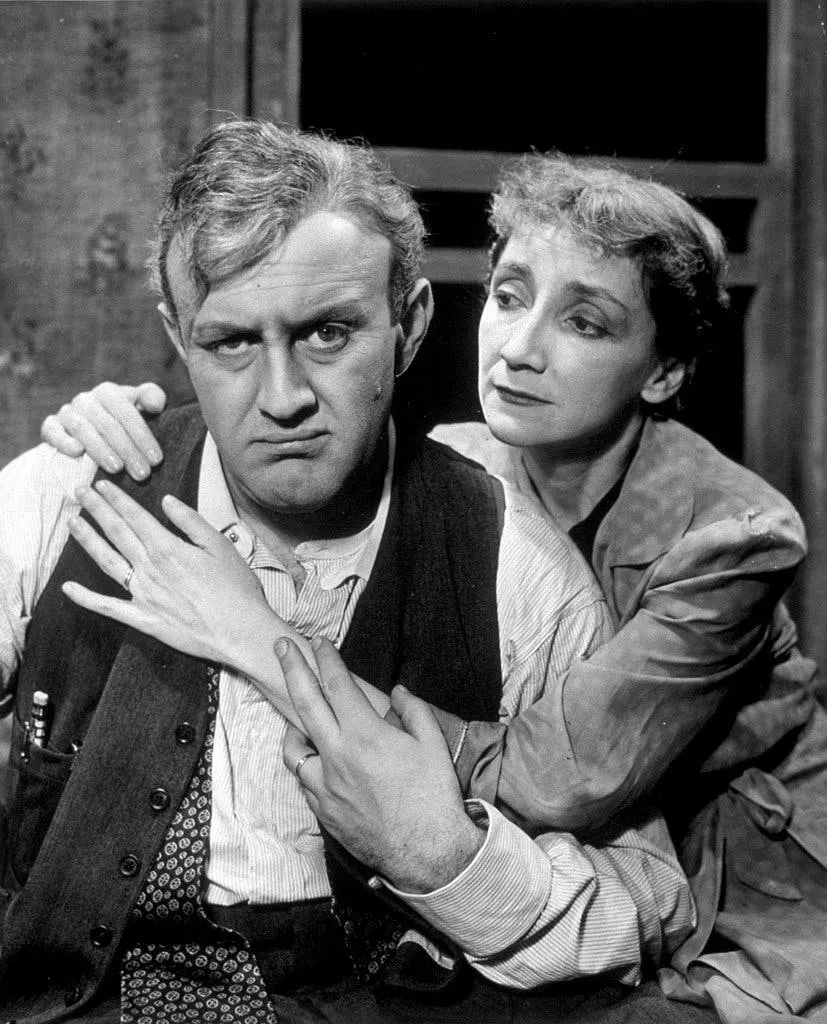
(Lee J. Cobb and Mildred Dunnock in the original Broadway production of Arthur Miller’s Death of a Salesman, 1949).
In a guest essay in the New York Times, former Washington Post theater critic Naveen Kumar writes that “Broadway is Serving Up Liberal Comfort Food.”
His piece concludes:
Not everyone goes to the theater hoping to be confronted with big questions, the kind that compel audiences to turn inward and disrupt their worldviews. But offering easy answers to those who do is its own form of injustice, shortchanging the medium’s potential. Why pat people on the back when what they really need — and what live performance is uniquely poised to deliver — is a punch to the gut?
What went wrong? His argument that in a response to theatre audiences claiming to be turned off by being “preached at” by the plays they attended on Broadway (and I can’t blame them), there has been a turn to the safe, the comforting, the pat on the back.
Five years ago, a lot of new theater was in a less indulgent mood. As the industry awoke in 2021 from pandemic shutdowns, many playwrights and producers were eager to champion the values of the social justice movement set off by the killing of George Floyd the previous spring. Works, often written by nonwhite artists, challenged audiences to face up to their latent biases — no matter how well intentioned they might have assumed they were as theater-loving liberals.
In New York there came a wave of shows that pushed boundaries and prodded progressive audiences. “Slave Play,” Jeremy O. Harris’s incendiary dark comedy about race and desire, which opened on Broadway in the fall of 2019, returned for an encore engagement. “A Strange Loop,” Michael R. Jackson’s hall-of-mirrors musical about a fat Black queer playwright grappling with his own subjectivity, won the Pulitzer Prize and the Tony for best musical. A slew of plays, including new works like Antoinette Nwandu’s “Pass Over,” an urban parable partly inspired by “Waiting for Godot,” and Tina Satter’s “Is This a Room,” about the interrogation of an N.S.A. whistle-blower, as well as revivals by Suzan-Lori Parks, Ntozake Shange and Alice Childress, crowded Broadway stages.
Those theater-loving liberals, thinking they are well intentioned, needed some prodding.
But now?
The Tony Awards race is dominated by plays that are more affirming than confrontational, offering the sort of benign provocation unlikely to keep people awake at night or wonder why they paid good money to feel unsettled. …
This spring, we have Nathan Lane in “Death of a Salesman,” Arthur Miller’s reliable elegy to the downtrodden working class.
Which is quite a dismissal of a play that is rightly seen as an American classic.
I think Mr. Kumar gives the game away in his discussion of Giant, by Mark Rosenblatt. Here is the entire discussion of this play:
Then there’s John Lithgow (competing against Mr. Lane for best actor), with his sour and prickly turn as Roald Dahl in Mark Rosenblatt’s “Giant,” a fiery topical debate lightly outfitted as a drama. The play, which premiered in London in 2024, finds Dahl mired in public controversy over a review he wrote about Catherine Leroy and Tony Clifton’s book “God Cried,” which documents Israel’s 1982 siege of Lebanon. As the play begins, Dahl’s essay has been denounced as antisemitic, and his editor and an emissary from his publisher, both Jewish, arrive to seek a public comment that will calm the waters before the release of his next book, “The Witches.”
The play, which quickly recouped its Broadway investment, raises two major questions, to my mind. One is why we continue to insist on making art about terrible men. The other is this: Does “Giant” succeed in dramatizing the interplay between antisemitism and criticism of Israel, or does it flatten that debate because Dahl is so obviously a grotesque bigot? Mr. Lithgow’s performance is a kinetic marvel, but there’s no question that his Dahl is a snarling and even gleeful hater of Jews.
The cynical view would be that “Giant” seeks to validate the anxiety, including among some supporters of Israel, that those who oppose its state actions must also be antisemitic. The less cynical view would be that all of this makes “Giant,” at the very least, a less interesting play for simply offering up an obvious villain.
So, a play about an author of very popular (though, to my mind, very uneven in quality) children’s books is shown to be a terrible person (there had already been a lot of published accounts to this effect), and that in itself is not prodding enough. Instead, the problem is that Dahl is shown to be anti-Israel but not in the right way, such that somebody who supports Israel, and is a bit dense, might think this play is validating. A better option, I guess, would be a play about someone who opposes the actions of the Israeli state but is more palatable, maybe who has a River-to-the-Sea poster but does not take it literally, and who has a Jewish friend, or some such?
In other words, Mr. Kumar wants plays that pat him on the back, for his proper views on political and social issues, and that give gut punches to those superficial theater-going liberals who secretly harbor views that are not quite radical enough. He wants plays with his politics; it’s those audiences, you know the type, that need to be “challenged.” His “worldview” doesn’t need changing.
Are pats on the back and gut punches the only options? What about plays that are just about being human, where at the end of the play you would have no idea whether a character was a Trump or anti-Trump voter, or anything about their views on defunding the police, or the two-state solution? Plays about falling in love, falling out of love, unrequited love? About dealing with the consequences of a terrible decision? About friendship, and betrayal? About a particularly dramatic historical event, where the cast do not wear hats with a G if they are a goodie and with a B if they are a baddie? Where a group cast does not seem like it was chosen for a Pew Research Center focus group? Where the play is just laugh out loud funny? That have not obviously been wrought with granting agencies and foundations foremost in mind?
Better than a knuckle sandwich.
Cross-posted at https://michaelrushton.substack.com/
Naveen Kumar has a very narrow view of what “big questions” are.; but that’s par for the course these days. He praises “an urban parable partly inspired by Waiting for Godot’”; yet if confronted by the actual “Waiting for Godot” he’d probably dismiss it as just so much bourgeois comfort food. The idea that the whole concern of art should be hot-button political issues ripped from the headlines is really a very recent one–if you want a political drama, there are other ways of being political–but it’s come to dominate English-language writing about the arts in and out of the academy ever since 1980, and especially in the last fifteen years. After a while, you become tired of an art scene that’s no more than a left-wing extension of the punditry industry.
I agree. There can be interesting art about politics, but, if I recall correctly as said by Tom Stoppard, the great thing about theater is that you can have different views expressed sincerely by different characters – it doesn’t have to end with a “right” or “wrong” answer. And the column seems to suggest there are “right” answers, and that “relevant” theatre ought to promote them, since the audience, in his view, isn’t yet properly enlightened.
That too. Politics in art isn’t a matter of having the right position on an issue, but the matter of representing an issue in the first place. In fact, much of the most interesting political art is on issues for which there are no clear-cut right or wrong answers.