
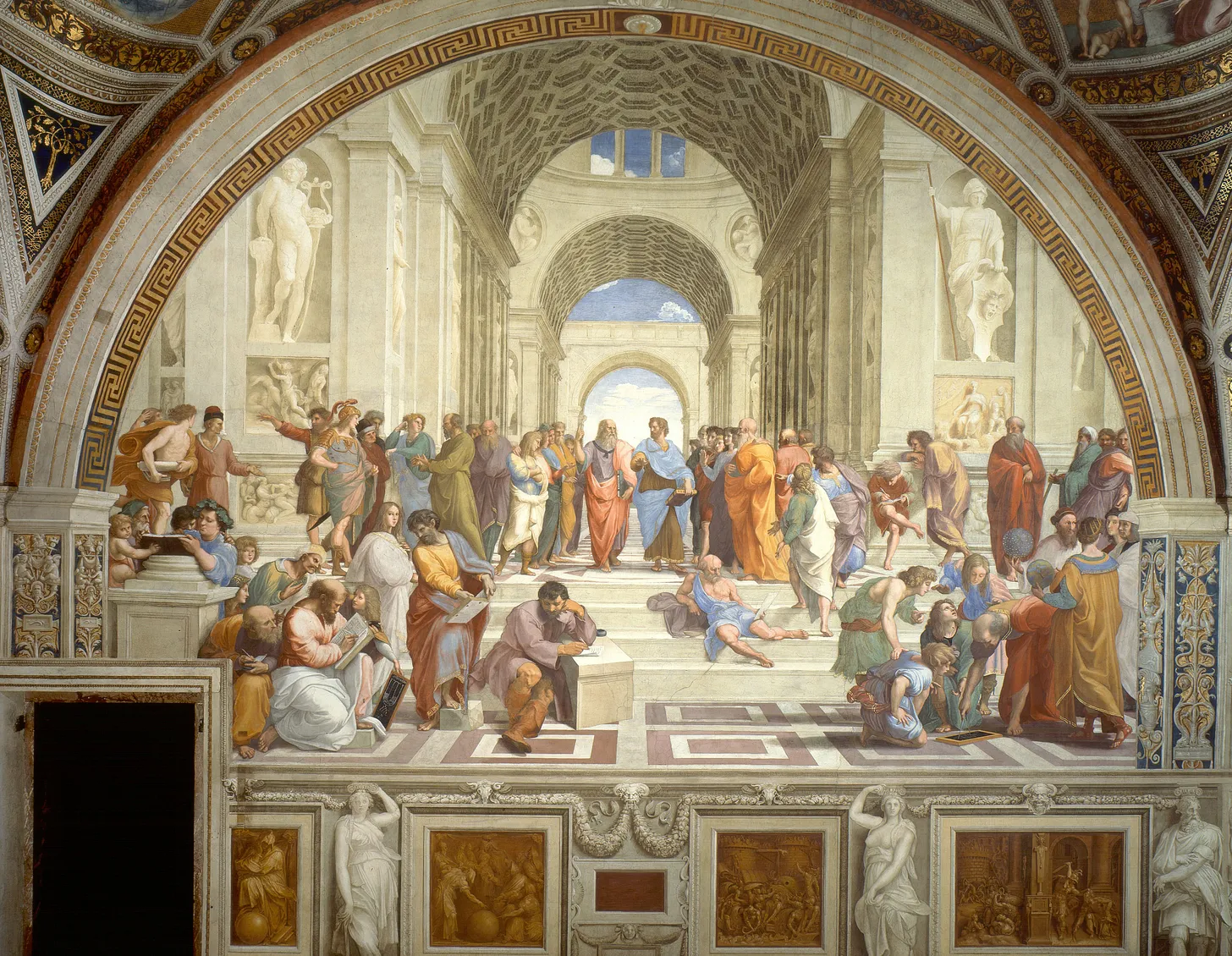
We would not have our Guardians grow up among representations of moral deformity, as in some foul pasture where, day after day, feeding on every poisonous weed, they would, little by little, gather insensibly a mass of corruption in their very souls. Rather we must seek out those craftsmen whose instinct guides them to whatsoever is lovely and gracious; so that our young men, dwelling in a wholesome climate, may drink in good from every quarter, whence, like a breeze bringing health from happy regions, some influence from noble works constantly falls upon eye and ear from childhood upward, and imperceptibly draws them into sympathy and harmony with the beauty of reason, whose impress they take.
Plato, The Republic, Book III (trans. F. M. Cornford).
The academy believes in developing in their cadets the essential values of respect, responsibility, integrity, kindness, and caring. The Honor Code mandates that “A cadet will not lie, cheat, or steal, or tolerate those who do.” Character is taught everyday both in and outside of the classroom while focusing on traditional values ethics, honesty, loyalty and accountability.
From the website of the New York Military Academy.
This weekend James Traub had a guest essay in the New York Times: “Strict Uniforms. Ancient Philosophy. Can a Public School Cure Our Toxic Politics?” (here’s a gift link). It is about the growth in so-called “classical schools”, which combine more rigor in student deportment with some education in classic texts from Western Civ:
The students were talking about the part of Virgil’s “Aeneid” in which Aeneas tells Queen Dido of Carthage the story of the Trojan War and the travails that had brought him to her shore. Their teacher, Jeremiah Lemon, asked if Aeneas was telling the truth or shaping the tale to his own advantage, as Odysseus had done in “The Odyssey.”
“I think he’s telling the truth,” said one student. “Odysseus was trying to make himself look good, but Aeneas is telling Dido all the dirty details.”
“I agree,” said another. “I think he wants to show Dido that he can persevere, that he can go through hardship and still come out of it.”
That second comment was a reference to Eagle Ridge’s moral code: Citizenship, integrity, perseverance, honor, excellence and respect. Those virtues are meant to infuse the school’s daily life. Almost everyone in Mr. Lemon’s class wanted to talk, but no one interrupted. There was no showboating. The students had arranged their desks in a big square to facilitate this Socratic seminar. At one point, a girl looked at a student who hadn’t spoken and said, “What do you think about this question?” And the student answered.
The problem, as Traub sees it, is that a heavy-handed moralism in nineteenth and early-twentieth century American schools led to a backlash in the form of individualism and “self-esteem” as the primary goals of schools, inevitably drifting into moral relativism.
Traub goes on:
Every school says it encourages civil discourse and mutual respect. But that can be the precondition for something greater. At Eagle Ridge, the habit of thinking in serious moral terms enabled the kind of conversation I heard in Mr. Lemon’s class. After talking about whether Aeneas was lying to Dido, Mr. Lemon asked whether the hero could freely choose to remain with Dido if he already knew that his fate was to found Rome. The kids concluded that fate probably precluded choice. Mr. Lemon then turned the question in a more personal direction: “What matters more, the fate or the journey to get to that fate?”
“Every single person is fated to die,” a student said. “But everyone has to make their own journey.” Another drew on his prior reading: “If you just knew Oedipus’s fate, you would think he was a terrible person. But once you understand the journey he took” — what both his father and mother had done — “you’d be more sympathetic.” They did not come up with an answer; after all, they were thinking about questions that had no definitive answer. And they were 14 and 15 years old.
Classical schools, and liberal education, may not be to your taste. But here’s a question to ask yourself: Would you feel better, or worse, if you knew that every future American citizen would receive an education like the one they get at Eagle Ridge?
Well, since he asks, worse.
It’s not that I object to students reading and thinking about and discussing the classics – I’m all for it. That said, while I don’t know about public schools in other places, at my children’s not-classical public high school, which has a mix of town kids and rural kids, they read Homer and Shakespeare and Goethe (though to be honest, by the end of reading him they felt as miserable as poor Werther himself), and they put on productions of Antigone; it’s hardly a cultural desert.
My bigger objection is Traub’s idea of a “cure for our toxic politics”, his notion – a twenty-five centuries old notion – that if only we ran schools this way, we would produce a better class of adults. This is just as misguided as those on the right (as well as some on the left, to be honest) who think that radical public school teachers are producing generations of Trotskyists, and that school choice and vouchers for private schools will see a surge in the ranks of Young Republicans. Our toxic politics – and it is toxic – was neither caused in our schools nor can it be cured there. The classmates at my own, pretty undisciplined, public school (an area was set apart in the courtyard for students who wanted to have a smoke between classes) turned out no less moral, no less civically responsible, than students who manage to obtain an elite, disciplined, classical education. There are ghastly people who drive our “toxic politics”, and it wasn’t an undisciplined high school that set them wrong. It is laughable to think the New York Military Academy’s most famous graduate, our toxic politician in chief, came to embody the “essential values of respect, responsibility, integrity, kindness, and caring.” Ethics is a practical activity, and children begin to learn it with their first steps and their first words. Some people will develop a worldview that that morals are for suckers, that might is right, that loyalty is to be demanded from others but does not constitute an obligation on oneself. The finest imaginable schools won’t change them.
We can teach students about the natural and the human world, its cultural heritage, and hope to instill intellectual and aesthetic curiosity. And we can also try to ensure that students are happy in what they are doing – education is not just future investment, like being sure to floss your teeth, but is about the present. I posted a note the other day about going to the local high school art show, and seeing students of all sorts getting great pleasure from showing their creations. It’s tough being a teen – you want them going to bed at night feeling good about the day and what’s to come tomorrow. Traub never convinces that his classical schools will do a better job of this.
I think the biggest weakness in Traub’s essay, and with this he is as one with the New York Times editorial board, who take it as axiomatic, is the assumption that the real problem in American politics is that people with different views don’t speak and listen to each other enough. That if only they could come together and see that we’re all just people trying to get along and make sense of the world.
At Eagle Ridge, they are taught to preface their remarks with, “I agree with you” or “I disagree with you.” Apparently they do disagree. Mr. Lemon told me that he listened to two girls whose parents were pro- and anti-Trump have a fierce political argument — then stand up and take each other’s hands.
Well that’s very nice. But we all live around and encounter people who vote differently from ourselves, and manage to do so with calm and civility. Sorry to keep going back to our local public school, but you don’t get fistfights breaking out over whether Trump’s tariff policy will actually revive manufacturing employment.
Our politics are toxic, but it’s not because ordinary citizens lack the ability to speak civilly with those who hold different political views. It’s because there are people in the highest political offices, and people who have their ear and influence, who have toxic ideas and want to do toxic things. As Adam Serwer famously put it, “the cruelty is the point.” That’s what toxic. And those toxic ideas are undiscussable.
Donald Trump: A whole civilization will die tonight, never to be brought back again.
Me: With all due respect, Mr. President, I disagree. Let’s shake hands.
Trump’s view that black people are congenitally less intelligent than white people is certainly toxic, but it is not amenable to civil discussion between adults or schoolchildren. We cannot shake hands on it.
And so, no, a classical school cannot cure our toxic politics.
So what then is the point of “classical schools”, if you can read and discuss the classics in any ordinary public school (and we do) and ordinary people seem to be able to discuss politics without screaming (and we do)?
It’s the aesthetics. People who’ve not themselves read Virgil or have any interest in actually doing so like the idea of kids in uniforms in highly disciplined classroom settings, undistracted by the riffraff who will hurt Kyle’s chances of getting into Dartmouth. Eagle Ridge’s website claims its uniform policy prevents unnecessary competition in fashion, but when I walk down the hall between classes at our school, I don’t see competition, but rather an anarchy of dress and dyed hair, and kids having a laugh, though not in single file. And these kids are alright.
Cross-posted at https://michaelrushton.substack.com/
Yet an anti-data center movement has seemed to unite us, Michael. Or maybe “we the people” are not as divided as our politicians and media say we are? Thank you for acknowledging the current Administration’s anti-Blackness. The chagrin and hubris of white supremacy has revealed that the U. S. would have been better positioned in its battle with Iran if it did not rely solely on the capabilities and talents of European American men tricked into believing that they are white. Indeed, LBJ said it best in 1960, “If you can convince the lowest white man he’s better than the best colored man, he won’t notice you’re picking his pocket. Hell, give him somebody to look down on, and he’ll empty his pockets for you.” Alas, firing Charles Q. Brown, Jr. was not a good idea or not listening to some of the more informed women in the administration. Tulsi Gabbard knew better, remember she was castigated for meeting with the Iranian government during the 2019 Democratic Presidential debates.