
Yes, Minister ran on BBC television in the early 1980s, the early Thatcher years (I’ll come back to the importance of this). I enjoyed it at the time (I was pretty young), and recalled it when I went to work in government myself in the 1990s. Canada has a UK-style Westminster parliamentary system, with more of a permanent staff of senior bureaucrats than in the US where political appointments play a much larger role (If you are following the debacle in the UK parliament right now, note that Olly Robbins, the very high-ranking official at the centre of the scandal, had senior positions in Labour and Conservative governments over many years). The theme of the show is how the permanent secretary (the civil servant at the head of the bureaucracy) Sir Humphrey Appleby (played by Nigel Hawthorne) attempts, sometimes with success and sometimes not, to get the elected politician and new cabinet member Jim Hacker, “Minister of Administrative Affairs” (Paul Eddington) to adopt policies that he, Sir Humphrey, would like to see, even when Hacker initially disapproves. The joke in the title is that each episode ends with Sir Humphrey saying “Yes, Minister” as if following a directive from Hacker, but in fact often it is Sir Humphrey who has managed to get Hacker to come around to Sir Humphrey’s views. It is genteel comedy, cleverly written and acted. It is not like the other, later, great British program about the relationships between cabinet and the senior civil service, The Thick of It, which is much more explicit in its anger and disgust at the methods of the government of Tony Blair. Still, Yes, Minister also has a pretty bleak view of how governments make decisions, as we shall see.
Season 3, Episode 7 is called “The Middle Class Rip-Off”, and it is about public funding for the arts. You can find the episode for a dollar or two on most streaming platforms, but here is a free clip that gives the gist:
The plot: Hacker is visiting his Midlands constituency in his role as MP, and is told by local council members that the city’s soccer team, Aston Wanderers (a mash-up of Villa and Wolves) is on the brink of bankruptcy. It could be saved through funds earned from selling the Corn Exchange Art Gallery (a rather dismal and not-well attended place) to a supermarket chain. Hacker thinks this is a marvelous idea. Sir Humphrey is appalled by it, seeing the thin end of the wedge of reducing arts funding in favor of subsidizing more popular entertainments – that’s where the clip above is taken. Sir Humphrey then puts his plans in motion: ensure the Art Gallery building’s heritage listed status makes demolition impossible, arrange a shuffle so that Hacker’s portfolio is increased by his becoming Minister with responsibility for the Arts in addition to Administrative Affairs and Local Government, such that having his first act in that role be the closing of an art gallery would look very bad, and use a pending increase in local council salaries and expenses to buy off the constituents who had been pressuring him (they reply that they could always knock down a primary school).
I was reminded of it because I get a notice whenever anyone has cited my Moral Foundations of Public Funding for the Arts book in a journal, and Connell Vaughan did so in this article in the Irish Communication Review, where he talks about contemporary Irish arts policy in light of this old Yes, Minister episode, and likens Sir Humphrey’s views on the arts to what I said in my chapter on conservative arts policy. He’s a bit snarky about my book, I think for even broaching the topic, but never mind – I’m more interested in Sir Humphrey and Minister Hacker.
Yes, Minister was written by Antony Jay and Jonathan Lynn (Disclosure: Wikipedia tells me that Lynn was descended, on his father’s side, from Lithuanians who in the early years of the twentieth century managed to make their way to Glasgow. I am too, on my mother’s side. Therefore, Lynn and I are cousins). Lynn was a career writer for television and movies, but Jay had worked in government, and served as an advisor in the Thatcher government. Thatcher’s government was revolutionary in its ideology, and strongly wanted to sweep the Sir Humphrey’s out of the bureaucracy, or at the very least get them to adapt to a new way of thinking. Thatcher loved Yes, Minister – it was the only comedy she really liked.
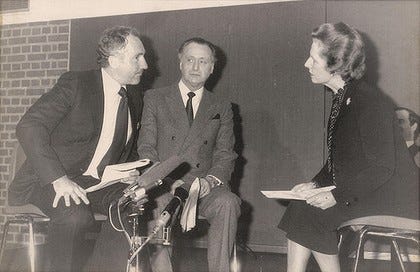
Thatcher, more than any other Anglophone head of government I can think of, with maybe the exception of Australia’s Paul Keating (I was living in Australia when I watched on television Paul Keating, then the Treasurer, explain the J-curve theory of balance of trade adjustments to a currency devaluation, and you just don’t get much of that sort of thing these days) was heavily influenced by academic economists (though she herself had studied Chemistry). She took them seriously, and had people with strong credentials in her policy circle. She read, and met with, Hayek, as well as the most prominent monetarist economists. Her famous pronouncement:
I think we have gone through a period when too many children and people have been given to understand ‘I have a problem, it is the Government’s job to cope with it!’ or ‘I have a problem, I will go and get a grant to cope with it!’ ‘I am homeless, the Government must house me!’ and so they are casting their problems on society and who is society? There is no such thing! There are individual men and women and there are families and no government can do anything except through people and people look to themselves first.
is straight from the adoption in economic modeling of methodological individualism – that there is nothing to say about the well-being of society other than the well-being of individuals and/or families.
In my book I also devoted a chapter to the economic approach to arts funding – a free working version is available here – and, in a way Jim Hacker would approve, the economic approach rests entirely on the existing tastes and preferences of the public. In the economic method, there is no room for Sir Humphrey’s elevation of taste, or of preserving something of value that your ordinary person does not think of as valuable. The economic approach to arts funding is built on the slim reed of whether there are “market failures” – spillover effects – but even that argument relies on the public recognizing the market failure and thinking something ought to be done about it. You can be an economist and still favor government support of the arts, but it’s not your economic models that will give you much justification; you will need to look elsewhere.
Now that applies to football too. But in practice we subsidize anything with a powerful enough constituency, even if small in numbers of people, and without justification through economic modeling. And so the arts keep their funding, even through Tory (or Republican) governments, and there are also subsidies to lucrative sports, and to film production, and to growing corn, whatever. In discussions with my arts policy peers I sound the warning that if there is to be no judgment about what sorts of art is worthy of funding, then it gets hard to justify any public funding at all. What makes art so special?
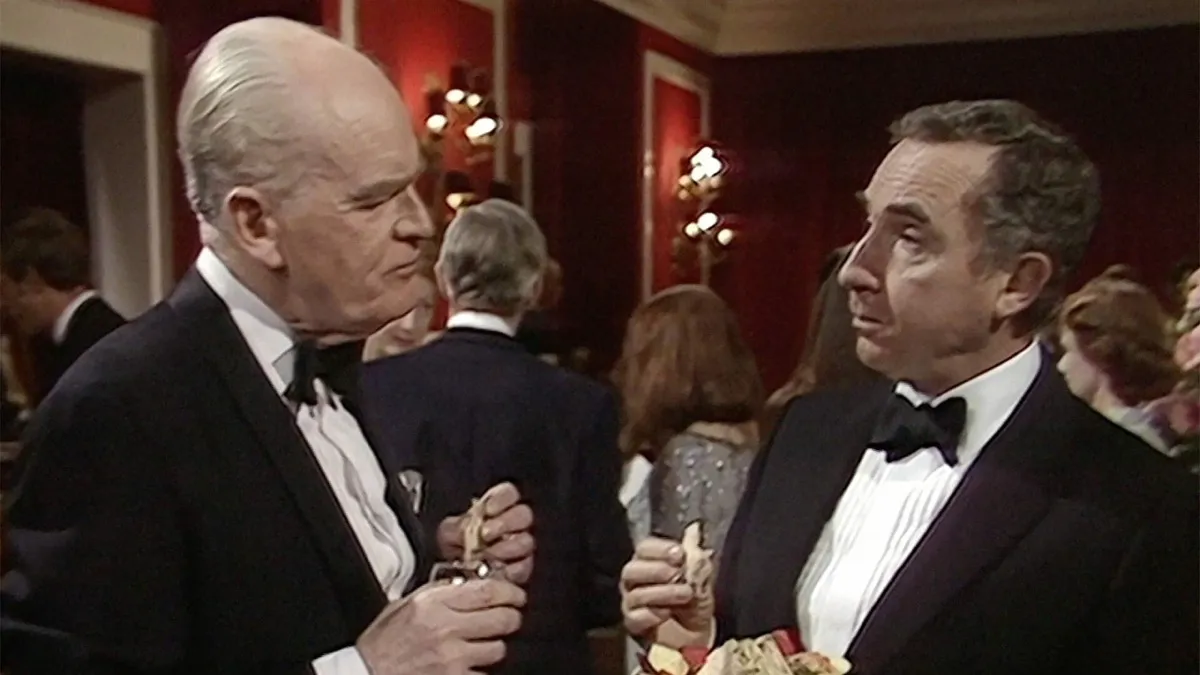
Sir Humphrey’s manner of arts advocacy is dead – there’s not one leader of a public arts funder who would (out loud) say anything remotely close to what he says in this episode. Nobody in government would have said it even in 1982 when the episode aired (I’m excluding Roger Scruton and the like). He is set up as a representative of everything Thatcher and her supporters hated in the conservative establishment, and it is shown through the episode that his support for “civilization” is nothing but self-serving snobbery. For all of Jim Hacker’s naivety, and, in the end, willingness to change tactics when it suits his own political future, his views on arts funding, a “middle class rip-off”, are never, in the episode, shown to be wrong: in the episode the opera is a place for men in black tie to enjoy smoked salmon sandwiches, and for permanent secretaries to plot to foil their political “masters” (although a scene is set at the intermission (shown at the top of this post) we never actually hear any music). And Sir Humphrey’s fulminating over saving civilization is always accompanied by audience laughter. No ordinary person could actually just enjoy opera.
One aspect of the episode that might seem quaint is the high arts being described as for the “middle class” – I’m not sure if anyone would say that today. Another is the notion of live football as the workingman’s pleasure. I looked online, and if I want to see Birmingham’s Aston Villa (one half of the model of the team in Hacker’s constituency) play at home against a pathetic and desperate Tottenham Hotspur on May 3rd, the cheapest ticket I can find is £87. If I wait a few days and instead go to see the touring Welsh National Opera perform The Flying Dutchman at the Birmingham Hippodrome, the most expensive seat is £69. This doesn’t mean the episode got things wrong – football has changed much more than the arts since the 1980s. But very, very rich sports teams still come around to local governments asking for public funds for stadium upgrades.
Cross-posted at https://michaelrushton.substack.com/
Leave a Reply