
I’ve always been skeptical of the idea that simply engaging with a lot of narrative fiction will make people more ethical, or more generally empathetic (which is not the same thing), or will increase the depth of their political understanding. There isn’t any evidence for it, and too many counter-examples of well-read jerks and political cranks.
But don’t the stories told in novels, films, plays and operas have moral and political content? Yes, the author will bring some sort of moral framework to what they compose, and assume that the audience will be for the most part on the same page. I am what Noel Carroll would call a “moderate moralist”, where usually I can appreciate the art in a work without thinking about its moral assumptions, unless the author has brought forward a point of view so contrary to what I believe that it negatively affects my ability to appreciate the aesthetic value of the work.
What about works that challenge my ethical or political assumptions, but in a good way? Works where the author, without simply writing a polemic, can open my eyes to a different way of thinking about human relationships? Martha Nussbaum, in previous works like Love’s Knowledge and Poetic Justice, has argued that yes, some fictional works can increase our understanding in ways that an analytic argument might fail. In a 1998 essay responding to a critique of any attempt to conflate morals and art by Richard Posner, she wrote:
Love’s Knowledge, where my primary concern is with moral philosophy, and with the claim that moral philosophy needs certain carefully selected works of narrative literature in order to pursue its own tasks in a complete way; and Poetic Justice, where my concern is with the conduct of public deliberations in democracy, and where my claim is that literature of a carefully specified sort can offer valuable assistance to such deliberations by both cultivating and reinforcing valuable moral abilities. In neither work do I make any general claims about “literature” as such; indeed, I explicitly eschew such claims in both works, and I insist that my argument is confined to a narrow group of pre-selected works, all of them novels, and some of which (the novels of James and Proust, for example) are frankly very critical of their predecessors and contemporaries in the genre. I also make it very clear that even in terms of the general line of inquiry I map out, I have chosen to focus rather narrowly on certain questions about how to live, and to leave other equally interesting questions to one side. …
With the condition that she wants to consider selected works, I am on board. The late Earl Winkler, who I had for my undergraduate course in Ethics at UBC, used this technique, and to this day it remains about the most memorable class I ever took.
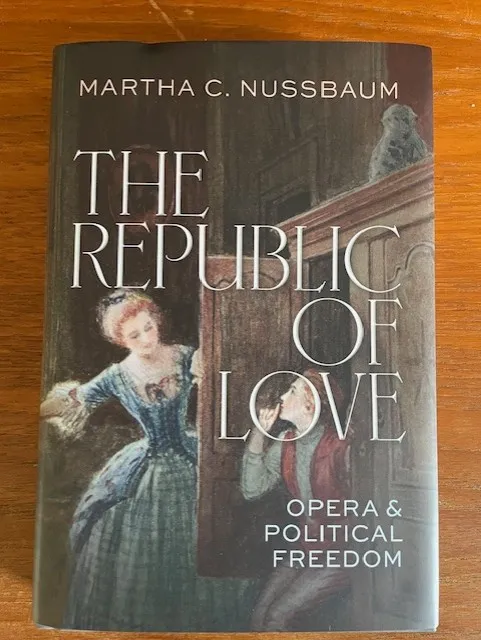
And so to Nussbaum’s latest book: what can opera contribute to political thinking?
The hero of the book is Mozart, and the first half of Republic of Love is devoted to a close listening to his operas. Note listening: Mozart himself said that with his operas the music comes before all else, and Nussbaum argues we cannot possibly understand the underlying moral vision of his (or anyone’s) operas simply through reading the librettos (in some cases, say Così fan Tutte, it would be quite misleading). Nussbaum calls Mozart one of the greatest philosophers of the Enlightenment, a bold claim. How does he earn this title? The late eighteenth century saw revolutionary change in how people saw their relationships to one another and to the state. What is expressed through Mozart’s operas (sometimes with difficulty) is the idea that this new world of liberté, égalité, fraternité needed men to discard past notions, or obsessions, with hierarchy, honor and revenge, possession and power, and through a change of heart come to love one another as we are, to show mercy and compassion, to listen to the women in their lives, to accept our imperfections, to be able to laugh at ourselves (Bernard Williams said that we should take Mozart’s comedy seriously; to be able to see oneself as slightly ridiculous is the beginning of moral thinking, and is vital to a happy romantic relationship. See also Verdi’s Falstaff, discussed by Nussbaum later in the book).
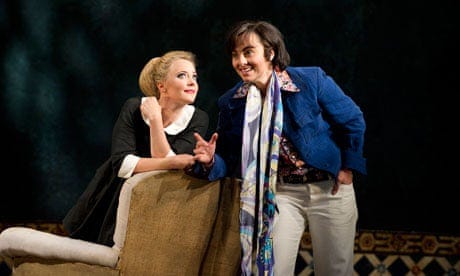
[Isabel Leonard as Cherubino, a character seen by Nussbaum as a very nice expression of Mozart’s vision of a new sort of man, in Glyndebourne’s (2012) Le Nozze Di Figaro]
In terms of Nussbaum’s own politics, while there is much of a standard liberal progressivism in her outlook, I was most reminded during her discussion of Mozart’s politics of her work on the concept of capabilities in thinking about well-being and equality (though she herself does not use the term directly here). This is the idea (which she developed together with Amartya Sen, though I think Nussbaum did more to try to work through the practical implications – I used to have my students read her essay in Women and Human Development) that while it is important to ensure people all have a basic income and the necessities of life, and constitutional protections of their rights, we also need to think deeply about what sort of lives people are capable of leading on a day to day basis: being able to take part in the ordinary aspects of society, everyone being treated as worthy of equal respect and dignity, no one living as an exile, whether outside of society or within. These are aspects of welfare that go beyond what the state alone can provide – they require an understanding amongst citizens regarding how we ought to treat one another (in The Republic of Love see especially Nussbaum’s analysis of Benjamin Britten’s Peter Grimes).
The second half of the book takes various post-Mozart operas, from Beethoven’s Fidelio to the contemporary operas Nixon in China and Dead Man Walking to illustrate how these new ideas of love and mercy continued to shape the art.
The anti-Mozart here is Wagner, and she chooses Die Meistersinger as the representative work of everything that is evil in an exclusionary nationalism. She includes a story about its Prelude being performed at a ceremony she attended at The New School in New York, and its complete inappropriateness given the history of that institution (at my own university the Prelude, performed by our student orchestra, was the highlight of a ceremony celebrating the university’s bicentennial, and, to be honest, it is an amazingly invigorating piece).
Wagner is the arch-enemy of Mozart’s Republic of Love not because he hates Jews, though he certainly does hate them. He is Mozart’s arch-enemy because he hates craziness, doubt, playfulness, difference, and reciprocity, aspects that the Republic of Love cherishes and cannot do without.
I enjoyed this book. Those with much deeper knowledge of opera than I have might have some disagreements with her analysis – her unrelenting disparagement of Wagner will certainly generate criticism. “I think Tristan is a tedious opera and that the view of love in it – all unsatisfied longing and no reciprocity – is adolescent and boring” are fightin’ words. But then it wouldn’t be a very interesting book if it left nothing else to say. For a layperson like myself, who enjoys opera but only rarely gets a chance to attend (though the productions at our university are excellent), it gave a new perspective, and this is a book I will re-read if one of the operas she discusses has an upcoming performance. She also made me really hoping for a chance to see some operas I’ve never seen before – if Verdi’s Don Carlos or Janáček’s Jenůfa is being performed nearby, I will be there.
And Nussbaum does fine work here, without going on about it, in dispelling the notion that opera is, and can only ever be, “elite.” Her book, and the operas she discusses, are available to anyone willing to take the time. And the great operas do not need to be “reimagined”, or have the villain dressed in a blue suit with a white shirt and a solid red tie, to be “relevant” to an audience in 2026. There’s plenty in Mozart that is relevant as it stands.
Cross-posted at https://michaelrushton.substack.com/
Leave a Reply