
• Home
  • About
    • For What it’s Worth
    • Michael Rushton
    • Contact
  • AJBlogs
  • ArtsJournal

For What It's Worth

Michael Rushton on pricing the arts

A dialogue on the nature of arts participation

November 10, 2024 by Michael Rushton Leave a Comment

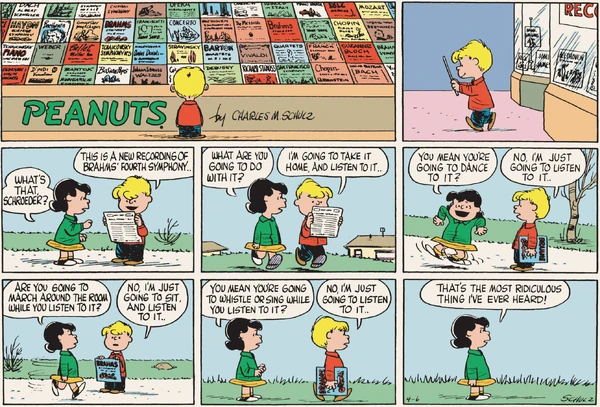
When I was a child we had some really old Peanuts paperbacks, now long lost, and for reasons unknown – some spirit knew I would end up in cultural policy? – this one stuck in my head, practically verbatim. Anyway, from April 6, 1958, thank you Mr. Schulz.
Share:

  • Email a link to a friend (Opens in new window) Email
  • Share on Facebook (Opens in new window) Facebook
  • Share on X (Opens in new window) X
  • Share on LinkedIn (Opens in new window) LinkedIn
  • Print (Opens in new window) Print

Related

Filed Under: issues

Leave a Reply Cancel reply

Your email address will not be published. Required fields are marked *

Michael Rushton

Michael Rushton taught in the Arts Administration programs at Indiana University, and lives in Bloomington. An economist by training, he has published widely on such topics as public funding of the … MORE

About For What It’s Worth

What’s the price? Everything has one; admission, subscriptions, memberships, special exhibitions, box seats, refreshments, souvenirs, and on and on – a full menu. What the price is matters. Generally, nonprofit arts organizations in the US receive about half of their revenue as “earned income,” and … [Read More...]

Archives

Recent Comments

  • ai video editor on Should there be a tax deduction for donating to the nonprofit arts?: “Switching from a tax deduction to a tax credit, similar to the Canadian model you mentioned, seems like a very…” Oct 20, 14:18
  • Jeff Woodruff on Reading James Marriott’s The New Dark Ages: “You referred to “the great centuries – 1750 – 1950.” I think there’s a lot of evidence that the whole…” Oct 18, 09:24
  • Mark Z Alpert on Reading James Marriott’s The New Dark Ages: “Leonard Bernstein’s “Young People’s Concerts” was perhaps, the most promising hope, along with “Omnibus”, that television would herald a most…” Oct 15, 12:33
  • Michael Rushton on Reading James Marriott’s The New Dark Ages: “Recordings and radio offered people different ways to experience music, and brought it to wider audiences than would have been…” Oct 8, 14:44
  • Richard Voorhaar on Reading James Marriott’s The New Dark Ages: “,Just as recordings and radio was the death of traditional folk music, non-western music, jazz and classical music. ,” Oct 8, 13:35
Return to top of page

an ArtsJournal blog

This blog published under a Creative Commons license

Copyright © 2026 · Magazine Pro Theme on Genesis Framework · WordPress · Log in