

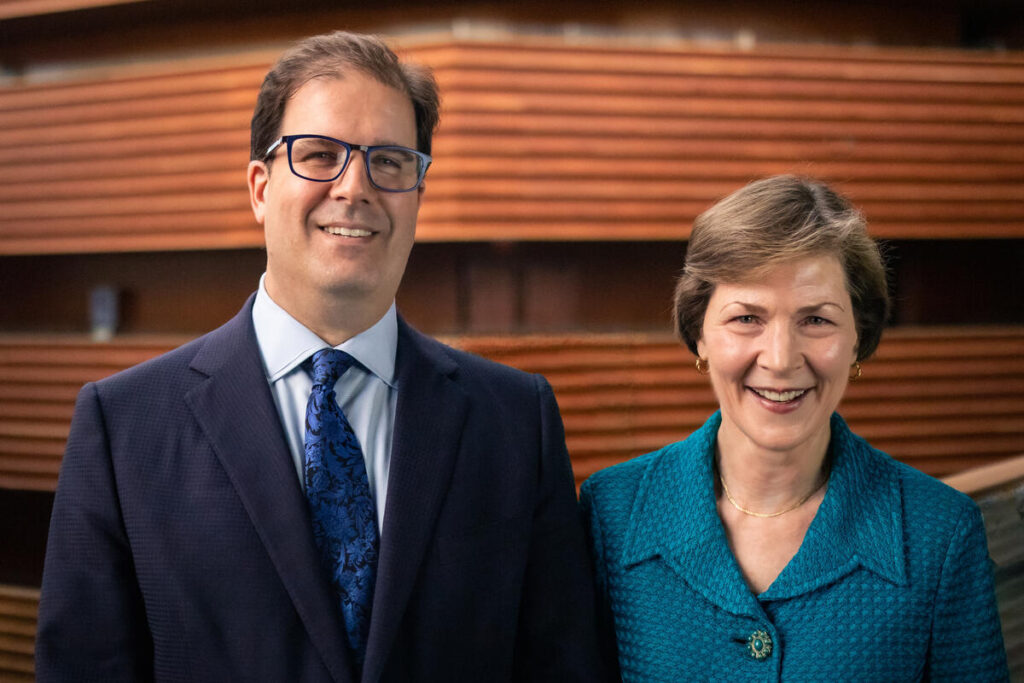
Photo by Jeff Fusco, courtesy of Ensemble Arts.
Most nonprofits don’t have a number two.
They have a chief executive and a row of vice presidents, all reporting to the same desk and all roughly equal in rank. On paper it looks collegial. In practice it means that when the executive director goes on vacation nothing substantive happens until she gets back, and when she leaves for good, the board discovers that its succession plan consists of a search firm and a prayer.
I made a version of that argument recently in a comment on a LinkedIn post by Rebecca White, who was writing about executive directors who can’t stop answering questions on vacation. I said every nonprofit needs a deputy director (not necessarily by title, but by function), someone trusted by the executive director and the board and respected by the rest of the senior team. The comment picked up more than 8,700 impressions, which for a reply sitting under someone else’s post tells me it touched a nerve. A dozen people also sent me private messages just to say thank you.
The objection I hear most is that elevating one senior staff member above the others is very un-nonprofitty. It feels hierarchical, it costs money and it risks bruising egos on the leadership team. All fair. But there’s a less flattering reason organizations skip it, and I said so in the same thread: some executive directors avoid appointing a true number two because that person might (perish the thought) be really good at the job.
For what it’s worth, I’ve found that there is an inverse relationship between the number of direct reports a CEO has and the amount of energy the organization has spent on succession planning. And the number of times a vice president cc’s the CEO on an email to a fellow vice president is inversely related to the odds that anyone on the senior team is truly a number two.
The best counterexample I know is right here in Philadelphia.
An Orchestra Coming Out of Bankruptcy
The Philadelphia Orchestra filed for Chapter 11 in 2011 and emerged a year later. In 2012, under president Allison Vulgamore, it hired Ryan Fleur, who had run the Memphis Symphony since 2003, as executive vice president for orchestra advancement, a job that covered concerts, touring, orchestra personnel and human resources. The next few years were not easy. The musicians accepted an unusual one-year contract in 2015, then struck on opening night in 2016, a walkout that lasted about two days but cost the orchestra its season opener. When Vulgamore stepped down at the end of 2017, the board named Fleur and Matthew Loden, his counterpart on the institutional advancement side, interim co-presidents while it searched for her successor.
That search produced Matías Tarnopolsky, who arrived from Cal Performances at Berkeley in August 2018. Think about what he walked into. One of the two people who had been running the orchestra for the better part of a year, someone who knew every musician and every line of the personnel budget, was still there and now reported to him. Plenty of incoming CEOs would treat that person as a problem to be managed out. Tarnopolsky made him executive director.
Early Contracts and a Planned Exit
The results showed up fast. In March 2019 the orchestra and its musicians reached a four-year contract six months before the old one expired, which the orchestra called the first early agreement in its modern history. Tarnopolsky and Fleur sat on the management side of the table together. The deal added two positions to the orchestra’s complement, and it came less than three years after a strike.
In December 2019, Anne Ewers, who had led the Kimmel Center since 2007, told her board chair she planned to retire at the end of her contract. She also started the conversations that produced the June 2021 announcement placing the orchestra and the Kimmel under a single parent company led by Tarnopolsky, with a board drawn equally from both organizations. When the deal closed in October 2021, Ewers retired and was invited to join the new parent board. The departing CEO decided she was leaving, told her board nearly two years ahead, helped design the structure that replaced her and stayed close enough to help it work.
Plenty of people in Philadelphia assumed this marriage was coming from the day the Kimmel opened in December 2001, when the orchestra left the Academy of Music, a hall it owned, to become the anchor tenant of a $275 million building whose endowment never matched its needs. The idea surfaced again and again over the next twenty years, including during the 2011 bankruptcy, when the orchestra used its petition to seek lower rent from the Kimmel, and in 2012, when the Inquirer reported that merger talks were on the back burner and Ewers said, “We haven’t thought about it.” It took two decades and a pandemic to get it done. That’s OK. Putting the hall and its biggest tenant under one board and one balance sheet was the right structure all along, and it took leaders willing to plan their own exits to make it happen.
Fleur’s role grew with the merger. The organization’s own announcement of his later appointment credits him with a key role in it, and by the time the combined company adopted Ensemble Arts Philly as its presenting name in January 2024, he was executive director of The Philadelphia Orchestra and Ensemble Arts.
Keeping the Music Director
Yannick Nézet-Séguin became the orchestra’s music director in 2012 and added the music directorship of the Metropolitan Opera in 2018, the same year Tarnopolsky arrived. Any orchestra board watching its star conductor take the top job at the Met has reason to worry about losing him. In February 2023, with Nézet-Séguin already under contract through the 2025–26 season, Tarnopolsky announced an extension through 2030 and an expanded title of music and artistic director, a tenure that puts him in the company of Stokowski and Ormandy.
I don’t want to oversell this. The 2023 musicians’ negotiation was rough. The players rejected two “final” offers, opened the season without a contract and took public aim at Tarnopolsky’s salary before ratifying a three-year deal in October 2023 with a 15.8 percent increase in minimum salary. The Inquirer later described those talks as bruising for some board members. What a stable leadership team does provide is continuity across the table, and Fleur sat on the management side in 2019, in 2023 and again this year.
When New York Called
In December 2024 the New York Philharmonic announced that Tarnopolsky would become its president and CEO on January 1, 2025, reuniting him with Gustavo Dudamel, the Philharmonic’s incoming music and artistic director and his musical colleague of two decades. Losing the head of the city’s largest arts organization to a rival orchestra on a month’s public notice would rattle most boards. Philadelphia named Fleur interim president and CEO, the second time he had led the orchestra on an interim basis, and then ran a real search anyway, an international one led by Isaacson, Miller. Fleur won it and was appointed president and CEO on April 23, 2025.
The board was right to search. An internal candidate who beats an outside field starts the job with a mandate, and the musicians, donors and staff all saw that he had earned it. When Tarnopolsky explained his departure to the Inquirer, he said matters in Philadelphia were “in a good place and are in the institutional DNA,” which is exactly what a departing CEO should be able to say.
This September, Fleur’s team reached a three-year agreement with the musicians that takes base salary from $176,280 to $200,008 by the final year. Fleur described a collaborative process with moments of frustration on both sides. The musicians ratified it that week, and it runs through September 2029.
What Fleur Has Done With the Job
A year and a half in, the record is impressive. In October the organization announced it had closed its fundraising campaign at $344 million against a $330 million goal, one of the largest ever for a Philadelphia cultural organization, with more than 55,000 gifts from 24,000 sources and 13,000 donors who had never given to the orchestra or the Kimmel before. The campaign started well before Fleur’s promotion (it counts gifts back to 2020, plus the anonymous $55 million gift from 2019), but he told the Inquirer when he took the job that at least half his time would go to raising money, and he closed it above goal. The combined endowment for the orchestra, the Kimmel and the Academy of Music now stands at roughly $450 million by the organization’s count (a figure that includes pledges and has not been audited), up from $230 million when the campaign began, and Fleur says the orchestra’s share ranks among the five largest of any American orchestra. Days later, David L. and Rhonda R. Cohen announced a $10.5 million gift that funds touring and performances of work by overlooked and emerging composers, names the president and CEO position for the Cohens and is meant as a lead gift for the next campaign.
He has also reorganized the staff around the needs of the combined company (moving people into the right seats, the organization says, rather than cutting jobs), set a public goal of bringing every Philadelphia child to its venues three times between kindergarten and 12th grade, and made deferred maintenance on the Kimmel, the Academy of Music and the Miller Theater a priority, starting with roof repairs to stop leaks that go back years. The Kimmel turns 25 in December, and he has launched a Kimmel Center 25 Fund to pay for that work.
The audience rebound is the most impressive number of all. Paid capacity for the orchestra rose from 47 percent in 2021–22 to 75 percent in 2024–25, which the Inquirer reports is above pre-pandemic levels, and the number of orchestra listeners 59 and under grew 78 percent between 2019 and 2024. That puts the orchestra well ahead of the region. In PA CultureCheck 2025, the statewide study led by PA Humanities with the Greater Philadelphia Cultural Alliance and the Greater Pittsburgh Arts Council, half of Pennsylvania’s cultural organizations said attendance still had not returned to pre-pandemic levels, and recovery remained uneven, especially for performing arts groups. This month the orchestra returned from a tour of South Korea and China led by principal guest conductor Marin Alsop, and a renovation of the stage and surrounding spaces at Marian Anderson Hall is funded and will be penciled in for construction in the next two years. With Nézet-Séguin on the podium and the labor agreement above in hand, it is still arguably the best orchestra in America.
What the Numbers Say
The consolidated audited statements for The Philadelphia Orchestra and Kimmel Center, Inc., the legal parent behind Ensemble Arts, show an organization with a strong balance sheet and an operating line that still runs red.
| Dollars in millions, fiscal years ending August 31; FY2024 as restated in the FY2025 audit | FY2023 | FY2024 | FY2025 |
|---|---|---|---|
| Operating revenue | 119.7 | 139.4 | 121.7 |
| Operating expenses | 134.8 | 145.4 | 136.7 |
| Operating result | (15.1) | (6.0) | (15.0) |
| Depreciation and amortization (in expenses above) | 12.3 | 12.7 | 12.8 |
| Net assets without donor restrictions | 178.5 | 172.7 | 166.3 |
| Endowment net assets | 285.2 | 317.6 | 339.4 |
| Notes payable (the only debt) | 4.8 | 4.6 | 4.5 |
Start with the good news. Endowment net assets grew from $264.9 million at the end of the merged company’s first (partial) fiscal year (PDF download) in August 2022 to $339.4 million three years later. Counting the Annenberg Foundation endowment assets that Northern Trust holds for the orchestra, the total grew from $310.9 million to $393.3 million, and the organization says the campaign has pushed the combined figure to roughly $450 million since. Debt is almost nonexistent, a $4.5 million mortgage on the Miller Theater, with a $4.4 million balloon payment due in FY2027. Financial assets available within a year totaled $54.1 million at the end of FY2025, a little over five months of cash operating expenses, with another $8.1 million in untapped bank lines behind it. For an organization that went through Chapter 11 fifteen years ago and maintains three buildings, two of them historic, that is a strong position.
Now the less flattering part. The organization ran operating deficits of $15.1 million, $6.0 million and $15.0 million in the three most recent audited years, and net assets without donor restrictions fell from $189.4 million to $166.3 million between August 2022 and August 2025, a decline of about $23 million. Cash dropped from $45.0 million to $32.0 million in FY2025 alone, when operations used $14.9 million, a drop the organization attributes to capital spending and the timing of advance ticket sales. Some context matters. Between $12.3 million and $12.8 million a year of those deficits is depreciation on the Kimmel, the Academy and the Miller, a real cost but not a cash one, so FY2024 was a surplus of about $6.7 million before depreciation and FY2025 a deficit of about $2.2 million. Contributions counted in operations also fell $11.0 million in FY2025, though FY2024 had included a one-time $5 million capital gift, and the organization notes that multiyear campaign pledges help even out the drop. That year also straddled the leadership change, with Fleur interim from January and permanent from April.
Still, a CFO reading these statements would ask the question Fleur raised himself last year, when he told the Inquirer that a modest deficit can turn very big very quickly. An endowment of about 2.5 times annual expenses is healthy for an orchestra and thin for an organization that also has to keep three buildings running, two of them historic, which is why his stated goal of a billion-dollar endowment makes sense. The FY2026 audit, covering the year that ended in August, will be the first full year on his watch and the first with the campaign closed, and that’s the one I’ll be reading.
What the Board Got Right
Strip away the names and Philadelphia did three things most boards don’t. It kept the person who had been running the place and gave him an executive director’s authority rather than one more vice-presidential title among equals. It put him in the room for the biggest decisions of the decade (two labor contracts, a merger and a music director extension) so that the board, the musicians and the donors knew him long before they needed him. And its departing chief executives, first Ewers and then Tarnopolsky, left in ways that handed over a functioning organization instead of a vacancy.
None of that required luck. It required a CEO secure enough to elevate someone who might one day replace him, and a board that treated succession as a standing responsibility rather than an emergency.
Fleur has since named a number two of his own. He made Crystal Brewe, a longtime member of the staff, executive vice president and chief operating officer. She helped steer the organization through the merger, created the Philadelphia Fall Arts Fest, pushed accessibility improvements across the venues and led the 2024 launch of Ensemble Arts Philly as the organization’s multi-genre presenting brand, and this month she received a Silver Stevie Award for that leadership.
A Test for Your Own Organization
If your executive director resigned tomorrow, who would run the next board meeting? Could a major donor get a real answer to a real question without the executive director on the call? Does anyone on the senior team have authority the other vice presidents don’t? Has the board ever spent time with that person without the executive director in the room? And would your executive director be relieved or threatened if that person were recruited for a top job somewhere else?
If the honest answers are “nobody,” “no,” “no,” “no” and “threatened,” you don’t have a succession plan.
I’ve had to answer these myself. I founded Voices of Gotham in 2008 in New York and stepped away for the first time in 2014, when I moved to Philadelphia. I came back in 2018 for what was supposed to be three years, long enough to combine our chorus with a sibling chorus into a single Gotham organization, and then the pandemic got in the way. When it was time to hand over the musical leadership, the chorus ran a real search. Four finalists, three of them from inside our own chapter, each led a full rehearsal, and the singers sent in feedback after every one. I agreed to stay on as president after I handed over the reins and then stepped off the board after two years so a new leader could take over.
So name your number two. Give that person authority the other vice presidents don’t have, put them in front of the board and the donors without you in the room, and pay them accordingly. Philadelphia’s succession worked because its leaders built the bench years before they needed it, not because a search firm found a miracle.
Disclosure: Before founding Strategic Nonprofit Finance, I was CFO of the Curtis Institute of Music, one of the Kimmel Center’s resident companies.