
I just woke from a vivid dream that I was telling a class about a jazz trio recording with Miles Davis, Kenny Barron, and a drummer whose name I never got. (Waking researches suggest that Miles and Barron never recorded together, and I realize now that the record cover I was looking at was actually Coltrane’s Ascension, with, significantly, only one figure on the cover.) The brief liner notes on the back – those were the days – merely told an anecdote about how Miles scoffed at the idea of explaining his music, and swore he could show his musicians how the music went without words. Next Miles, Barron, and this drummer whose name I was trying to remember came to lunch with me at the Bard faculty dining room (which also looked, in the dream, like Chicago’s old Museum of Contemporary Art, where I first worked in 1981). Kenny Barron talked most, discussing the impossiblility of capturing music in words, but finally Miles leaned over and spoke into my ear, so close that his lips touched me, and told me that you had to have a really divided allegiance working for The Man in a place like this. I realized that he was talking about being Black, but added (with amazement at my own temerity at telling Miles Davis anything) that it was also inherently difficult for an artist, because academia expects you to explain what you’re doing, and artists can’t always justify themselves logically. Miles kind of nodded. I woke up and ransacked my jazz vinyl collection for a Miles Davis trio record, which, of course, wasn’t there.
I’ve been listening to little besides jazz lately, because I’m writing a concerto for piano and a saxophone/trumpet/trombone ensemble, and it strikes me that the effective, American prototypes for combining piano with reeds and brass are all jazz: so I listen to the Earl Hines orchestra, Louis Armstrong’s Hot Seven with Lil Hardin, Bix Beiderbecke and Frankie Trumbauer, and the Miles Davis/Gil Evans orchestrations. I guess that accounts for me dreaming about Miles, along with a pianist he never played with. The last time I had a dream encounter this significant with a famous musician was 1991, when a bunch of people were waiting in Charles Ives’s living room for him, and he came out to see me, played the piano with me, and gave me his blessing. That was a tremendously empowering dream. But I think Miles Davis just told me I talk too much.
 However, I should have realized that the brilliance of Taruskin’s writing would have made it difficult to put down regardless of topic, and the book has a tremendous amount to teach not only about Stravinsky but about musical progress in general. One of Taruskin’s tremendous strengths as a musicologist, beyond the panoramic sweep of his research, is his theoretical ability to correctly grasp and describe compositional process. Take a look at the following statement about Stravinsky’s youthful Piano Sonata in f#:
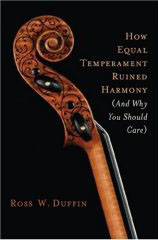 Duffin apparently started the book as a much-needed antidote to Stuart Isacoff’s mendacious and unaccountably popular Temperament: The Idea that Solved Music’s Greatest Riddle of several years back. Isacoff’s populist tome was a heady celebration of the status quo: “hey, 12 equal steps to the octave is the perfect tuning, aren’t we glad they came up with it, no reason to ever consider anything else!” To argue that, he had to sweep a mountain of inconvenient acoustic phenomena under the rug. (I wrote a Village Voice review saying so, and, comically, Isacoff wrote a letter to the editor excoriating me as – I quote from memory – “one of those dogmatic pedants who can only imagine doing a thing one way.” Of course, the “one way” I pedantically insisted on was allowing and exploring thousands of different tunings; the open-minded route he so generously opened up was to impose one bland, invariant scale on all mankind’s music for the rest of eternity.) Strangely for so esoteric a topic, Isacoff’s Temperament got a tsunami of undeserved publicity.
 Through some passages of Feldman’s late works, it is remarkable – too remarkable for mere coincidence – how often his textures change at the end of a page. It doesn’t seem true at the beginnings of pieces, which will often be seamless. But at some point in a work, he will begin to settle into a rhythm. A texture or pitch set will be consistent for a page, and then the next page will have a different texture and pitch set, and the next page a different one still, and so on. It is almost as though he treated the page visually, as a whole, and every time he turned to a new page, thought, “Now for something new.”