There’s a one-word hint in Michiko Kakutani opening paragraph that her review of Laurence Gonzales’ novel will take a disparaging tone:
Think of a contemporary version of Mary Shelley’s “Frankenstein” in which an egotistical scientist’s creation is not a hideous-looking monster but a well-mannered teenage girl who quotes Shakespeare, listens to Tom Petty and uses Facebook and YouTube. This is the high-concept premise of Laurence Gonzales’s lumpy new novel, “Lucy.” (more)
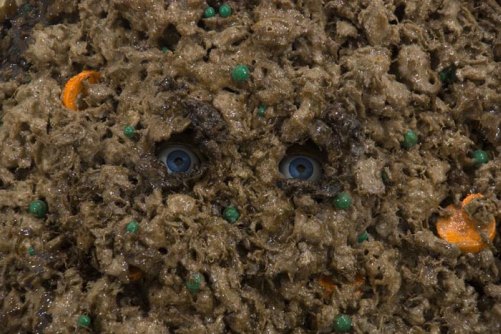
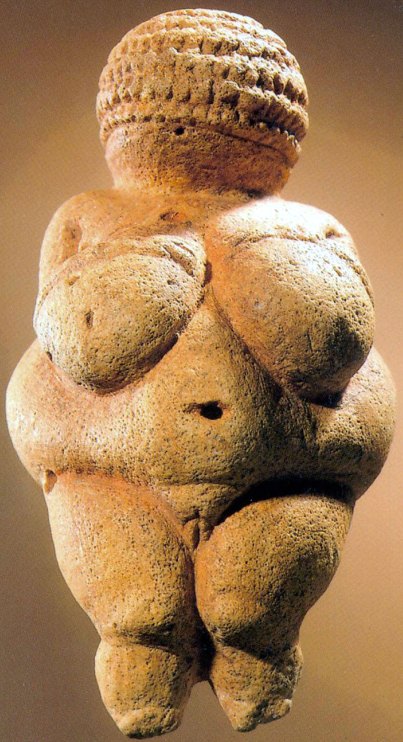
Right. It’s “lumpy.” When lumpy is the first descriptive in a book review, that review will fall short of rave. The same can’t be said in visual art, where a critic might easily use the word as praise. In visual art, silky is not a top and lumpy a bottom. They are just another spectrum across which artists secure a place.
(Via)
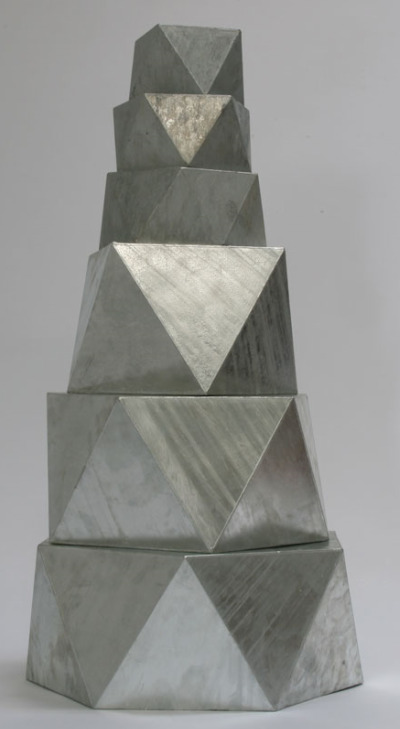 His triangles join, like cupped hands, to make a bowl.
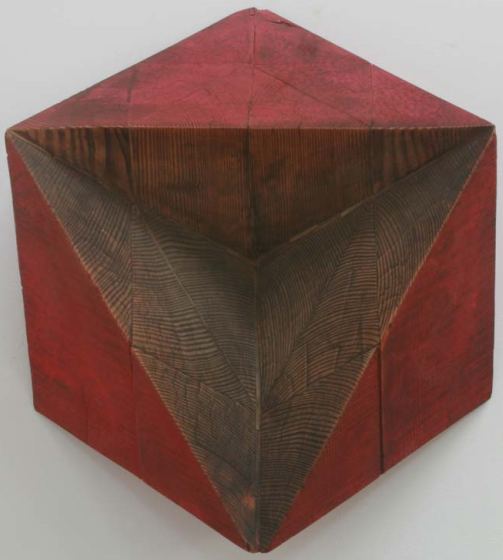 He moves back and forth between wood and steel, from carving into a solid to manipulating the empty skin of metal. In metal he can extend and twist a triangle. When triangles try to become a square, they fail, just as, in Millett’s mind, the American effort to remake Iraq in its image will fail.
 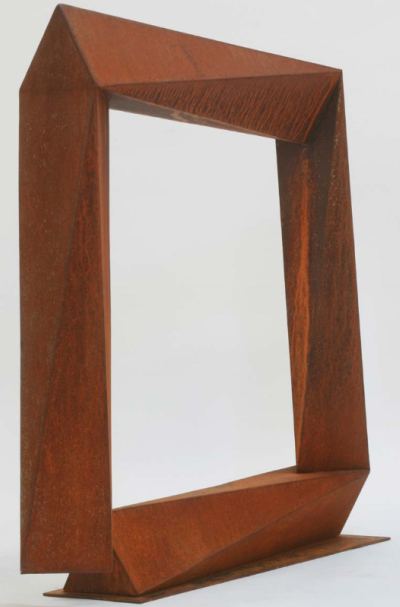 He makes no models or drawings for his sculpture, preferring to work directly with what he calls the “real stuff.” While real stuff is in his hands, real stuff is in his head. His current exhibit at
 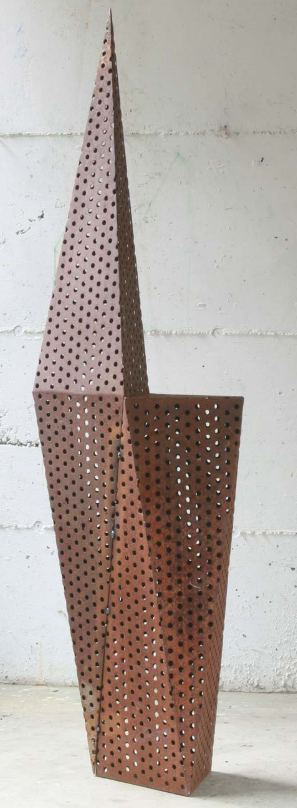 Decades ago, traveling in Iran, Millett was struck with the spare
 Who were they afraid of? The usual thugs ready to kill anyone who doesn’t see the world their way. Seattle artist Molly Norris attempted to lighten the issue with humor. Can’t depict Mohammad? How about as a purse, a cherry or a spool of thread?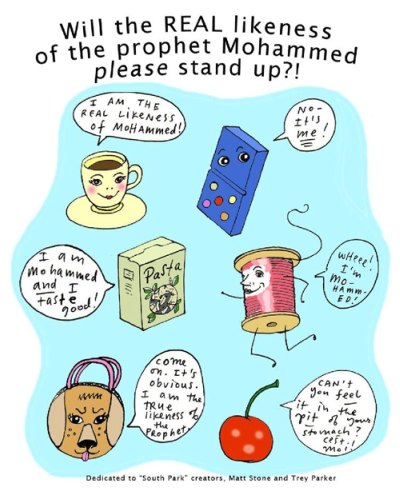
 Then the haters showed up and filled pages with their contempt for all Muslims. Dismayed, Norris tried to shut it down. Too late, because hate also calls to hate.
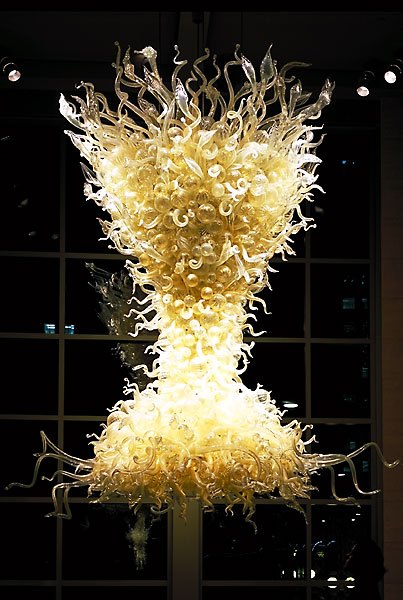 BENAROYA HALL, SEATTLE, WA
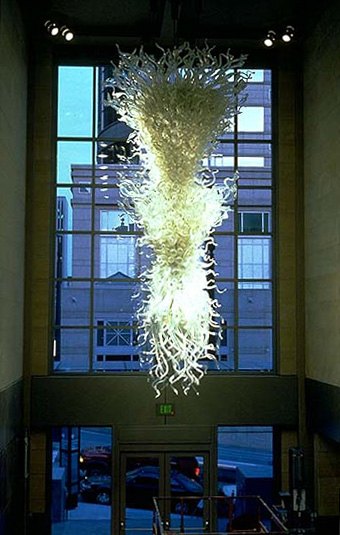 Detail, SILVER CHANDELIER
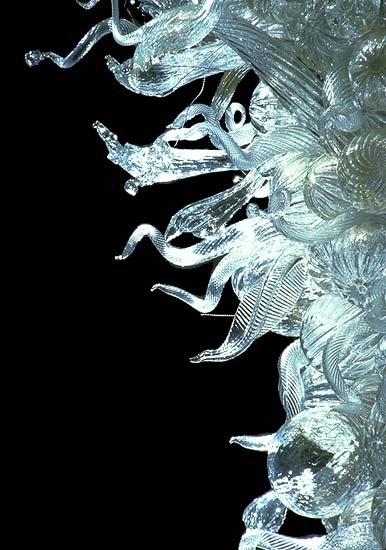 Pure as Communion wafers, these chandeliers have bawdy hearts. They push the idea of the decorative past beauty, past reason and past Surrealism, into a