


Limón Dance Company / Baryshnikov Arts Center, NYC / February 9 -10, 2010
Sokolow Theatre/Dance Ensemble: Anna Sokolow Birthday Tribute / 92nd Street Y, NYC / February 14, 2010
Limón Dance Company / 92nd Street Y, NYC / March 5-7, 2010
Can dance history exist without dancing? How can we make the choreography we treasure survive? Much of the history of the art exists in words written about dancing. Even at its most evocative or detailed, such evidence preserves dance at several removes. With passing time, the ways of recollecting what is, ironically, the wordless art, expanded beyond text, drawings, and notation to still photography, and then to recorded motion via film and video. Yet none of these methods, invaluable though they are, comes anywhere close to recreating live performance, with its visceral thrill.


Recently, showings by the Limón Dance Company and the Sokolow Theatre/Dance Ensemble demonstrated the efforts being made to keep dances by José Limón and Anna Sokolow in the working repertory, although seven decades have passed since the earliest of these pieces was created. The job would be uphill work at any time, because the ticket-buying public has the final word about which dances live or die and the general viewer has scant interest in past glories. Just now the task is even tougher, today’s dismal economy being ruthlessly unkind to the arts.
Limón and Sokolow had much in common. Close in age, both were prominent in the generation of choreographers that followed the era of the radical innovators–Martha Graham and Doris Humphrey at their fore–who essentially defined American modern dance as a distinct, dynamic genre. Sokolow was a member of Graham’s early company; Limón was Humphrey’s protégé. Limón was Mexican-born, and the vivid culture of his birthplace infiltrates many of his works as a melodramatic, even surrealistic element; Sokolow was fascinated by Mexico and spent a significant amount of time there, touring and teaching. Both were dead serious and both explored the human psyche, often its dark side. (I’ve been told that Sokolow’s preoccupation with gloom earned her the sardonic nickname of “Little Mary Sunshine.”) Both choreographers were very much of their time; the work of both, I believe, deserves a life beyond it.
The Limón company, led by Carla Maxwell, a former star dancer with the group, is in the stronger position by far, boasting an unbroken existence since Limón’s death. With the choreographer’s works augmented by others carefully chosen or commissioned to be compatible with Limón’s humanistic values, it can still present itself as an established group offering pleasure and food for thought to the general public. Still, it has gone through precarious periods, and may indeed be in one now, with only short, intermittent engagements in New York.
Appearing at the Baryshnikov Arts Center (BAC) February 9 and 10, the Limón troupe offered two dances that have long been considered masterpieces. Limón’s 1956 There Is a Time, is set to Norman Dello Joio’s Meditations on Ecclesiastes, commissioned for the dance and winner of a Pulitzer Prize. The full cast represents a community that, hands linked, keeps re-forming in a moving circle, a thematic statement that frames and formalizes solos, duets, and small groups. These vignettes illustrate the consoling Biblical passage that acknowledges the vastness of human experience (birth and death; planting and harvesting; love and war) and counsels “To every thing there is a season, and a time to every purpose under heaven.”
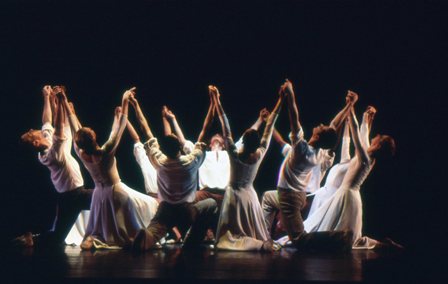
The Limón Dance Company in Limón’s There Is a Time
Superbly danced–as it was only sporadically here–it’s a lovely piece, if just a season or two too long, as are many of Limón’s efforts. “Cut it in half and fix the rest,” Humphrey often told emerging choreographers, but Limón chronically failed to follow this sound, if severe, advice.
At this showing, I particularly liked Logan Kruger’s appearances as a woman who is comfort itself and Kathryn Alter in the dark roles. The male soloists were fully adequate to their assignments but none of them made me feel I’d remember them forever–as I do Nina Watt in “A time to laugh . . . a time to dance.” Watt was so utterly the image of a wildly giggling child, the epitome of buoyant, irrepressible delight, that the role might as well have been retired when she retired. Overall, the current Limón dancers are undeniably experts in softness, sensitivity, fluency, and accuracy of detail. What they need most just now is a walloping dose of impetuousness; they are too pleasant and too neat.
The other item on the BAC program was Anna Sokolow’s Rooms, generally considered her masterpiece (to the neglect, perhaps, of the rest of her repertoire). Rooms is a superb work, as pertinent on the subject of urban loneliness and isolation as it was at its making in 1955. Simply by assigning each dancer a stark wooden chair as his or her home base, the choreographer leads us to imagine a low-end rooming house in which individuals with drastically limited human intercourse drown in their despair or dream heart-breakingly impossible dreams.
All the segments of the piece were thoughtfully danced, but Kristen Foote and Daniel Fetecua Soto emerged as its stars. “Escape” gave us Foote, soft, powerful, and sexy as hell in an orangey-pink dress, revving up for a romantic encounter. After a mimed toilette in which she luxuriated in her own beauty, she leaned from her chair to caress an invisible beau in an empty chair she’d placed opposite hers. As convincing as her anticipation of sensual pleasure–and, simply, connection–were the moments when her confidence evaporated, perhaps as she remembered bitter, even humiliating, past experiences. Then grief broke through–until she forced herself, once again, to imagine that this time . . .
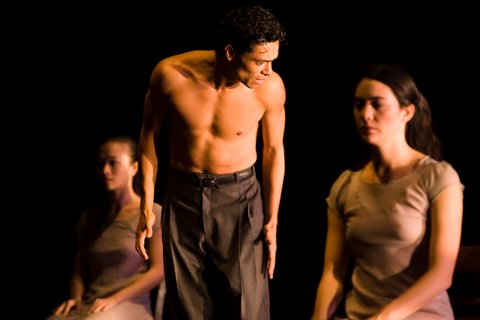
Daniel Fetecua Soto in Anna Sokolow’s Rooms
In “Panic,” Fetecua Soto, tense and bare-chested, sat in his chair like a criminal awaiting execution. Four other seated figures surrounded him yet ignored his very existence. They stared ahead as if frozen, then, one by one, abandoned the scene. Fetecua Soto’s character grew more and more twitchy, shielded his face with his palms as he whipped his head back and forth, and finally, seemingly pushed over the edge of sanity by his plight, abandoned himself to nothingness.
The haunting jazz score, created for Rooms by Kenyon Hopkins, was played live by the Manhattan School of Music Jazz Ensemble, conducted by Justin DiCioccio. As is always the case when live music serves as choreography’s partner, it made all the difference.
Early in March the Limón company played the 92nd Street Y–a haven for major and minor moderns back in the day–with a program of works by Limón and dance makers who were his contemporaries: Sokolow, Daniel Nagrin, and Donald McKayle. The dancing was much feistier than in the earlier performance, I’m glad to report. Unfortunately though, the format of offering fragments to represent work by the fellow toilers in the field felt “educational” rather than theatrical. The highlight of the program was Limón’s 1947 La Malinche, reconstructed and directed by Sarah Stackhouse, a former Limón star.
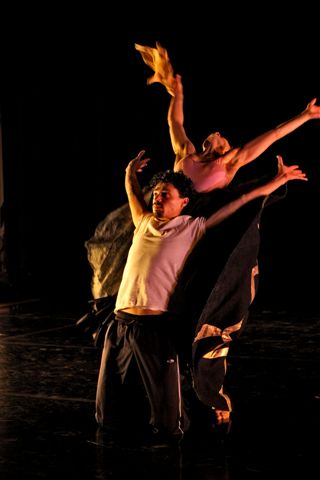
Daniel Fetecua Soto and Kathryn Alter in Limón’s La Malinche
The shape and nature of La Malinche is startlingly close to Graham’s 1940 El Penitente, with a troupe of three that arrives to present a primitive morality play in a village square, then, having imbued the roles with personal passion, moves on, presumably to give the same performance in the next town. The faux-naif dance style is also very close to the one Graham used for her piece. Did Limón borrow too freely? Or, perhaps, did Graham? There’s evidence that Limón had begun developing the dance that became La Malinche as early as the mid-1930s, and that his 1939 Danzas Mexicanas was a concrete result of the way his imagination had been working. In either case, it’s useful to think of Graham’s frequent comment: “I only steal from the best.”
The story told in Limón’s piece, which is set to a serviceable score by Norman Lloyd, is one that the choreographer remembered seeing enacted in his childhood: A Mexican-Indian woman (La Malinche) is lured into abetting the European conqueror of her land (El Conquistador–that is, Cortez), who reduces the local inhabitants to slavery. Having betrayed her people–represented by a native man who is her rightful partner (El Indio)–she repents after her death, returning as a ghostly presence to support him in the revolution against oppression.
The plot may sound corny today, but the astute simplicity of the choreography makes it convincing. The dancing, by Alter, Fetecua Soto (as the good guy), and Dante Puleio (the bad guy) hit all the right notes of dictatorial complacency, succoring womanhood, and rebellious fervor without fuss or exaggeration.
Meanwhile, the Sokolow troupe gave a single performance on February 14 at the 92nd Street Y to honor the 100th anniversary of the choreographer’s birth. The group represents a heroic effort by Jim May, once a dancer with Sokolow, to show us her greatest gift: the ability to fuse the rules governing a “well-made” dance (clarity, classically balanced structure, and so on) with invention and emotional authenticity.
The program comprised numerous small works and excerpts from larger ones. It included two latter-day versions of the 1945 female solo Kaddish (set to Ravel), which refers to the Holocaust by evoking the Jewish prayer for the dead; Ballade (Scriabin), a fresh-as-springtime quartet that represented Sokolow in her lyrical vein; and excerpts of earthier pieces such as Kurt Weill; Frida (an evocation of Frida Kahlo, the doom-eager and doom-plagued Mexican painter); and Murals, recently resurrected by May.
The problem with finding a sizable, steady audience today for work like Sokolow’s lies in the pieces’ seeming too small in scale and impact. (The histrionic behavior of Limón’s outsize heroes, as they contend with the vagaries of fate or their own flaws, has a distinctly popular appeal.) Sokolow’s work is quieter and more subtle. It’s best seen in an intimate space, where the close-up view reveals the fine-tuned detail of both motion and emotion. For today’s public, given what it has been schooled to appreciate, Sokolow’s dances are not large and “loud” enough.
It’s unfortunate, too, that the dancers May can commandeer just don’t look fully professional, lacking the confidence and projection typical of seasoned performers. At best, a couple of the men seem promising. Most of the women lack the highly toned bodies of dancers who perform regularly. Yes, the group has clearly responded to May’s coaching and can be admired for its sincerity of purpose. But May’s quest is in a race with time, the great obliterator.
Photo credits: Limón: unidentified; Sokolow: Lionel Fredman; There Is a Time: David Levy; Rooms: Meems; La Malinche: Julie Lemberger
© 2010 Tobi Tobias
Super site! Your writing is so much better in comparison to most other bloggers’. Thank you for posting. When you do, I’ll be sure to keep visiting!
Your knowledge, excellent eye, and generous sensibility bring to life the work of these two venerable artists. As always, a hearty thank you!
In the last few years I have seen so many performances of “historical” works that could use “a walloping dose of impetuousness” from the dancers I can’t count them. I blame it on the stagers, many of them, so anxious to be completely accurate that they lose the spirit of the work. Nothing makes a work look more dated than preserving it in the hardened amber of accuracy.
Having said that, I did see, at the Joyce Theater a few years ago, the Limon company perform “La Malinche” with the energy and commitment the work demands–it was stunning.
TT’s writing skills, I would add, do bring the Sokolow and Limon works to life, making this reader at least able to “see” a performance from a distance.
I agree with Martha Ullman West’s observation. The “letter of the law” mindset, essential to scrupulous dance notation, may well leach the energy out of a pious staging of a “historical” work. The stager needs also to be a coach, encouraging the dancers to embody the spirit of the work. I thought Sarah Stackhouse achieved this with the Limon company’s production of “La Malinche.” The late Sallie Wilson instinctively worked in this way with Tudor’s ballets, as did Annabelle Gamson with the dances of Isadora Duncan. Readers may want to add their own examples. tt
Your article strengthens a feeling I’ve had for several years. If the masterworks of modern dance are to survive, the form must turn into a repertory format. Particularly with the economic climate as it is and will be, the single choreographer company is no longer viable. No modern-dance company today, with the exception of Paul Taylor’s and Mark Morris’s groups, can maintain the necessary presence (and hence the fund-raising and ticket sales required) to remain viable. Even Merce Cunningham experienced difficulty before his passing. The Graham company is marginalized; Limon, as you mention, can no longer sustain regular seasons. If a repertory modern-dance company could offer a program of three works — imagine a Graham, a Limon, and something brand new — the draw would become a strong one. Much coaching would be necessary and no doubt something indefinable (a group of dancers working with a choreographer for years) would be lost, but the works would survive. One need only see a modern-dance work transferred to a ballet company to see the downside, but if the masterworks are to endure, this must (unfortunately or not) be the future.
There’s also a small but dedicated company: Linda Diamond: Sokolow Dance, trying to keep Sokolow’s work alive. They are located in Woodstock, New York, and have performances several times a year.
Such a thoughtful review, Tobi. As always you raise such great questions while elegantly describing what I’m too far away in MN to see. I so appreciate your infallible eye.
Wonderful review. I was at both BAC performances and many of your comments track with my thoughts. And thanks for acknowledging the Limon company’s “unbroken existence” — 37 years — since Limon’s death.
I don’t know what the Limon company’s current fiscal situation is but it has an extensive touring schedule this year — China in December, Italy in March, Switzerland in April and Mexico in May.
To respond to Bob Y’s point, the Limon company has already morphed into a true repertory company. Under Carla Maxwell’s direction, it got over the existential hurdle of what to do when the founder is gone by programming works from other choreographers whose work is congenial to Limon’s aesthetic. In this decade alone, I have seen them perform good-to-great works by Jiri Kylian, Lar Lubovitch, Donald McKayle and Anna Sokolow. So, it is possible to find a new creative life after death.