


Trisha Brown Dance Company / BAM Howard Gilman Opera House, NYC / April 29 – May 2, 2009
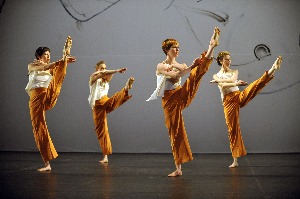
Trisha Brown’s L’Amour au théâtre
Photo: Stephanie Berger
Trisha Brown, recently back at the Brooklyn Academy of Music, offered a show that indicates how she’s moved from her beginnings to today, in a career that spans five decades.
One of the most wonderful aspects of her early work was its plainness. If the Shakers had had progeny, they might have been her ancestors. In the 1960s, Brown was a hero of postmodernism, as it came to be called, rejecting traditional concert-dance accoutrements, such as plot, emotion, musical accompaniment, decor, and costumes other than the sort of threads in which you washed the car. Quiet, smart as hell, witty, and determined, she had people walking down the facades of buildings, with the gawkiness of entry-level mountain climbers in reverse; communicating movements to one another from Soho rooftops (as if in a visual game of Telephone); making ordinary, often pointless tasks–like picking up a pile of sticks, one at a time, from a spot on the floor and moving them to a similar nondescript heap just several feet away–somehow thrilling.) Without ever indulging in self-congratulatory fuss about it, she embodied the shock of the new.
The 1968 Planes, the oldest work on the BAM program, looked back to these plainspoken dances, though it augments bare-bones movement with hyperactive film that jazzes up and, indeed, almost overwhelms the main, live action. (It also incorporates some music by Simone Forti, a fellow revolutionary.) This is the deal: a pale rectangular wall stands center stage. Pierced regularly by circles, it offers foot- and handholds to three women in jump suits, who ascend, descend, and travel slowly across it at a serene pace, with no destination indicated. The film starts out as a shaky, handheld camera-style view of urban detail animated by frenetic lighting, moves on to add color, and eventually becomes a travelogue of exotic lands. From time to time a pretty young woman in a pink leotard that nearly matches her skin, magnified way beyond life size compared to the live performers, straddles the space and performs supple back bends. Is she a latter-day Terpsichore?
Gradually embracing the elements that add conventional grandeur to dance, Brown moved toward opera-house acceptance, consistently doing so on her own terms. O złożony / O composite (the second element of the title is the French translation of the Polish first part) was created in 2004 for three étoiles of the Paris Opera Ballet (the French adore Brown). It was these top stars–Aurélie Dupont, Manuel Legris, and Nicolas Le Riche–who performed the piece at BAM in its American premiere. While the choreography is far from being top-notch, it was a pleasure to see how these mature ballet-made bodies absorbed the fluid style of the movement Brown gave them, while she in turn, who never studied classical dance, allowed them occasional steps from the technique they had perfected from childhood.
The best (and key) passage in the dance occurs early on and closes the piece as well. The two men face each other and walk softly with the woman’s body held horizontally between them. Her body hides their supporting hands, so she seems to float. The balance of the dance, although each of the participants is given a little solo, is essentially an exploration of how delicately and intricately a physical ménage à trois can be managed. The territory might have been Ashton’s, and he would have made it more tender and far easier to understand.
Brown’s dance is accompanied by a meditatively melancholy score that Laurie Anderson based on poems by Edna St. Vincent Millay and Czeslaw Milosz and is danced before Vija Celmins’s irresistible backdrop of a nearly black sky thick with stars (that is, étoiles).
The glory of the program was the 1979 Glacial Decoy, one of Brown’s perfect collaborations with the late visual artist Robert Rauschenberg. Against a huge four-panel slide show of black and white Rauschenberg photographs of commonplace things, mostly rural, whose interest and beauty so often goes unnoticed, five women flitter back and forth along a cross-stage path that seems, on both sides, to go on into the wings where the audience can no longer see it. If that’s not a metaphor for life, I don’t know what is.
Rauschenberg costumed the women–angels? fairies? visions?–in filmy white nightgown-like dresses with dropped sleeves that fan out like little parasols, leaving the dancers’ fine-boned shoulders bare. So what you see is a sculptural mass of uninterrupted flesh–head, neck, and shoulders–that proclaims warmth and vitality, while the rest of the body is cocooned in a cool scudding cloud.
There is no sound other than the ambient hum that makes a room come alive and the dancers’ often emphatic footfalls. No other sound is needed.
In the world premiere slot in the program was L’Amour au théâtre (Love in the Theater) set to excerpts from Jean-Philippe Rameau’s Hippolyte et Aricie, based on Racine’s tragic Phèdre. Brown is slated to stage the full opera in France in 2010, and the choreography we saw will be dropped into that production in segments. The opera itself is rife with melodramatic situations, dense with strong human feeling. It’s hard to say how Brown will fare with this vehement work and its violent passions. She has certainly progressed in her investigation of complex human relationships between O złożony and L’Amour au théâtre, and the segments we saw bunched into a whole in the latter will register more sharply when they’re separated. Still, even this latest material leaves Brown needing to invent choreography that makes it clear that erotic love is not a merely a matter of tangling arms and legs, no matter how intricate.
© 2009 Tobi Tobias
Several years ago when I was working on a career overview cum profile essay on Brown for the Chronicle of Higher Education Review, I had a wide-ranging conversation with her about a number of things, including her popularity with the French and why that was so. I submitted that she is basically a visual artist, and the French understand visual artists who move perhaps better than we do. We also spoke of her use of space, which I suggested might be influenced by the place where she grew up, in Washington State, in a small town on Puget Sound, backed by the tall trees of the Olympic forest (hence her early work of treating buildings as if they were trees and dancers as if they were loggers, and her tendency to use the edges of the stage rather than its center. Brown investigates space and the human body consistently, but the emotional content of her work–“Geometry of Quiet” comes to mind–is detached; for this audience member, the response is aesthetic–as in how beautiful, rather than how tragic. So I too am curious to see how she deals with tragedy and melodrama. Since I can’t see the BAM retrospective with my own eyes, I am grateful indeed for Tobi’s insightful eloquence.
Thanks, I loved the little “Etoile” aside–because Americans are not supposed to know what it means, then here comes, two lines later, the hidden translation.
As to drama, didn’t Brown choreograph Monteverdi’s “Orpheus”? I saw it in the Montpellier Dance Festival. All was there on stage: love, fear, and the laughter of the gods.
I’ve never understood the charm of scaling walls, up or down, or moving on roof tops, nor can I understand those as dance experiences, but rather the need for a choreographer to do something different and for a company director to try to keep a company together. That was my impression, too, of last night’s San Francisco Ballet program. It included Ratmansky’s “Russian Seasons,” which seemed to be decades long while trying to be cute as we grew weary. Perhaps it suffered from the usual SFB interpretations, which are gloss-overs and, seemingly, a sincere effort not to be involved with any nuances. I don’t see this choreographer as the Great One.