


Merce Cunningham Dance Company: Nearly Ninety / BAM Howard Gilman Opera House, NYC / April 16 – 19, 2009
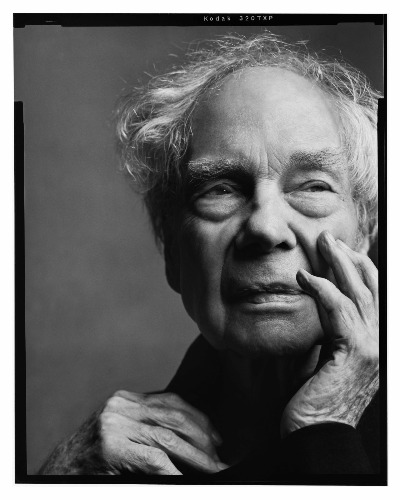
Merce Cunningham
Photo: Mark Seliger
Yesterday, April 16th, was Merce Cunningham’s 90th birthday. Long may he wave! The event was celebrated at the BAM Howard Gilman Opera House with the world premiere of his new full-evening piece, Nearly Ninety.
It’s only natural that the viewer would attribute a futuristic mindset to the piece–exploring space, because of the scenery, and a subtextual reminder of the Heaven that awaits the choreography sooner than later. But, oddly, the work has a dated effect. The most arresting element of Nearly Ninety, the decor, is dominated by Benedetta Tagliabue’s huge, handsome, changing construction which, in its progressive incarnations, suggests a spaceship. It’s skeletal, though, and the figures moving within it–seen more clearly as the lighting gradually brightens–are not technicians preparing for lift-off but the musicians creating their eerie, often cacophonic sound. The glamour of space travel, however, wore thin decades ago.
The abstract choreography itself–created simultaneously but not collaboratively with the music (this time by John Paul Jones, Takehisa Kosugi, and Sonic Youth: Kim Gordon, Thurston Moore, Lee Ranaldo, and Steve Shelley)–seemed typically Cunninghamesque, with its familiar off-kilter partnered balances, its cousinly relationship to classical ballet with the dissimilarities thought-provokingly apparent, the sudden exits of the dancers as if they were birds taking flight at the least hint of fear or finding a new focus of interest in a territory unseen by the audience.
In Nearly Ninety, though, the dance vocabulary suddenly appears limited. Take away the myriad attenuated arabesques, for instance, and where would it be? It also seems to have lost some of its signature sharpness–in the long leaps and the flickering footwork particularly. Strangest of all is the lack of relationship between the “spaceship” and the dancers. They just go on doing their stuff in the downstage space left by its looming presence until the very end, when a fragile young woman enters it and, on a small high platform projecting from it, moves in attitudes that suggest a heroic action is about to occur. She looks like she’s going to throw herself from the edge, her plunge to be broken, if she’s lucky, by her fellow dancers.
Cunningham’s immune to melodrama of that cheap sort, but the lengthy build-up leads to mere insignificance: nothing more than her quietly backing off and unobtrusively descending a sturdy staircase to solid ground and safety.
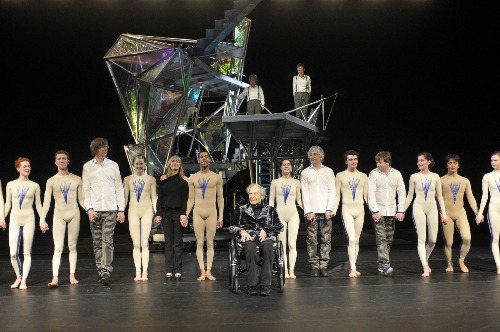
Curtain call for premiere of Nearly Ninety
Photo: Stephanie Berger
The performance had an onstage coda about which we were warned and asked to stay for in the single intermission. Arranged in a cross-stage line, the usual suspects made small speeches about Cunningham’s enduring wonderfulness and the silent dancers did little pliés and foot stretches to help their recently hard-worked bodies endure the longueurs of standing still and looking benign. In the center of this display sat its raison d’être, in a wheelchair that, with him in it, became a throne, his all-black clothes topped with a shiny jet smoking jacket that suggested “magician,” playing his role with understated, perfect-mannered elegance. He received no awards, common to such occasions, probably because he has all of them already–and has surely earned them by repeatedly giving us, down the decades, “something to see,” in his own words, “that [we] hadn’t seen before.”
This accomplished, the rich and famous went to a party held in a tent across the street from the theater and the rest of us found the half-renovated Atlantic Avenue subway station and went home.
A curiosity: the dancers were dressed, by Romeo Gigli, in glossy black and white unitards that changed slightly in the course of the piece for no reason I could see except to keep viewers from getting bored. But why, I kept wondering, did the initial costumes have one black sleeve that ended in a glove, conjuring up memories of Balanchine’s La Valse and other ballets of the French surreal persuasion? The conceit mates weirdly with bare feet.
A mistake? At the end of this season, Cunningham will not renew the contracts of three of his senior dancers–Holley Farmer, Koji Mizuta, and Daniel Squire–for artistic reasons, it was announced. At first people assumed this was a money-saving device imperative in these perilous economic times, since the seniors command the highest salaries. Then commentators surmised it was because the choreographer takes his greatest pleasure in exploring what younger, unformed dancers might achieve. As far as I’m concerned, letting Farmer go was dead wrong. She humanizes Cunningham’s material with an erotic element it benefits from greatly. Farmer is expressive in a technique that deliberately ignores expressiveness. Cunningham danced with Martha Graham early in his stage career and probably had quite enough of that and the excesses it can lead to. But I’d suggest, respectfully, that one shouldn’t turn one’s back too adamantly on one’s past.
© 2009 Tobi Tobias
You’re wonderful, as always, and I’m so glad to see you using this comment box, an invention that’s just terrific.
As usual beautiful, elegant, and honest writing, but what a pang it gave me to read that the “glamor of space travel, however, wore thin decades ago.” It had such an impact on artists of every stripe in the fifties and early sixties, including my father who was the first easel painter to make a picture of man in space, inspired by John Glenn’s first orbits of the earth. Ballet choreographer Todd Bolender never ceased to be fascinated, making a ballet called “Voyager” in the early eighties using projections of film of outer space taken by NASA. He was a little older than Merce, but of the same generation. It seems to me that that Merce would continue to explore outer space, and I’m sorry this recent piece is not quite up to snuff aesthetically.
As for the costumes (I haven’t actually seen any of this for myself, you understand), I find I am regularly cursing the inventors of the unitard–a more unbecoming costume even for those beautiful dancers’ bodies, unless it’s bicycle shorts, cannot be imagined.
Years ago I attended an exhibition of late Picassos, at the Guggenheim I think, in the company of my artist father, who looked around and said, “Oh lord, even Picasso is painting Picassos these days.”
Re. Merce: I found your review to be as articulate and insightful as always, and confirmation!
I am particularly grateful for your acknowledgement of Holly Farmer, and for the comments you made at the end of the review. I have been outraged by what I’ve read in the press about the firing, and by the speculation and assumptions made by one critic in particular. I find them to be not only gratuitous and hurtful, but dismissive of the years of devotion and artistry on the part of dancers, and not only Merce’s, that make great choreography possible.
I had also wanted to respond to your wonderful article about living in NYC, and have just not had the time. I really miss the city, and you captured so many of the things that still make it home for me.
Many thanks for all.
Masterful review!