


This article originally appeared in the Culture section of Bloomberg News on November 4, 2008.
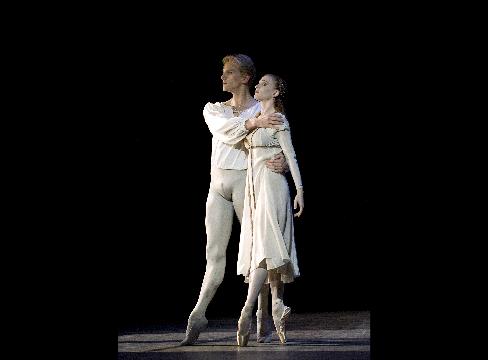
Gillian Murphy, right, and David Hallberg perform the pas de deux from “Romeo and Juliet (Romeo’s Farewell)” during American Ballet Theatre’s Tudor Centennial Celebration in New York on Oct. 21, 2008. The celebration runs at New York’s City Center through Nov. 2. Photographer: Gene Schiavone/ABT via Bloomberg News
Nov. 4 (Bloomberg) — The ability to reveal, through movement, the complex emotional life of a human being, was the supreme gift of Antony Tudor (1908-1987), whom American Ballet Theatre calls its own.
Closing out its fall season at New York’s City Center this past weekend, ABT’s Tudor Centennial Celebration presented a handful of works charting a career solidly begun in England and then continued in America.
Tudor was not prolific, he had his failures and he is nearly impossible to mount today. His ballets’ profound effect demand extensive rehearsal time, his own coaching (which could be remorseless) and the willingness of the audience to recognize itself in the mirror his dances hold up to them. Nevertheless he remains a unique choreographer who stands indisputably among the dance geniuses of the 20th century.
The program included a pair of Tudor’s most celebrated ballets. “Jardin aux Lilas” (“Lilac Garden”), made in England in 1936 and set in the Edwardian era, concerns an arranged marriage that breaks the hearts of a young woman, the youth she loves, the vehement abandoned mistress of “the man she must marry” and perhaps even that man himself, though his I-claim- you-as-my-rightful-property attitude masks it.
Set to Ernest Chausson music that swells with emotion, the action takes place at a garden party in which the heroine says farewell to her friends and her innocent, ardent lover, to depart, frozen, on the arm of the man who has acquired her. The ballet seems suffused with the delicate scent of blooming lilacs — suggesting loveliness doomed to an early death. ABT gave it an admirable performance, with Julie Kent, as the heroine, at her tremulous best.
`Pillar of Fire’
“Pillar of Fire” (1942) tells a spinster’s story. Frustrated by Edwardian propriety and feeling herself devoid of sexual attraction, she offers herself up to a one-night-stand stud, then finally finds understanding, forgiveness for her “sin” and — yes — love, from the most ordinary-seeming man in the world. This is no fairy tale, though; the action moves from repressed emotion to turbulence to catharsis, leaving the sympathetic viewer shaken to the core. The secondary characters were oddly miscast, but Gillian Murphy’s power in the central role was soul-wrenching.
Lighter in weight, yet piercing in its own way, the 1938 “Judgment of Paris” is a sardonic riff on the Greek myth of Paris, asked to choose the most beautiful or gifted of three goddesses. A progressively inebriated old gent loses both his valuables and his dignity in a seedy cafe, lured by a trio of ladies of the night who have seen far better days. The simultaneous combination of humor and tragedy is a feat few choreographers could bring off. The pathetic “goddesses,” danced by ABT alumnae, were positively Stanislavskian.
`Romeo and Juliet’
The tenderness of Tudor’s 1943 one-act “Romeo and Juliet” is partly due to the choreographer’s slyly avoiding the bombastic Prokofiev score. Tudor chose Delius and created a work that is exquisitely poignant and humane — and considered all but lost today. The bedroom pas de deux, called “Romeo’s Farewell,” has been retrieved, though, and more of the ballet may eventually resurface. Xiomara Reyes and Gennadi Saveliev were woefully illcast, but at the season’s opening night gala, Murphy and David Hallberg were both expressive and precise, making every gesture count.
`Continuo’
Tudor made the 1971 “Continuo” for his students when he was teaching at Juilliard. It was danced here by their equivalent, newer members of the corps de ballet. Its three couples flow through space with the weightlessness of a dream, evoking the natural beauty and unself-conscious lyricism of the young.
Sadly, the masterwork of Tudor’s late years, the plotless “The Leaves Are Fading,” was scrapped for lack of time. At least “Leaves” was performed earlier in the course of the season. In it, several young couples emerge from a small community in duets that evoke the variety of love’s ecstasy. A less sophisticated choreographer would have made the piece dulcet. Tudor takes this quality for granted, subtly varies the duets’ moods, and adds the intensity of rapture understood in retrospect.
ABT calls Tudor its “artistic conscience” and its stagers and dancers must have tried hard to make the present productions accurate and moving. Still a good deal more needs to be done, beginning by keeping the ballets active in the repertory, if the Tudor legacy is to survive. In a cruelly commercial society, the Tudor ballets don’t “sell” anymore — in part because ABT has taught audiences that his worlds of deep feeling and piercing insights into human nature are passe compared to the meaningless spastic gyrations of Jorma Elo.
© 2008 Bloomberg L.P. All rights reserved. Reprinted with permission.