Lubovitch Group Brings Vintage Dances, New Dancers

This article originally appeared in the Culture section of Bloomberg News on November 7, 2008.

Nov. 7 (Bloomberg) -- The gala opening night of the 40-year-old Lar Lubovitch Dance Company, Wednesday, at New York's City Center, revealed a great deal of what we've come to expect of this choreographer: grace, lyricism, easy musicality, clear structure and sentimentality.
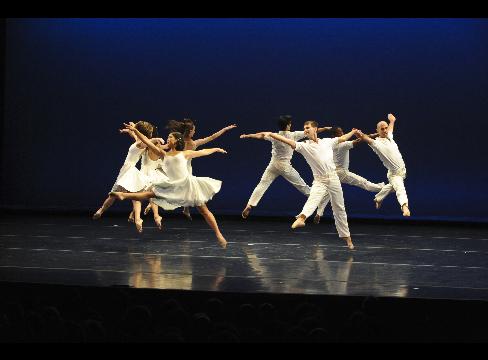
lld1.jpg

Members of the Lar Lubovitch Dance Company perform ``Concerto Six Twenty-Two,'' to music by Mozart in this undated handout photo released to the media on Thursday, Nov. 6, 2008. The company is performing at the New York City Center, 131 W. 55th St., through Nov. 9. Photographer: Christopher Duggan/Lar Lubovitch Dance Company via Bloomberg News

Lubovitch's work is pleasing, not challenging, certainly not confrontational; some find it banal. He presents lovely, accomplished dancers who reach occasional rhapsodic moments -- a key reason for his company's worldwide popularity, even if it isn't out to set your mind or soul on fire.

Of the three vintage works on the bill, ``Concerto Six Twenty-Two'' (1986, named for its Mozart score), gives you Lubovitch in a nutshell.

The first and last of its three sections are elated dances by a large group and segments of it that invariably link back to the full community. The choreography is distinctive for its ever- evolving circles, traced in turning patterns and individual swirling bodies. The effect is marred slightly by little bits of sophomoric tomfoolery, perhaps inserted purposely, as if to break up the otherwise relentless loveliness.

The mid-section, entirely disconnected from rest of the dance, is a tender, meditative male duet. It's a persuasive argument, if one is needed -- and it was, at the height of the AIDS epidemic -- to respect love between two men.

Dark Stunner

``North Star'' (1978, to Philip Glass) is a dark stunner that seems to be set in a night sky, with a galaxy breaking and re-forming as if inseparable for eternity. It moves on to a pulsing, witchy solo for a woman, then a calm, limb-stretching one for a man who summons the star-cluster back to surround him.

The earliest dance on the program, the 1969 ``Whirligogs,'' claims in its program note to have been inspired by Paul Taylor's simultaneously frightening and funny ``Three Epitaphs,'' a singular small masterpiece. It wasn't inspired enough.

Of the two recent dances shown, I preferred this year's ``Jangle,'' to Bartok music in his Slavic mode. An impromptu response to street music, it means to portray a middle-European, working class group from a decade long past.
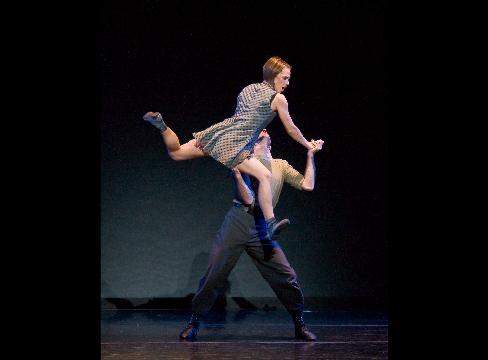
lld2.jpg

Kate Skarpetowska and Brian McGinnis of the Lar Lubovitch Dance Company perform "Jangle" to music by Bartok in this undated handout image released to the media on Thursday, Nov. 6, 2008. Photographer: Sharen Bradford/Lar Lubovitch Dance Company via Bloomberg News

It would look better if it felt more weighted and seemed more spontaneous. However its vivacity, tied to folk forms, and its varieties of mood increase as the dance progresses, and the music is irresistible. The piece has a marvelous duet for a troubled couple and cheeky bravado in Jonathan E. Alsberry's solo passages that suggest Lubovitch may be moving beyond his familiar boundaries.

Virginal White

The 2007 ``Dvorak Serenade'' is essentially another pretty dance, performed in virginal white. It's remarkable, though, for its leading couple: Mucuy Bolles (she of the still center) and Scott Rink as her sympathetic cavalier, who responds to her calm reticence and delicacy.

Lubovitch uses a lot of classical scores, as well as the stellar moderns (Philip Glass, Steve Reich) and suave vintage popular music (George Gershwin, Cole Porter). He is rarely in the forefront of new sound, though he was one of the first to use minimalist music.

When it comes to choreography, he is infinitely adaptable, working in several genres besides modern dance: among them ballet, musical theater, and ice dancing, that most self- contradictory of modes. He refuses to make sharp distinctions among dance forms or vocabularies; to him dancing is dancing and he's very competent at creating work from the sources he knows best. So what do you want? More? Yes.

Through Nov. 9 at 131 W. 55th St. Information: +1-212-581- 1212; http://www.lubovitch.org.

© 2008 Bloomberg L.P. All rights reserved. Reprinted with permission.

November 7, 2008 10:26 AM |

Categories:

Other Words


. . . and while I know a woman who learned Greek at ninety there are nevertheless some skills, like ballet dancing and gum chewing, which can only be mastered by the very young.
-- Jean Kerr, Penny Candy

Now that my hair is white, and my years of life ahead are growing fewer, I think that the pains I have taken over dancing have not really been pains, and I must study harder, much harder.
-- Onoe Kikugoro VI (familiarly called Rokudaime), in Ben Bruce Blakeney, "Rokudaime," Contemporary Japan, 18

When people grow old they must be dull. Dancing can't go on for ever.
-- Anthony Trollope, Can You Forgive Her?

When you do dance, I wish you / A wave o' the sea, that you might ever do / Nothing but that.
-- William Shakespeare, The Winter's Tale

Sitelines

ARTSJOURNAL

ARTS & LETTERS DAILY

BALLET.CO

BALLERINA GALLERY

THE DANCE INSIDER

DANCEVIEW TIMES

FOOTNOTES

GREAT DANCE WEBLOG

THE WINGER

The RÉUNION DES MUSÉES NATIONAUX (The National Museum Association's Photographic Agency) offers a photographic catalogue of some 200,00 holdings of French museums. It can be searched by artist, country, period, subject, and so on. You can make a personal album of your favorites on the site. New York's Metropolitan Museum of Art and D.C.'s National Gallery have similar services, but the French one is the most ambitious and extensive. Text in English as well as French.

AddALL is an ultimate umbrella for finding used and out of print books online. It doesn't have the atmosphere of Foyle's, Powell's, or even the Strand, but it will give you every opportunity to need yet another bookcase.

PROJECT GUTENBERG More books. No bookcase required. Over 6000 free electronic texts.

CALLIGRAPHY LESSONS ONLINE Learn the italic hand and make yourself legible. Don't miss the animation.

Color charts of HERBIN INKS. If you have to ask, you'll never know.

THE NEW YORK TIMES Because it's there.

About this Entry

This page contains a single entry by Seeing Things published on November 7, 2008 10:26 AM.

Tudor's Stricken Lovers End Ballet Theatre Season was the previous entry in this blog.

What Ever Happened to Bebe Miller? is the next entry in this blog.

Find recent content on the main index or look in the archives to find all content.

AJ Ads

Introducing
AJ Arts Blog Ads

Now you can reach the most discerning arts blog readers on the internet. Target individual blogs or topics in the ArtsJournal ad network.

Advertise Here

AJ Blogs

AJBlogCentral | rss

culture
About Last Night
Terry Teachout on the arts in New York City
Artful Manager
Andrew Taylor on the business of arts & culture
blog riley
rock culture approximately
CultureGulf
Rebuilding Gulf Culture after Katrina
Dewey21C
Richard Kessler on arts education
diacritical
Douglas McLennan's blog
Flyover
Art from the American Outback
Life's a Pitch
For immediate release: the arts are marketable
Mind the Gap
No genre is the new genre
Performance Monkey
David Jays on theatre and dance
Rockwell Matters
John Rockwell on the arts
Straight Up |
Jan Herman - arts, media & culture with 'tude

dance
Foot in Mouth
Apollinaire Scherr talks about dance
Seeing Things
Tobi Tobias on dance et al...

jazz
Jazz Beyond Jazz
Howard Mandel's freelance Urban Improvisation
ListenGood
Focus on New Orleans. Jazz and Other Sounds
Rifftides
Doug Ramsey on Jazz and other matters...

media
Out There
Jeff Weinstein's Cultural Mixology
Serious Popcorn
Martha Bayles on Film...

classical music
The Future of Classical Music?
Greg Sandow performs a book-in-progress
On the Record
Exploring Orchestras w/ Henry Fogel
Overflow
Harvey Sachs on music, and various digressions
PostClassic
Kyle Gann on music after the fact
Sandow
Greg Sandow on the future of Classical Music
Slipped Disc
Norman Lebrecht on Shifting Sound Worlds

publishing
book/daddy
Jerome Weeks on Books
Quick Study
Scott McLemee on books, ideas & trash-culture ephemera

theatre
Drama Queen
Wendy Rosenfield: covering drama, onstage and off
lies like truth
Chloe Veltman on how culture will save the world
Stage Write
Elizabeth Zimmer on time-based art forms

visual
Aesthetic Grounds
Public Art, Public Space
Artopia
John Perreault's art diary
CultureGrrl
Lee Rosenbaum's Cultural Commentary
Modern Art Notes
Tyler Green's modern & contemporary art blog
Creative Commons License
This weblog is licensed under a Creative Commons License.