


This article originally appeared in the Culture section of Bloomberg News on June 5, 2008.
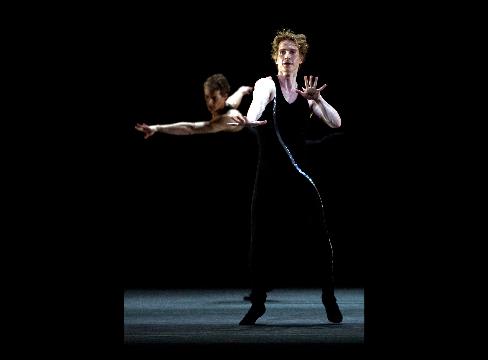
Ethan Stiefel, right, performs in the American Ballet Theatre production of Twyla Tharp’s “Rabbit and Rogue” at the Metropolitan Opera House in New York on June 2, 2008. Performances continue through July 12 at the opera house, part of Manhattan’s Lincoln Center. Photographer: Rosalie O’Connor/ABT via Bloomberg News
June 5 (Bloomberg) — Ethan Stiefel, his Mr. Perfect technique softened since an operation for knee trouble, is the elder brother, all smart-alecky goofiness. Herman Cornejo, a whiz of a dancer, is his competitive kid brother. Driving each other nuts yet irrevocably bonded, the two are the heroes of Twyla Tharp’s “Rabbit and Rogue,” given its world premiere Tuesday night in New York by American Ballet Theatre.
The pair sets out to see the world, accompanied by a colorful mix of music by the film composer Danny Elfman. Well, a postmodern idea of the world: They visit Hell, where Gillian Murphy and David Hallberg, alternately quarreling and making love, are the central patrons of a with-it nightclub where the required dress is black, skimpy and spangled. (Outfits by Norma Kamali.)
Next stop is Heaven, a peaceable kingdom, all white gowns and silver trousers, reigned over by Paloma Herrera and Gennadi Saveliev. In this place, one might find serene compatibility, even true love, perhaps bliss. Then the worlds commingle, as in real life.
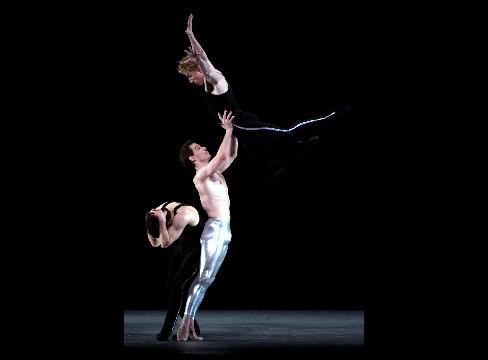
Dancers, from left, Herman Cornejo, Craig Salstein and Ethan Stiefel perform in the American Ballet Theatre production of Twyla Tharp’s “Rabbit and Rogue” at the Metropolitan Opera House in New York on June 2, 2008. Performances continue through July 12 at the opera house, part of Manhattan’s Lincoln Center. Photographer: Rosalie O’Connor/ABT via Bloomberg News
At this point, the ballet begins to feel too long and too diffuse.
The most remarkable thing about the choreography is that most of it travels in horizontal lines from one side of the stage to the other. The dancers look like an adrenalin-infused Greek frieze or simply a view of life’s passing parade. Leave it to Tharp to break one of dance-making’s cardinal rules about variety with deadpan confidence.
Steel-Trap Mind
From conventionally avant-gardish beginnings in the late 1960s, Tharp — with her steel-trap mind, theatrical flair and inordinate ambition — swiftly found her singular mode of combining classical ballet, jazz and vernacular moves. Her choreography has always been rigorous and complex, wittily melding popular with highbrow.
From exquisite pieces that caught the mood of a moment in cultural history, she switched to semi-narrative work that ran on rage. In recent years, she created high-voltage shows for Broadway. “Movin’ Out,” set to Billy Joel songs, had legs; “The Times They Are A-Changin,” to Bob Dylan numbers, was a dud. “Rabbit and Rogue” brings her back to ABT after a long absence. Surprisingly, for she is a great inventor, it doesn’t have much in it that seems new.
`Etudes’
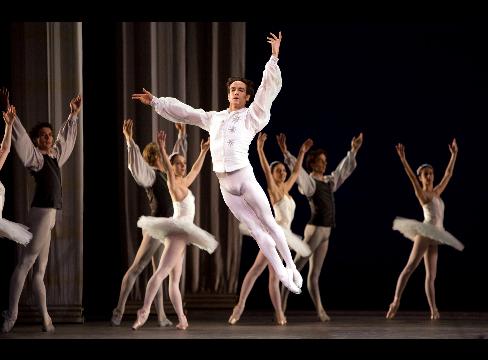
Sascha Radetsky, center, performs in the American Ballet Theatre production of Harald Lander’s “Etudes” at the Metropolitan Opera House in New York on May 19, 2008. Performances continue through July 12 at the opera house, part of Manhattan’s Lincoln Center. Photographer: Rosalie O’Connor/ABT via Bloomberg News
In 1948, Harald Lander created “Etudes” — his best work, I’m afraid — for the Royal Danish Ballet, which he headed. He left the company under unpleasant circumstances a few years later for the Paris Opera Ballet, where he reworked the piece into the souped-up version seen worldwide today. For reasons I can’t fathom, ABT revived its production to accompany the Tharp.
Granted, “Etudes” is a crowd pleaser, but it’s in execrable taste. It purports to show the classical dancer’s training in a nutshell, goes on to hokey incarnations of the contrasting Romantic and Classical periods and climaxes in a series of escalating virtuoso feats performed in intersecting diagonal lines — a situation that titillates the audience with its looming peril.
On the whole, ABT’s dancers performed it with immaculate precision, a mark of commendable technique throughout the ranks. Still, the company might have done better to sacrifice neatness to more fire in the belly.
Through July 12 at the Metropolitan Opera House, Lincoln Center, Broadway at 65th Street. Information: +1-212-419-4321; http://www.abt.org.
© 2008 Bloomberg L.P. All rights reserved. Reprinted with permission.