


This article originally appeared in Voice of Dance (http://www.voiceofdance.org) on September 27, 2007.
New York Baroque Dance Company, with Company XIV and Concert Royal: “Points of Departure” / Mark Morris Dance Center, James and Martha Duffy Performance Space / Brooklyn, NY / September 21, 22, 28, and 29, 2007
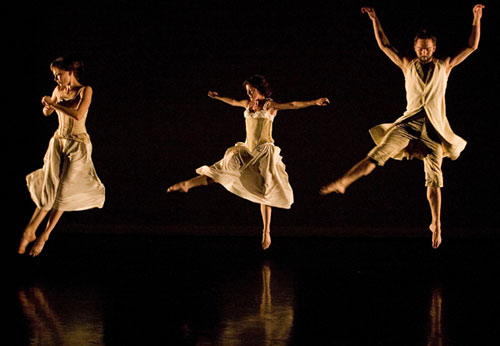
New York Baroque Dance Company in Seth Williams’s Point of Departure. Photo by Chris Woltmann.
First it happened in the world of cookery–fusion cuisine replaced the more single-minded foreign cuisine as the next new thing. And before we knew it, the impulse migrated to the dance world with the same prevalence and fervor.
Classical ballet, of course, has for a couple of centuries been picking up “outsider” ways of moving–folk dance, jazz–and infusing its straight-laced principles with them, much to its advantage, shifting and growing slowly and organically, the way spoken language does. More abruptly, modern dance and ballet, once sworn adversaries, made friends, and we acquired the term “crossover choreographer.” To adapt themselves to the concert stage, which is hardly their native–or even a congenial–element, flamenco and the tango have co-opted elements like narrative. More recently, classical Indian dance has looked beyond its traditional borders to annex other genres of movement from our now globalized culture.
No surprise, then, that the New York Baroque Dance Company, led by Catherine Turocy, the esteemed and charming scholar-performer of the late seventeenth- and early eighteenth-century dance that prefigured ballet, should have masterminded a show called “Points of Departure.” At Brooklyn’s Mark Morris Dance Center in late September, her company–augmented by Austin McCormick’s Company XIV, and, where live music was used, accompanied by James Richman’s admirable Concert Royal–presented a handful of pieces that used the movement style and themes of Baroque dance as a springboard into contemporaneity. Being a longtime admirer of Turocy’s customary efforts, I wish I had loved them more.
The most ambitious item on the program, Seth Williams’s Point of Departure proved to be the best of the offerings by a long shot. Why? Because it looks like a dance, not a self-conscious contrivance. Pointedly, its six performers wear handsome white and tan outfits that let them move freely, all the while subtly referencing period costume. In the first part of the piece, full of vivacity and bounce, the choreography makes you think of Baroque dance loosened up. Then, especially in its patterns and implied emotions, it begins to look like modern dance inspired (perhaps rather too literally) by Paul Taylor. The live music enhanced the proceedings immensely and the piece took on a let-joy-be-unconfined air. The standout among the dancers was Laura Careless, dulcet, buoyant, tender, and blessed with curly strawberry blonde hair.
Another group piece, Austin McCormick’s Trompe L’Oeil provided a highfalutin program note about juxtaposing “the meditative/spiritual side…and the grotesquely distorted side of the Baroque.” What we actually saw was a half-dozen barefoot dancers in fragments of Baroque costume and gilded face-paint, with golden masks worn on the back of their heads. In murky light, the players murkily enacted a tale of unstained romance menaced by the devil that lurks in us all. Davon Rainey, as the threatening yet irresistible persona, was the most compelling dancer of the lot.
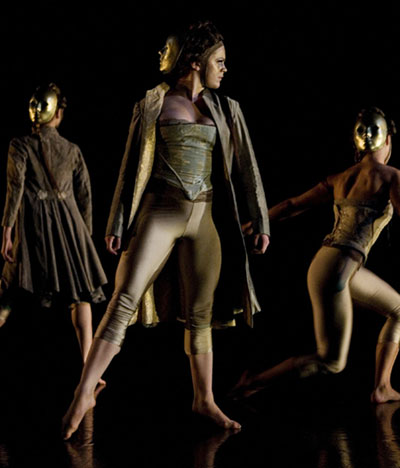
New York Baroque Dance Company in Austin McCormick’s Trompe L’Oeil. Photo by Chris Woltmann.
Two women from NYBDC performed long (far too long) solos of their own creation; both dancers have much to learn about choreography. The innately dramatic Sarah Edgar offered Armida Abbandonata, though, without access to the press release, you’d have been unlikely to know that it referred specifically to “the unrequited love suffered by [a] ravishing Persian sorceress, queen and warrior.” Trying to figure out what the hell is going on naturally distracts one’s attention from the dancing itself, which was pretty, anguished, and finally vehement.
My favorite moment had Edgar scooping up the paper flowers she’d initially laid out to define the space she would use, lifting her arms over her head, and letting the crushed petals rain down on her body. Affecting too was the subsequent passage in which she crouched over her heart and belly in sorrow that translated into physical agony, then suddenly stood erect to move ferociously, embarking on a grief-fuelled revenge. I think this piece is salvageable and recommend Doris Humphrey’s still-useful advice: “Cut it in half and fix the rest.”
Patricia Beaman’s Accumulating Venus was little more than a bagatelle–done gravely, alas, rather than lightly–about costume, the main feature of which was a length of vibrant persimmon curlicues suggesting the unruly fleece of a mythological animal given to erotic misbehavior. The piece consisted largely of a reverse strip-tease in which the dancer gradually donned the underpinnings of the female Baroque wardrobe, including the corset that confines–nearly immobilizes–the torso and the wire construction that enlarges the hips to Earth Mother proportions. The most vivid moment had the “fleece” shift from the role of cloak to that of a blanket of flowers covering the supine dancer as if she lay in her coffin.
Beaman incorporated the arm and hand behavior of Baroque dancing into her choreography, such as it was, and riffed weirdly on the period footwork, but these references looked obligatory and perfunctory. The marvelous costume was designed by Leslie Weinberg and constructed by Christian Milk.
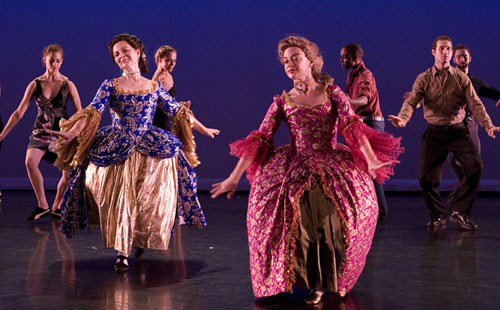
New York Baroque Dance Company in Catherine Turocy’s Prelude. Photo by Chris Woltmann.
The program was framed by a pair of Turocy efforts to make the event cohere. Prelude featured a pair of female dancers in the ornate pannier-skirted gowns of the Baroque–all jewel tones and gilt–demonstrating the sedate carriage of the form (with its core of seductive mischief), its gently undulating arms decorated with filigreed work from wrist to fingertips, and its precise, frisky footwork. Caprice closed the show with all the evening’s dancers outfitted for modern night life, in a structured improvisation. Just as in Baroque practice, where caprice meant improv and its demands were intended to cultivate and display the individuality of a performing artist, this piece, though slight and ramshackle, gave each participant a chance to shine. Turocy herself, with her gift for making rhythm visible, and Seth Williams, borrowing some spiffy moves from break dancing, provided the most delight.
© VoiceofDance.com 2007