


This article originally appeared in the Culture section of Bloomberg News on July 26, 2007.
July 26 (Bloomberg) — Thoreau was right when he wrote that urban life threatens to do us in. Frederic Flamand, director of the Ballet National de Marseille, tackles this theme in “Metapolis II,” which opened last night at the New York State Theater as part of the Lincoln Center Festival.
A collaboration with Pritzker Prize-winning architect Zaha Hadid, the ballet creates a maelstrom of elements that dehumanize our society: frenetic pace, crowding, an impersonal environment. At the same time, it proposes that moments of empathy and tenderness, even an occasional return to the scale in which man is the measure of all things, are still possible.
The hubbub of modern life is represented by a heady mix of media. Projections of fast-moving, crazily angled cityscapes — jangly street life, cars traveling endlessly through claustrophobic tunnels, buildings imploding — are juxtaposed with dancers interacting with real-time images of themselves.
Hadid contributed three zigzagging aluminum bridges that the performers manipulate into changing configurations, standing, lying, crawling and sliding on them, even popping in and out of circular cutouts in their surfaces. Her futuristic costumes, severe and gaudily playful by turns, reveal the consoling glow of flesh. This helps us think of the dancing figures as real people, at once beautiful and vulnerable, rather than as automatons.
Disembodied Voices
The collaged score involves a violin played live, occasionally plaintively, most often against percussive thrumming and static or disembodied voices that seem to lack a common language.
The choreography is the weakest link in the mix. “Metapolis II” is a makeover of the original “Metapolis,” created in 2000 with a troupe specializing in experimental dance. In transferring the piece to the Ballet National de Marseille, Flamand reworked it for classically trained performers, combining traditional ballet steps with a generic postmodern style. He can’t make a coherent dance phrase, though, so the movement registers as an endless series of gestures.
About three-quarters of the way through the piece, passages we’d recognize as love duets under more auspicious circumstances overtake the disaffected proceedings. Still, even these occasions for intimacy have no subtle moments and no climaxes.
Flamand’s greatest flaw — an odd one for a man who has collaborated with several respected architects — is a gravely deficient command of structure. The choreography for “Metapolis II” is just a restless string of happenings. One brief scene succeeds another, but as a whole the ballet goes nowhere and takes far too long to get there.
Shen Wei
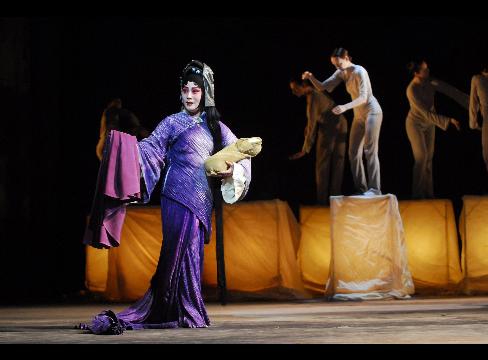
Sheathed in pale gray pajama-like outfits, faces chalked white, the dozen dancers in Shen Wei’s radical version of the Beijing opera “Second Visit to the Empress” look like ghosts. Their ultra-fluid movement, adamantly abstract, is done in groups, as if they’ve been shorn of individual identity.
By contrast, the three leading singers in this political melodrama — translated in terse supertitles at Lincoln Center’s New York State Theater — are costumed in wildly imaginative shapes, textures and color schemes, bathed in golden light and initially enshrined like saints. Their voices pour out from their stillness, powerful and evocative.
The piece, which originated some 300 years ago, became a staple of the Beijing Opera repertory. Shen loved the opera and wanted to give it new life as he pursued his career as a choreographer and visual artist in the U.S.
Adding Dance
In Shen’s version, presented during the final week of the Lincoln Center Festival, the score has been cut and edited to make it palatable to today’s audience. Shen intended to beef up the dynamics by adding dancing to what was originally an excruciatingly static presentation, the three main characters placed in an immobile row and left to get on with their vocalizing.
Shen’s strongest gift is for creating visual imagery, however, not movement. In this production, the 16-member Chinese- instrument orchestra of winds, strings and percussion churns up far more energy and emotion than the dancing wraiths. And the diva, Zhang Jing, bends and sways in antiphonal curving shapes, looking for all the world as if she assiduously took dance class several times a week.
“Metapolis II” will be repeated tonight and tomorrow at the New York State Theater, Lincoln Center. “Second Visit to the Empress” will be repeated July 28 and 29 at the New York State Theater, Lincoln Center. Information: +1-212-721-6500 or http://www.lincolncenter.org.
© 2007 Bloomberg L.P. All rights reserved. Reprinted with permission.