


This article originally appeared in Voice of Dance (http://www.voiceofdance.org) on June 28, 2007.
Mikhail Baryshnikov and Hell’s Kitchen Dance / Howard Gilman Performance Space, Baryshnikov Arts Center, NYC /
June 22-24, 2007
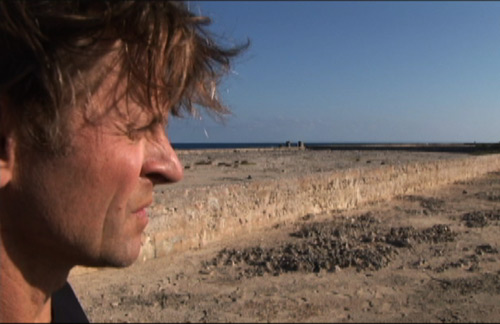
Dancer Mikhail Baryshnikov. Photo by Olivier Simola.
Tragically, classical ballet dancers are athletically over the hill in their thirties. That leaves decades of life to be used constructively. Some artists–like the legendary Alicia Alonso, Margot Fonteyn, and Rudolf Nureyev–insisted upon performing until the last gasp, pathetic yet still gripping. (Frayed genius is still genius.) Some take up related work–leading companies, teaching. A few (though usually not the superstars) move on to entirely different professions. The 59-year-old Mikhail Baryshnikov, whose name is as likely to be indelible in the history books as Nijinsky’s, found eloquent ways to dance once ballet’s virtuoso jumps, leaps, and turns were beyond him, notably in the postmodern mode with his White Oak Dance Project (1990-2002).
The year 2005 marked the opening of the long-awaited Baryshnikov Arts Center, way west on 37th Street in Manhattan, to foster the development and collaboration of artists in multiple disciplines. June 22-24, in BAC’s Howard Gilman Performance Space, a black box theater that seats 180 when you pack ’em in real tight, Baryshnikov showed New Yorkers Hell’s Kitchen Dance (named after BAC’s nabe), which has been touring the country. The two commissioned works on the bill, Donna Uchizono’s Leap to Tall and Aszure Barton’s Come In, both created in 2006, encompass the present-day skills of the superstar, dancing with superb, mostly youngish performers.
Today, Baryshnikov is naturally weaker in the departments that middle age erodes: strength, speed, and elasticity. Those who thrilled to him in his physical prime will probably be saddened by what they see today. Yet he remains a phenomenon.
He has retained a certain amount of his legendary physical dexterity. Though muted, it still represents the Platonic ideals of classical dancing. When he’s standing in place, his posture is too taut, almost militaristic, as if defiantly confronting ruin. Once he starts moving, though, his joints look remarkably supple.
His theatrical intensity is undiminished. The only performer I’ve ever seen upstage him was the venerable Merce Cunningham, who, standing in the background, grasping a barre for support part of the time as he sketched a move or two, managed to be even more compelling than Baryshnikov dancing full-out in the foreground.
The killer charisma is intact. But it has evolved from a winning boyishness to the allure of a mature man, face lined by experience, who is piercingly clear-eyed about life and the passage of time. His keen intelligence is more evident than ever.
And then there was the choreography, better than average, certainly, yet nothing you’d rush to see were such a hero not at its center.
Uchizono’s Leap to Tall (what the title might mean escapes me) is a trio for Baryshnikov and two women, Hristoula Harakas and Jodi Melnick, who is wonderful and mature enough to have copped her Bessie award for “sustained achievement in dance” half a dozen years ago.
The design of the dance is tasteful and intelligent, beginning with the two women upstage, delicately edging their way across the space with tiny pivots of the feet, while Baryshnikov lurks quiescent, barely visible in the shadowy foreground. But serviceable craftsmanship alone–largely presenting Baryshnikov in inviolably rigid stances that eventually melt into more fluid action–can’t create a telling theatrical experience. Clocking in at 31 minutes, the piece feels far too long, its stubbornly enigmatic key gestures repeated too often to keep the viewer’s mind curious–or even alert.
The only segments that hit the heart (and are interesting physically, to boot) are the tender and witty takes on male-female partnering. In his heyday, Baryshnikov did his magnificent share of hoisting ballerinas aloft, his strength, impeccable carriage, and ardent chivalry making them look like airborne divinities even when his mouth was full of tutu-tulle. Uchizono’s women occasionally return the favor granted to their back-in-the-day sisters. They act like gentle puppeteers, seeming to propel Baryshnikov through steps that recall his triumphant reign as a classical dancer and cradling him with their arms to lift him just a few inches from the floor, as if he were a much-beloved toddler. His cooperation is at once sweet and ironic.
The music, by Michael Floyd and Iva Bittova, follows upbeat percussion with lulling pop-romance.
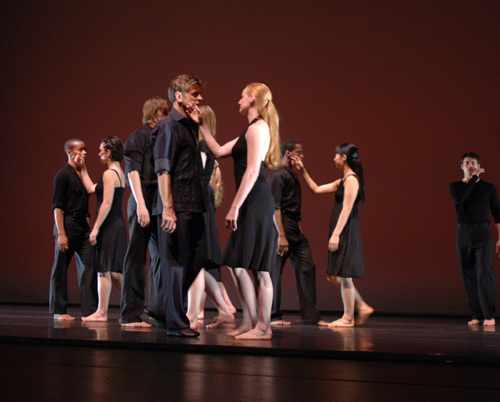
Mikhail Baryshnikov and Hell’s Kitchen Dance in Aszure Barton’s Come In. Photo by Nancy J. Parisi.
Aszure Barton’s piece, Come In, takes its name from its Elgar-like score by the contemporary Russian composer Vladimir Martynov. Both music and choreography give nostalgia a good name, and Barton’s work has far more emotional impact than Uchinozo’s.
Against a videotaped landscape panorama evoking Baryshnikov’s Russian origins, a populace in simple black clothes seems to confront the past and acknowledge that (pace Proust) it cannot be recaptured. Baryshnikov being the central figure in the piece, the sentiment can be applied specifically to his performing career and his expatriate status. However, the choreographer and the dancers make it universal–resonant for all of us in one way or another.
Two elements engrave themselves in one’s recollection of the dance: Baryshnikov’s making a simple gesture take on new nuances every time the choreography requires him to repeat it, thus expressing decades of emotion and memory, and the sense of present love for a particular person meshing with abiding love for a place left behind. Perhaps I’m exaggerating the virtues of Barton’s piece, but it’s the sort of thing to which I’m susceptible.
© VoiceofDance.com 2007. Reprinted with permission.