


Sylfider, Trolde og Linselus: En Fotografisk Rejse i Bournonvilles Balletter (Sylphides and Trolls Caught in the Lens: A Photographic Journey Through Bournonville’s Ballets) / Round Tower, Copenhagen / May 13 – June 12, 2005
Housed in Copenhagen’s Round Tower, Sylfider, Trolde og Linselus: En Fotografisk Rejse i Bournonvilles Balletter (Sylphides and Trolls Caught in the Lens: A Photographic Journey Through Bournonville’s Ballets) is a modest, pleasurable exhibition produced by the Royal Theatre and designed by Mia Okkels with the assistance of Kirsten Simone. Organized by ballet, it traces each of the main extant Bournonville works through the casts that have enriched it over time. The display feels like a family album, the family happening to be one of Denmark’s most significant in the realm of culture.
One way to look at this exhibition is to choose a single dancer and trace his or her career through the repertoire. A number of the artists represented are first seen as mere children, since Bournonville created countless roles in his ballets for the RDB school’s young students, to provide them with stage experience from their earliest years. The late Kirsten Ralov, for example, appears here first in Konservatoriet, as little Fanny, the child of impoverished itinerant performers, who aspires to a place in the classical-dance academy. Ralov went on to be a sparkling principal dancer and, subsequently, a teacher, a stager of Bournonville’s ballets, a company administrator, and the first to preserve the Bournonville Schools fully and formally. Nilas Martins, who was to switch his allegiance to the New York City Ballet, can be seen as one of the children taking dance class with their elders (fulfilling Fanny’s dream, as it were) in a later production of the same ballet; he’s the blond boy with the cherubic face and the gorgeous instep.
Subsequent artistic directors of the RDB are shown in their dancing days: Frank Andersen, the current incumbent, who has masterminded the third Bournonville Festival, and Henning Kronstam, under whose aegis the first—and stilll most glorious—Bournonville Festival took place in 1979. Both are “dancers who stayed,” as the company puts it. The “defectors” to Balanchine—those who were tempted away from the Danish ballet early in their careers—appear here too, on the stage that gave them their training: Ib Andersen, Peter Martins, Nikolaj Hübbe.
A number of actual families crop up: Kirsten Ralov, married first to Børge Ralov and then to Fredbjørn Bjørnsson, all three indispensable to the Danish ballet in their time; the siblings Kirsten Simone and Flemming Ryberg, classical-dance stars in their heyday who have evolved into vivid, resourceful character dancers; father and daughter Niels Bjørn Larsen and Dinna Bjørn; as well as a three-generation group consisting of Peter Martins; his uncle, Leif Ørnberg; and his son (with Lise la Cour), Nilas. Such clusters may seem to be of merely anecdotal interest, but I think they suggest something about the RDB’s tight-knit nature and long-lived traditions.
The pictures also capture history at the moment it’s being made. A 1945 photo of Far from Denmark, showing Margot Lander and Børge Ralov in the leading roles, includes Kirsten Ralov and Margrethe Schanne as the two cadets, roles traditionally given (and, in this case, aptly) to a pair of young women whose promise is on the brink of fulfillment.
As one might expect, the older photographs are the most resonant. A shot of Gerda Karstens as the witch, Madge, in La Sylphide, towards the end of her career in 1952, and two of Niels Bjørn Larsen in the same role, one from 1957, another from the 1994-95 season, show you the glories of the past. They also tell you what to look for in the role today: a keenly observed persona that is physically and emotionally developed in detail and coupled with ferocity of projection.
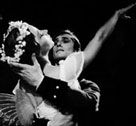 Two of the most striking images in the display record a pair of haunting embraces from La Sylphide. One, from the 1966-67 season, shows the consummate danseur noble Henning Kronstam cradling the head of the dying Sylphide (Anna Lærkesen) as she falls back in his arms. His face is a mask of sheer poetry, summing up love, longing, and loss in a single sublime moment. In the other, from the 1979-80 season, Sorella Englund, as Madge, embraces Arne Villumsen’s half-fainting James from behind, inserting her face, all grinning malevolence, next to his as if she were some terrible twin to the beautiful man whose ruin she has helped Fate execute. Viewers may notice that both Kronstam’s and Englund’s hands echo what their faces express. This congruity—half instinctive, half consciously honed—is something to look for in a performing artist likely to go down in the history books.
Girding the real photographic history of Bournonville’s ballets at the center of this show is a series of photographs commissioned by the Royal Danish Ballet for its 2005 calendar. It offers some dismaying evidence of how the company sees its future, how it intends to cope with making Bournonville appeal to a young generation of spectators who couldn’t care less about the treasures of the past. The photographer, Per Morton Abrahamsen, fancies himself a “visual provocateur.” By his own admission, he knew next to nothing about Denmark’s great nineteenth-century choreographer and his ballets before undertaking the assignment. After the fact, apparently, he understands even less. Nevertheless he produced a dozen mise-en-scenes in which—claiming to modernize the tales told by the ballets, to free the action from, as he puts it, the repressions of “Victorian piety”—he trashes them with a vulgarity so cheap and superficial, it would make you laugh if only you weren’t crying. (Let’s assume the translator meant “propriety.”) For the sake of fairness, let me add that, in a few cases, as in his response to sylphdom, Abrahamsen merely sentimentalizes his subject, in the manner of an ad for perfume.
For the most part, the work reflects the cool young crowd at play, with lots of slick, noir eroticism, complete with criminal violence and conspicuously populated with victimized women. One svelte-bodied beauty seems to have been raped. Another is being flung out of a high window (grinning, mind you) into the dubious embrace of a firefighter’s net manned by a bunch of guys stripped to display their pecs—if, indeed, by good or ill luck, she misses hitting the pavement below. I forget which of Bournonville’s ballets these images purport to represent. For Abdallah (think “harem”), Abrahamsen gives us the club scene, artfully streaked with fire and crowded with glossy bronzed bodies. The available ladies are nude (breasts much in evidence, pubic area coyly turned away or airbrushed), while the sole gentleman (I use the word advisedly) keeps his shiny black boxers on—for fear, I guess, of offending some oldster who may still be hewing to Victorian hang-ups.
This exhibition also includes a collage of film and video taken from the archives of the Royal Theatre and arranged by Ida Wang Carlsen. It was too dim to see the day I visited the Round Tower, so I must take its virtues on faith. Its background music, co-opted from the scores of the Bournonville ballets, was inescapable. I do wish—in vain, I know—that the fashion for augmenting visual exhibitions with sound scores of any kind would go away. I am a slow looker (one of the few left on earth, no doubt), and it drives me to distraction to hear the same tape loop played over and over again while I’m trying to see something. I consoled myself for this aural abuse by walking the full route of the spiraling cobblestone ramp that winds through the Round Tower. The roughness of the walkway and its just slightly precipitous pitch alert you to matters of texture and balance. And, for the eye’s delight, as you ascend or descend, you get glimpses of the gentle cityscape through the small deep-set windows that punctuate the tower’s rough white plaster walls. The Round Tower is a simple and perfect exercise in architectural purity. To experience one’s body moving through this space is, especially for a dance fan, one of the myriad small but intense delights that Copenhagen has to offer.
Photo: Mydskov: Anna Lærkesen and Henning Kronstam in August Bournonville’s La Sylphide
© 2005 Tobi Tobias