


Royal Danish Ballet: Bournonville Festival / Royal Theatre, Copenhagen / June 3-11, 2005
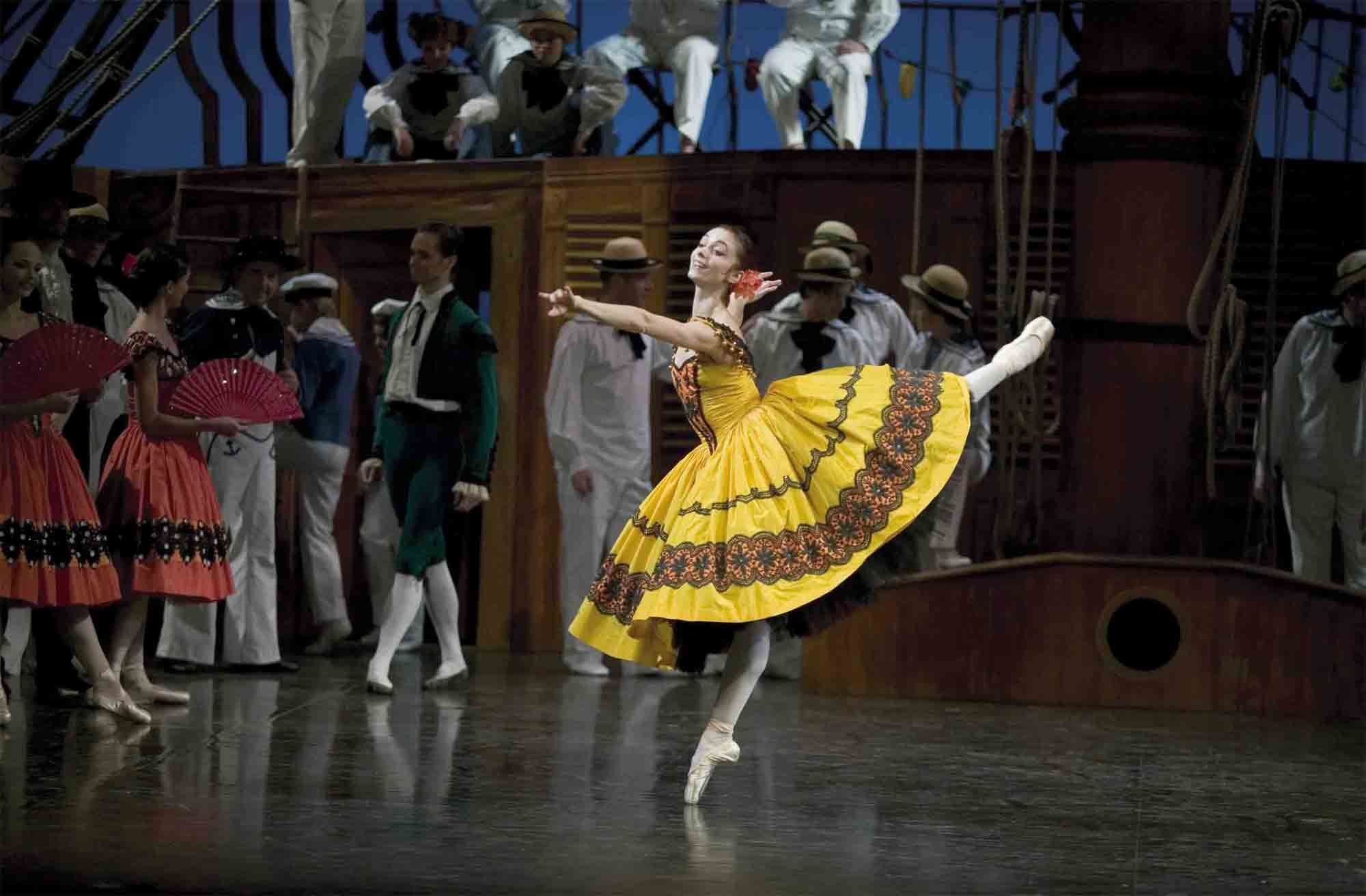
Bournonville’s Far from Denmark is a seemingly frivolous, trifling ballet about life at sea, but it’s anchored by poignant feeling. The Danish navy, from grizzled veterans to barely adolescent apprentices, finds itself harbored in Argentina—one of the exotic Elsewheres of Bournonville’s imagination—where passions are given a brief holiday from the decorum of Danish conduct. Though he has a fiancée (whom we never see) waiting for him back home, Wilhelm, a young lieutenant, succumbs to the seductions of Rosita, a South American belle. By turns languorous and fiery, she’s something of a man collector as well, though she has her own local steady beau, predictably hot-tempered in his jealousy. Mind you, this is Bournonville, so Wilhelm’s infatuation with Rosita never goes beyond flirtation. The Danish sailors invite the Argentineans to an evening ball on board their ship, where the two cultures mutually offer gracious respect and homegrown entertainment. In the course of the hectic festivities, Wilhelm realizes where his heart truly lies. When the visitors depart, the Danish sailors let loose in a succession of shenanigans frat partyers might indulge in if they were given to dancing and happened to have a chest of outlandish costumes handy.
The story, with its themes of loyalty—fidelity in love, patriotic fervor—unfolds, largely in mime balanced by social and character dance, in the most leisurely, relaxed manner imaginable. It juxtaposes the gentlest of sentiments—love of the familiar and of the exotic, longing for what one has lost or will never have—with rough, raucous humor. To say that it is typically Danish would be redundant.
A word to the p.c. police: You’re warned to stay away from this ballet, because once you see it, you’ll feel obliged to shut it down. The Argentinean upper class it represents, entirely Caucasian, is served by mulatto servants rendered as garish caricatures. The tolerant will view this as an aspect of vintage theatrical convention. Others will be understandably appalled, embarrassed, insulted, even outraged. The fact that, in its second half, the ballet makes gross fun of a handful of other non-dominant communities—Eskimo, Native American, Chinese—and, perhaps, in the various uses of cross-dressing, of non-standard sexual preferences as well, doesn’t help any. While the viewer is in exasperated mode, he or she might care to note, moreover, that the only black faces in the Royal Danish Ballet’s productions owe their existence to the deeper hues of pancake makeup.
My own main complaint about the present production is that it looks as if the company has lost confidence in the ballet. The dancers don’t seem to inhabit their characters, to know—or to be interested in—who they are. (Mads Blangstrup is certainly the right Romantic type for Wilhelm, but he doesn’t seem to have invested enough imagination or energy in the role.) What’s more, there hasn’t been much perspicacity in the casting. (Marie-Pierre Greve makes a pretty Rosita but not an alluring one.) The practice of using senior members of the company to add an important social dimension and a gracious dignity to the shipboard party has been abandoned. (The presence of the elders may now be thought a minor concern, yet I’ll never forget Lillian Jensen, playing one of these roles in her sixties, dancing gravely and just “being there.”)
The once-tender elements of the ballet are no longer properly realized. The piquantly matched pair of cadets (young women playing young men) exaggerate their pertness, rather than delivering the sweet melancholy that’s required in the scene in which one of them gets a letter from home and the other doesn’t. Another key moment barely registers—the one in which, despite the formal hands-across-the-sea courtesies between the Danes and the Argentineans, a young naval recruit, barely into his teens, impetuously comes forward to kneel before the Danish flag and reverently kiss its hem. The “ethnic” dances, for the most part, lack the raw energy, the gleeful abandon in the absurd portrayals, and, most significant, the irony at which the Danes are so expert.
The diminished Far from Denmark demonstrates, once again, the fact that the company is no longer as eloquent in mime as it once was. The current production of this ballet suggests, further, that it no longer finds yesteryear’s forms of theater as compelling as it once did. This development was inevitable, I suppose, but it bodes no good for the Bournonville repertory.
Photo: Martin Mydtskov Rønne: Marie-Pierre Greve in August Bournonville’s Far from Denmark
© 2005 Tobi Tobias