


Royal Danish Ballet: Bournonville Festival / Royal Theatre, Copenhagen / June 3-11, 2005
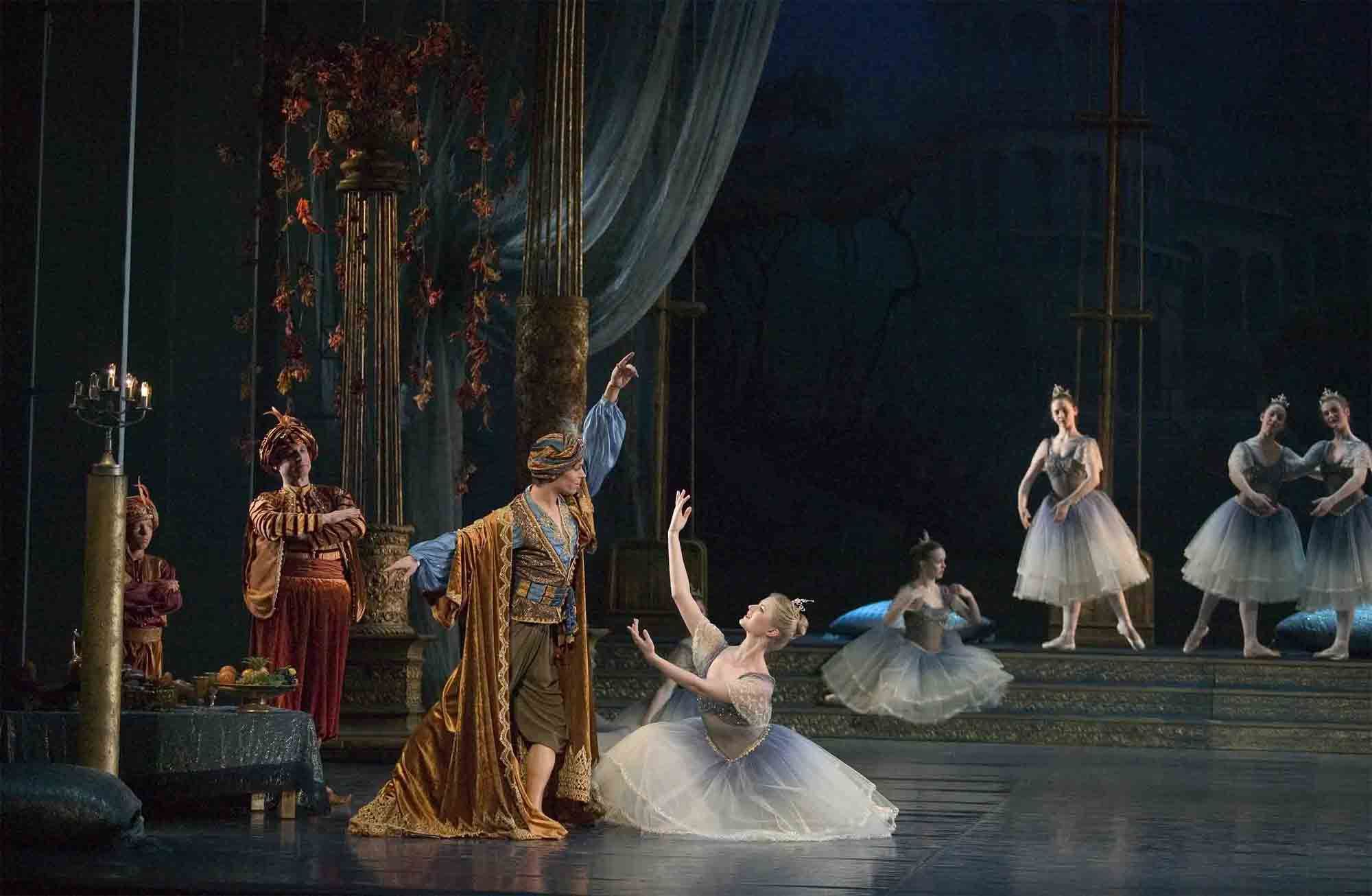
While the Bournonville Festival is dedicated to presenting the complete extant repertory choreographed by the master, with Abdallah the Royal Danish Ballet has also made room for some faux-Bournonville.
This ballet does not claim to be part of what the Danes call “the living tradition”—works that have been passed down in an unbroken line from generation to generation of RDB artists. Choreographed in 1855, Abdallah was decidedly not a hit with either the critics or the public, and by 1858 it was off the boards. Apparently, viewers thought it contained too much pure dancing—ironically the very element to which today’s step-hungry public is perfectly willing to sacrifice the balancing element of mime.
What we’re looking at in 2005 is an ingenious and effervescent, if not entirely satisfying, latter-day concoction brought into being by Bruce Marks, an American dancer who did a stint with the Royal Danish Ballet; his wife, the Danish ballerina Toni Lander Marks; and Flemming Ryberg, a principal dancer and mime with the RDB and an incisive Bournonville stylist. This resourceful little committee based its production on Bournonville’s telling but incomplete choreographic notations in the musical score, preserved in the Royal Library. The three shaped and augmented that information with their own rich knowledge of the extant Bournonville repertory and keen theatrical savvy about what might attract a contemporary audience. The “modern” Abdallah was given its premiere in 1985 in Salt Lake City, Utah, by Ballet West, where Bruce Marks was artistic director. It entered the RDB repertory the following year.
As its title suggests, Abdallah is an Arabian Nights tale—ravishingly decorated in that vein by the late scenographer Jens-Jacob Worsaae. It’s set in Iraq, and its opening act—which features a barrage of Bournonville-style dances—is further churned up by a bit of regime change. The poor shoemaker, Abdallah (a fellow of “very few brains” but infinite ingenuous appeal) courts the local reigning beauty, Irma. He succeeds in winning her heart, though not that of her virago of a mother who’d hoped for a more prosperous match. Suddenly the town is turned upside down by an armed band trying to get rid of the local sheik. Abdallah saves the ruler’s life and is duly rewarded with a five-branched candelabra that will grant him the desires so common to raw male youth they are almost excusable—wine, women, and upscale luxury. All this will be his, provided he observes the admonition to leave the last candle unlit. Abdallah gets his desired change of wardrobe and interior decoration, a slew of servants at his beck and call, and a whole harem of gently seductive lovelies. With these ladies he enjoys a modest dancing orgy until, in drunken abandon, he lights the forbidden candle and is reduced to his former impoverished state, having lost his true love as well. Needless to say, matters are patched up in the final act, with the sheik playing deus ex machina to ensure that the happily reconciled couple begins married life with a lavish dowry and that the scolding mom-in-law is removed from the scene via a trap door concealed by a curtain of flame.
The dancing was capable throughout and, in several cases, particularly distinguished, from the crystal-clear execution of young Tobias Praetorius, playing an impudent little slave boy, to the technical aplomb and ingratiating personality of Morten Eggert in the title role. Among the women, Yao Wei, recently made a soloist, seemed to have taken it upon herself, single-handed, to revive the “type” of the nineteenth-century Bournonville ballerina. She looks like an exquisite porcelain figurine brought to life, precise and delicate in her movement, sweetly shy in her personality. Born and trained in China, she’s the perfect example in a company that now, of necessity, includes many non-Danes, of the fact that Bournonville dancing is not the exclusive province of the “natives.” It can also be mastered through an affinity that is aesthetic—perhaps spiritual as well.
How the Danes bring this production off, I don’t know. Thinkers and sophisticates would surely dismiss it as idiotic. The story is trite and not rendered particularly magical in this telling. The moral weight Bournonville managed to invest in even the slightest, most frivolous subjects (as in his King’s Volunteers on Amager) is absent here—in part, perhaps, because Abdallah has not yet been enriched by decade after decade of dancers putting themselves into the roles. What’s more, the streams of enchaînements, taken together, are nearly stultifying, though any one solo, duet, quintet—even single choreographic phrases—may be ingenious, exciting admiration and pleasure. It’s just that it’s impossible to watch that much of that sort of thing; the eye simply flags. And yet the company—with its indefatigable quicksilver feet, its charm, and its unforced communal desire to please—does bring it off, making you feel, even as your good sense is crying out, “Enough! Enough!,” that you’ve somehow been delighted.
For the record: The score, by Bournonville’s most frequent musical collaborator, H.S. Paulli, will sound strangely familiar at times, even to audience members new to Abdallah. Hans Beck, the RDB’s ballet master from 1894 to 1915, appropriated stretches of it to add variations to the cascade of ebullient dancing already present in the celebratory closing act of Napoli—another instance in which—though it’s heresy to say it, I suspect less might have been more.
Photo: Martin Mydtskov Rønne: Morten Eggert and Haley Henderson in August Bournonville’s Abdallah
© 2005 Tobi Tobias