


Royal Danish Ballet: Bournonville Festival / Royal Theatre, Copenhagen / June 3-11, 2005
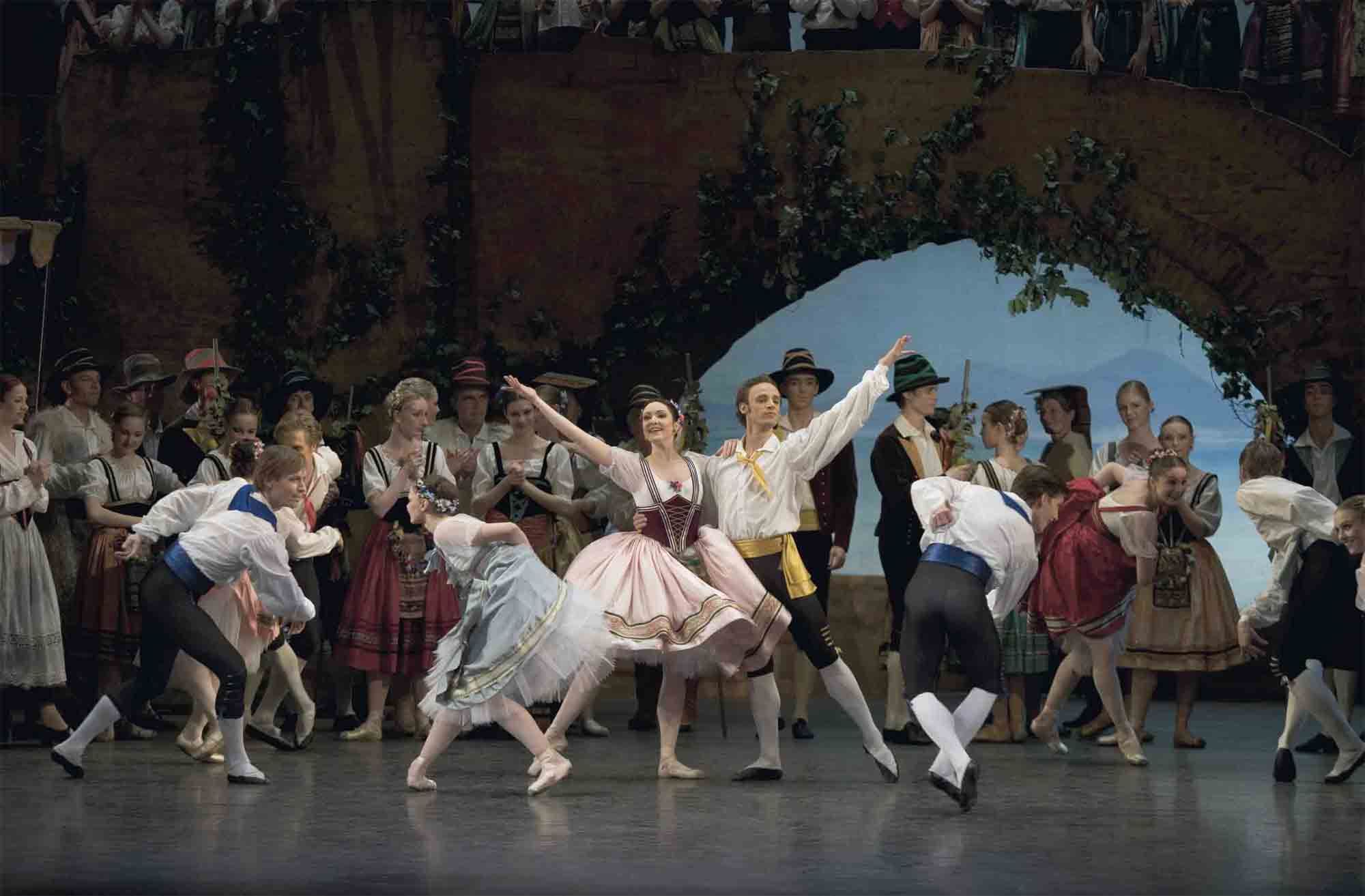
Having boldly opened its Bournonville Festival with two new productions—of Kermesse in Bruges and La Ventana—the Royal Danish Ballet devoted its second night to a traditional staging of Napoli, the ballet it accurately terms its calling card. The curtain went up on the familiar vibrant panorama of a mid-nineteenth-century Italian quayside packed to the hilt with all manner of colorfully dressed people—earthy locals, street vendors, clergy, wealthy tourists, the neighborhood’s kids—bustling about on their own agendas, singly and in tight-knit clusters, yet forging an entirely cohesive whole that symbolized the richness of life lived, spontaneously, to the hilt. I’ve seen Napoli danced dozens of times, but it was as if I’d forgotten how very wonderful this ballet is, and I fell for it all over again.
The Danes themselves are the first to say that their Royal Ballet reserves its best efforts for grand occasions like premieres, galas, and festivals—especially when having lots of foreign visitors in the house adds to the excitement. From my own experience, both in Copenhagen and in the States, I’d say there may be some truth in this. Yes or no, this was as full-blooded a rendition of Napoli as one could hope for, its only dampening feature the ever-problematic second act. This midsection of the ballet takes place in the underwater kingdom of the Blue Grotto, ruled by a sea demon given to changing nubile young women into naiads. (The ballet’s heroine, Teresina, on the cusp of marrying her fisherman boyfriend, is threatened with this fate.) Despite a cool, hypnotic atmosphere that makes a useful dramatic contrast with the two sunny, ebullient acts surrounding it, the Blue Grotto episode was tepid, it’s held, even in Bournonville’s original version. It has continued to discourage the viewer’s enthusiasm with tedious stretches—mostly in the ensemble work—in subsequent attempts at revision. The current production uses Dinna Bjørn’s version, which is probably the best effort made in living memory. Still, torn between respect for genteel nineteenth-century dance conventions and a desire to make psychological sense of the action, it fails to be definitive.
Acts I and III, however, went from strength to strength, steps and phrases clear, beautifully shaped, musically rendered, and informed with bubbling energy. A communal confidence and elation among the dancers seemed to grow and grow until, in the pas de six and tarantella, a veritable torrent of dancing that climaxes the third act, the performance reached that let-joy-be-unconfined state that can only occur spontaneously, among artists who have been working at it together for years.
Napoli is a cornucopia of dancing both classical and folk. Tina Højlund and Thomas Lund were terrific in the leading roles of Teresina and Gennaro. Lund, who looks like a character dancer and has, indeed, made a fine start on such roles (playing Geert in Kermesse in Bruges, for example), also happens to be the most adept Bournonville stylist on the male side of the RDB roster. On this occasion, he coupled perfection of technique with acting so observant in its detail, so guileless and deep in its feeling, you wished Bournonville himself could see how this faithful heir was tending his legacy.
Højlund, who combines delicious looks and wiles with a penchant for hot-tempered roles, was perfectly cast as Teresina. Though she hasn’t been awarded the official rank of principal dancer, she’s one of the most interesting, gifted, and unusual performing artists in the company—a natural mover and dramatic to the core. Sometimes I imagine her doing Lynn Seymour’s roles (say Frederick Ashton’s Six Dances in the Manner of Isadora Duncan), sometimes Nora Kaye’s (Hagar in Tudor’s Pillar of Fire, in particular).
The pas de six, one of the ballet repertoire’s grandest occasions for dancing, was peopled by stars (Gudrun Bojesen, the most typically Danish of the company’s ballerinas; Caroline Cavallo; Gitte Lindstrom; Mads Blangstrup; and Andrew Bowman—and one possible star in the making, Femke Mølbach Slot, a diminutive young woman with a piquant face and long limbs that imprint bold calligraphy on the air.
Among the slew of character dancers that the ballet features, I especially enjoyed the work of Jette Buchwald, who makes a salty Veronica, the mom who tries to get her daughter to marry rich, then succumbs to the persuasions of true young love, and of Flemming Ryberg, who creates a duly amusing yet etched-in-acid Lemonade Seller.
All of the ensemble work was distinguished for its energy, precision, and intense desire to please. For this, surely, the company’s regisseurs should share in the glory due to the dancers.
My main reservation about the present staging has to do with the rushed pace at which the score is now played. Allegro passages are taken so fast that the mime, of necessity, has grown smaller, lighter, and sketchier. In the past few years, it’s become more like careless throwaway pedestrian gesture—the physical vocabulary of ordinary life—than a theatrical language that has weight and meaning, one that is an imperative foil to the danced passages in Bournonville when the ballets are presented in their full-length form. With the mimed “conversations” conducted at top speed, the ostensible listening party has no time to listen before responding. After we’ve seen our heroine embark on a midnight sail with her fiancé in his fishing boat and witnessed the subsequent furious, lightning-laced storm (meteorologic turbulence indicating dramatic furor), the fearful answer “Out there on the water!” from a person in the crowd comes before another’s desperate question “Oh, God, where is she?”—and its import—has been absorbed. No wonder the audience is at sea.
This flaw affects most of the ballets, not just Napoli, and it is a grave one. Capable of remedy, yes, but only if the company is willing to reconsider its attitude toward the mime element in the Bournonville ballets and entertain the idea that, in this area, older ways are best. There is a senior generation of RDB dancers—some retired, some still performing character roles—who remember “how it used to be.” Might they not be summoned to transmit this essential aspect of Bournonville to their successors before it disappears?
Photo: Martin Mydtskov Rønne: Tina Højlund and Thomas Lund in August Bournonville’s Napoli
© 2005 Tobi Tobias