


Royal Danish Ballet: Bournonville Festival / Royal Theatre, Copenhagen / June 3-11, 2005
I first saw Bournonville’s A Folk Tale in 1979, at a dress rehearsal to which journalists who’d made the pilgrimage to Copenhagen for the first Bournonville Festival had been invited. (A Royal Danish Ballet dress rehearsal means a full-fledged, uninterrupted performance with almost no one in the audience apart from the company’s current personnel and its venerable retired dancers.) At that time, Bournonville had not yet been fully “discovered” by the international dance world; most of us visitors were ignorant even of the ballet’s plot—to say nothing of the virtues that place it easily among the great achievements of Romantic art. Between the ballet’s two acts, as the small number of privileged spectators from abroad stumbled from the darkness of the auditorium into the sunlit foyer, I encountered the dance critic and historian David Vaughan, a longtime colleague and friend. I remember that neither of us could speak; we were both weeping. The work was so tender, so luminous in its fantasy—and so very Danish—that it seemed beyond the reach of words. This is how I described it eventually in the essay I wrote on the 1979 Festival for Dance magazine:
“Bournonville’s A Folk Tale . . . is as shimmering, delicate, and self-contained as a soap bubble—the product of a unique imagination.
“The argument of the ballet is a fairy-tale staple: an exchange of infants from dichotomous backgrounds who grow up to uncover their true nature. Here a human child of the gentry is secretly replaced in her cradle with a baby of the troll colony that lurks, half-hidden, in its under-the-mountain (that is, subconscious) domain. The switched girls grow to maidenhood, each instinctively revealing or seeking her roots. Although the human Hilda is promised by the dowager troll to the more loutish of her two sons, she yearns for an ideal goodness, which the ballet symbolizes, endearingly, by Christianity and the handsome young hero, Junker Ove. On the other hand, despite the gentility of her upbringing, Birthe remains a troll at heart and, aptly, in body. In one of the ballet’s most entertaining and psychologically keen sequences, she dances before a full-length mirror, in narcissistic, lyrical phrases—into which contorted troll-motions break uncontrollably.
“The ballet contains a vestige of the themes of Romantic preoccupation—in the elf-maidens (a cross between the wilis and the nightgowned muses-with-flowing-hair in the Élégie section of Balanchine’s Tschaikovsky Suite No. 3) who emerge from their mountain caverns and swirl through the dry-ice fog to entrap Junker Ove, and in Ove himself, a sketchy indication of the morbidly dreamy temperament of the model Romantic hero. But the ostensible villains of the piece, the troll folk, feel harmless—because they are so quaint. (The second brother eventually grows as lovable as one of Snow White’s dwarfs.) This is a common folkloric device—subverting the potency of figures of mystery and fear by rendering them whimsically. But the real mark of Bournonville’s genius is that, at the same time, he is able to make the entire troll community a riotously accurate personification of the human race in its less attractive guises. I’m particularly fond of the show of self-congratulatory indulgence in the minor vices revealed at their orgy, but Bournonville’s deftest shaft may be in making the most characteristic attribute of these appalling creatures their bad manners.
“Of course Bournonville, that inimitable proselytizer for joy, gives his story a happy outcome. What is remarkable about this closing scene in A Folk Tale is that one is wholly disarmed by the sweetness and purity of his means. The ballet ends, naturally, with the wedding of the lovers made for each other, Hilda and Ove. Imagine this sequence of images: six very young women (blond nymphets in pale green dresses, holding blossoming branches) softly waltzing; a slow processional, bland as a walk, for the wedding party, under wreaths of flowers; then, oddly slowed, the simplest of love pledges—the hand to the heart, then extended to the partner; a brief dance around a pastel-ribboned maypole; and the final assertion of the dulcet waltz motif accompanying a flurry of rose petals. Few artists could work with such trusting innocence.”
I have written about A Folk Tale many times since I made the above wonder-struck report, most recently in an essay for Dance Insider, on the ballet’s theme of “home.” My love of this ballet survived the new production in 1991, by Anne Marie Vessel Schlüter and Frank Andersen, with costumes and décor by Her Majesty Queen Margrethe II, that I thought coarsened it—and, where the trolls were concerned, thoroughly Disneyfied it. This production is still in use today; overall, it has not acquired nuance or luster with time.
The 2005 Festival cast was distinguished, nevertheless, by the performances of Gudrun Bojesen as Hilda, Kenneth Greve as Junker Ove, and Tina Højlund as Birthe. All glowing innocence, Bojesen embodied, as Hilda should, the unsullied loveliness of the young. Today, Bojesen is more conscious of her effect than she was earlier in her career, but if—as is only natural and inevitable—some of her former dewiness and reticence has vanished, it has been replaced by the growing knowledge of her particular dancing persona and the confidence in her powers that are marks of a ballerina coming into her own. Greve fulfilled, excellently, the “type” he was playing—a beautiful, brooding young man instinctively aspiring to perfect love. Højlund, as always, performed with enormous energy and spontaneity, creating a lightheaded, lusty Birthe who relishes her own deviltry, yet spares an occasional wistful sigh for the joys of a virtuous, civilized world that she will never have.
As I’ve commented, discussing other Festival productions, the music here was played too fast for the mime to register properly—and mime, an expressive mode that refuses to be rushed, is every bit as essential to A Folk Tale as dancing. On the other hand, mime portrayals that I thought slim a while back have deepened, notably Eva Kloborg’s Muri, which has accumulated a gratifying weight and some psychological complexity, and Lis Jeppesen’s Viderik (the “good” troll brother), which is not so flighty as it was early on. Thomas Lund was outstanding in the “Gypsy” pas de sept (classical fireworks inserted to liven up the dulcet wedding scene that concludes the ballet). He’s still the only guy in the company able to make the Bournonville style look entirely natural.
The wedding scene itself should, with its calm, ever-modest radiance, sum up everything that has gone before, yet now it doesn’t, quite. It’s as if the collaborators on the production—the stagers, the coaches, and a majority of the dancers—either didn’t understand its intrinsic qualities (which are, at heart, spiritual) or simply didn’t value them. In its present state, there’s still enough magic in A Folk Tale to enchant Bournonville newbies, even to retain the affection of veteran Folk Tale fans, but this time round, it didn’t make me cry.
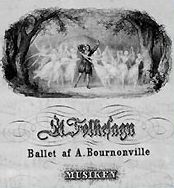
Photo: Lithograph from the cover of the piano score for August Bournonville’s A Folk Tale
© 2005 Tobi Tobias