


Tyl & Trikot—Bournonvilles Balletkostumer / Nationalmuseet, Copenhagen / May 14-June 12, 2005
An essential part of the Bournonville Festival now under way in Copenhagen is the plethora of exhibitions mounted all around town—and in some outlying, Bournonville-associated, districts as well. These shows complement the thrill, the rush, and the essentially ephemeral nature of the Royal Danish Ballet’s stage productions with a contemplative consideration, in various aspects, of the master choreographer’s work. Faithful readers of SEEING THINGS, knowing my love for costume, onstage as well as off, will understand why I chose to discuss threads first.
Curated by the theater historian Viben Bech, Tyl & Trikot—Bournonvilles Balletkostumer (think of it in English as Tutus & Tights) has all the right ideas. Even the posters for the show that you encounter as you enter the fabulous National Museum (a Viking-rich contender among the world’s top natural history institutions) tell their story well. One poster shows a man’s costume; the other, a woman’s. Both images are blurred, as if they’ve been set in whirling motion by the dancers inhabiting them. Then, just before you enter the exhibition itself, you can examine a quartet of three-dimensional mock-ups of the scenography for the Royal Theatre’s Bournonville productions, including the strikingly stark, half-abstract one just created for Kermesse in Bruges by Rikke Juellund. These maquettes can be viewed not only from the front but also from both sides, as if you were scoping out the stage from the wings.
After this prologue, you enter a vast room, darkened as if for performance, down-lights illuminating just the things you need to see and shutting out, as performance at its best does, whatever is extraneous—in other words, the distracting particulars of the so-called real world. The display seemed so rich, I cautiously started on its periphery. Lining three walls of the space are still photos of the Bournonville ballets that date back to the very start of the twentieth century and record, in close-up, what the choreographer’s unforgettable characters wore over the decades. Often, images of the same moments in a given ballet, as performed in different eras, are displayed side by side, allowing you to see—distinctly, incontrovertibly—the evolution of the costuming. You can compare, say, what Eleonore and her Carelis wore in Kermesse in Bruges for their pas de deux of shy yet ardently escalating young love in 1900 and then in 1966 or how the cadets in Far from Denmark (traditionally played by a contrasting pair of soubrette-type girls piquantly masquerading as naval youths) were fitted out in 1866 and 2004. The surprising conclusion these comparisons offer is proverbial: the more things change, the more they remain the same. Costumes for Bournonville, from his time to our time, tend to show more family resemblance than they do difference. Periods in which rebellious experiment produced radical changes (as is happening right now with Kermesse in Bruges), were often followed by a “corrective” return to more conservative design, as if Bournonville’s visualization of his ballets still had considerable power. A footnote, as it were: The photos also provide a telling indication of how the pointe shoe has evolved. Indeed, you could spend a rapt hour with these images, studying the footgear alone and inferring from it a good deal about the ongoing development of the dancers’ technique.
A fourth wall is devoted to costume designers’ sketches, including the watercolors of today’s Danish queen, Margrethe II, for both the uncouth trolls and the soulful hero of A Folk Tale. (Just the other day, a dancer acquaintance of mine reported that Queen Margrethe was at the dress rehearsal of the ballet she designed, “making sure that all the hats were on straight.”) A good many of these sketches, done primarily for practical reasons (some even have swatches of the fabric to be used appended to them), are also pleasing examples of the illustrator’s art. I especially admired those of Edvard Lehmann, contemporary with Bournonville, and those of Lars Juhl, from the last quarter of the twentieth century.
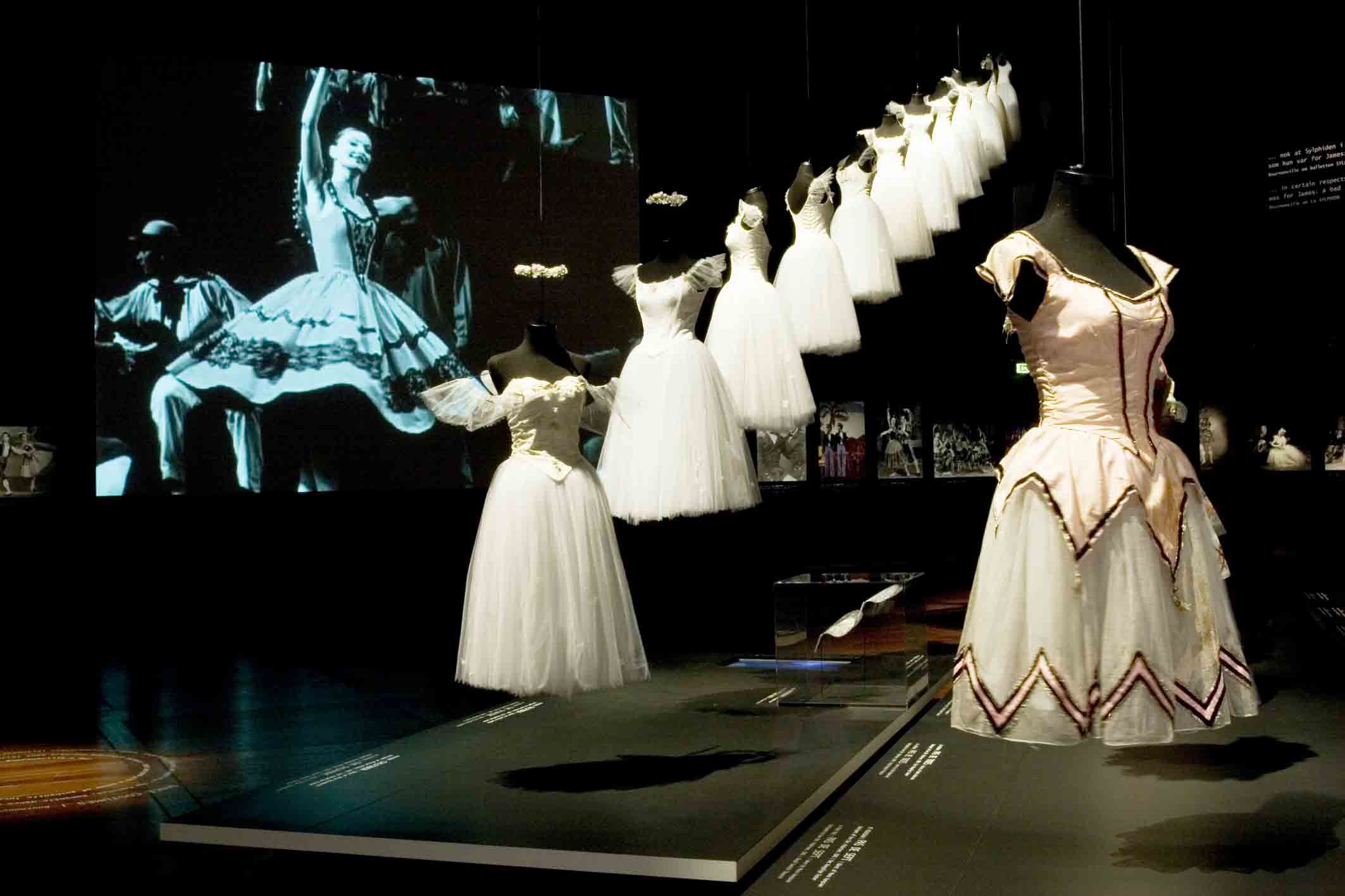
And then you come to the beating heart of the exhibition—angled rows upon rows of actual costumes, suspended at leg’s length from the floor on black torsos that fade into the prevailing darkness so that the costume itself appears to float in space, taking on, for the moment, a life independent of a dancer. Most important, the arrangement deftly permits you to see each costume from various angles, as if it were a piece of sculpture, which is no more than it deserves.
The most brilliant stroke in the display is a line of identical La Sylphide tutus, a bodiless corps de ballet that diagonals up to the faraway ceiling of the space as if soaring to the heavens, all gossamer lightness, the sole adornment on the clouds of white tulle a few pale, fragile petals. On the floor beneath these truly Romantic tutus, caged in a Lucite box, is a near-transparent pair of wings, the attachments that will allow them, with luck, to fall to the ground as the chief Sylphide herself dies, the victim of miscalculated love, clearly visible to the insatiably curious balletomane.
As always, the display of costumes literally within one’s reach is fascinating, allowing you to understand how each one must feed the spectator’s (and perhaps the dancer’s) fantasy and yet withstand the brutal wear and tear it’s subject to in performance. The items on view here have all been lovingly and immaculately preserved. Their condition made me think of the Gertrude Stein line (used, incidentally, in a ballet by Ashton) about “a gown newly washed and pressed.” The labels add further resonance, telling you not merely which ballet (and specifically which scene) an item comes from and which character it was designed for, but also which dancer wore it. For the aficionado, this naming of names evokes ballet history with a personal punch.
One advantage of an exhibition like this is that you learn far more about the costumes than you possibly could merely from the on-the-run glimpses of them you get in performance. As the promotional flyer for the show claims, “Costumes usually only seen at a distance on stage will be right there in front of you.” But the display is more than simply useful. It is oddly poignant as well, bearing out the claim of Tine Sander, who heads the Royal Theatre’s costume department, that “a good ballet costume has its own artistic soul.”
Photo: Nationalmuseet
© 2005 Tobi Tobias