


Jérôme Bel: The Show Must Go On / Dance Theater Workshop, NYC / March 24-26, 2005
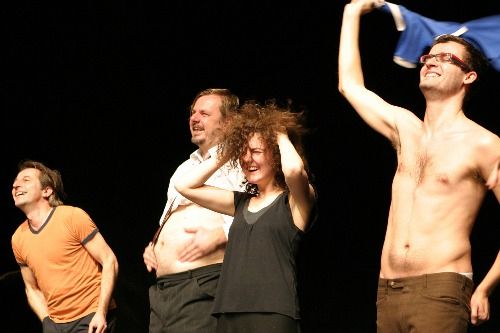
The advance word on Jérôme Bel (French-born and -trained, well traveled globally), made him out to be a bad boy—a renegade, an iconoclast, a threat to Things as They Are. Sort of a latter-day incarnation of early postmodernists like Yvonne Rainer of the celebrated refusal that began “No to spectacle no to virtuosity, no to transformations and magic and make-believe.” Or of Merce Cunningham, whose tactics were truly radical, truly assaultive. Turns out, as we discovered at the post-performance Q & A and reception for The Show Must Go On, M. Bel’s a sweet leprechaun of a guy. And the show he puts on is tame, rather old hat (undertrained, casually costumed performers, mining awkwardness for all it’s worth, have been engaging audiences in staring contests for decades now), and intermittently charming. God only knows what’s been riling spectators since its premiere in 2001. Well, just in case you were curious but couldn’t get in—it was a hot ticket—I’ve blogged it. Here you are.
They make the house dark and we, the prospective audience, get cooperatively quiet. The way it’s s’posed to be. And then we sit listening to a recorded pop song without anything to look at. For quite a long time. The song—Tonight, tonight—favors kitsch sentiments.
Then more darkness. And silence. And then another pop song. Still nothing to look at. With nothing else to do, we recall who and where we were when that music, those lyrics were always in the air.
Very, very slowly, the stage space brightens a little. There’s no one in it.
The stage is quite bright now. Still no one there. A third song starts. I guess the idea is that if you look at nothing for a very long time, you’ll be fascinated by anything that finally shows up. There’s some truth in this, but you’re less likely to perceive wonders in vacancy when you know some director type is using the sensory-deprivation strategy as a gimmick.
Finally, eighteen people in relaxed, occasionally rakish, street clothes saunter on, string themselves out in a ragged horizontal line and . . . just stand there. Doing nothing more than looking around. Mostly at us.
As they let their gaze shift, their heads travel a little, not much. Or they shift their weight, just a little. We examine them back.
Few of them are handsome in any conventional sense. Even fewer are securely at home in their bodies. The program labels them actors, not dancers, but they look more like a bunch of pedestrians for whom performing is far from second nature.
Suddenly, a big event: a few moments of club dancing. Some of the actors turn out to be spectacular movers after all, fluent and pulsing with rhythm. Others are so-so. A few are pathetic.
Then it’s back to 98% stasis. And staring.
I like to move it, move it. One guy moves the curtain behind them. Others jiggle the looser parts of their flesh—beer belly, slack thigh, luscious breast—as if they were Jell-O. A petite woman animates her splendid mop of curly hair. One man works on his privates, his hand decently under his trousers. (This must be a substitute for a more in-your-face act reported from abroad. Welcome, dear polyglot troupe, to the land of the New Puritanism.)
A woman deaccessions layers of her clothing at top speed, stripping down to a plainspoken black bra and bikini, then, keeping up the pace, gets dressed again, then undressed, then . . .
I don’t need a man. At the first sound of these lyrics, all the guys split. The women work on their port de bras and other signature ballet moves. Few, it would seem, have gone beyond Advanced Beginners level in this traditional discipline. I imagine we’re supposed to realize how interesting they all are in their effort or awkwardness or whatever and be moved by it. But the gorgeous blonde breast waggler in Ugg boots and a flirty patterned skirt steals the show. Ballerina Girl. She’s all Kirov Dying Swan fabulous doing her adagio, and she’s got a face (Russian? Polish?) made for the movies. Note to self: Find out her name. [Carine Charaire.]
The sound-and-light man who’s been operating at the front edge of the stage, practically in the lap of the front-row viewers, abandons his post, ambles lackadaisically into the middle of the space, and, turning his back to us, begins—Private Dance—a private little dance of his own. No sooner does he launch into it than the femmes depart. He amps up the sound, fashions himself a spotlight, steps into it. In due time, having gotten performing out of his system, he reassumes his regular duties.
The others return to deliver a more or less unison routine of pulsing gestures, jumping a quarter turn as the phrase repeats so as to face north, east, south, and west sequentially. They do this long enough for you to memorize the phrase and take it home with you. After this mini-aerobics class, they stand in place, catching their collective breath, once again examining the audience. We return the favor. They are, most of them, utterly ordinary. So are we. This is not a deeply fascinating state of affairs. Neither, in Bel’s hands, is it a theatrical one.
I don’t believe in an interventionist God. They couple up and embrace, then walk around seemingly at random, next—I don’t believe in the existence of angels—couple up again, also seemingly at random. The third time they embrace, they stay that way in silence until the next song begins.
This show goes on and on. I think maybe we’re at the halfway mark.
One member of each couple manipulates his/her partner like a dance teacher molding a student into an approximation of ideal posture. Then one supports the other in precarious leaning positions. Few are adept at this or even comfortable doing it, but they persist, mild-tempered descendants of Sisyphus. The persistence—the doing of the assigned task despite the absence of skill—seems to be the point. (Clever of Bel to maintain an amiable air as he strikes his blow against classicism.) One fellow, who has gradually assumed the role of dance captain or scout master, parts the back curtain so the rest of them can walk off into a space that’s safe from our eyes, then follows the last figure into this sanctuary. Or trap. (After all, they might cease to exist if we weren’t looking at them.) Somehow, this passage is touching, perhaps because it evokes so many theatrical and actual exits we’ve witnessed.
The empty stage goes dark, apart from a streak of light from under that back curtain. (Is the gang partying in there?). Now the spectators are bathed in red light. La vie en rose. Are we supposed to ogle each other as if we were providing the entertainment? Most of the audience fails to respond to the invitation, stares straight ahead at the dark, empty stage, studiously examines its program. Blackout. Total darkness throughout the theater while the recorded music plays steadfastly on. Well, we refused to look at each other, we insisted upon staring at a stage devoid of life. Now we can continue to gaze outward at nothing whatsoever or look inward at—what? No one lights a candle, not even a teeny-tiny pocket flashlight. (Certainly not a Zippo—it’s against the fire laws and, besides, we’ve given up smoking). No one curses the darkness. European audiences, those advance reports said, were not so tame.
Strips of light glow faintly along the aisles. Music starts up only to be ruthlessly cut off. The Sound of Silence. We’ve been put on spare rations. People just laugh. Is it so remarkable that no one gets overtly angry? The proceedings aren’t radical enough to get anyone passionately engaged. Indeed, veteran onlookers (including me) experienced this kind of stuff in boot-camp form in the sixties.
The full cast line-up reforms—pretty straight and tight now—at the front edge of the dance floor. Glaring light pours down on the stageside bodies and spills over onto us. Few of them, more of us, smile. They stand with their arms at their sides or locked behind their backs. I’ll be watching you. Even M. Son et Lumière is staring at us. You don’t need no Bible. Just look in my eyes. One by one the performers give up and walk off.
The group returns equipped with portable disk players and earphones. Son et Lumière rises from his tech table and gives them a conductor’s gesture for starting. They click their On buttons. So now we’re watching them standing still, listening (presumably) to music we can’t hear.
They start singing out phrases. If they’re singing what they’re hearing, everyone is listening to his/her own tune. Each repeats her/his phrase over and over again. Apart from a septet that shares a single player, everyone has his/her own one-track mind.
They drift off, leaving one of their number behind—I’m still standing—then reassemble to sing Killing Me Softly With His Song. Now they lie down, feigning sleep, with their mouths shut, while the song continues and we realize they’ve been lip synching. Was this possibly the last, but not the first time they had us fooled?
When Bel and his admirers talk about his work, the words conceptual and ironic come up a lot. I don’t think Susan Sontag, a high priestess in these domains, would have applied them to this simplistic, ingenuous show. Still, I wouldn’t have missed it for the world. Its good humor was mildly diverting and, after all, one must keep up with the times.
Photo: Briana Blasko: Members of the cast of Jérôme Bel’s The Show Must Go On
© 2005 Tobi Tobias